Search results for: “liquid jet”

  • Cavitating Inside a Tube

    Cavitating Inside a Tube

    Cavitation – the formation and collapse of low-pressure bubbles in a liquid – can be highly destructive, shattering containers, stunning prey, and damaging machinery. Inside an enclosure, cavitation can happen repeatedly. Above, a spark is used to generate an initial cavitation bubble, which expands on the right side of the screen. After its maximum expansion, the bubble collapses, forming jets on either end that collide as the bubble shrinks. Shock waves form during the collapse, too, although in this case, they are not visible.

    Those shock waves travel to either end of the tube, where they reflect. The reflected waves behave differently; they are now expansion waves rather than shock waves. Their passage causes lower pressure. The two expansion waves meet one another toward the left end of the tube, in the area where a cloud of secondary cavitation bubbles form after the first bubble collapses. Pressure waves continue to reflect back and forth in the tube, causing the leftover clouds of tiny bubbles to expand and contract. (Image credit: C. Ji et al., source)

  • Bouncing Off a Film

    Bouncing Off a Film

    Surface tension is the result of an imbalance between intermolecular forces near an interface. Imagine a water molecule far from the surface; it is surrounded on all sides by other water molecules and feels each of those pulling on it. Since all the nearby molecules are water, the tugs from every direction balance and there is no net force. Now imagine that water molecule near the air interface. Instead of being influenced on all sides by water, our molecule now feels water in some directions and air molecules in another. The water molecules tug harder on it than air, leaving a net force that pulls along the interface. This is surface tension, and, for a liquid-gas interface, it behaves somewhat like an elastic sheet. Surface tension is even strong enough to let a jet of soap solution bounce repeatedly off a soap film. Each bounce deforms the interface, like a trampoline dimpling when someone jumps on it, but surface tension keeps the interface taut enough for the jet to skip off without breaking it. (Image credit: C. Kalelkar and S. Phansalkar, source)

  • Featured Video Play Icon

    Paintball Collisions

    In their latest video, the Slow Mo Guys collide paintballs in mid-air, creating some pretty great paint splashes. The high-speed video does a nice job of revealing some of the typical stages a splash goes through. Initially, the paint spreads in a liquid sheet. As it expands and (necessarily) thins, holes form and grow, driving the paint into string-like ligaments. These ligaments are also stretching and eventually break up into an spray of droplets, much like the jet dripping from your faucet does. If you’d like to see some more awesome high-speed liquid collisions, check out what happens when a solid projectile hits a falling drop and then look at when a laser pulse hits a droplet. (Image and video credit: The Slow Mo Guys; submitted by Omar M.)

  • Cavitating

    Cavitating

    Cavitation happens when the local pressure in a liquid drops below its vapor pressure. A low-pressure bubble forms, typically very briefly, when this occurs. These bubbles are spherical unless they form near a surface. In that case, the bubbles take on a flatter, oblong shape. As they collapse, the bubbles form a jet, like the one seen inside the bubble above. The jet extends through the bubble and stretches into a funnel shaped protrusion on the bubble’s far side. Eventually, the whole shape becomes unstable and breaks into many smaller bubbles. Shock waves can be generated in the collapse, too; often the jet generates at least two in addition to the ones created when the bubble reaches its minimum size. This is part of why cavitation can be so destructive near a surface. (Image credit: L. Crum)

  • Putting Out Fires

    Putting Out Fires

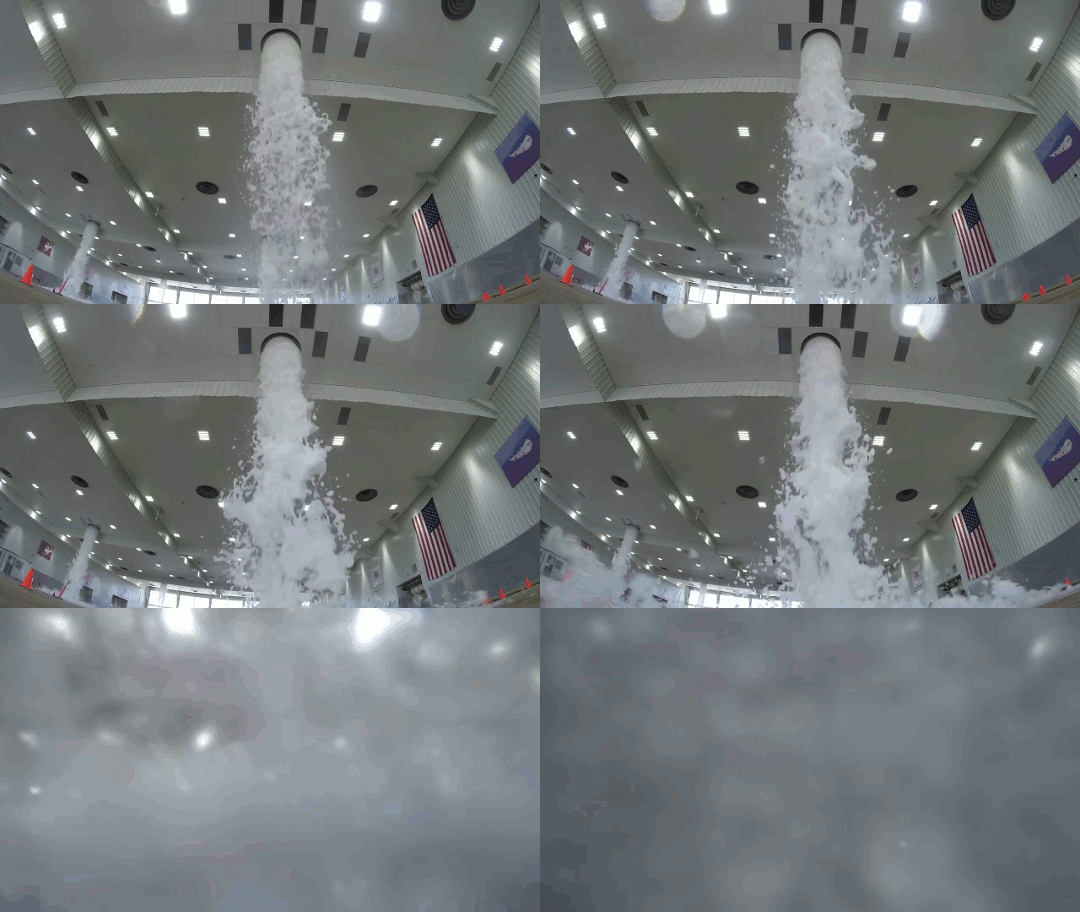
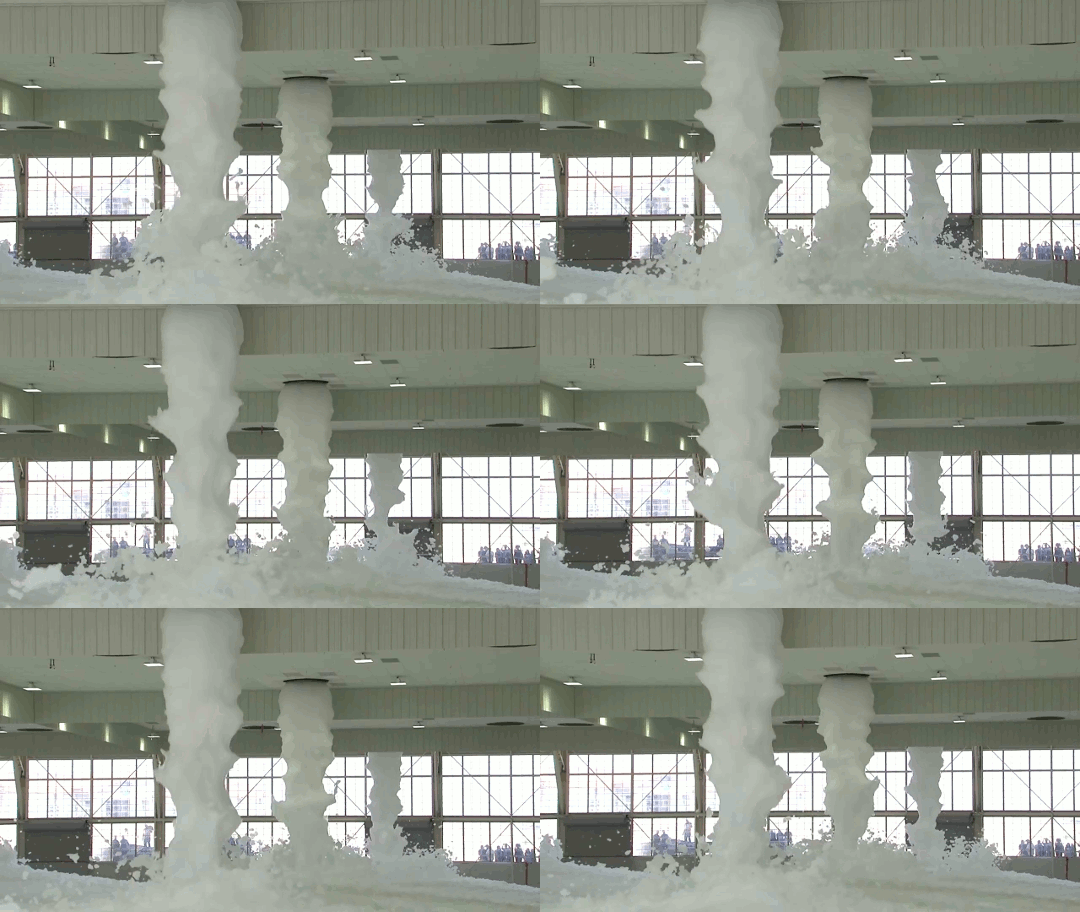
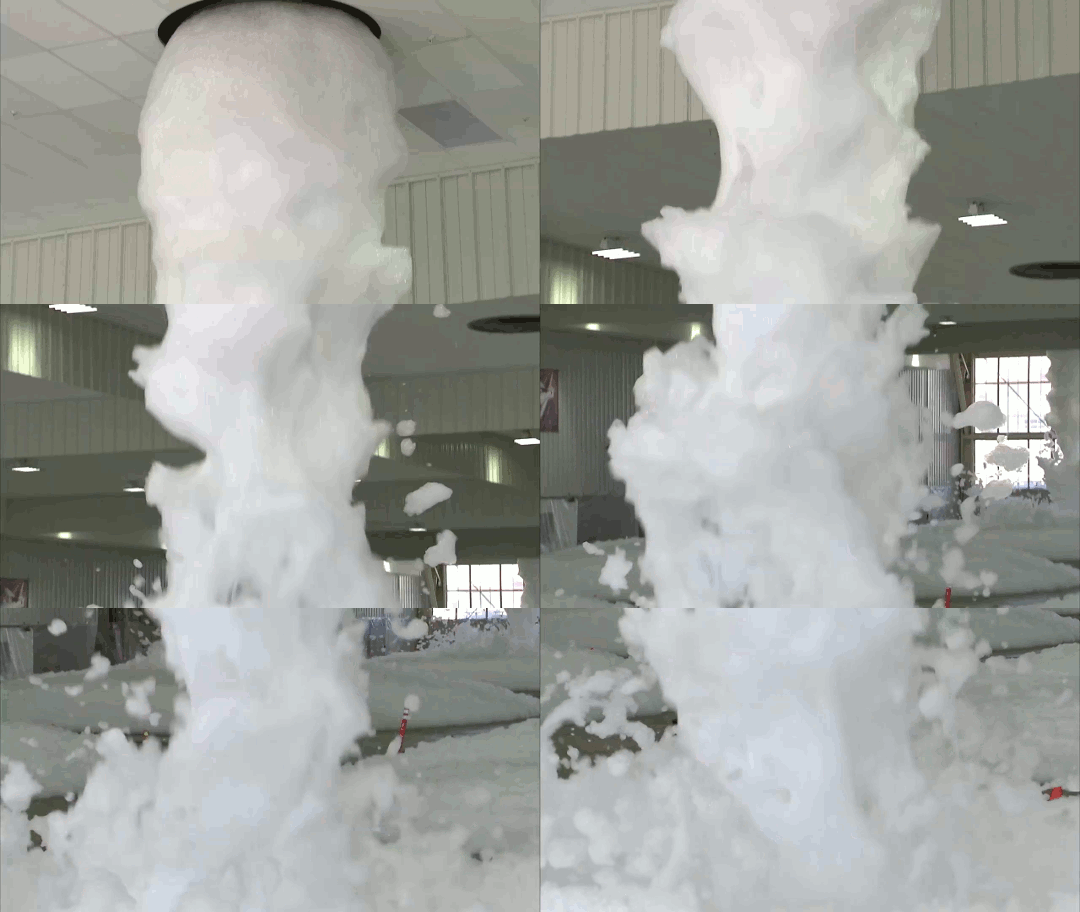
    Fires in large, open spaces like aircraft hangers can be difficult to fight with conventional methods, so many industrial spaces use foam-based fire suppression systems. These animations show such a system being tested at NASA Armstrong Research Center. When jet fuel ignites, foam and water are pumped in from above, quickly generating a spreading foam that floats on the liquid fuel and separates it from the flames. Since the foam-covered liquid fuel cannot evaporate to generate flammable vapors, this puts out the fire. 

    The shape of the falling foam is pretty fascinating, too. Notice the increasing waviness along the foam jet as it falls. Like water from your faucet, the foam jet is starting to break up as disturbances in its shape grow larger and larger. For the most part, though, the flow rate is high enough that the jet reaches the floor before it completely breaks up. (Image credit: NASA Armstrong, source)

  • Cavity Collapse

    Cavity Collapse

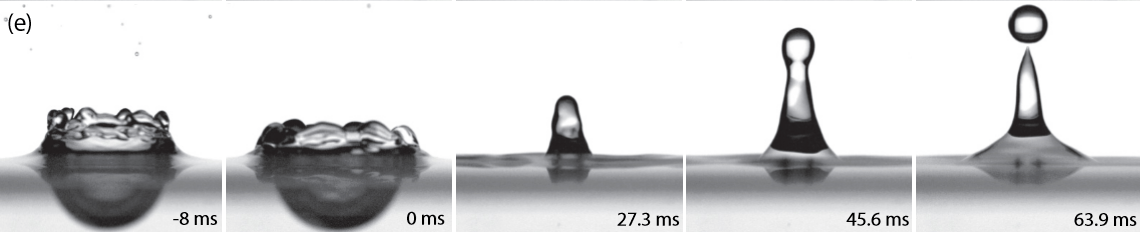
    One of the most iconic images in fluid dynamics is that of a drop impacting a liquid. When a drop hits a pool, it creates a crater, or cavity. That cavity expands and then collapses to form a jet that rebounds above the pool’s surface. If the jet is fast enough, it will eject one or more droplets before it falls back into the pool. Faster droplets, like the one that formed the cavity and jet shown above, actually create slower and fatter jets. In this regime, the complicated interplay of surface tension and gravity effects results in a jet velocity that is independent of impact speed and the liquid’s viscosity. Understanding this jet and splash dynamics is important for many industrial applications, including ink-jet printing. (Image credit: G. Michon et al.)

  • Titan’s Bubbly Islands

    Titan’s Bubbly Islands

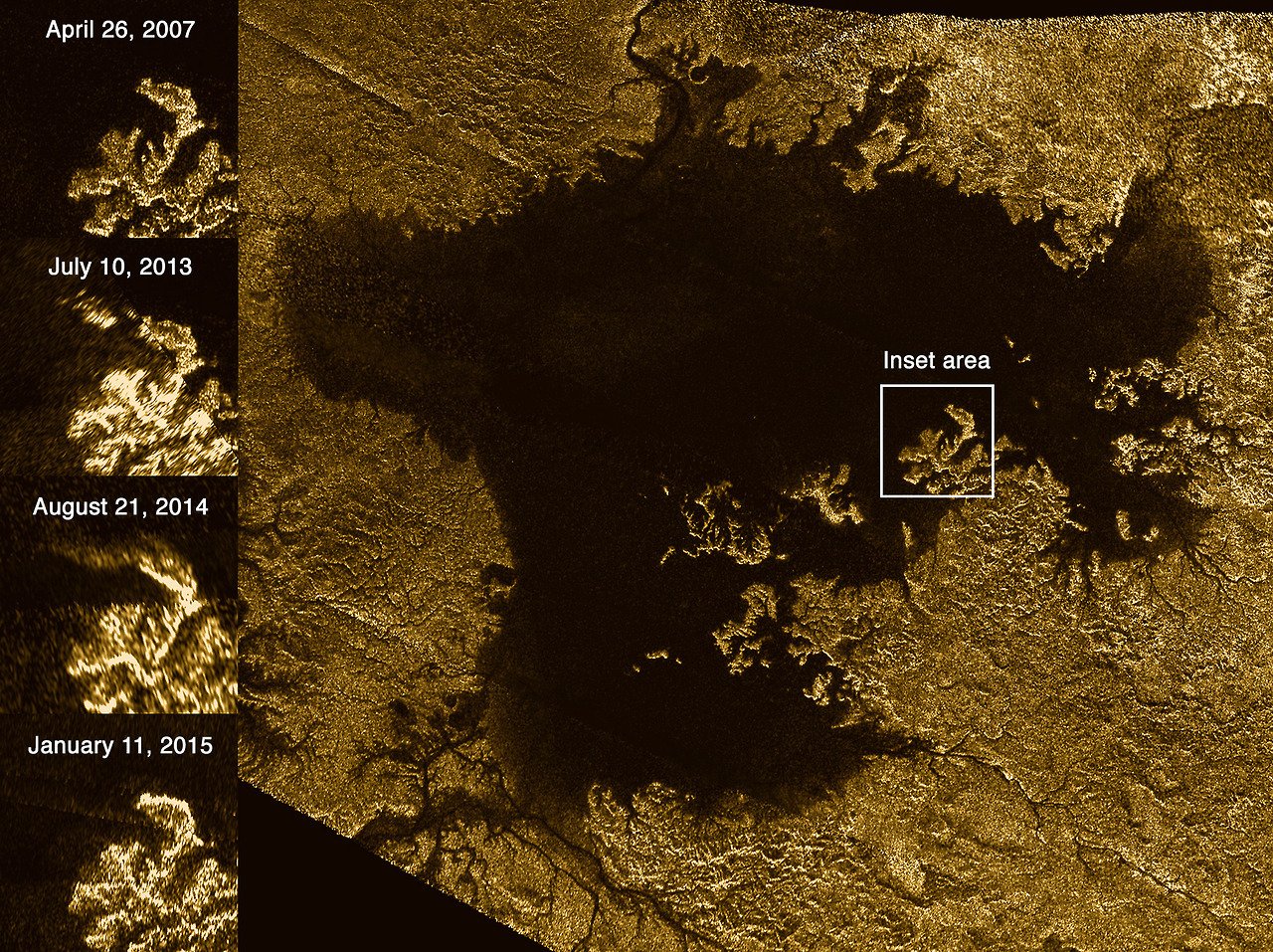
    Titan, Saturn’s largest moon, is a fascinating world with remarkable similarities to our own. It is the only other world we know of with stable bodies of liquid at its surface. Unlike Earth, frigid Titan’s lakes and seas are filled with methane and ethane. Radar data from the Cassini mission has shown oddly changing shorelines on Titan, above, with islands that seem to magically appear and disappear over time.

    Researchers at NASA’s Jet Propulsion Laboratory now think these islands may, in fact, be bubbles. As Titan’s lakes cool, they’re better able to absorb nitrogen gas, but when temperatures warm up, that gas comes out of solution and floats to the surface, much like the bubbles of carbon dioxide in a soda. If this hypothesis holds up, there are some interesting implications for Titan’s atmosphere. Here on Earth, bubbles popping in the ocean are a major source of aerosol particles. It’s possible migrating rafts of bubbles could behave similarly on Titan. (Photo credit: NASA/JPL-Caltech/ASI/Cornell; submitted by jpshoer)

    I’m excited to announce I will be visiting JPL later this month (March 30th), where I have the honor of giving a Women’s History Month talk. If there are any JPLers who are FYFD fans, I hope to see you there. Be sure to RSVP to the ACW luncheon by the March 24th deadline.

  • Featured Video Play Icon

    Molten Copper

    In this video, the Slow Mo Guys prove that pouring molten copper in slow motion is every bit as satisfying as one would imagine. Because they pour the metal from fairly high up, they get a nice break-up from a jet into a series of droplets; that’s due to the Plateau-Rayleigh instability, in which surface tension drives the fluid to break up into drops. Upon impact, the copper splashes and splatters very nicely, forming the crown-like splash many are familiar with from famous photos like Doc Edgerton’s milk drop. The key difference between the molten copper and any other liquid’s splash comes from cooling; watch closely and you’ll see some of the copper solidifying along the edges and surface of the fluid as it cools. In this respect, watching the molten copper is more like watching lava flow than seeing water splash. (Video and image credit: The Slow Mo Guys)

  • Crowns On Impact

    Crowns On Impact

    Dropping a partially-filled test tube of water against a table makes the meniscus at the air-water interface invert into a jet of liquid. In some cases, the impact is strong enough to generate splashing crowns of water around the base of the jet. These crowns come in two forms – one with many splashes layered upon one another and the other with only a few splashes and a faster jet. 

    The many-layered splash crowns come from the pressure wave that reflects back and forth from the bottom of the tube to the surface and back. This pressure wave moves at the speed of sound and vibrates the water surface, creating the many splashes. The same reflected pressure wave occurs in the second type of splash crown, but it gets disrupted by cavitation bubbles that form in the water (visible in the lower left image). Instead the splash crowns form from the shock waves generated when the cavitation bubbles collapse. (Image credits: A. Kiyama et al.)

  • Reader Question: Splashes

    Reader Question: Splashes

    Reader effjoebiden asks:

    So is the crown splash the curving wave of water on either side of the tire, the spikes of water in the middle behind the tire, or both? And is the Worthington jet also the same phenomenon that can happen with a massive meteorite impact?

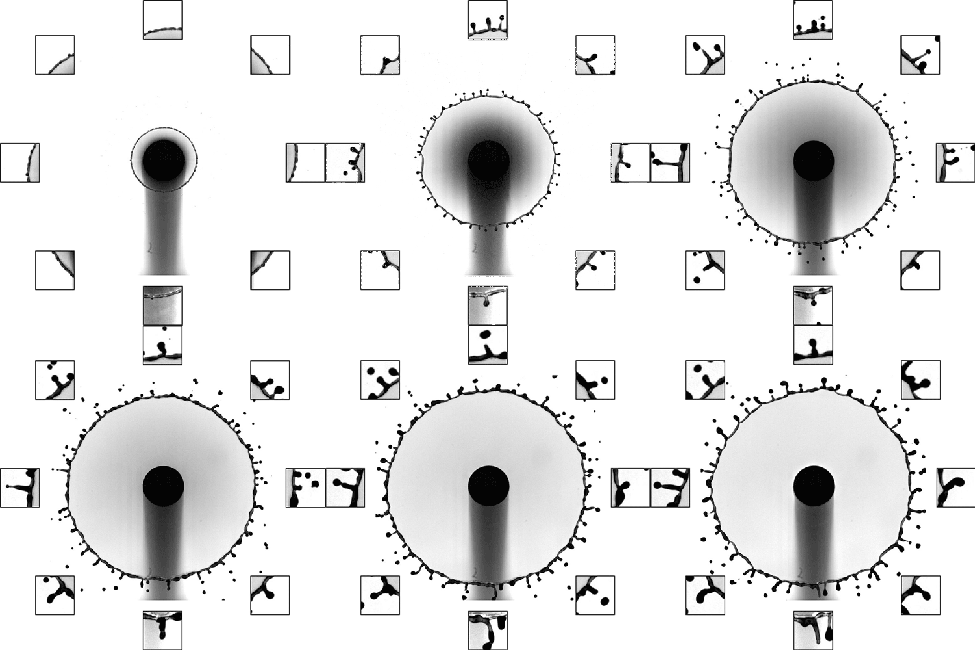
    Here the term “crown splash” refers to the curving sheets of water spreading on either side of the tire. Those liquid sheets (or lamella) break down at the edges into spikes and droplets just like the ones seen when a drop falls into a pool, which is the traditional source of the term “crown splash” because it resembles a crown.

    And, yes, enormous meteor impacts can create Worthington jets (that column of fluid that pops up after a droplet impacts)! This is why some craters have peaks in the middle. There are actually some surprising similarities between meteor impacts and fluid dynamics.

    (Image credits: S. Reckinger et al., original post)