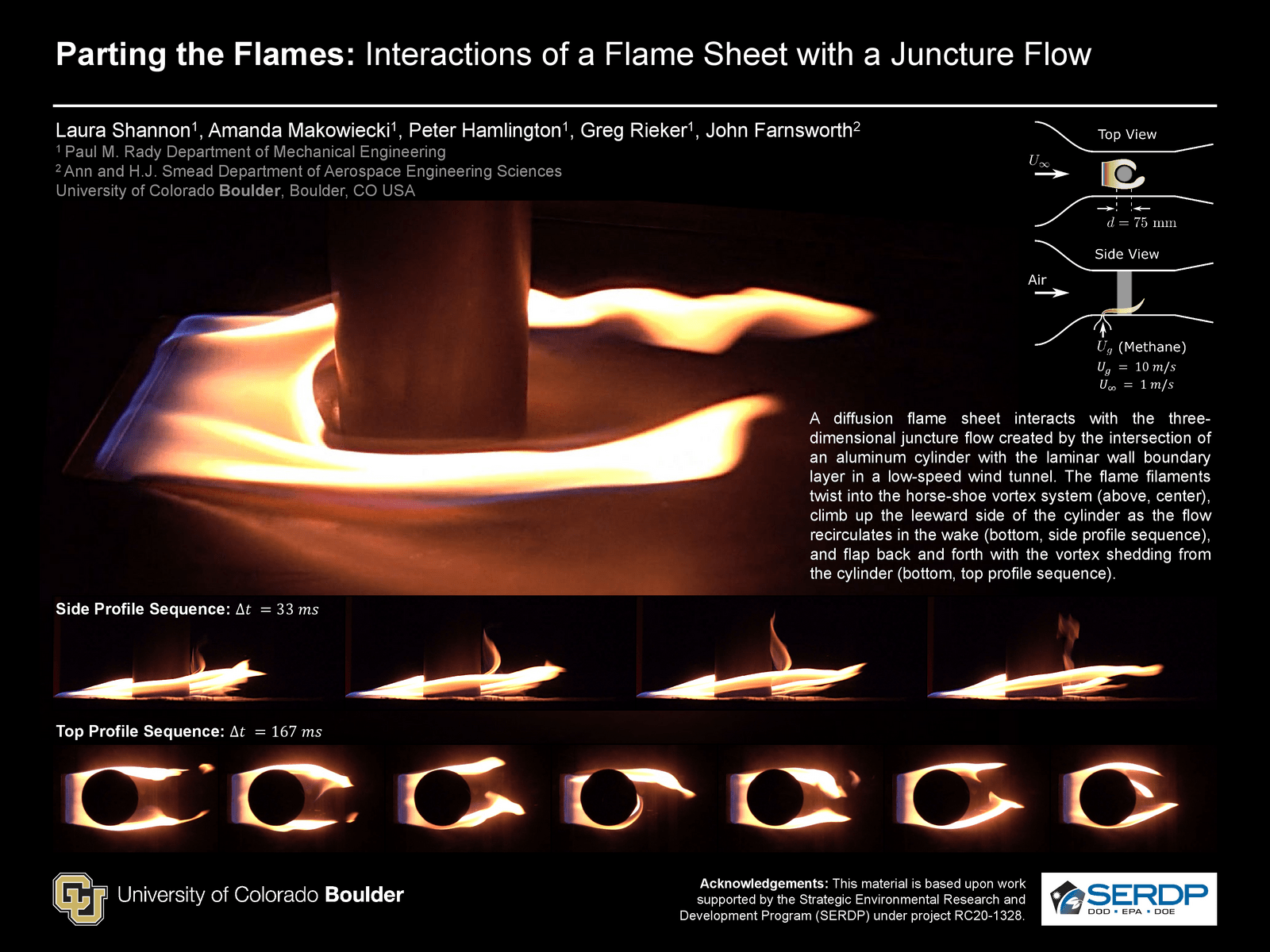
A sheet of flame splits around a cylinder in this Gallery of Fluid Motion poster. Looking at the image sequences, you can see how the flames lift up as they flow around the cylinder, following the arms of a horseshoe vortex. Researchers study situations like this one to better understand how wildfires move as they encounter obstacles. Understanding and predicting how fires flow is increasingly important with more wildfires encountering human-built infrastructure. (Image credit: L. Shannon et al.)
Search results for: “lift”

Turbulent Thermal Convection
In the winter, warm air rises from our floor vents or radiators, creating a complex, invisible flow in the background of our lives. Buoyancy lifts warmer air upward while cooler, denser air sinks back down. This thermal convection is everywhere: in our buildings, the ocean, the sky overhead — even in the visible layer of our sun.
In nature, these systems are so large and complex that fully measuring or simulating them remains impossible. Instead, researchers focus on a simplified system — a Rayleigh-Bénard cell — that’s essentially an idealized version of a pot on a stovetop. The lower surface of the cell is heated — like the bottom of a pan on the burner — while the upper surface of the fluid cools. Even this idealized system is a challenge, though, and neither lab-scale versions nor simulations can reach the same conditions that we find in nature.
To bridge the gap, scientists rely on mathematical models — theories built on our best understanding of the physics — and physical analogies to similar systems — like flow over a flat plate — that are “easier” to measure. For a thorough overview of recent work in the area, check out this review in Physics Today. (Image credit: A. Blass; research credit: D. Lohse and O. Shishkina in Physics Today)

A Working Wirtz Pump
In the mid-eighteenth century, pewterer Andreas Wirtz invented a spiral pump. Even today, his design is useful for small-scale, low-power pumping, as seen in this Steve Mould video. The design relies on a series of air and water plugs to build up pressure that’s then used to lift the fluids higher. In the video, Mould visits a stream-powered, home version of a Wirtz pump that regularly delivers water over eight meters in elevation. See it in action in the full video! (Video and image credit: S. Mould)

Withstanding Rocket Launches
It takes a lot of power to lift a giant rocket‘s payload all the way to orbit, and in the first moments of a rocket launch, all that energy is directed downward at a concrete pad. How do engineers design and protect launch pads? In this Practical Engineering video, Grady tackles just that question through a comparison of SpaceX’s Stage Zero and NASA’s Launch Pad 39A.
SpaceX notoriously chose to build Stage Zero without a trench or water sprayer system like the ones NASA use. Trenches deflect the rocket exhaust to reduce the impact on infrastructure beneath the engines. And water sprayers reduce the temperatures the pad experiences and disrupt shock waves that otherwise hammer the pad. Without those precautions, even special heavy-duty concretes have a hard time holding together against a launch. (Video and image credit: Practical Engineering)

Modeling Wildfires With Water
Turbulence over a burning forest can carry embers that spread the wildfire. To understand how wildfire plumes interact with the natural turbulence found above the forest canopy, researchers modeled the situation in a water flume. Dowel rods acted as a forest, with turbulence developing naturally from the water flowing past. For a wildfire, the researchers used a plume of warmer water, which buoyancy lofted into the turbulence over their model forest.

The experiment used to model wildfire flows. Dowel rods represent the forest and a plume of warm water (right side; distorting the background) represents the wildfire. The dark device in the foreground is a probe used to measure turbulence. The flow over the forest canopy naturally forms side-by-side rolls of air rotating around a horizontal axis. As the buoyant plume rises, it can be torn apart by these rollers, as well as carried downstream. Varying the turbulence, they found, did not affect the average trajectory of the plume. But the more intense the turbulence, the greater the vertical fluctuations in the plume. Those large variations, they concluded, could lift more embers into stronger winds that distribute them further and spread a fire faster. (Image credit: wildfire – M. Brooks, experiment – H. Chung and J. Koseff; research credit: H. Chung and J. Koseff; via APS Physics)

How Squall Lines Form
Summertime in the middle U.S. means thunderstorms, many of which can form long lines of storms known as squall lines. Complex convective dynamics feed such storms. Here is an illustration of one part of a squall’s lifecycle:

As rain falls and evaporates, it fuels the formation of a cold pool of air below the cloud. Incoming wind (gray arrows) blocks the cold pool from spreading. In turn, the cold pool acts as a ramp that redirects this warm, moist air upward. The vertical variation in wind speed (wind shear, shown with pink arrows) creates a positive vorticity. Together with the negative vorticity in the cold pool, this induces a vorticity dipole that lifts air and moisture, feeding the growing line of storms. As it falls, rain evaporates, cooling air near the ground and forming a cold pool. If incoming winds block the cold pool from spreading, the pool will act instead as a ramp that redirects the wind upward, carrying any warmth and moisture up into the storm cloud. Wind shear — a vertical variation in wind strength with altitude — creates positve vorticity that opposes the negative vorticity inherent to the cold pool. Together these two regions of opposing vorticity lift more air and moisture into the squall, generating more clouds and more rainfall. (Image credit: top – J. Witkowski, illustration – C. Muller and S. Abramian; see also C. Muller and S. Abramian)

Predicting Contamination in Urban Environs
The canyons of a city’s streets form a complex flow environment. To better understand the risks of a spreading contaminant, researchers simulated a release in lower Manhattan’s urban jungle. The released particles spread due to the dominant wind pattern of the area. Initially, the particles follow the street pattern and stay at a low elevation. But updrafts on the downwind side of skyscrapers lift the particles higher, spreading them to lower concentrations at more elevations.
Public officials study simulations like these to understand what response is needed to protect people in the event of an accidental or intentional release of harmful materials. (Image and video credit: W. Oaks and A. Khosronejad)

Long-Lived Bubbles
Without surfactants to stabilize them, bubbles don’t last long at room temperature. But adding a little heat changes the picture. When heated, the bubbles get stabilized by a thermal gradient that lifts fluid toward the bubble’s peak, where it cools and gathers. Eventually, the cold fluid grows heavy enough to sink down the side of the bubble (in either a constant stream or occasional drips); with warm fluid getting pulled up to replace it (via the Marangoni effect), the process repeats and the bubble lives on. (Video credit: S. Nath et al.; see also)

Bouncing Bullets Off Water
With the right shot, it’s possible to skip a bullet off water, as shown in this video from the Slow Mo Guys. The angle of the bullet relative to the water needs to be quite shallow, as this sets the bullet up for the hydrodynamic lift needed to skip. Physically, the mechanism for skipping a bullet is similar to rock-skipping. The bullet’s impact creates a cavity that the bullet rides. With the right conditions, the cavity orients the bullet upward, creating the lift needed to skip. (Video and image credit: The Slow Mo Guys)

Cellular Clouds
Though tough to make out from the surface, our oceans are often covered by cell-shaped clouds stretching thousands of kilometers. This satellite image shows off two such types of marine stratocumulus cloud. Open-celled clouds appear as thin wisps of vapor around an empty middle; in these clouds, cool air sinks through the center while warm air rises along the edges. Open-celled clouds are good rain producers.
On the flip side, closed-cell clouds have a vapor-filled center and breaks in the cloud cover along each cell’s edge. These clouds don’t produce much rain, but they do lift warm, moist air through their middles and let cool air sink along their edges. Closed-cell clouds tend to last much longer than their open-celled counterparts; they can stick around for half a day, whereas open-celled clouds break up in only a couple hours. (Image credit: J. Stevens; via NASA Earth Observatory)