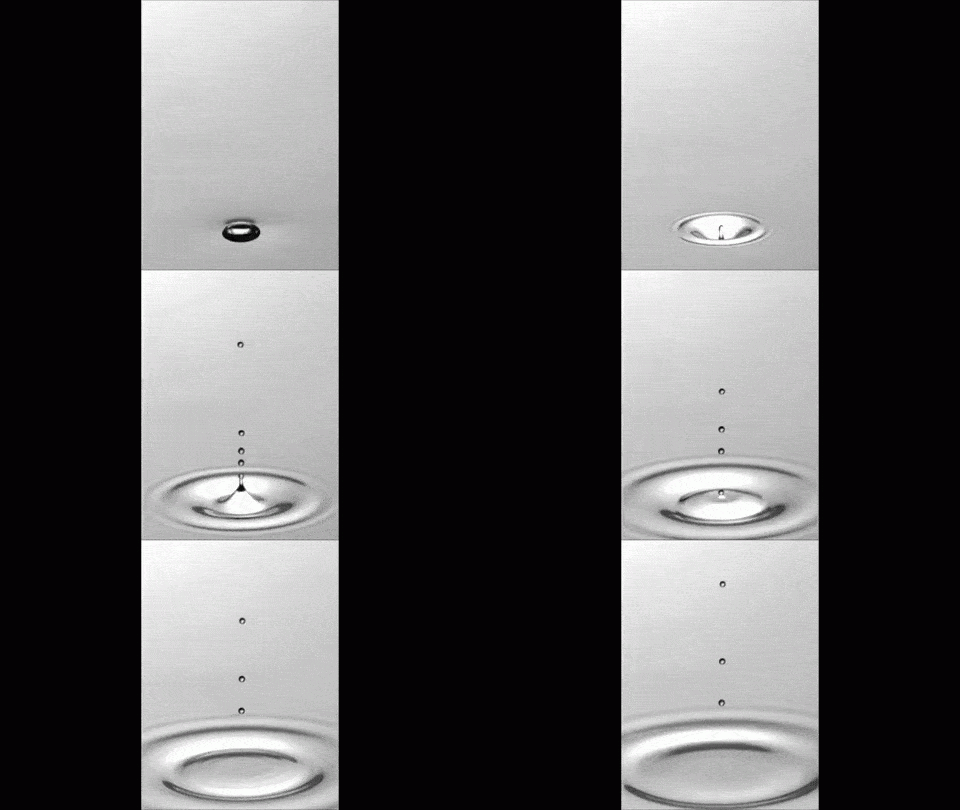
A fluidic oscillator is a device with no moving parts that sprays a fluid from side to side. The animations above illustrate how they work. A nozzle funnels a fluid jet through a chamber with two feedback channels. When the jet sweeps close to one side of the chamber, part of the fluid is directed along the feedback channel and back toward the inlet. That flow feeds into a recirculating separation bubble in the middle of the chamber. As that bubble grows, it pushes the jet back toward the other feedback channel, continuing the cycle. Many automobiles use fluidic oscillators in their windshield washer sprays. Check out the award-winning full video from the Gallery of Fluid Motion. (Image credit: M. Sieber et al., source)
Jupiter’s colorful cloud bands alternate between dark belts and light zones. The bands mark convection cells in Jupiter’s atmosphere, and, like on Earth, powerful jet streams form due to this atmospheric heating and the planet’s rotation. The jet winds can even move in opposite directions, creating strong shear forces between neighboring cloud bands. The shear helps drive Kelvin-Helmholtz instabilities in the clouds, resulting in the regularly spaced waves and vortices seen along the edges of some bands. (Image credit: NASA/ESA; via APOD)
Atmospheric re-entry subjects vehicles to extreme conditions. At high Mach numbers, the leading shock wave compresses the air so strongly that it reaches temperatures hotter than the surface of the sun. At these temperatures, oxygen and nitrogen molecules in the air dissociate, bathing a vehicle in a plasma of ionized gas molecules. Often these atoms chemically react with the surface materials of a vehicle causing ablation that removes mass from the vehicle while helping protect the vehicle substructure from re-entry heating. Tests in specialized ground facilities like arc-jet plasma tunnels are necessary to develop thermal protection systems capable of shielding a vehicle during hypersonic flight. (Image credit: D. Ponseggi/NASA)
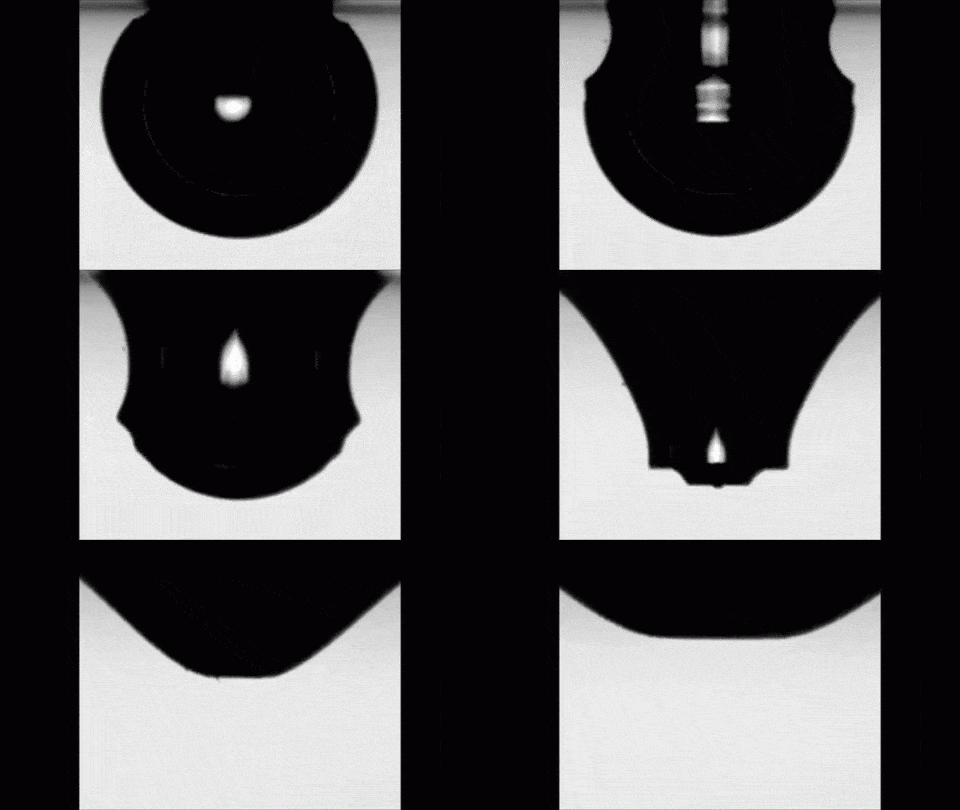
Fizzy drinks like soda or champagne contain dissolved carbon dioxide which forms bubbles when the pressure inside its container is released. The tiny bubbles rise to the surface where the liquid film covering them can rupture, creating a small cavity at the surface. The cavity collapses in a matter of milliseconds (bottom animation). Above the surface, the cavity reverses its curvature to create a liquid jet (top animation) which can expel multiple tiny droplets. These droplets can tickle a drinker who hovers too close, but they also carry and distribute the aroma molecules that are part of the experience of a drink like champagne. (Image credit: E. Ghabache et al., source)
St. Pauli, a neighborhood in the German city of Hamburg, has demonstrated one of the most unusual applications of superhydrophobicity I’ve ever heard of. St. Pauli is known as a party district, and the residents of the area have grown understandably frustrated with inebriated visitors publicly urinating on their buildings and, yes, playgrounds. When fines failed to curb the issue, they took to treating walls chemically to make them superhydrophobic. As the targeted audience has discovered, water repellency tends to make liquid jets bounce off rather than run down a surface. Well played, St. Pauli. (Video credit: IG St. Pauli; submitted by entropy-perturbation)
Amorous alligators call to mates with a behavior known as water dancing. Their audible bellows are accompanied by infrasonic sound–vibrations below the 20 Hz limit of human hearing. These vibrations from their lungs excite Faraday waves in the water near the alligator’s back and make the surface explode in a dance of jets and atomized droplets. I’ve seensimilarresultsin otherinstancesof vibration, but this may be the only example of this I’ve seen in the wild. Researchers studying the phenomenon noted that the frequency of sound the alligators emit corresponds to a wavelength equal to the spacing of the raised scales, or scutes, on the alligators’ backs. They hypothesize that the shape of the scutes helps males create the display. (Image credit: N. Marven, source; research credit: P. Moriarty and R. Holt; h/t to io9)
——————
Don’t forget about our FYFD survey! I’ve teamed up with researcher Paige Brown Jarreau to create a survey of FYFD readers. By participating, you’ll be helping me improve FYFD and contributing to novel academic research on the readers of science blogs. It should only take 10-15 minutes to complete. You can find the survey here. Please take a few minutes to participate and share!
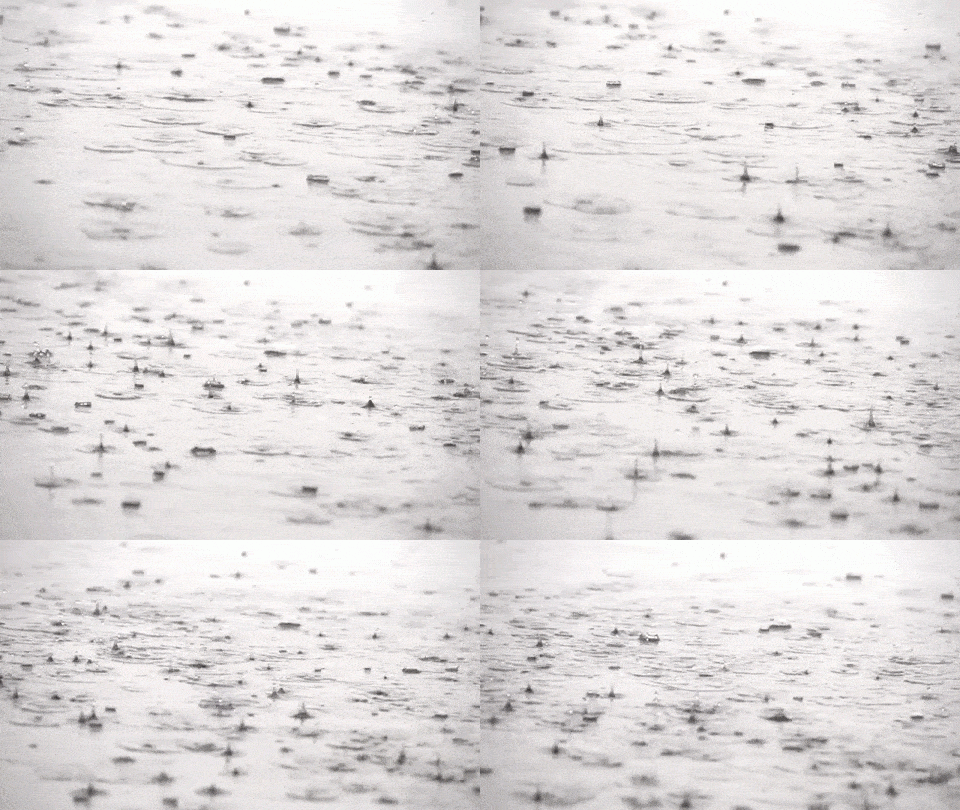
Watching rain drops hit a puddle or lake is remarkably fascinating. Each drop creates a little cavity in the water surface when it impacts. Large, energetic drops will create a crown-shaped splash, like the ones in the upper animation. When the cavity below the surface collapses, the water rebounds into a pillar known as a Worthington jet. Look carefully and you’ll see some of those jets are energetic enough to produce a little satellite droplet that falls back and coalesces. Altogether it’s a beautifully complex process to watch happen over and over again. (Image credit: K. Weiner, source)
——————
Help us do some science! I’ve teamed up with researcher Paige Brown Jarreau to create a survey of FYFD readers. By participating, you’ll be helping me improve FYFD and contributing to novel academic research on the readers of science blogs. It should only take 10-15 minutes to complete. You can find the survey here.
so, how is lift actually generated? i’ve been going through Anderson’s Introduction to Flight (6th Ed.) and while it offers the derivation of various equations very thoroughly, it barely touches on why lift is generated, or how camber contributes to the increase of C(L)
This is a really good question to ask. There are a lot of different explanations for lift out there (and some of the common ones are incorrect). The main thing to know is that a difference in pressure across the wing–low pressure over the top and higher pressure below–creates the net upward force we call lift. It’s when you ask why there’s a pressure difference across the wing that explanations tend to start diverging. To be clear, aerodynamicists don’t disagree about what produces lift – we just tend to argue about which physical explanation (as opposed to just doing the math) makes the most sense. So here are a couple of options:
Newton’s third law states that for every action there is an equal and opposite reaction. If you look at flow over an airfoil, air approaching the airfoil is angled upward, and the air leaving the aifoil is angled downward. In order to change the direction of the air’s flow, the airfoil must have exerted a downward force on the air. By Newton’s third law, this means the air also exerted an upward force–lift–on the airfoil.
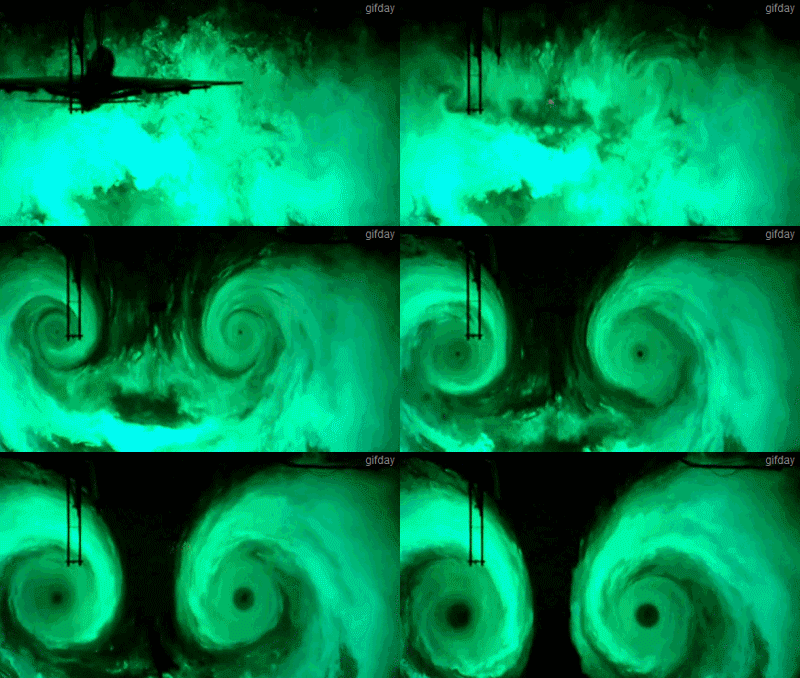
The downward force a wing exerts on the air becomes especially obvious when you actually watch the air after a plane passes:
This one can be harder to understand. Circulation is a quantity related to vorticity, and it has to do with how the direction of velocity changes around a closed curve. Circulation creates lift (which I discuss in some more detail here.) How does an airfoil create circulation, though? When an airfoil starts at rest, there is no vorticity and no circulation. As you see in the video above, as soon as the airfoil moves, it generates a starting vortex. In order for the total circulation to remain zero, this means that the airfoil must carry with it a second, oppositely rotating vortex. For an airfoil moving right to left, that carried vortex will spin clockwise, imparting a larger velocity to air flowing over the top of the wing and slowing down the air that moves under the wing. From Bernoulli’s principle, we know that faster moving air has a lower pressure, so this explains why the air pressure is lower over the top of the wing.
Asymmetric Flow and Bernoulli’s Principle
There are two basic types of airfoils – symmetric ones (like the one in the first picture above) and asymmetric, or cambered, airfoils (like the one in the image immediately above this). Symmetric airfoils only generate lift when at an angle of attack. Otherwise, the flow around them is symmetric and there’s no pressure difference and no lift. Cambered airfoils, by virtue of their asymmetry, can generate lift at zero angle of attack. Their variations in curvature cause air flowing around them to experience different forces, which in turn causes differing pressures along the top and the bottom of the airfoil surface. A fluid particle that travels over the upper surface encounters a large radius of curvature, which strongly accelerates the fluid and creates fast, low-pressure flow. Air moving across the bottom surface experiences a lesser curvature, does not accelerate as much, and, therefore, remains slower and at a higher pressure compared to the upper surface.
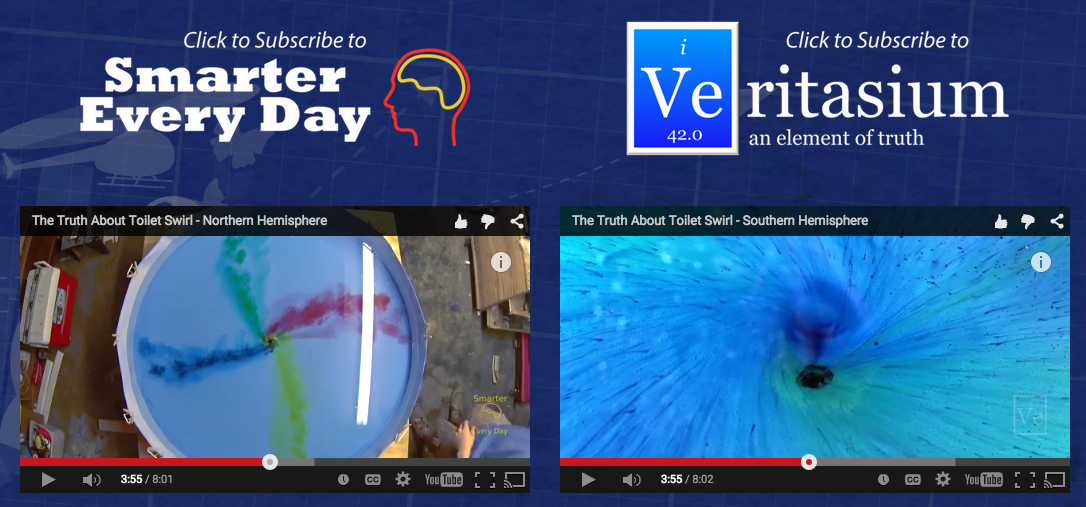
There’s an infamous supposition about drains swirling one way in the Northern Hemisphere and the other way in the Southern Hemisphere. Destin from Smarter Every Day and Derek from Veritasium have put the claim to the test with experiments on either side of the globe. First, go here and watch their synchronized videos side-by-side. (To synchronize, start the left video and pause it at the sync point. Then start the second video and unpause the first video when the second video hits the sync point.) I’ll wait here.
…
That was awesome, right?! The demonstration doesn’t work with toilets because they’re driven by the placement of jets around the circumference. And your bathtub doesn’t usually work either because any residual vorticity in the tub gets magnified by conservation of angular momentum as it drains. It’s like a spinning ice skater pulling their arms in; the rotation speeds up. So, to get around that problem, Destin and Derek let their pools sit for a day to damp out any motion before draining. At that point, the Coriolis effect is strong enough to cause the pools to rotate in opposite directions when drained. You may wonder why the effect is so slight for the pools when it’s pretty stark with hurricanes and cyclones. The answer is a matter of scale. The pools are perhaps 2 meters wide, which means that the difference in latitude across the the pool is very slight and therefore, the differential speed imparted by the Earth’s rotation is also very small. Because hurricanes and cyclones are much larger, they experience stronger influence from the Coriolis effect. (Image credits: Smarter Every Day/Veritasium; via It’s Okay To Be Smart)
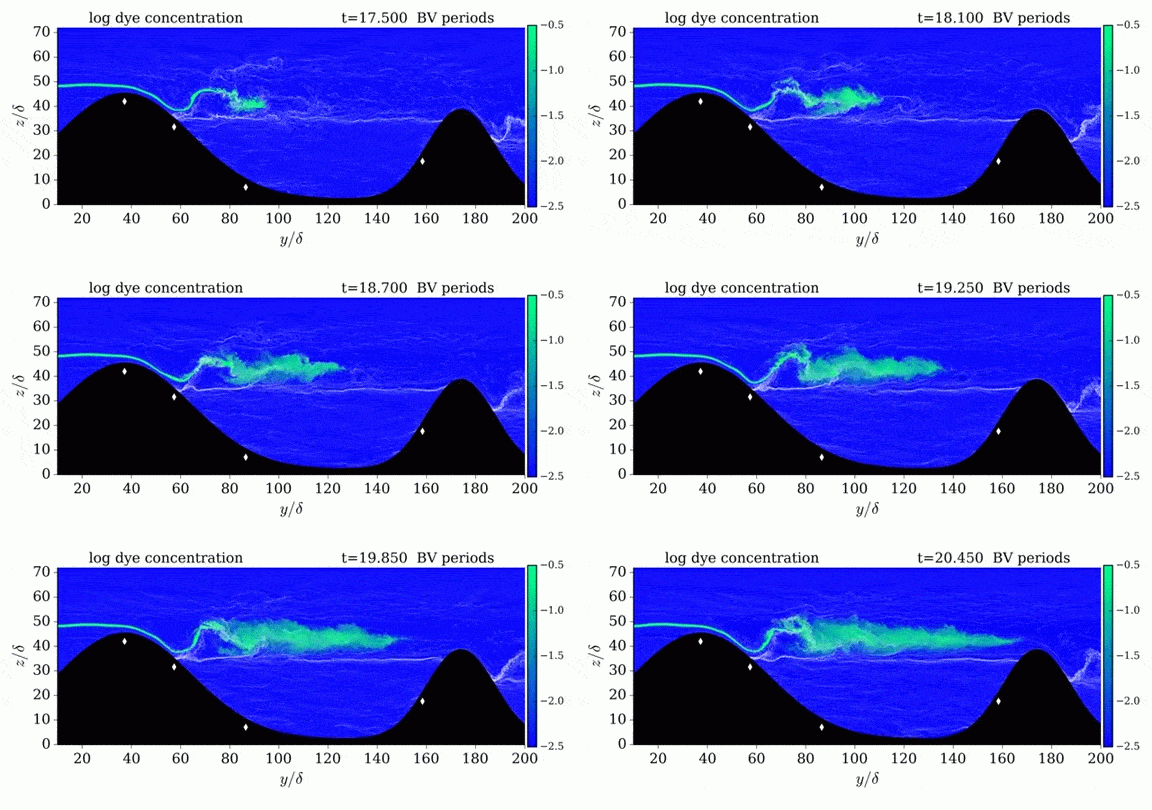
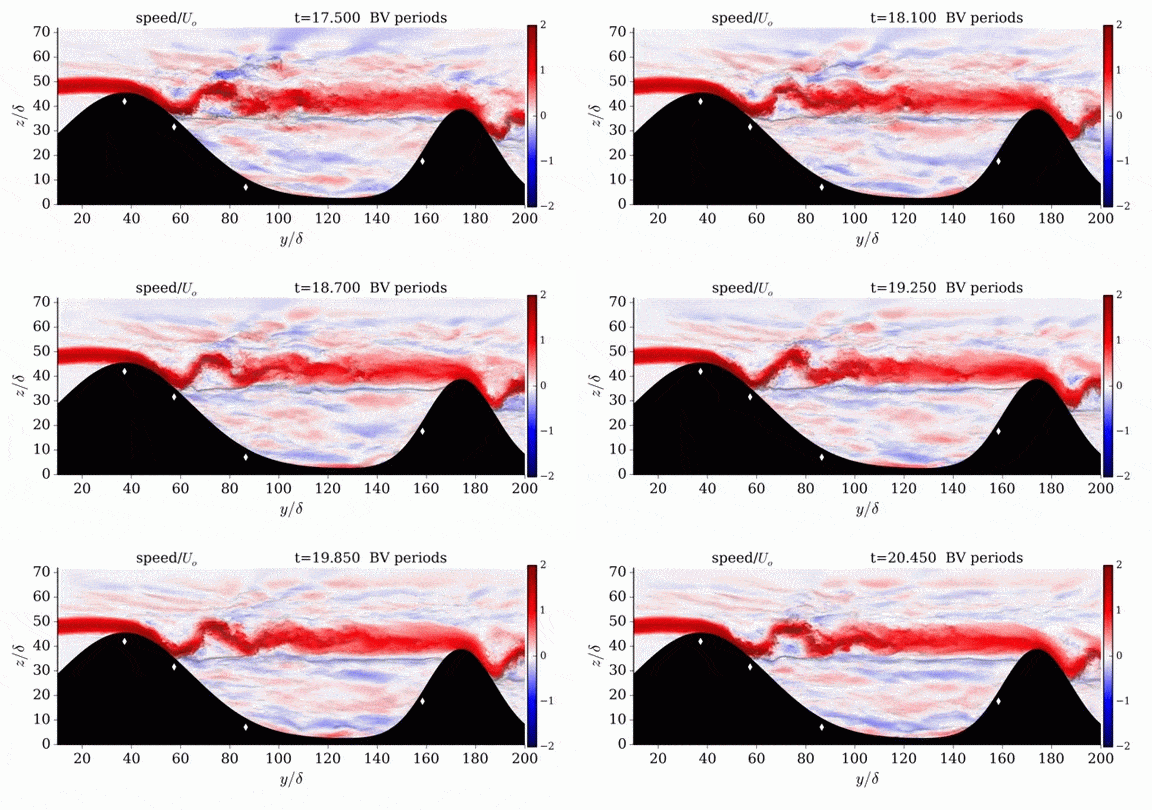
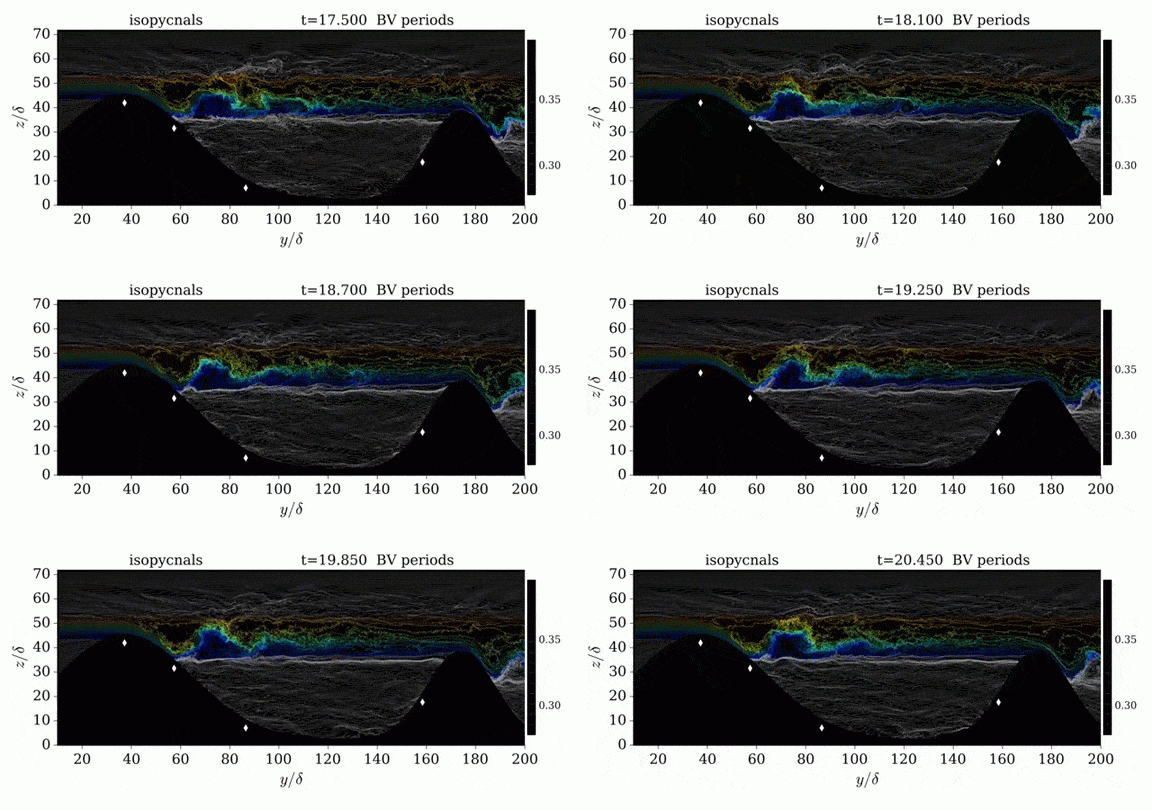
One of the factors that complicates geophysical flows is that both the atmosphere and the ocean are stratified fluids with many stacked layers of differing densities. These variations in density can generate instabilities, trap rising or sinking fluids, and transmit waves. The animations above show flow over two ridges with dye visualization (top), velocity (middle), and contours of density (bottom). The upstream influence of the left ridge creates a smooth, focused flow that quickly becomes turbulent after the crest. The jet rebounds as a turbulent hydraulic jump before slowing again upstream of the second ridge. Like the first ridge, the second ridge also generates a hydraulic jump on the lee side. Clearly both stratification and the local topography play a big role in how air moves over and between the ridges. If prevailing winds favor these kinds of flows, it can help generate local microclimates. (Image credit and submission: K. Winters, source videos)