
Humans have long been fascinated by staring into flames, and the Slow Mo Guys carry on the grand tradition here with 4K, high-speed video of a flamethrower. Like firebreathers, a flamethrower’s fire is the result of a spray of tiny, volatile droplets of fuel. Once ignited, the spray becomes a turbulent jet of flames. Turbulent flows are known for having both large and small-scale structure, and there’s some really great close-ups showing this around the 2:00 mark. Also watch the edges of the flame, where the nearby air has gotten hot enough to shimmer. You can see how the trees in the background ripple and blur as the fire heats up the air and changes its density and refractive index. (Video credit: The Slow Mo Guys)
Search results for: “jet”

Reader Question: Splashes
Reader effjoebiden asks:
So is the crown splash the curving wave of water on either side of the tire, the spikes of water in the middle behind the tire, or both? And is the Worthington jet also the same phenomenon that can happen with a massive meteorite impact?
Here the term “crown splash” refers to the curving sheets of water spreading on either side of the tire. Those liquid sheets (or lamella) break down at the edges into spikes and droplets just like the ones seen when a drop falls into a pool, which is the traditional source of the term “crown splash” because it resembles a crown.

And, yes, enormous meteor impacts can create Worthington jets (that column of fluid that pops up after a droplet impacts)! This is why some craters have peaks in the middle. There are actually some surprising similarities between meteor impacts and fluid dynamics.
(Image credits: S. Reckinger et al., original post)

Daily Fluids, Part 4
Inside or outside, we encounter a lot of fluid dynamics every day. Here are some examples you might have noticed, especially on a rainy day:
Worthington Jets
After a drop falls into a pool, there’s a column-like jet that pops up after it and sometimes ejects another small drop. This is known to fluid dynamicists as a Worthington jet, but really it’s something we all see regularly, especially if you watch rain falling onto puddles or look really closely at your carbonated drink.
Crown Splash
Like the Worthington jet, crown splashes often follow a drop’s impact into another liquid. But they can also show up when slicing or stomping through puddles!
Free Surface Dynamics
Anytime you have a body of water in contact with a body of air, fluid dynamicists call that a free surface. How the interface between the two fluids shifts and transforms is fascinating and complicated. Waterfalls are a great example of this, but so are ocean waves or even the ripples from tossing a rock into a pond.
Hydrophobic Surfaces
Water-repellent surfaces are called hydrophobic. Water will bead up on the surface and roll off easily. While many manmade surfaces are hydrophobic, like the teflon in your skillet, so are many natural surfaces. Many leaves are hydrophobic because plants want that water to fall to the ground where their roots can soak it up. Keep an eye out as you wash different vegetables and fruits and see which ones are hydrophobic!Check out all of this week’s posts more examples of fluid dynamics in daily life. (Image credit: S. Reckinger et al., source)

Daily Fluids, Part 1
Just getting cleaned up and ready for the day involves a lot of fluid physics. Here are a few of the phenomena you may see daily without realizing:
Plateau-Rayleigh Instability
This behavior is responsible for the dripping of your faucet. More specifically, it’s the reason that a falling jet breaks up into droplets. It works on rain, too!
Forced Convection
Everyone is familiar with a winter wind making them colder or hot air from a dryer getting the moisture off their hands. These are examples of forced convection – heat transfer by driving a fluid past a solid. Another common example? The fans in your computer!
Liquid Atomization
This is the process of breaking a liquid into lots of tiny droplets. Aside from any aerosol can ever, this phenomenon is also key to your daily shower and internal combustion in your car.
Archimedes Principle
This might be one of my favorite bits of the whole video because it hearkens back to some of my own earliest fluid dynamics exposure. Archimedes Principle says that buoyancy is equal to the weight of the fluid a body displaces. My mom (a science teacher) taught me about this one in the bathtub! It’s key to everything that ever floated, including us!Tune in all week for more examples of fluid dynamics in daily life. (Image credit: S. Reckinger et al., source)
When Lasers Strike
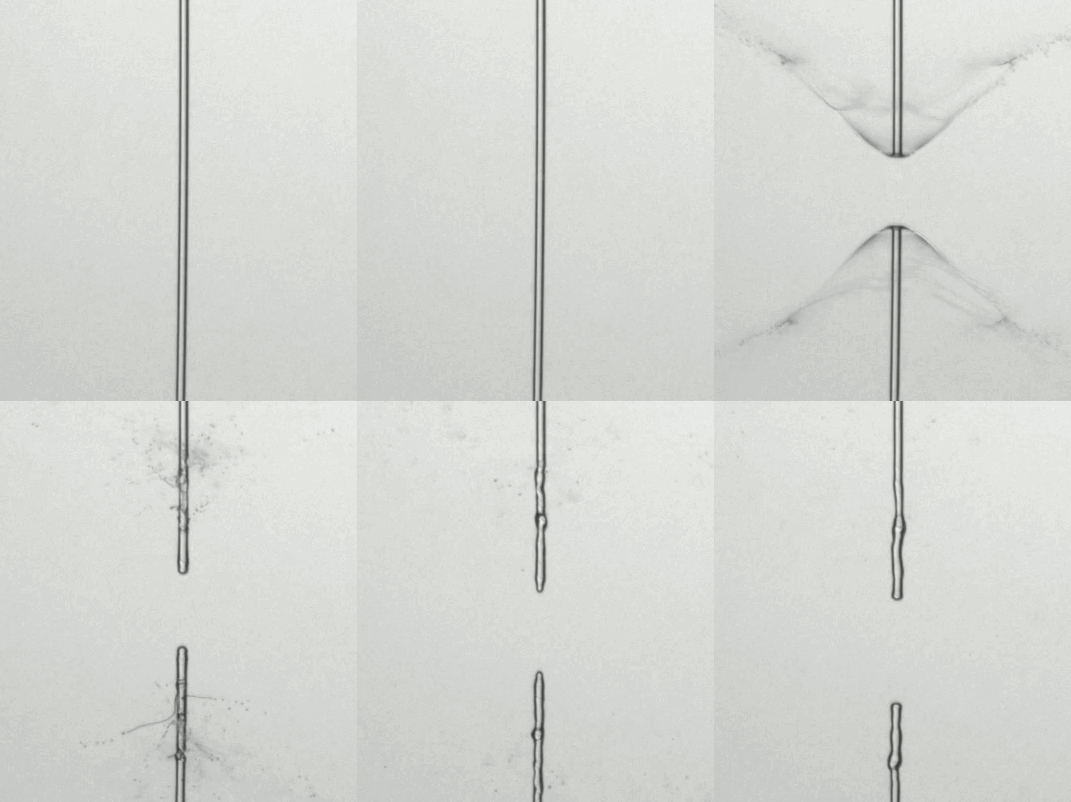
Lasers are a great way to deliver a lot of energy very quickly. In this animation, you see a jet of water get struck by a pulse from a powerful X-ray laser. The energy from that laser pulse gets absorbed by the water in a matter of picoseconds – that’s trillionths of a second. All that energy in so little time makes the water vaporize explosively. It’s this vapor explosion that breaks the jet in two. As the vapor expands outward, it forces water from the jet into a thin film that forms a cone. The conical film bends back on itself until it strikes the jet and coalesces. For more, check out this video of a similar experiment that looked at laser impacts on droplets. (Image credit: C. Stan et al., from Supplementary Movie 5; via Gizmodo)

HIFiRE


Earlier this month, an international team launched a successful hypersonic flight test in Australia. The Hypersonic International Research Experimentation (HIFiRE) Flight 5b was launched atop a two-stage rocket and reached its maximum speed of Mach 7.5, well above Mach 5, which defines the start of the hypersonic regime. The purpose of this particular flight test was not to test new propulsion technologies – there was no scramjet engine on this flight. Instead, researchers wanted to study aerodynamics at high Mach number, specifically the behavior of the air very close to the vehicle, its boundary layer.
The payload being tested was an elliptical cone mounted on the front of the vehicle and shown in images above. The shape of the payload is such that flow will curve around the cone rather than following straight lines. The image on the lower right contains black streamlines that show how air twists around the cone. This complex flowfield complicates the physics of the boundary layer near the cone’s surface and increases the likelihood that the boundary layer will transition from laminar flow to turbulent flow, thereby increasing heating on the payload. Ideally, the data from the test flight will let engineers test their ability to understand and predict this boundary layer transition in the future. For more on boundary layer transition and its effects at hypersonic speeds, check out my latest FYFD video. (Image credit: Australia Department of Defense, R. Kimmel et al., F. Li et al.; topic requested by Guido)

Vortex Ring Roll-Up
Vortex rings are endlessly fascinating, and they appear throughout nature from dolphins to volcanoes and from splashes to falling drops. One way to form them is to inject a jet into a stationary fluid. Viscosity between the fast-moving jet and the quiescent surrounding fluid slows down fluid at the jet’s edge. That slower fluid slips to the rear, only to get sucked into the faster -moving flow and pushed forward again. The result is a spinning toroid, or ring. A similar method generates vortex rings by pushing a fluid out a round orifice. In this case, interaction between the fluid and the wall provides some of the force necessary to form the vortex ring. (Image credit: Irvine Lab, source)

Shock Waves in Flight
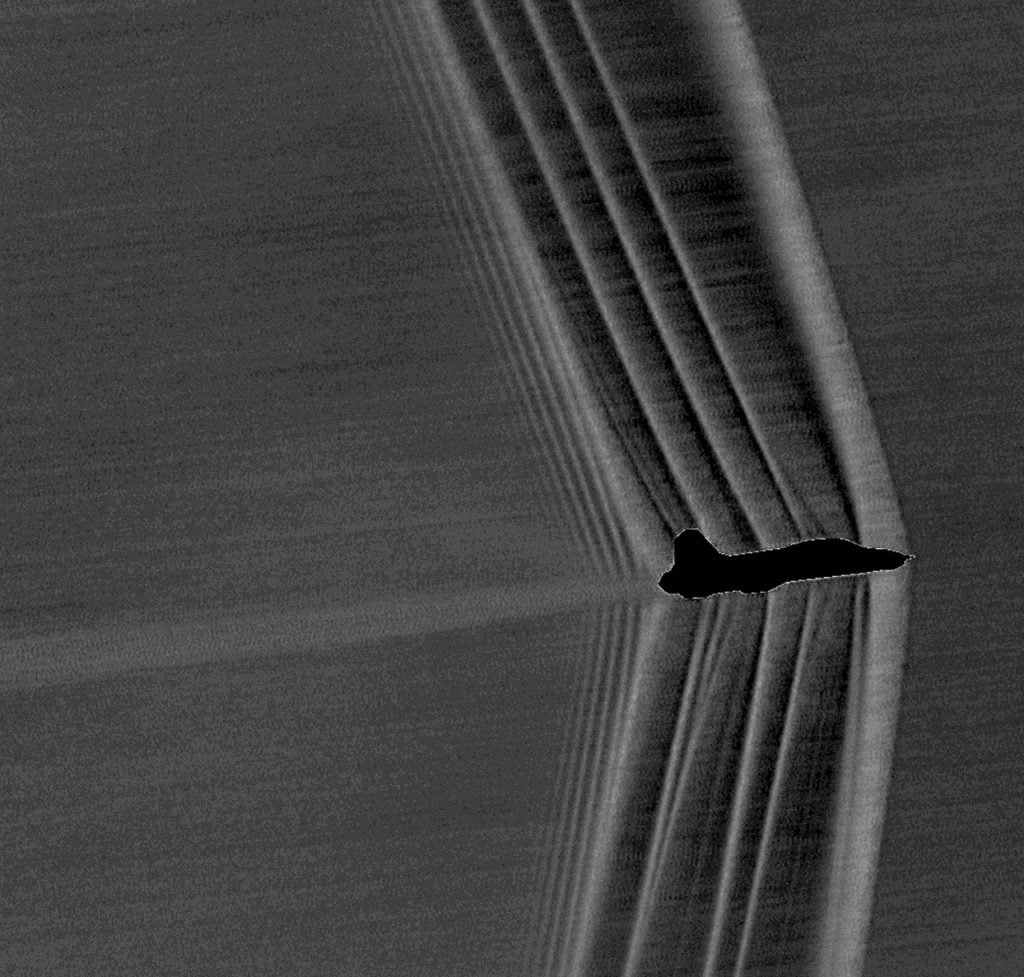
This week NASA released two new images of the shock waves surrounding T-38C jets in free flight. They’re the result of NASA’s new adaptations of the schlieren photography technique, which has let scientists visualize shock waves (in the lab, at least) for more than a century. To celebrate, I thought it would be fun to demonstrate some of the data engineers can extract from images like the one above. So I’m going to show you how to calculate how fast this plane was flying!
Shock waves depend a lot on geometry. This is not too surprising, really, since shock waves are nature’s way of quickly turning the air because there’s an object in the way. This leads to a very powerful observation, though: the angle of a shock wave depends on the geometry of the object and the Mach number of the flow. (The Mach number is the ratio of an object’s speed to the local speed of sound, so an object moving at Mach 1 is moving at the speed of sound.)
The reverse observation is also true: if we can measure the angle of a shock wave from a known geometry, then we can calculate the Mach number. Now, I don’t have any special information about the geometry of a T-38, so most of the shock waves in this picture can’t tell me much quantitatively.
But, it turns out, I don’t need to know anything about the geometry of the plane to figure out its Mach number. That’s because that very first shock wave over on the right is coming off a sharp probe mounted over the airplane’s nose. The probe is sharp enough, in fact, that I can treat it as though it’s a tiny point disturbance. That means that rightmost shock wave is a special kind of shock known as a Mach wave, and its geometry depends solely on the Mach number. It’s a pretty simple equation, too:

So, all I have to do is fire up some software like GIMP or ImageJ and estimate the angle of that first shock wave.

I came up with an estimate of about 77 degrees for the shock wave angle, which gives Mach 1.026 for the plane’s speed. Keep in mind that a) I’m using a grainy photo; and b) I have no information about the plane’s orientation relative to the camera. Nevertheless, NASA’s caption reports that this plane was moving at Mach 1.05 in the picture. My quick and dirty estimate is only off by 2%!
Of course, engineers are interested in a lot more than estimating an aircraft’s speed from these photos. With a little more geometry information, they can gather a lot of useful data from these images. One of the goals for the new photography technique is to help study new aircraft designs that generate weaker shock waves and quieter sonic booms. (Original images: NASA)

Blowing Through a Straw
As kids, most of us got in trouble at some point for blowing through a straw into our nearly-empty drinks. What you see here is a consequence of such misbehavior, though in this case the fluid is silicone oil and the straw is a metal needle (not shown) through which helium is continuously injected beneath the liquid surface. Depending on the angle of the straw, different behaviors are observed, as seen in this video. The photo above shows an intermediate regime, in which tiny jets form at the surface and eject a stream of drops. Each drop sails in a little parabolic arc and briefly bounces on the surface, like the drops on the right, before coalescing into the pool. (Image credit: J. Bird and H. Stone; video)
Electric Coiling
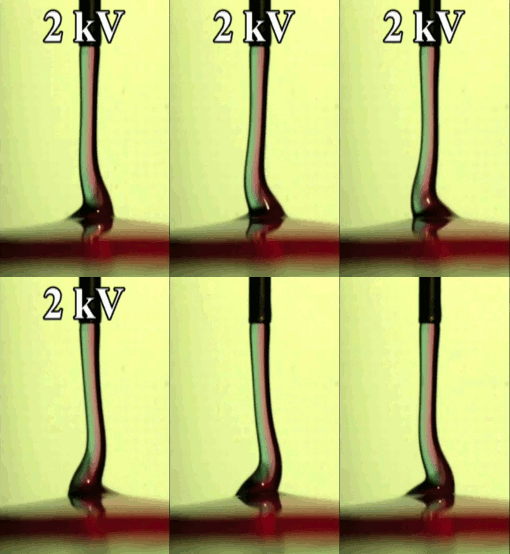


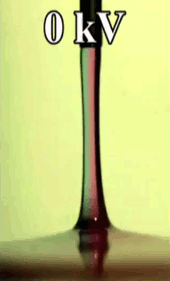
A falling jet of viscous fluid–like honey or syrup–will often coil. This happens when the jet falls quickly enough that it gets skinnier and buckles near the impact point. Triggering this coiling typically requires a jet to drop many centimeters before it will buckle. In many manufacturing situations, though, one might want a fluid to coil after a shorter drop, and that’s possible if one applies an electric field! Charging the fluid and applying an electric field accelerates the falling jet and induces coiling in a controllable manner.
An especially neat application for this technique is mixing two viscous fluids. If you’ve ever tried to mix, say, food coloring into corn syrup, you’ve probably discovered how tough it is to mix viscous substances. But by feeding two viscous fluids through a nozzle and coiling the resulting jet, researchers found that they could create a pool with concentric rings of the two liquids (see Figure C above). If you make the jet coil a lot, the space between rings becomes very small, meaning that very little molecular motion is necessary to finish mixing the fluids. (Image credits: T. Kong et al., source; via KeSimpulan)
