Search results for: “flow visualization”

  • Pancake Ice in the Sea

    Pancake Ice in the Sea

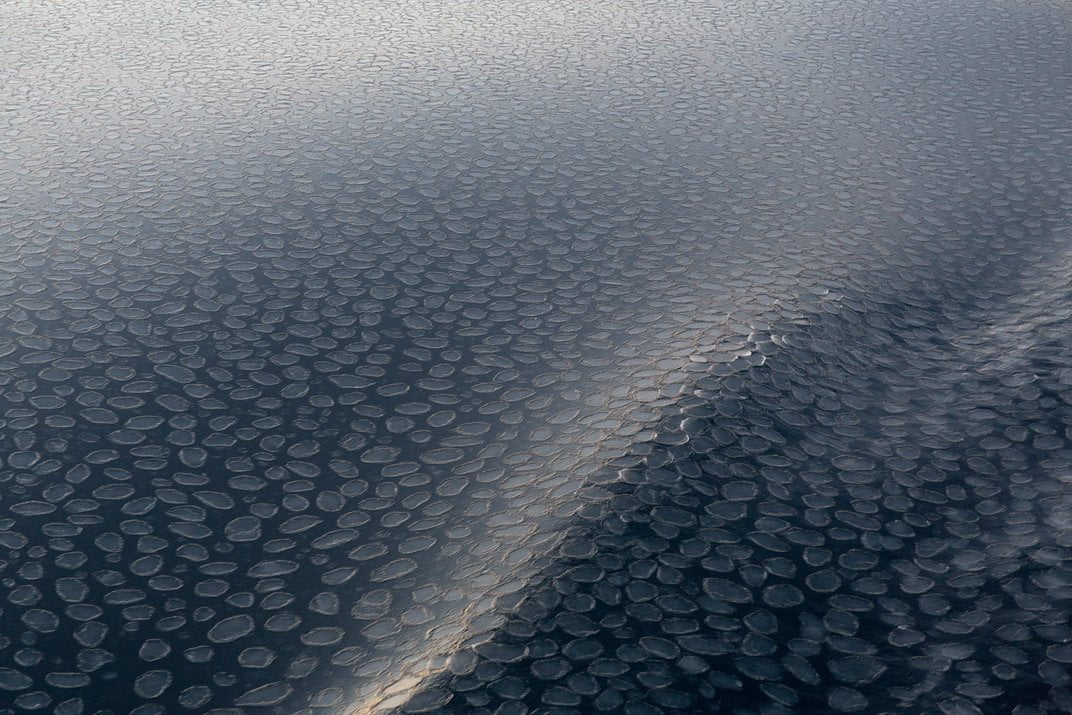
    Sea ice forms in patterns that depend on local ocean conditions. Pancake ice, like that shown in the above photo from the Antarctic Ross Sea, is formed in rough ocean conditions. Each individual pancake has a raised ridge along its edge, due to wave-induced collisions with other pieces of ice. Over time the smaller pieces of ice will merge together, forming large sheets. Evidence of its turbulent formation will persist, however, in the rough surface of the ice’s underside. For more, check out the National Snow and Ice Data Center. (Image credit: S. Edmonds; via Flow Visualization)

    Do you enjoy FYFD and want to help support it? Then please consider becoming a patron!

    Reminder: If you’re at the University of Illinois at Urbana-Champaign, I’m giving a seminar this afternoon. Not in Illinois? I’ve got other events coming up, too!

  • Science Hackathon

    Science Hackathon

    Just a heads-up that I’ll be at Brown University tomorrow giving a talk and then helping out with a science visualization hackathon. I’m super excited for the opportunity to have some hands-on flow visualization fun with folks!

    The lecture is public, but I think only Brown students can register for the workshop.

  • Featured Video Play Icon

    Visualizing Vortices

    Flow visualization can be a valuable tool for understanding fluid dynamics. In this video, we see how it can help elucidate the mechanisms of flapping flight. By dyeing vortices from the leading edge in red rhodamine and vortices from the trailing edge in green fluorescein, it’s possible to distinguish their competing effects for wings of different size. The speed and efficiency of a flapping wing depends on the vortices it sheds–these provide its lift and thrust. On a short wing, the leading edge vortex is significant and spins in a counter-clockwise (positive) direction. When it reaches the trailing edge, it meets a vortex spinning clockwise (negative). The interference of the two vortices weakens the shed vortex, thereby slowing the wing. Lengthening the wing weakens the leading edge vortex, which reduces its interference at the trailing edge and makes the longer wings more efficient. (Video credit: T. Mitchel et al.; via @AlbanSauret)

  • The Challenges of Micro Air Vehicles

    The Challenges of Micro Air Vehicles

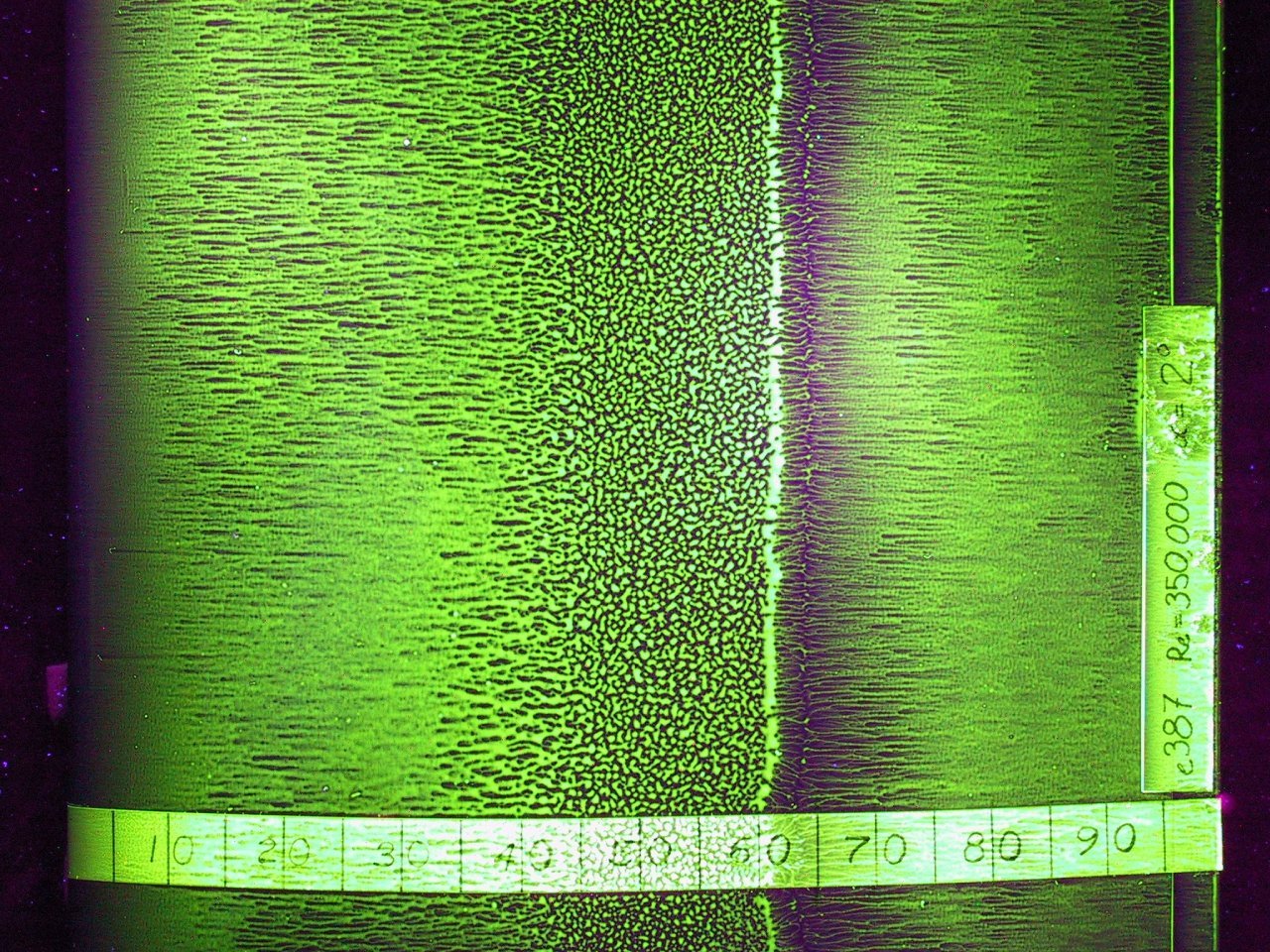
    Interest in micro-aerial vehicles (MAVs) has proliferated in the last decade. But making these aircraft fly is more complicated than simply shrinking airplane designs. At smaller sizes and lower speeds, an airplane’s Reynolds number is smaller, too, and it behaves aerodynamically differently. The photo above shows the upper surface of a low Reynolds number airfoil that’s been treated with oil for flow visualization. The flow in the photo is from left to right. On the left side, the air has flowed in a smooth and laminar fashion over the first 35% of the wing, as seen from the long streaks of oil. In the middle, though, the oil is speckled, which indicates that air hasn’t been flowing over it–the flow has separated from the surface, leaving a bubble of slowly recirculating air next to the airfoil. Further to the right, about 65% of the way down the wing, the flow has reattached to the airfoil, driving the oil to either side and creating the dark line seen in the image. Such flow separation and reattachment is common for airfoils at these scales, and the loss of lift (and of control) this sudden change can cause is a major challenge for MAV designers. (Image credit: M. Selig et al.)

  • Laser-Induced Fluorescence

    Laser-Induced Fluorescence

    One of the challenges of experimental fluid dynamics is capturing information about a flow that varies in three spatial dimensions and time. Experimentalists have developed many techniques over the years–some qualitative and some quantitative–all of which can only capture a small portion of the flow. The photos above are a series of laser-induced fluorescence (LIF) images of an airfoil at increasing angles of attack. The green swirls are from an added chemical that fluoresces after being excited with a laser. In this case, the technique is providing flow visualization, showing how flow over the upper surface of the airfoil shifts and separates as the angle of attack increases. The technique can also be used, however, to measure velocity, temperature, and chemical concentration. (Image credit: S. Wang et al.)

  • Top 10 FYFD Posts of 2014

    Top 10 FYFD Posts of 2014

    It’s only fitting to take a moment to look back at 2014 as we step into the New Year. It was a big year in many respects – we hit 1000 posts and broke 200,000 followers; I started producing FYFD videos on our YouTube channel; and, on a personal note, I finished up my PhD. But since we’re all about the science around here, I will give you, without further ado, the top 10 FYFD posts of 2014:

    1. Bioluminescent crustaceans use light for defense
    2. What happens when you step on lava
    3. Flapping flight deconstructed
    4. Wingtip vortices demonstrated
    5. Saturn’s auroras
    6. Raindrops’ impact on sand
    7. Water spheres in microgravity
    8. The surreal undulatus asperatus cloud
    9. Inside a plunging breaker
    10. A simply DIY Marangoni effect demo

    I can’t help but notice that 9 out of the 10 posts feature animated GIFs. Oh, Tumblr, you rascals. Happy New Year! (Image credits: BBC; A. Rivest; E. Lutz; Nat. Geo/BBC2; ESA/Hubble; R. Zhao et al.; D. Petit; A. Schueth; B. Kueny and J. Florence; Flow Visualization at UC Boulder)

  • Featured Video Play Icon

    Foggy Canyon

    Timelapse photography reveals the tide-like motions of fog that filled the Grand Canyon last week. This unusual meteorological condition was created by a temperature inversion. Usually air near the ground is warmest and the atmosphere cools as the altitude increases. But occasionally a mass of warm air will trap a layer of cooler air beneath it. In the case of the Grand Canyon, cool foggy air was capped by a warmer air mass, resulting in a sea of fog. Depending on the conditions, temperature inversions can create other distinctive weather patterns like cloud streets or even supercell thunderstorms. (Video credit: Vox; via Flow Visualization)

  • Light Paintings

    Light Paintings

    Photographer Stephen Orlando uses programmable LEDs to create light paintings. Here floating LEDs illuminate a track down a waterfall. In flow visualization terms, this is a pathline because it records the trajectory a particular particle followed through the flow. Streamlines, streaklines, and pathlines are all important concepts for interpreting fluid flow through visualization. To see more of Orlando’s light paintings, including some wonderful portraits of canoeing and kayaking, be sure to check out his galleries. (Photo credit: S. Orlando; via Colossal)

  • “Courants et Couleurs”

    Although flow visualization is a scientific technique, there is very much an art to it. Flow structures are, by their nature, ephemeral. To capture them, one must design an experiment that introduces dye into regions of interest without altering the flow significantly and without either ignoring or obscuring important physics. One of the great masters of this scientific art was Henri Werlé, whose extensive flow visualization work at France’s national aerospace lab is documented in the short film above. The film includes examples of simple geometries, full aircraft models, subsonic flow, shock waves, and more. eFluids has a whole gallery of Werlé images, too. Take a few minutes to enjoy the mesmerizing beauty of these experiments and appreciate the talents of those who made them possible. If you have questions about specific clips, feel free to ask! (Video credit: H. Werlé/ONERA; via J. Hertzberg)

  • The Marangoni Effect

    The Marangoni Effect

    Differences in surface tension can create Marangoni flow along an interface. Imagine a shallow bowl filled with a liquid. In the middle of the fluid, every molecule is surrounded on all sides by like molecules, which push and pull it equally in all directions. But at the surface, the fluid molecules are only acted on by similar molecules in some directions. This imbalance in molecular forces is what creates surface tension. When the surface tension is constant, the fluid surface is like a taut rubber sheet. Poke a hole in that sheet, and everything pulls away from the hole. Likewise, when the surface tension varies, fluid will move from areas of low surface tension toward areas of higher surface tension. This effect is easily demonstrated at home in a setup like the animation above. Pour milk (higher fat content is better) and food coloring in a shallow container. Then lower the local surface tension using dish soap or rubbing alcohol and watch the colors run away! (Image credit: Flow Visualization at UC Boulder, source video)