Search results for: “flow visualization”

  • Space Shuttle Sonic Booms

    Space Shuttle Sonic Booms

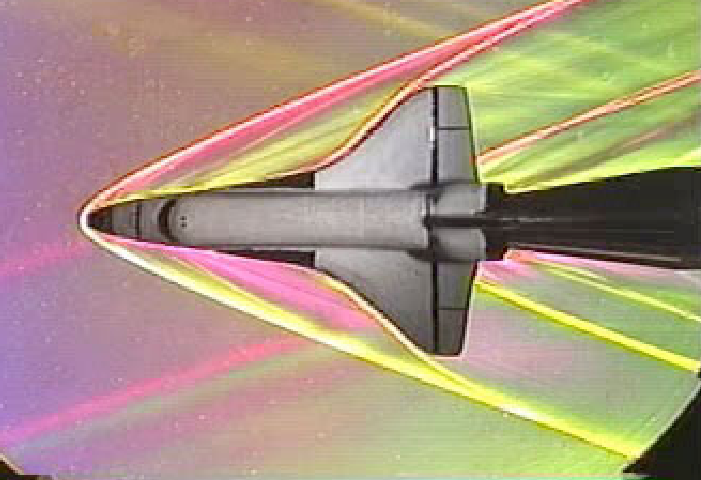
    The Space Shuttle had a famous double sonic boom when passing overhead during re-entry. This schlieren flow visualization of a model shuttle at Mach 3 reveals the source of the sound: the fore and aft shock waves on the vehicle. The nose of the shuttle generates the strongest shock wave since it is the first part of the vehicle the flow interacts with. This initial shock wave turns the flow outward and around the shuttle. The second boom comes from the back of the shuttle and serves to turn the flow back in to fill the wake behind the shuttle. (The actual shock wave would look a little different than this one because there’s no sting holding the shuttle like there is with the model.) The other major shock wave comes from the shuttle’s wings, but, at least for this Mach number, the wing shock wave merges with the bow shock, making the two indistinguishable. (Image credit: G. Settles, source)

  • Cycling Skinsuits and Vortex Generators

    Cycling Skinsuits and Vortex Generators

    It didn’t take long for an aerodynamic controversy to crop up in this year’s Tour de France. At the 14km individual time trial, riders from Team Sky wore custom Castelli skinsuits with integrated dot-like patterns on their upper arms (shown above). By the next day, a sports scientist with a competing team cried foul play, claiming that these fabrics could have given Team Sky as much as 25 seconds’ advantage over other riders. The Sky team finished with 4 out of the top 10 places on the time trial, and their leader, three-time Tour winner Chris Froome, finished some 35 seconds ahead of his expected competitors for the yellow jersey.

    Vortex generators explained

    So how could a few dots make a measurable difference? These protrusions are vortex generators meant to modify flow around a cyclist. Humans are not aerodynamic and what typically happens when air flows over a cyclist’s arms is shown in the flow visualization above: the air follows the curve of the arm part way, then it separates from the body, leaving a region of recirculation that increases drag. Vortex generators can help prevent or delay that drag-inducing flow separation by adding extra energy and turbulence to the air near the arm’s surface. Because turbulent boundary layers can follow a curve longer before separating, this helps reduce the drag by reducing the recirculation zone.

    About that time savings

    Aerodynamically speaking, those vortex generators can make a difference, but the question is, how much? In his complaint, Grappe cites a 2016 paper by L. Brownlie et al. that wind-tunnel tested different vortex generator patterns for use in running apparel. The speeds tested included those relevant to cycling. The specific numbers Grappe quotes aren’t directly relevant, however:

    As noted above, race garments that contain VG provide reductions in Fd of between 3.7 and 6.8% compared to equivalent
    advanced race apparel developed for the 2012 London Olympics which in turn provided substantially lower drag than
    conventional race apparel.

    the effectiveness of 5, 10 and 15 cm wide strips of VG applied to each flank of a sleeveless singlet revealed that the 5 cm wide
    strips provided between 3.1 and 7.1% less Fd than the 10 cm wide strips and between 1.9 and 4.3% less Fd than the 15 cm wide
    strips.  

    Here Brownlie et al. are specifically describing the savings for running apparel, which uses vortex generators in very different places than you would on a cyclist. Note the second quote even refers to a sleeveless singlet, so the vortex generators measured are definitely not in the same place as these skinsuits!

    The bottom line

    I fully expect that vortex generators give a marginal aerodynamic edge, which is why Sky and other teams have already been using them in competition. But I hesitate to declare that the savings is as high as 5-7%, and I have no way to verify Grappe’s subsequent claims that this translates to 18-25 seconds in the time trial. Those are numbers he gives without citing what model is being used to translate drag gains into time.

    In the end, what is needed is clarification of the rules. As they stand, one rule seems to allow the skinsuits because the vortex generators are integrated into the fabric, whereas another states clothing is forbidden “to influence the performances of a rider such as reducing air resistance”. Those two stances seems contradictory, and, for now, the race officials’ verdict to allow the suits stands.

    If you want to learn more about aerodynamics and cycling, be sure to check out my latest FYFD video. (Image credits: B. Tessier/Reuters; Getty Images; L. Brownlie et al. 2009; h/t to W. Küper)

  • How Cycling Position Affects Aerodynamics

    How Cycling Position Affects Aerodynamics

    New FYFD video! How much does a rider’s position on the bike affect the drag they experience? To find out I teamed up with folks from the University of Colorado at Boulder and at SimScale to explore this topic using high-speed video, flow visualization, and computational fluid dynamics. 

    Check out the full video below, and if you need some more cycling science before the Tour de France gets rolling, you can find some of my previous cycling-related posts here. (Image and video credit: N. Sharp; CFD simulation – A. Arafat)

    ETA: Please note that the video contained in this post was sponsored by SimScale.

  • Featured Video Play Icon

    Quad Copter Schlieren

    Schlieren photography is a classic method of flow visualization that utilizes small variations in density (or temperature) to make otherwise unseen air motion visible. Because changing air’s density or temperature changes its index of refraction, variations in either quantity show up as dark and light regions. Here researchers use it to reveal some of the airflow around a small quadcopter, including the vortices that spiral off each propeller and help generate the lift necessary for take-off. The full video includes a couple of neat demos, including what happens when the blades are wet (shown below). In that case, the wingtip vortices are somewhat disrupted by strings of water droplets being flung off the blades by centrifugal force. Beautiful!  (Video and image credit: K. Nolan et al., source; submitted by J. Stafford)

  • Starfish Vortices

    Starfish Vortices

    Starfish larvae, like other microorganisms, use tiny hair-like cilia to move the fluid around them. By beating these cilia in opposite directions on different parts of their bodies, the larvae create vortices, as seen in the flow visualization above. The starfish larvae don’t use these vortices for swimming – to swim, you’d want to push all the fluid in the same direction. Instead the vortices help the larvae feed. The more vortices they create, the more it stirs the fluid around them and draws in algae from far away. The larvae actually switch gears regularly, using few vortices when they want to swim and more when they want to eat. Check out the full video below to see the full explanation and more beautiful footage.  (Image/video credit: W. Gilpin et al.)

  • Featured Video Play Icon

    Fluorescein Ghosts

    Fluorescein is a popular chemical for flow visualization, and, as this video from Shanks FX demonstrates, it’s not hard to extract from highlighters if you’d like to experiment with it yourself. Fluorescein can also be purchased in powder form, but it’s typically rendered into a dye before use. When dripped into water, it can leave behind ghostly glowing wakes. Happy Halloween! (Video credit: Shanks FX)

    In other news, I am back from my vacation! Thanks again to Claire from Brilliant Botany for looking out for everything while I was gone. – Nicole

  • Soap Film Wakes

    Soap Film Wakes

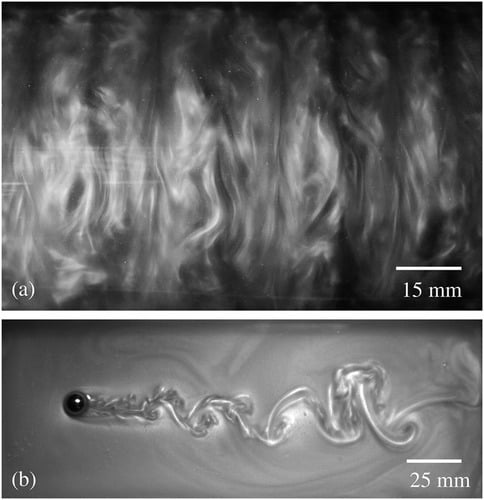
    Soap films can create remarkable flow visualizations when illuminated with monochromatic (single color) light. Each of the photos above shows a flow moving from left to right with a small object near the left creating an obstruction. In the top two images, the objects are cylinders; in the lower one it’s a flat plate tilted at 45 degrees. All of the objects shed vortices as the flow moves past. These vortices alternate in direction – the first spins clockwise, the next counter-clockwise, then clockwise again and so on. This pattern is known as a von Karman vortex street and can even show up in the atmosphere! (Image credit: D. Araya et al.)

  • Rio 2016: Rugby

    Rio 2016: Rugby

    The sport of rugby returns to the Olympics in Rio this year. Rugby’s ball is somewhat similar in size and shape to an American football, but it is a little wider and more rounded. Aerodynamically, this means that the rugby ball has  more drag, but it is also more stable in flight, allowing players to pass and kick accurately, with or without a spiral.

    As seen in the flow visualizations above, air travels up and around the ball before separating on the far side. The more the ball is tilted, the larger this separated region is and the greater the drag. At the same time, though, that tilt provides lift on the ball. The ideal orientation is the one with the largest ratio of lift force and drag force. For a rugby ball, this occurs at about 40 degrees.(Image credits: Planet Rugby; A. Vance et al.)

    Previously: The aerodynamics of the American football

    Join us throughout the Rio Olympics for more fluid dynamics in sports. If you love FYFD, please help support the site!

  • Flying with Large Ears

    Flying with Large Ears

    Evolution often requires compromise between competing effects. Large-eared bats, for example, rely on the size of their ears to aid their echolocation, but such large ears can hurt them aerodynamically, thus limiting their flight. Results from a recent experiment, however, suggest that large ears are not a total loss aerodynamically speaking. Researchers used particle image velocimetry to study the wakes behind free-flying, large-eared bats and found significant downward flow behind the bats’ bodies. This indicates that the bats generate some lift with their ears, body, and/or tail. The position and tilt of the ears in flight is similar to forward swept wings, which the authors suggest could help contract the wake behind the ears and reduce its negative influence on flow over the wings. Although the evidence is not yet conclusive, the study does suggest that large ears may be more aerodynamically beneficial than they appear. (Image credit: L. Johansson et al./Lund University, source; via Jalopnik)

    The next FYFD webcast will be this Saturday, May 21st at 1pm EDT. My guests will be Professor Jean Hertzberg of the University of Colorado at Boulder and Professor Kate Goodman of the University of Colorado at Denver. Dr. Hertzberg is the creator of the course Flow Visualization, an interdisciplinary course combining engineering, art, and fluid dynamics. It’s a class (and website) that’s been an inspiration for me and FYFD since the early days! Dr. Goodman, an expert in engineering education, earned her PhD studying the Flow Viz course and its impact. This will be wide-ranging discussion – with everything from experimental fluid dynamics and engineering education to art, photography, and hopefully even cardiac fluid dynamics!

    (Original images: P. Davis et al.; B. Moore; L. Swift et al.)

  • Featured Video Play Icon

    Fluids Round-up

    Time for another look at some of the best fluids content out there. It’s the fluids round-up – with a special focus this week on oceans!

    – Ryan Pernofski spent two years filming the ocean in slow motion with his iPhone to make the short film “Slowmocean” seen above. It’s a gorgeous ode to the beauty of breaking waves.

    Oceans with higher salinity than Earth’s could drive global circulation that would make exoplanets more hospitable to life.

    – Speaking of alien oceans that could harbor signs of life, there’s discussion afoot of how future missions to icy moons like Europa or Enceladus could collect samples from plumes ejected from beneath the ice.

    – Wind and waves make harsh, erosive environments. This photo essay from SFGate shows how greatly the sands of Pacifica shift over time. (submitted by Richard)

    Bonuses:

    – New research explores how Martian mountains may have been carved out by the wind.

    – Ever listened to an orchestra made from ice? You should! Learn about Tim Linhart, who builds and maintains ice instruments. (submitted by ashketchumm)

    – MIT has demonstrated a new 3D-printing technique that allows for printing liquid and solid parts simultaneously, allowing would-be creators to rapid-prototype hydraulically-driven robotics.

    Even more bonus bonus!

    – ICYMI, the new FYFD video made Gizmodo!

    If you’re a fan of FYFD, please consider becoming a patron. As a bonus, you’ll get access to this weekend’s planetary science webcast!

    (Video credit: R. Pernofski; via Flow Visualization; Pluto image credit: NASA/APL)