Search results for: “flow visualization”

  • Rip Currents

    Rip Currents

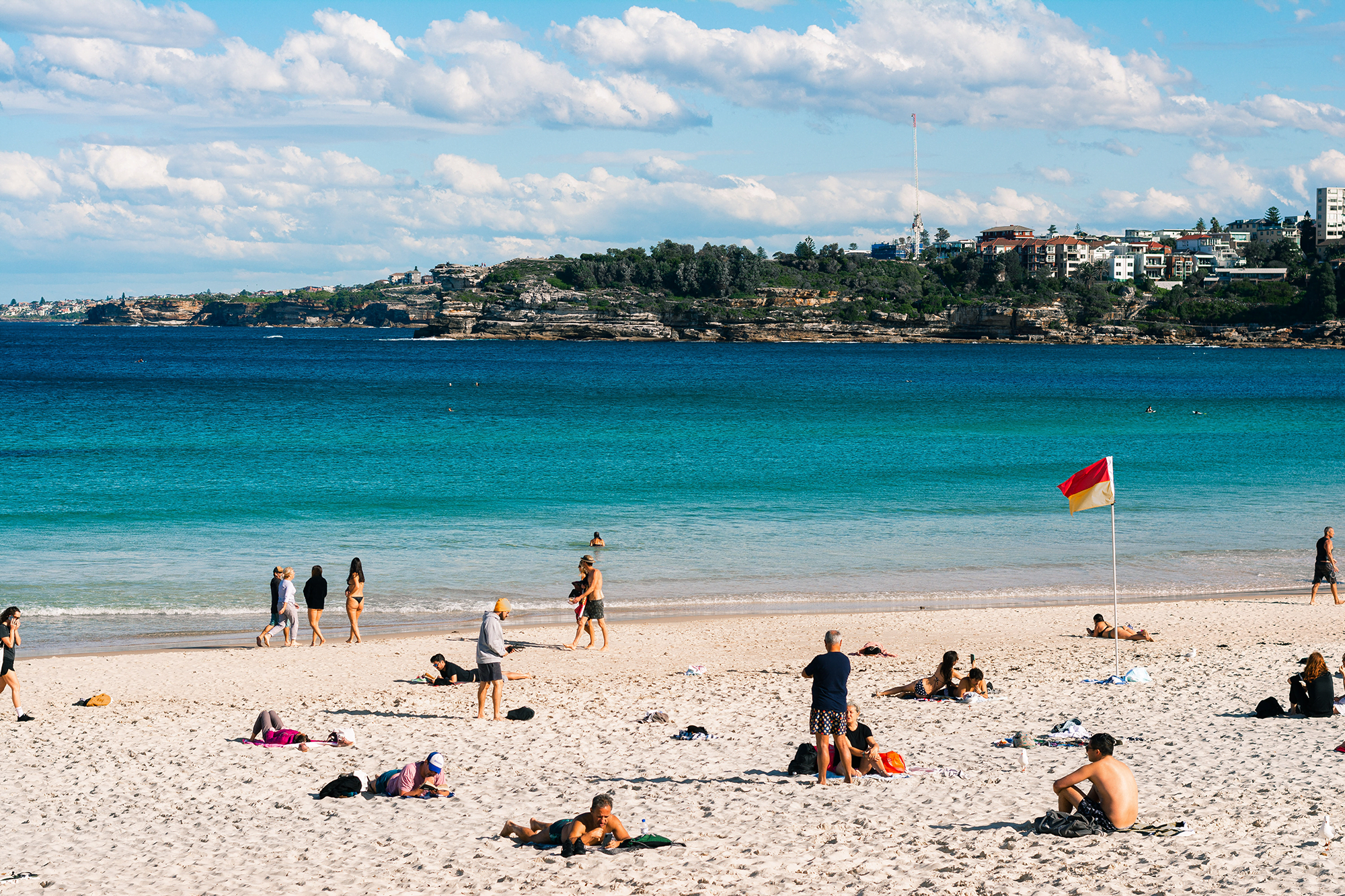
    Rip currents — also known as rips — are a threat to beachgoers around the world, and, unfortunately, they’re often underestimated or misunderstood. As waves crash on the shore, water must find a path back out to sea, often through deeper channels that provide a break between the waves. These flow paths are rip currents, and they can form, shift, and intensify with little warning.

    Over the years, researchers have found that efforts to educate beachgoers through signs, flags, and other methods once at the beach have done little to help visitors understand, avoid, or escape rips. Instead, it’s better to educate people long before the water is in sight. Since no one method is guaranteed success for escaping a rip, it’s better to learn to recognize and avoid these dangerous areas. Check out the video below for advice on spotting rips, and here’s a video showing rips from a surfer’s perspective, as well as one using dye flow visualization to mark a rip. Be safe and smart out there! (Image credit: P. Auitpol; video credit: Surf Life Saving Australia; via Hakai Magazine; submitted by Kam-Yung Soh)

  • Featured Video Play Icon

    RC Ground Effect Plane

    The ekranoplan was a massive, Soviet-era aircraft that relied on ground effect to stay aloft. In this video, RC pilots test out their own homemade version of the craft, including some neat flow visualization of the wingtip vortices. When an aircraft (or, for that matter, a bird) flies near the ground, it experiences less drag than at higher altitudes. This happens primarily because of the ground’s effect on wingtip vortices.

    In normal flight, the vortices from an aircraft’s wingtips create a downwash that reduces the wing’s overall lift. But in ground effect, the vortices cannot drift downward as they normally do. Instead, they spread apart from one another, thereby reducing the drag caused by downwash from the aircraft. The end result is better performance, though it comes with added risk since there’s very little time to correct an error when flying at an altitude less than half the aircraft’s wingspan. (Video and image credit: rctestflight; submitted by Simplicator)

  • Light Painting

    Light Painting

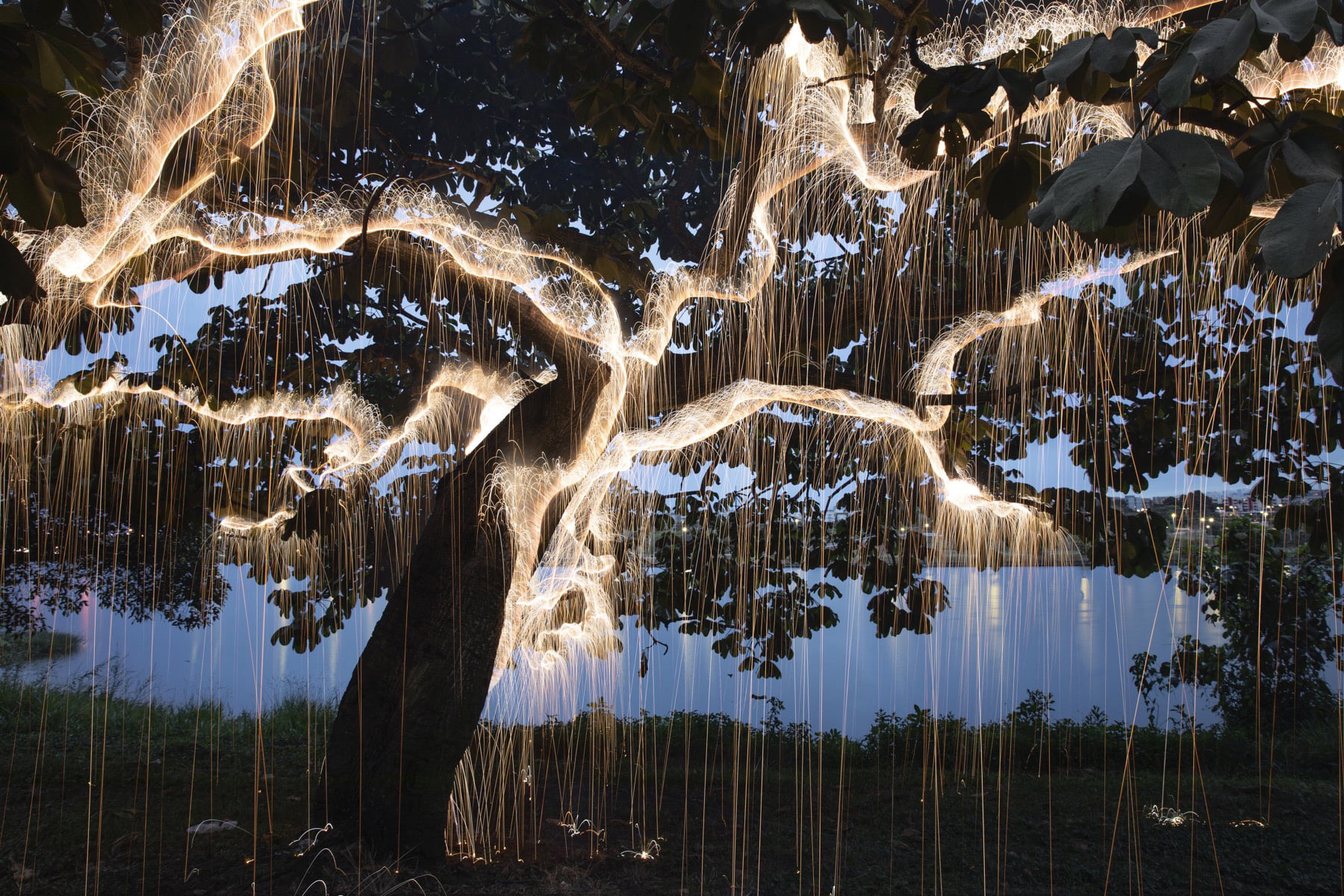
    Light streams from the branches of trees in this series from photographer Vitor Schietti. The effect is created with a combination of fireworks, long-exposure photography, and compositing. I love how the falling sparks create streaklines just like so many flow visualization diagnostics do! Follow more of Schietti’s work on Instagram. (Image credit: V. Schietti; via Colossal)

  • Resources

    I get a lot of questions from people who want to learn more about fluid dynamics, whether casually or seriously. Below are some resources that may be useful in such pursuits. Affiliate links are marked with an asterisk (*).

    Videos

    • NCFMF Fluid Mechanics Series – This series of videos date from the 1960s and is intended to teach undergraduates about fluid dynamics. They remain an incredible source of demonstrations on all kinds of subjects in fluids. They feel a bit slow, but they are well worth the time.
    • Khan Academy’s Fluids series – A twelve part video series addressing some fundamentals of fluid dynamics.
    • CrashCourse Physics – If you want to dig into fluids further, it helps to know the basics. After all, the Navier-Stokes equations are simply Newton’s Laws applied to a fluid!
    • Science Off The Sphere – This video series by astronaut Don Pettit features FD and other physics in space.
    • Physics Central – Not FD-specific, but this website features lots of great educational physics, including fluid dynamics.
    • MIT + K12 – Includes fluids-related video lessons as well as many other science subjects.

    YouTube Channels

    • Library Laboratory (LIB LAB) – This project comes from fluid dynamicist A. J. Fillo. It’s aimed toward kids but is fun for all ages. Includes fluid dynamics and other topics in physics.
    • The Lutetium Project – This channel is produced by fluid dynamicists in France in conjunction with art and music students, so it offers a great intersection of art and science. Videos are available in French and English.

    Websites

    • U of Colorado’s Flow Visualization – One of my favorite websites dedicated to FD, this interdisciplinary course features engineering and art students working together to make beautiful FD. If you are at Colorado, take this course. Seriously.
    • APS Gallery of Fluid Motion – Every year the American Physical Society’s Division of Fluid Dynamics publishes the year’s best FD photos and videos. Most of this will look familiar to FYFD readers. 
    • CFD-Online – For anyone looking to get into computational fluid dynamics (CFD), this website and forum is full of great resources and comprehensive links.
    • Learn ChemE – Full of videos, screencasts, and simulations relevant to fluid dynamics.
    • Flow Visualization Facebook group – A nice place to find links to fun FD and clouds.
    • eFluids – More pretty pictures and videos from researchers.
    • opencalculus – Not directly fluids-related, but if you want to dig further into the subject, a strong foundation in math is important (see note to undergrads below).
    • Teaching Fluid Mechanics – This website focuses on demonstrations that can be used in the classroom to help teach and illustrate fluid dynamics concepts.

    Other FD Blogs

    • FlowViz – Focuses on general FD, much like FYFD does
    • Physics in Drops – Exploring the world of microfluidics
    • Liquifun – Lots of car-related aerodynamics as well as general FD
    • Symscape – Computational fluid dynamics, for the most part, but with general FD thrown in

    Books (No Diff EQ Needed)

    • An Album of Fluid Motion(*) by Milton van Dyke – This is a classic visual guide to fluid dynamics for laymen and practitioners alike.
    • The Life and Legacy of G. I. Taylor(*) by G. K. Batchelor – A great biography of one of the major fluid dynamicists of the 20th century. Taylor’s adventures range from measuring atmospheric turbulence from a ship deck to teaching himself to fly in WWI to measure pressure on a wing; from studying the swimming of microorganisms to helping predict the blast wave from the atomic bomb. Batchelor provides great insight into the man and his scientific process.
    • Life in Moving Fluids(*) by Steven Vogel – This text was written as an introduction to fluid dynamics for biologists and focuses largely on the subject’s applicability to that field. There’s some math in here, but not too much. Check out my full review.

    Books (For Those With Calculus/Diff EQ)

    • Fundamentals of Aerodynamics(*) by John Anderson – Anderson is known for textbooks (he has a bunch) that are good at introducing important concepts in fluid dynamics and aerodynamics without super-advanced mathematics and notation. This was my first aerodynamics textbook and my first introduction to the Navier-Stokes equations during my junior year.
    • Boundary Layer Theory(*) by Hermann Schlichting – Most of this text actually comes from 1930s German fluid dynamics class notes. It’s not an easy read, but it’s a great reference for advanced undergrads/early graduates working in FD.

    For Undergrads Who Want More Fluids But Don’t Know Where To Start

    In addition to the resources above, I have a couple of tips.

    • Look for professors who study fluid dynamics. – Check your school’s websites. Profs who do FD are often found in mechanical, aerospace, civil, and chemical engineering, but they can also be found in physics, mathematics, geology, atmospheric science, and theoretical and applied mechanics departments. Check out their research pages, find their office hours, and go talk to them. Volunteer to work in their lab. Demonstrate your interest!
    • Check out the NSF Research Experience for Undergraduates (NSF REU) program. Positions in this program exist all over the U.S. and frequently involve doing research over the summer. Even if your school doesn’t have anyone who does FD, you can find a school that does and do research there over the summer. (Suggestion when looking for positions: search for “fluid”, “fluid dynamics”, “fluid mechanics”, etc.) If you like it, consider graduate school!
    • Build strong mathematical skills. – One aspect of fluids education I lament is its tendency to come so late (or not at all) in a students’ education—that’s part of why FYFD exists. But the truth is that researching FD requires a lot of math—calculus, differential equations, partial differential equations, etc.—courses that get taken in freshmen and sophomore years of college before professors even start talking about FD. Having a strong foundation in these subjects is very helpful, but it’s not a prerequisite to working in a lab as an undergrad.

    Got more suggestions for helpful fluid dynamics resources? Let me know.

    (*) Links marked with an asterisk are affiliate links. Following these links and making a purchase may provide a commission to FYFD at no additional cost to you.

  • Fiery Streaklines

    Fiery Streaklines

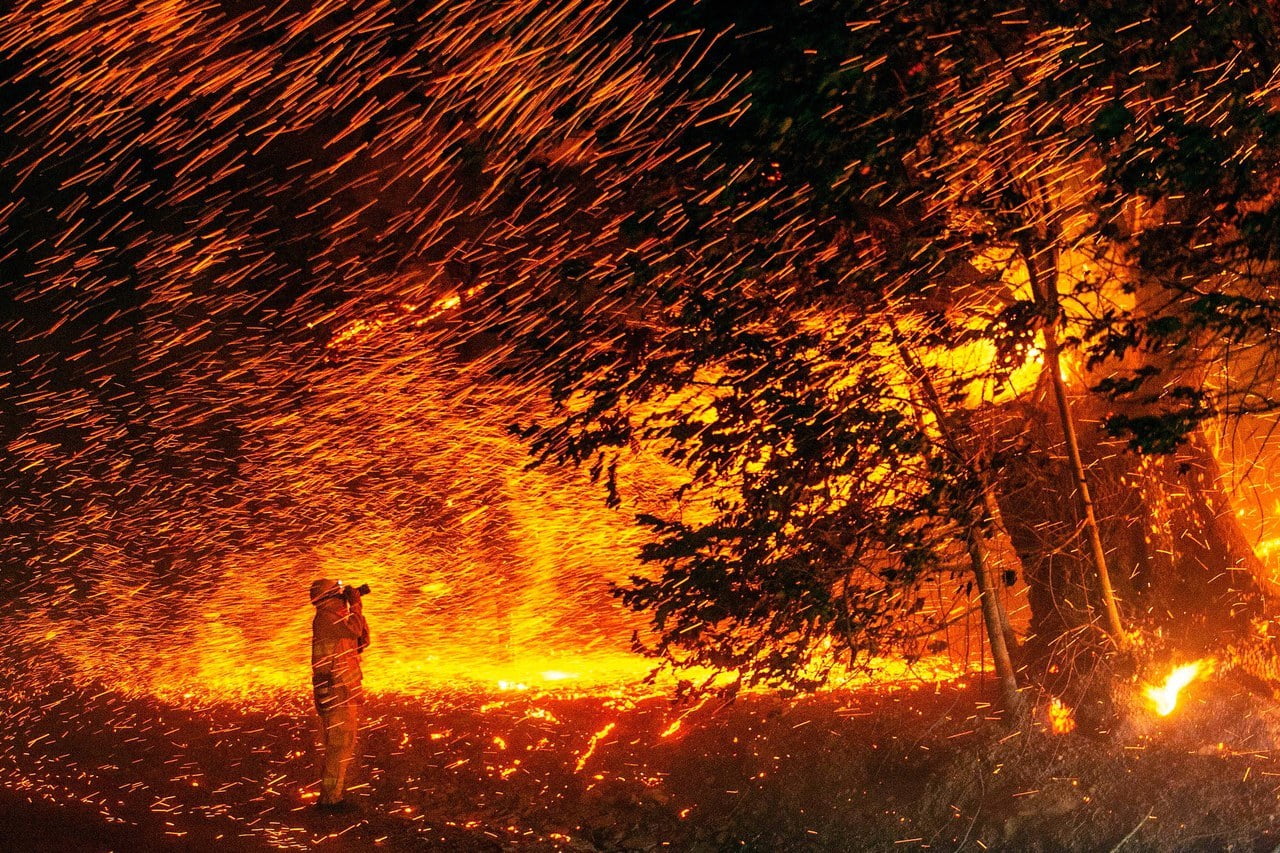
    Embers fly through the Kincade wildfire leaving streaks of light that reveal the strong winds helping drive the fire. This unintentional flow visualization mirrors techniques used by researchers to understand how flows are moving. The shutter of the camera remains open for a fixed time, so the length of each streak tells us about the speed of the flow. Longer streaks occur where embers moved faster. 

    Here we see the longest streaks in the upper left side of the image, which tells us that the wind was moving faster there than it did at lower heights, like near the photographer in the picture. That’s in keeping with what we would expect. In general, winds move faster above the ground than they do near the surface. That speed difference is one of the reasons wildfires are so difficult to contain; a single ember caught by high winds is easily carried to unburnt areas, allowing the fire to spread more quickly than if it had to burn along the ground. (Image credit: J. Edelson/Getty Images; via Wired)

  • Featured Video Play Icon

    Fluid at Work

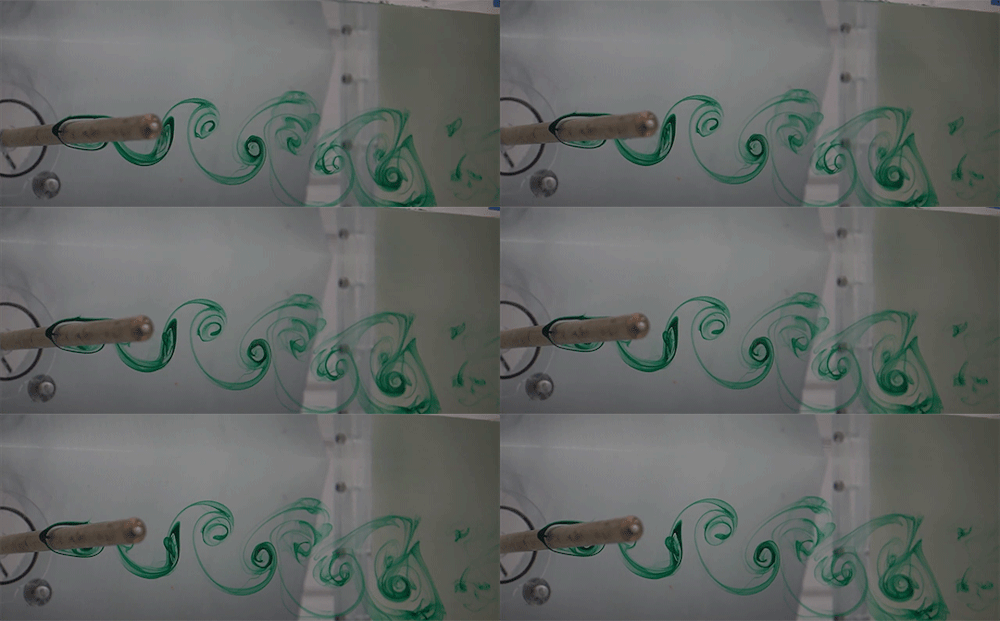
    For many engineering students, their first experience with flow visualization comes in undergraduate labs, where dye introduced into a flume demonstrates basic flow features around airfoils, cylinders, and spheres. This short video by undergraduate Nick Di Guigno and partners quietly illustrates that experience, from the introduction to the equipment to loading the dye and watching the flow develop under the commentary of one’s professor. For those of you who have done this, I suspect it may ignite a bit of nostalgia. For those who haven’t, I think it captures some of the magical feeling of stepping into the lab the first time, even when you’re just recreating a phenomenon others have seen a thousand times before. (Image and video credit: N. Di Guigno et al.)

  • Ice Cream Vortex

    [original media no longer available]

    Here’s a fun demonstration of vorticity: sticking an ice cream cone in a bathtub vortex. Now, before someone points out that this is clearly a sink, not a bathtub, the term “bathtub vortex” actually has a standard scientific usage; it’s used to describe a vortex that forms when water drains out a small hole in a larger container.

    Vortices like this have a surprisingly complex flow structure. Although there is some flow dragged into the vortex near the surface, flow visualization shows that most of the flow actually occurs along the bottom of the container. Fluid there gets dragged along the surface, then sucked upward near the center of the vortex, and finally gets pulled down the drain.

    So what’s going on here? As long as the ice cream cone stays balanced inside the center of the vortex, it spins with the fluid due to viscous drag. When it’s unbalanced – like when it precesses too far or throws a chunk of cone off –  I suspect the bottom of the cone is encountering that area of upwelling, which tips the cone completely. The surface flow then pulls it back into the center of the vortex, allowing it to right itself. (Video credit: Cheesemadoodles; research credit: A. Anderson et al.; submitted by randumblrposts and eclecticca)

  • Phytoplankton Swirl

    View this post on Instagram

    Every summer, phytoplankton spread across the northern basins of the North Atlantic and Arctic Oceans, with blooms spanning hundreds and sometimes thousands of kilometers. One of our Earth-observing satellites captured this natural-color image of striking swirls of green seawater rich with blooms of phytoplankton whirling in the Gulf of Finland, a section of the Baltic Sea. Note how the phytoplankton trace the edges of a vortex; it is possible that this ocean whirlpool is pumping up nutrients from the depths. Credit: NASA/U. S. Geological Survey/ Joshua Stevens/Lauren Dauphin #nasa #science #vortex #phytoplankton #earth #landsat #picoftheday #finland #earthview #views #satellite #lava #balticSea #beautiful #blooms

    A post shared by NASA (@nasa) on

    During the warm summer months, phytoplankton blooms pop up in waters around the world. This natural-color satellite image shows a bloom in the Gulf of Finland. The tiny phytoplankton serve as tracker particles for the flow, revealing large-scale features like the spectacular vortex in the center of this image. The presence of the phytoplankton here suggests that this vortex could be pumping nutrients up from the deep. 

    Researchers also use particles for flow visualization. This can be as simple as adding small, neutrally buoyant particles, illuminating smoke, or even using natural snowfall to see what’s happening in the flow. (Image credit: NASA/USGS/J. Stevens/L. Dauphin)

  • Replacing Kalliroscope

    Replacing Kalliroscope

    Although you may not recognize the name, you’ve probably seen Kalliroscope (top image), a pearlescent fluid that creates beautiful flow patterns when swirled. This rheoscopic fluid was invented in the mid-1960s by artist Paul Matisse and, over the following decades, became a staple of flow visualization techniques. Kalliroscope contained a suspension of crystalline guanine. Since the crystals were asymmetric, they would orient themselves depending on the flow and, from there, scatter light, creating the beautiful pearlescent effect seen above.

    Unfortunately for researchers, the production of guanine crystals was expensive and difficult. The cosmetics industry was their main consumer and over time, they moved toward mica and other cheaper mineral alternatives. The company that produced Kalliroscope gave up production in 2014, leaving researchers scrambling for a suitable alternative.

    One contender for a new standard rheoscopic fluid is based on shaving cream. By diluting shaving cream 20:1 with water, researchers are able to extract stearic acid crystals, which form an admirable alternative to Kalliroscope (middle collage). Like Kalliroscope, the resulting fluid is pearlescent and reveals flow features well (bottom two images). Stearic acid crystals are also closer in density to water than guanine, so the fluid remains in suspension far better than Kalliroscope. Plus, the best shaving cream is cheap and widely available, meaning that this is a DIY project just about anyone can do! (Image credits: Kalliroscope – P. Matisse; other images – D. Borrero-Echeverry et al.; research credit: D. Borrero-Echeverry et al.)

  • Dissolving Candy

    Dissolving Candy

    In nature, solid surfaces often evolve over time in conjunction with the flows around them. This is how stalactites, canyons, and hoodoos all form and change over time. Here researchers examine a surface formed from hard candy that is dissolving from below. Over time, the initially flat surface develops a pitted appearance (top image, scale bar is 1 cm) with roughness that is approximately 1 mm in scale. Flow visualization (bottom row) suggests that these pits result from local flow where narrow, millimeter-sized dense plumes fall away from the surface. 

    As material dissolves from the candy, it forms a dense layer of sugar-water mixture near the solid surface. Once that layer grows to a critical thickness, it will be too unstable for viscosity to counter. At that point, the Rayleigh-Taylor instability takes over, causing the dense sugar-water layer to break up into narrow, sinking plumes. Although each area is evolving independently, the rate at which material dissolves is uniform everywhere, so the dissolving body retains the same shape over time. (Image and research credit: M. Davies Wykes et al., source)