Hospital-acquired infections are a serious health problem. One potential source of contamination is through the spread of pathogen-bearing droplets emanating from toilet flushes. The video above includes high-speed flow visualization of the large and small droplets that get atomized during the flush of a standard hospital toilet. Both are problematic for the spread of pathogens; the large droplets settle quickly and contaminate nearby surfaces, but the small droplets can remain suspended in the air for an hour or more. Even more distressing is the finding that conventional cleaning products lower surface tension within the toilet, aggravating the problem by allowing even more small droplets to escape. To learn more, see the Bourouiba research group’s website. (Video credit: Bourouiba research group)
Search results for: “flow visualization”

Pathlines vs. Streaklines
When considering fluid motion, there are many ways to describe trajectories through the flow. One is the pathline, the trajectory followed by an individual fluid particle. Imagine releasing a rubber duck down a stream. Following the duck’s position over time would give you a pathline. Now imagine that instead of releasing a single rubber duck you release lots of them – say one every half-second from the exact same starting spot. You would end up with a line of rubber ducks stretching downstream, each of them sharing the same origin but with a different starting time. This is called a streakline. Would the streakline of rubber ducks follow the same trajectory as the lone duck? Not if the flow is time-varying! In fact, for unsteady flows, pathlines and streaklines can give completely different pictures of a flow, as illustrated in the video above. Knowing and understanding the difference between these types of trajectories is extremely important when it comes interpreting flow visualizations in unsteady flows because some visualization methods produce pathlines and others produce streaklines. (Video credit: V. Miller and M. Mungal)
Floating Water Bridges
Water bridges that seem to float on air are an electrohydrodynamic phenomenon. By filling two beakers with extremely pure deionized water and applying a large voltage across them, flow is induced from one beaker to the other, as seen in the first few seconds of the video above. This flow is stable enough that the beakers can then be separated by a few centimeters without disturbing the bridge. Gravity tends to make the water bridge sag and capillary action tries to thin the bridge, but both effects are countered by the polarization forces induced in the water by the electric field. You can learn much more about the effect and see both photos and videos of it in action at Elmer Fuchs’ webpage. The flow visualization videos are especially neat! (Video credit: E. C. Fuchs)
Fluids Round-up – 20 October 2013
Some very cool fluids applications in this week’s fluids round-up. On to the links!
- Like many colleges, MIT has campus myths about those unbelievably windy spots. But, unlike many others, they have a CFD analysis deconstructing the myths.
- Even rocks can behave like fluids sometimes. Check out this article from @s_i_r_h_c on fluid instabilities left behind in rocks.
- Reader Julian de Charentenay demonstrates some DIY aerodynamic analysis on Pixar’s Lightning McQueen. One of the neat features here is using photos of an object to construct a 3D model, a technique I used in my own research at one point.
- Physics.org explains why teapots drip.
- Phys.org reviews a paper suggesting that fluid dynamics influenced the evolution of lung structure.
- io9 discusses new research on how the brain gets rid of waste products, which includes experiments with flow visualization in mice brains.
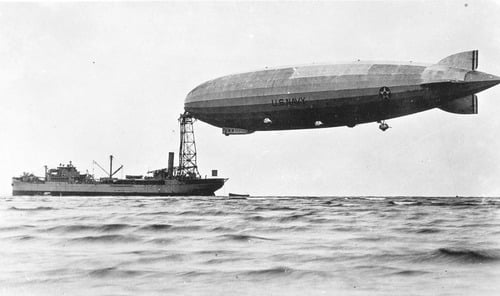
- Finally, our lead image shows the airship USS Los Angeles moored to the USS Patoka and comes from The Atlantic’s In Focus series on airships past and present.
ETA: I somehow forgot to include the first of the upcoming APS presentations to get wide media recognition: Law of Urination, which has shown up all over the place.
(Photo credit: San Diego Air and Space Museum Archive/In Focus)

Dynamic Stall
In nature, birds and other flying animals often use unsteady flow effects to enhance the lift their wings generate. When a wing sits at a high angle of attack, it stalls; the flow separates from the upper surface, and its lift force is suddenly lost. If, on the other hand, that wing is in motion and pitching upward, lift is maintained to a much higher angle of attack. The reason for this is shown in the flow visualization above. This montage shows a rectangular plate pitching upwards. Flow is left to right. Each row represents a specific angle of attack and each column shows a different spanwise location on the plate. As the plate pitches upward, a vortex forms and grows on the leading edge of the plate. Eventually, the leading-edge vortex separates, but not until a much higher angle of attack than the plate could sustain statically. This effect allows birds to maintain lift during perching maneuvers and is also key to helicopter rotor dynamics. (Image credit: K. Granlund et al.)

Fluids Round-up – 5 October 2013
This is the last week that my IndieGoGo project is open for donations. All money above and beyond what is needed for the conference will go toward FYFD-produced videos. Also, donors can get some awesome FYFD stickers.
As a reminder, those looking for more fluids–in video, textbook, or other form–can always check out my resources page. And if you know about great links that aren’t on there, let me know so that I can add them. On to the round-up!
- Popular Science has look at what it was like to fly on the Concorde, the only supersonic commercial airliner ever flown.
- For the cyclists and CFD folks out there, Zipp has put out a new video discussing their Firecrest wheels’ aerodynamics.
- io9 explains how superhydrophobic surfaces impart a charge to water droplets and how this can be used to increase efficiency at power plants.
- BuzzFeed UK has 32 fun science GIFs, several of which are fluids-related, and several of which will look familiar to long-time readers. (via Flow Visualization on FB)
- Wired has an intriguing short on Acoustic Archives, a group that focuses on capturing the acoustic qualities of historic locations using custom-designed 3D microphones.
- Congratulations to Richard over at Flow Viz for hitting his 100th post! Here’s to many more.
- Finally, our lead image comes from Martin Klimas. Smithsonian’s blog has a feature on his work in which he transforms songs from artists like Pink Floyd, Daft Punk, and Bach into sonic sculptures using paint on speakers. (via Flow Visualization on FB)
I had a lot of fun earlier this week giving a talk for the Texas A&M Applied Mathematics Undergraduate Seminar series. I didn’t get a chance to record it, but the slides are up here if anyone is interested.(Photo credit: M. Klimas)Maze-Solving Droplets
The Leidenfrost effect occurs when liquids come in contact with a substrate much, much hotter than their boiling temperature. Rather than immediately boiling away, a thin layer of the liquid vaporizes and insulates the bulk of the liquid from the heat. This essentially turns droplets into tiny hovercrafts that skate over the surface. If you use a rough surface with rachets, the Leidenfrost drops will self-propel toward the steepest part of the rachet. The vapor underneath the drop is constantly trying to flow away, and the rachets in the surface prevent the vapor from escaping in the steeper direction. The vapor instead flows out the shallower side and–thanks to Newton’s third law–creates thrust that pushes the droplet the opposite direction. Here students from the University of Bath have used these effects to build a maze through which the droplets fly. (Video credit: C. Cheng et al.; via Flow Visualization FB page and several submissions)
For readers at Texas A&M University, I will be giving a talk Wednesday, October 2nd entitled “The Beauty of the Flow” as part of the Applied Mathematics Undergraduate Seminar series at 17:45 in BLOC 164.

Fluids Round-up – 21 September 2013
First off, I’d like to give a special shout-out to FYFD’s friends at Pointwise, who were kind enough to invite me for a visit this week. For any readers looking for CFD grid-generation software, check them out; they are a fantastic bunch and very good at what they do.
My thanks again to everyone who donated this week to help get me to the APS conference. The campaign is still open if anyone wants to get in on the FYFD wallpapers and stickers on offer to donors. As a reminder, any funds beyond conference costs will go toward improving FYFD, including getting equipment to make FYFD videos. On to the fluids round-up!
- Wired takes us behind the scenes of the creation of Games of Thrones’ dragons. Believe it or not, the VFX team actually did digital simulations of the dragons flying in a wind tunnel.
- Nature dissects whether a submarine at relativistic speeds sinks or floats. (via io9) Note that Nature article says the submarine is in water but the original paper simply says that the submarine is immersed in a fluid and makes no account for the compressibility (or lack thereof) of that fluid.
- Add some excitement to your day with liquid-nitrogen-induced explosions from Distort (via io9).
- Flow Viz shows off a great picture of condensation-induced flow visualization on an airplane wing.
- Check out this awesome video of vibrating lycopodium powder from Susi Sie. (via io9)
- National Geographic considers whether Hawaii’s molasses spill is more or less environmentally damaging than an oil spill.
- Finally, our lead image shows a natural visualization of flow around a kayaker. The foam atop the water forms when air and water mix with the gas produced by decomposing leaves. The photo by Lucas Gilman appeared in Outside Magazine earlier this summer. (via Flow Visualization)
(Photo credit: L. Gilman)
Fluids Round-up – 24 August 2013
Fluids round-up time! Here are your latest fluids links to check out:
- One of the great fundamental questions of life is, of course: what is the airspeed velocity of an unladen swallow? Jonathan Corum explains how to use fluid dynamics to estimate the answer. (submitted by Andrew C)
- Sound and acoustics play a big role in fluid dynamics. Check out acoustics blog Listen To That Noise to learn more about the subject daily.
- io9 has a great collection of crazy natural ice sculptures, some of which remind me of wild airfoil-shaped ice I found several years back.
- For the chemically-inclined, Simon Gladman has a neat implementation of Hiroki Sayama’s Swarm Chemistry that adds fluid dynamics and advection into the simulation. Check out videos and get links to the code here.
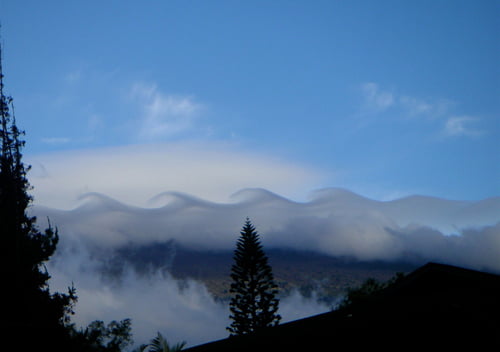
- Finally, TED has some gorgeous photos of unusual clouds including our headliner, a lovely example of a Kelvin-Helmholtz cloud, to go along with Gavin Pretor-Pinney’s talk on the joys of cloud-spotting. (via Flow Visualization on FB)
(Photo credit: G. Pretor-Pinney)

Streamlines in Oil
Bernoulli’s principle describes the relationship between pressure and velocity in a fluid: in short, an increase in velocity is accompanied by a drop in pressure and vice versa. This photo shows the results left behind by oil-flow visualization after subsonic flow has passed over a cone (flowing right to left). The orange-pink stripes mark the streamlines of air passing around the Pitot tube sitting near the surface. The streamlines bend around the mouth of probe, leaving behind a clear region. This is a stagnation point of the flow, where the velocity goes to zero and the pressure reaches a maximum. Pitot tubes measure the stagnation pressure, and, when combined with the static pressure (which, counterintuitively, is the pressure measured in the moving fluid), can be used to calculate the velocity or, for supersonic flows, the Mach number of the local flow. (Photo credit: N. Sharp)