Search results for: “droplet”

  • Breaking Jets Into Drops

    Breaking Jets Into Drops

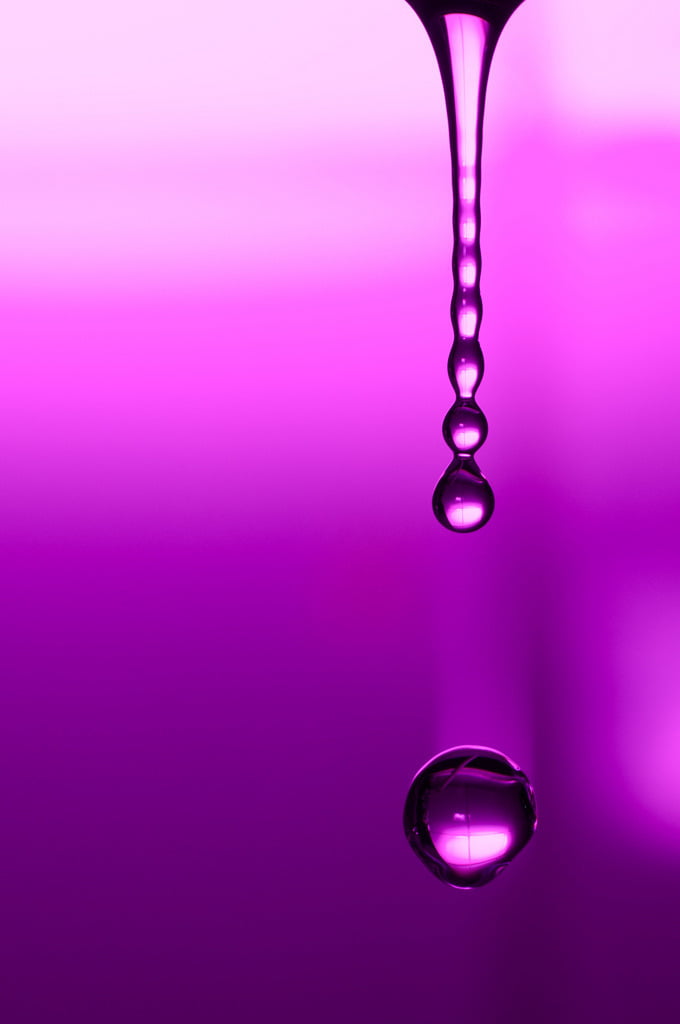
    A falling stream of water will break into droplets due to the Plateau-Rayleigh instability. Small disturbances can create a wavy perturbation in the falling jet. Under the right conditions, the pressure caused by surface tension will be larger in the narrower regions and smaller in the wider ones. This imbalance will drive flow toward the wider regions and away from the narrower ones, thereby increasing the waviness in the jet. Eventually, the wavy jet breaks into droplets, which enclose the same volume of water with less surface area than the perturbed jet did. The instability is named for Joseph Plateau and Lord Rayleigh, who studied it in the late 19th century and showed that a falling jet of a non-viscous fluid would break into droplets if the wavelength of its disturbance was larger than the jet’s circumference.  (Image credit: N. Morberg)

  • Spinning Paint

    Spinning Paint

    Fluid dynamical behaviors are often the result of competing forces. Here paint flung from a spinning rod illustrates the effects of adhesion, surface tension, and centrifugal force. In general, surface tension tries to hold a fluid together, and adhesion allows it to stay attached to a surface. Centrifugal force, on the other hand, tends to push the fluid outward. As the spinning rod accelerates, centrifugal force wins over adhesion and the paint spirals outward. For awhile, surface tension manages to hold the paint together, stretching it into spiraling ligaments of fluid. But when centrifugal force overpowers surface tension as well, the ligaments of paint snap into smaller droplets, still flying outward. Check out the full video for more great slow motion shots, and be sure to look at photographer Fabian Oefner’s “Black Hole“ series, which inspired the video. (Image credit: BBC Earth Unplugged, source video)

  • Bubble Rupture

    Bubble Rupture

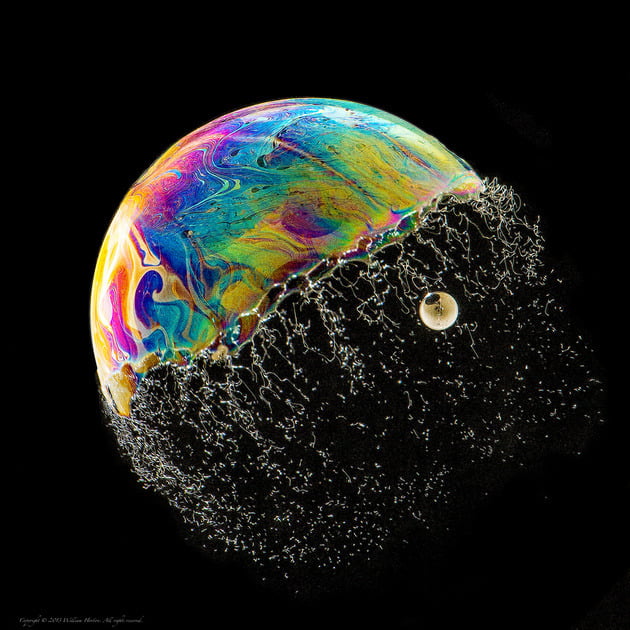
    Surface tension draws bubbles into spheres, but the balance of forces holding the sphere together is delicate. When pierced by a projectile, sometimes soap films can heal themselves, but often the film ruptures. Once a hole forms in the bubble, the film’s integrity is lost. Instead of holding the bubble together, surface tension pulls the soap film apart in a spray of thread-like ligaments that break into droplets. In the blink of an eye, the bubble is gone. (Image credit: W. Horton)

  • Featured Video Play Icon

    Water in Oil

    Pouring water on an oil fire is a quick way to cause almost explosive results. Since water is denser than oil, it quickly sinks to the bottom of a container, heating up as it does. When the water reaches its boiling point, it evaporates and expands as steam. That phase change involves a huge change in volume, a fact made especially clear in the video below. The steam expands and rises, throwing droplets of oil upward and outward. These smaller atomized droplets are easier to combust, which, in the case of the video above, causes a veritable cloud of flames if a fire has already started. 

    (Video credits: The Slow Mo Guys and N. Moore)

  • Sea Foam

    Sea Foam

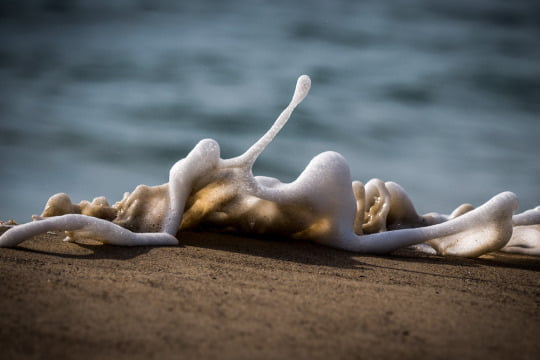
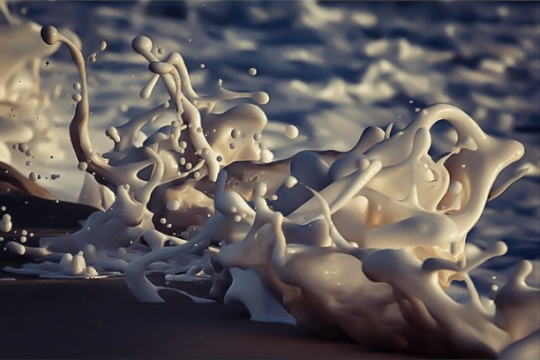
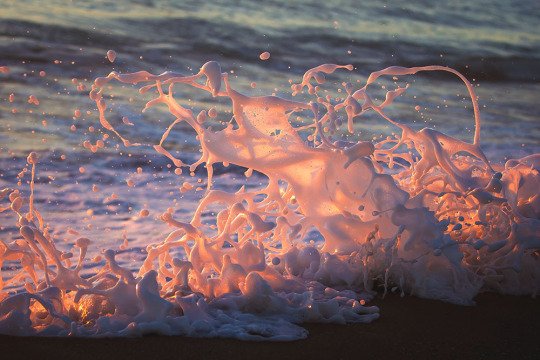
    Photographer Lloyd Meudell captures surrealistic images of breaking sea foam.

    Interestingly, the sea foam is essentially a three-phase fluid made up of air, water, and sand. Yet despite the surrealism of its forms, the foam bears strong resemblance to other flows. The shapes the foam forms are reminiscent of vibrated non-Newtonian fluids like paint or oobleck. Momentum deforms the foam into sheets and ligaments smoothed and held together by surface tension until droplets snap free. You can find more of Meudell’s work at his site. (Image credits: L. Meudell; via freakingmindblowing; submitted by molecular-freedom)

  • Featured Video Play Icon

    Rain-spread Pathogens

    Like humans, plants can spread pathogens to one another. Although scientists had observed correlations between rainfall and the spread of diseases among plants, this study is one of the first to look at the fluid dynamics of leaf and rainfall interaction. When a raindrop hits a leaf, it doesn’t simply splash as it would against an immobile surface. The impact of the drop deforms the leaf, and the plant’s rebound significantly affects the trajectory and size of the resulting droplets. Depending on factors like the leaf’s stiffness, a large drop, carrying many pathogens, may rebound and splatter onto a neighboring leaf. Other leaves tend to catapult out many smaller droplets, which may fly farther afield but carry fewer pathogens. For more, check out the press release or the original research paper. (Video credit: Massachusetts Institute of Technology; research credit: Bourouiba Research Group)

  • Coalescence Cascade

    Coalescence Cascade

    The simple coalescence of a drop with a pool is more complicated than the human eye can capture. Fortunately, we have high-speed cameras. Here a droplet coalesces by what is known as the coalescence cascade. Because it has been dropped with very little momentum, the droplet will initially bounce, then seem to settle like a bead on the surface. A tiny film of air separates the drop and the pool at this point. When that air drains away, the drop contacts the pool and part–but not all!–of it coalesces. Surface tension snaps the remainder into a smaller droplet which follows the same pattern: bounce, settle, drain, partially coalesce. This continues until the remaining droplet is so small that it can be coalesced completely. (Image credit: Laboratory of Porous Media and Thermophysical Properties, source video)

  • Featured Video Play Icon

    Acoustic Levitation

    Destin from Smarter Every Day has a great new video exploring acoustic levitation. With carefully placed speakers, you can create a standing wave with sound that’s capable of levitating lightweight objects against the force of gravity. Around 4:00, Destin demonstrates this with colored water droplets, which is where the real fireworks start. As he turns up the volume on the speakers, the big droplets explode. This happens when surface tension can no longer hold the drop together. But the high-speed footage offers other clues about what’s going on. Notice how the drops flatten out as the sound volume increases. If you look back to the standing wave animation at 1:33, you’ll notice that just to either side of the nodes (the spots that don’t move), the wave is still oscillating back and forth a little bit. As you increase the sound volume, that standing wave gets stretched to a larger amplitude, which means that those little oscillations just to either side of the node get stronger (and steeper), too. This change in acoustic pressure squishes the drops into pancakes as the fluid tries to stay right at the node. Eventually the droplet is just too flattened for surface tension to keep it together and it bursts into smaller droplets. (Video credit: Smarter Every Day; submitted by Matthew P.)

  • Featured Video Play Icon

    Drops on a Porous Surface

    The splashing of a drop upon impact is a remarkably complicated phenomenon. Perhaps surprisingly, the air around the impacting drop plays a major role in determining which drops splash and which don’t. Lowering the air pressure, for example, stops a drop from splashing. The layer of air that gets trapped beneath the spreading edge of a drop during impact seems to be responsible for splashing. As seen in the video above, drops that impact on a leaky surface, where air can escape, do not splash. By varying where leakage is possible on the surface, the researchers can localize where trapping the air matters most. There’s a critical radius during the drop’s spread where, without leakage, air will be trapped and cause the drop to splash. (Video credit: Y. Liu et al.)

  • Featured Video Play Icon

    Cloud Formation

    Clouds are so ubiquitous here on Earth that it’s easy to take them for granted. But there’s remarkable complexity in the mechanics of their formation. This great video from Minute Earth steps through the processes of evaporation and condensation that drive basic cloud formation. After evaporation, buoyancy lifts warm, moist air upward. That warm air expands and cools until it reaches an altitude where water droplets can condense onto dust particles in the atmosphere. These droplets form the wispy cloud we see. Turbulence mixes these droplets and helps them collide and grow. Interestingly, although we understand the basic process of cloud formation, relatively little is understood about the details, and the subject is still very much an area of active research. (Video credit: Minute Earth; via io9)