Search results for: “convection”

  • Featured Video Play Icon

    Pluto: Subsurface Convection

    Pluto’s rich and unexpected surface features indicate the dwarf planet is still geologically active. This is one of the largest surprises of the New Horizons mission because it was assumed that Pluto was too small, too isolated, and too old for such activity. Instead, its cryovolcanoes and surface convection cells point to significant and vigorous convection in Pluto’s mantle, likely heated by the decay of radioactive elements in its core. The simulation above shows a representation of mantle convection on Earth, simulated over billions of years.

    Mantle convection is described by the dimensionless Rayleigh number, which compares the effects of thermal conduction to those of convection. Above a fluid’s critical Rayleigh number, convection is the driving process in heat transfer. In Pluto’s case, if one assumes a mantle of pure water ice, the Rayleigh number is about 1600, barely enough to surpass the critical point where convection dominates. If, instead, one assumes a mantle containing 5% ammonia, the resulting composition has a Rayleigh number of more than 10,000–well past the critical point and large enough to support the vigorous convection necessary to explain Pluto’s surface features.  (Video credit: W. Bangerth and T. Heister; Pluto research credit: A. Trowbridge et al.; via Purdue University)

    This concludes FYFD’s week of exploring Pluto’s fluid dynamics. You can see previous posts in the series here.

  • Pluto: Convection in Sputnik Planum

    Pluto: Convection in Sputnik Planum

    The icy plain of Sputnik Planum, located in Pluto’s heart-shaped Tombaugh Reggio, is criss-crossed with troughs that divide the plain into polygons.  The current interpretation of these features is that they are the result of thermal convection. As with Rayleigh-Benard convection cells on Earth, the interior of the polygons is formed by the upwelling of warmer, buoyant material, and the troughs between cells mark locations where cooled material convects back into the mantle. On Pluto, these cells consist of nitrogen ice (and occasional water ice like the dirty black chunk seen in the upper right photo) that slowly rises and sinks from the planet’s surface, constantly refreshing the surface features. This would explain why Sputnik Planum is missing evidence of typical older features like impact craters. (Image credits: NASA/JHU APL/SwRI)

    Join FYFD all this week for a look at fluid dynamics and planetary science on Pluto! Check out the previous posts here.

  • Convection Cells

    Convection Cells

    This magnified photo shows Rayleigh-Benard convection cells in silicone oil. This buoyancy-driven convection occurs when a fluid is heated from below and cooled above. Inside the cells, fluid rises through the center and sinks along the edges; this motion is made apparent here thanks to aluminum flakes in the oil. The distinctive hexagonal shape of the cells is actually due to surface tension. Here, the upper surface of the fluid is left open to the air and this free surface boundary condition causes hexagonal shapes to form. If the fluid were instead covered by a solid surface, the convection cells that form would be shaped differently. (Image credit: M. Velarde et al.; via Van Dyke’s An Album of Fluid Motion)

    ——————

    LAST CALL: FYFD reader survey closes Wednesday! I’ve teamed up with researcher Paige Brown Jarreau to create a survey of FYFD readers. By participating, you’ll be helping me improve FYFD and contributing to novel academic research on the readers of science blogs. It should only take 10-15 minutes to complete. You can find the survey here.

  • Featured Video Play Icon

    Convection from a Heat Source

    Convection is a major driver in many flows in nature. In this film, the UCLA Spinlab demonstrates buoyant convection caused by a local heat source. They deposit dye on a submerged, continuously heated plate, then observe as the dye slowly rises with the heated (lower density) fluid. The surface forms a cap for the rising dye, which then spreads horizontally. Qualitatively similar flows can be seen in nature over volcanic eruptions or in thunderstorms when clouds reach the troposphere or a capping inversion. Be sure to check out the rest of the Spinlab’s videos. (Video credit: UCLA Spinlab; submitted by Jon B.)

  • Featured Video Play Icon

    Double-Diffusive Convection

    Convection can be driven several mechanisms, including temperature and concentration differences. The video above shows convection between a a layer of sucrose solution and a layer of saline solution. Initially, the lighter sucrose layer sits over the denser salt water. After the interface is perturbed, the differences in concentration – and thus in density – between the fluids causes diffusion both upward and downward in the form of fingers. This instability behavior is analogous to salt-fingering, which occurs in the ocean when a layer of warm, salty water lies over a layer of cooler, less saline water. In the ocean, these temperature and salinity differences help drive ocean circulation as well as the mixing that occurs between different depths. (Video credit: William Jewell College)

  • Featured Video Play Icon

    Convection Cells

    Human eyesight is not always the best for observing how nature behaves around us. Fortunately, we’ve developed cameras and sensors that allow us to effectively see in wavelengths beyond those of visible light. What’s shown here is a frying pan with a thin layer of cooking oil. To the human eye, this would be nothing special, but in the infrared, we can see Rayeigh-Benard convection cells as they form. This instability is a function of the temperature gradient across the oil layer, gravity, and surface tension. As the oil near the bottom of the pan heats up, its density decreases and buoyancy causes it to rise to the surface while cooler oil sinks to replace it. Here the center of the cells is the hot rising oil and the edges are the cooler sinking fluid. The convection cells are reasonably stable when the pan is moved, but, even if they are obscured, they will reform very quickly.  (Video credit: C. Xie)

  • Featured Video Play Icon

    Holiday Fluids: Cocoa Convection

    If you make a proper cup of hot chocolate this holiday, watch carefully and you just may catch some Rayleigh-Benard convection like the video above. (Note, video playback is 3x.) The canonical Rayleigh-Benard problem is one in which fluid is heated from below and cooled from above. For the cup of hot chocolate, the cooling comes from the colder, ambient air at the cocoa’s surface. Because cooler fluid is denser than warmer fluid, the cocoa near the surface will tend to sink down, allowing warmer cocoa to rise. As that warm cocoa reaches the surface, it too will cool and sink back down, continuing the cycle. The effect relies on buoyancy and, by extension, gravity; on the International Space Station, for example, astronauts would not observe such convection. The distinctive shape of the cells depends on the boundaries of the cup. This post is part of our weeklong holiday-themed fluid dynamics series. (Video credit: Armuotas)

  • Convection on the Sun

    Convection on the Sun

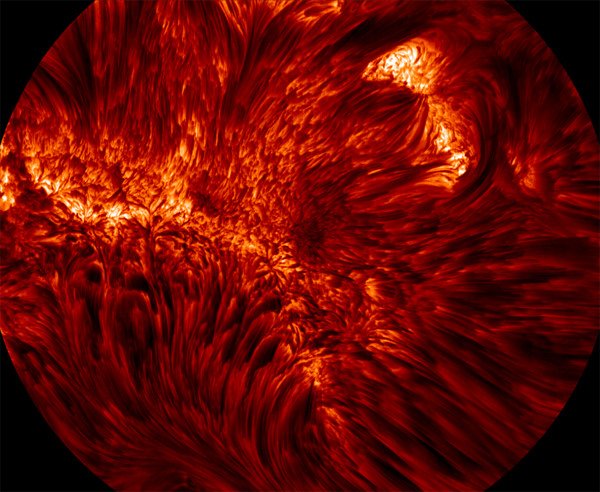
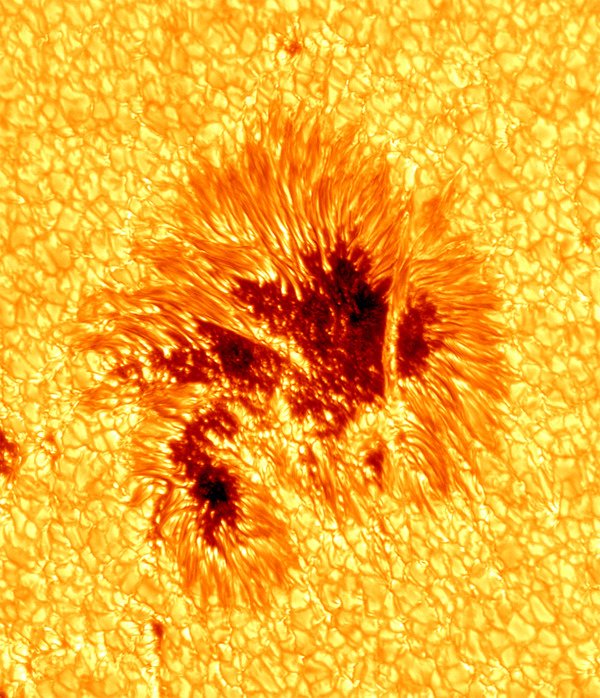
    New photographs showing ultra-fine structure in the sun’s chromosphere and photosphere have been released. They offer a fascinating view into the magnetohydrodynamics of the sun, where the fluid behaviors of plasma are constantly modified by the sun’s magnetic field. The left image shows fine-scale magnetic loops rooted in the photosphere, while the right image shows our clearest photo yet of a sunspot. The dark central portion is the umbra, where magnetic field lines are almost vertical; it’s surrounded by the penumbra, where field lines are more inclined. Further out, we see the regular convective cell structure of the sun. (Photo credit: Big Bear Solar Observatory/NJIT; via io9 and cnet)

  • Featured Video Play Icon

    Super-Highway Convection

    In the ocean, many forces compete in driving convection, including the temperature and salinity of the water. In the laboratory, it’s possible to mimic these characteristics of oceanic circulation using two different fluids driven by temperature and concentration differences. Recently, researchers were exploring this problem–with the added twist of tilting the fluids ~1 degree–when they discovered a surprising result. After an extended time, the convection self-organized into alternating parallel columns of ascending (dark) and descending (light) fluid. The researchers nicknamed this behavior super-highway convection. Read more about it here or in their paper. (Video credit: F. Croccolo et al; submitted by A. Vailati)

  • Featured Video Play Icon

    Convection Visualization

    Here on Earth a fascinating form of convection occurs every time we put a pot of water on the stove. As the fluid near the burner warms up, its density decreases compared to the cooler fluid above it. This triggers an instability, causing the cold fluid to drift downward due to gravity while the warm fluid rises. Once the positions are reversed, the formerly cold fluid is being heated by the burner while the formerly hot fluid loses its heat to the air. The process continues, causing the formation of convection cells. The shapes these cells take depend on the fluid and its boundary conditions. For the pot of water on the stove and in the video above, the surface tension of the air/water interface can also play a role in modifying the shapes formed. The effects caused by the temperature gradient are called Rayleigh-Benard convection. The surface tension effects are sometimes called Benard-Marangoni convection.