Search results for: “art”

  • Slipping Along Enceladus

    Slipping Along Enceladus

    Home to a sub-surface ocean, Saturn‘s moon Enceladus is a fascinating candidate for life in our solar system. As it orbits Saturn, plumes periodically shoot out long surface features known as tiger stripes that sit near the icy moon’s southern pole. A recent study, based on numerical simulation, suggests a geophysical mechanism that could account for the plumes.

    The team suggests that, like the San Andreas Fault, the tiger stripes are a fault subject to strike-slip motion. In this type of fault, the ice on either side meets along a vertical face and the two sides will slide past one another in opposite directions. As Enceladus orbits, its proximity to Saturn causes tidal compression across the fault that modulates how much slip motion occurs. In their model, the authors found that strike-slip motion would intermittently open gaps in the fault that would allow water from the subsurface ocean to create plumes at intervals consistent with those observed. (Image credit: top – NASA/JPL-Caltech/Space Science Institute, illustration – A. Berne et al.; research credit: A. Berne et al.; via Gizmodo)

    Illustration of the strike-slip mechanism over the course of Enceladus's tides. The two sides of the "tiger stripe" fault move in opposite directions. How much they move depends on the amount of tidal compression caused by Enceladus's orbit around Saturn. At times, motion along the fault pulls apart narrow sections of the ice, allowing a plume to spray out.
    Illustration of the strike-slip mechanism over the course of Enceladus’s tides. The two sides of the “tiger stripe” fault move in opposite directions. How much they move depends on the amount of tidal compression caused by Enceladus’s orbit around Saturn. At times, motion along the fault pulls apart narrow sections of the ice, allowing a plume to spray out.
  • Searching for Stability in Cleaner Flames

    Searching for Stability in Cleaner Flames

    Spiking natural gas power plants with hydrogen could help them burn cleaner as we transition away from carbon power. But burners in power plants and jet engines can be extremely finicky, thanks to thermoacoustic instabilities. As a flame burns, it can sputter and fluctuate in its heat output. That creates pressure oscillations (which we sometimes hear as sound waves) that reflect off the burner’s walls and return toward the flame, causing further fluctuations. This feedback loop can be destructive enough to explode combustion chambers.

    Adding hydrogen to a burner designed purely for natural gas can trigger these instabilities (above image), but researchers hope that by exploring fuel-mixtures and their effect at lab-scale, they can help designers find safe ways to adapt industrial burners for the cleaner fuel mixture. (Image and research credit: B. Ahn et al.; via APS Physics)

  • Featured Video Play Icon

    The Solar Corona in Stunning Detail

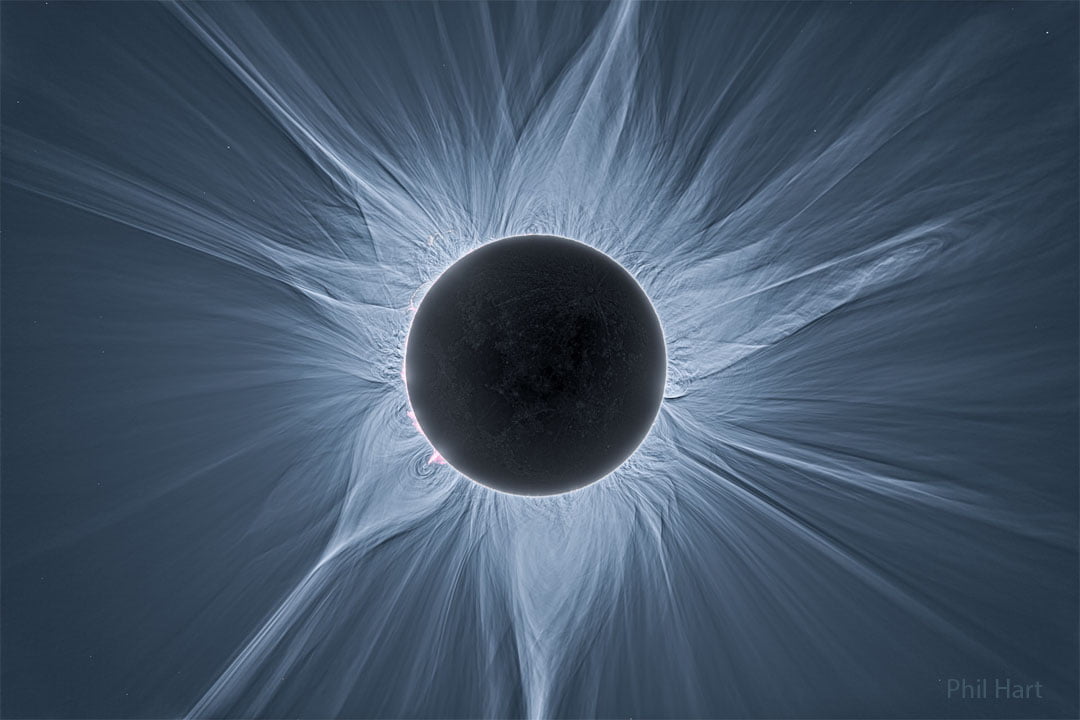
    The ESA’s Solar Orbiter captured this beautifully detailed video of our sun‘s corona last September. The Solar Orbiter took this footage from about 43 million kilometers away, a third of the distance between the sun and the Earth. Scattered across the visible surface are fluffy, lace-like features known as coronal moss. Along the curving horizon, gas spires called spicules stretch up to heights of 10,000 kilometers. The video also highlights a “small” eruption of plasma that is nevertheless larger than the entire Earth. We can even see evidence of coronal rain, denser and darker clumps of plasma that gravity pulls back toward the sun. (Video and image credit: ESA; via Colossal)

  • Featured Video Play Icon

    Making Magnetic Crystals From Ferrofluids

    Ferrofluids are a great platform for exploring liquids and magnetism. Here, researchers trap ferrofluid droplets along an oil-water meniscus and then apply a magnetic field that makes the drops repel one another. The results are crystalline patterns formed from magnetic droplets. For a given patch of drops, increasing the magnetic field’s strength pushes drops further apart. But changing the drops’ size and levels of self-attraction also shifts the patterns. Check out the video to see the crystals in action. (Video and image credit: H. Khattak et al.)

  • How Venus Is Losing Its Water

    How Venus Is Losing Its Water

    Since Venus formed at the same time as Earth and is similar in size, scientists believe it once had the same amount of water our planet does. Today, hellish Venus has hardly any water, a fact scientists have struggled to explain completely. Most of its water was lost long ago, as incoming particles from the solar wind stripped water from the upper atmosphere; unlike Earth, Venus doesn’t enjoy the protection of a magnetic field.

    But that mechanism doesn’t explain just how arid Venus is now. A new study instead suggests that Venus’s water loss is ongoing, driven by simple chemical reactions. The team found that molecules of HCO+ (an ion made from one hydrogen, one carbon, and one oxygen atom) could mix with any remaining water to form a positively-charged molecule. Due to that charge, the chemical easily attracts loose electrons. Once combined, however, the resulting molecule is too energetic and breaks apart; when it does so, it releases highly-energetic hydrogen, which escapes the atmosphere into space. Without that hydrogen, water molecules can’t reform. This process of dissociative recombination could explain why the rest of Venus’s water has disappeared.

    Science missions that have flown to Venus so far haven’t been equipped to measure HCO+, and the authors recommend this as a priority for future missions to our neighbor. With that data, we could confirm or disprove this mechanism for Venusian water loss. (Image credit: NASA; research credit: M. Chaffin et al.; via Gizmodo)

  • Featured Video Play Icon

    How We Got Atoms From Brownian Motion

    In 1827, botanist Robert Brown observed an odd jittery motion of particles as he watched grains of pollen floating in water under his microscope. He saw the random motion also with inorganic — which is to say definitely Not Alive — particles as well. But it was Einstein nearly 80 years later who figured out how to connect this observable motion to atoms. Einstein realized Brown’s particles were being constantly jostled by atomic collisions, and, with a little work, we could use those moving particles to determine Avogadro’s number. Steve Mould walks you through the whole story in this video. (Video and image credit: S. Mould)

  • “Dew Point” Deposits Droplets

    “Dew Point” Deposits Droplets

    Artist Lily Clark loves to work in water. One of her recent sculptures, “Dew Point,” uses superhydrophobic ceramic to grow and manipulate water droplets over and over and over. Droplets coalesce in four corners until they grow large enough for gravity to pull them into a circular depression. Given their limited contact with the ceramic, the falling water droplets zip and slide on their way to a return slit in the center of the piece. You can see more of the action in the video below. Personally, I’m reminded of coins falling into a collection box! (Video credit: L. Turczan; artwork by: L. Clark; via Colossal)

  • Wind Sculptures

    Wind Sculptures

    Vibrantly colored fabrics move in the breeze in artist Thomas Jackson’s outdoor installations. During the golden hours, he captures that movement in photographs like these. Jackson uses tulle, silk, and other everyday objects in his projects, and when finished, he takes a “leave no trace” approach, removing all materials and recycling them into new projects. Find more work on his website and Instagram. (Image credit: T. Jackson; via Colossal)

  • Kelvin-Helmholtz and the Sun

    Kelvin-Helmholtz and the Sun

    Kelvin-Helmholtz instabilities (KHI) are a favorite among fluid dynamicists. They resemble the curls of a breaking ocean wave — not a coincidence, since KHI create those ocean waves to begin with — and show up in picturesque clouds, Martian lava coils, and Jovian cloud bands. The instability occurs when two layers of fluid move at different speeds and the friction between them causes wrinkles that grow into waves.

    Scientists have long suspected that KHI could occur in solar phenomena, too, like the coronal mass ejections that drive space weather. The Parker Solar Probe, a spacecraft designed to explore the sun, caught evidence of a series of turbulent eddies during a 2021 coronal mass ejection, and a recent study of those observations shows that the series of vortices are consistent with KHI. Put simply, the team found that the features are spaced and aligned as we’d expect for KHI and, during the probe’s measurements, the features grew at the rate Kelvin-Helmholtz eddies would. Although the instability itself may be common in the sun’s corona, it’s unlikely that we’ll see it often, simply because conditions need to be just right for them to be visible. (Image credit: NASA/Johns Hopkins APL/NRL/Guillermo Stenborg and Evangelos Paouris; research credit: E. Paouris et al.; via Gizmodo)

    Fediverse Reactions
  • “Bulging Balloons”

    “Bulging Balloons”

    This planet-like balloon started out as two elastomer sheets, heat-sealed together into a spiraling tube. As the balloon was inflated, it changed from flat to a saddle-like shape. With more air, the pressure inside increased, triggering an instability that caused the middle of the balloon to bulge. As inflation continued, the central bulge expanded, unbonding layer after layer of the seal. Even late in inflation, the balloon maintains hints of its original shape in the form of a ring around the Jovian bulge in the middle. (Image credit: N. Vani et al.)

    Fediverse Reactions