
Flocks of birds, schools of fish, and herds of sheep all resemble fluids at times, and physicists have been trying to recreate their collective motion for decades. Many of these models simplify the animals into particles that follow simple rules based on the direction and speed of their neighbors. Over time, the models have grown more complex; for example, some might differentiate a “sheepdog” particle from “sheep” particles. And some models even tweak the “sheep” to account for the personality traits that real sheep show, like how skittish they behave toward a sheepdog. Physics World has a neat overview of several studies in this vein. (Image credit: E. Osmanoglu; via Physics World)
Search results for: “art”

Non-Newtonian Raindrops


Fluids like air and water are called Newtonian because their viscosity does not vary with the force that’s applied to them. But many common fluids — almost everything in your fridge or bathroom drawer, for example — are non-Newtonian, meaning that their viscosity changes depending on how they’re deformed.
Non-Newtonian droplets can behave very differently than Newtonian ones, as this video demonstrates. Here, their fluid of choice is water with varying amounts of silica particles added. Depending on how many silica particles are in the water, the behavior of an impacting drop varies from liquid-like to completely solid and everything in between. Why such a great variation? It all has to do with how quickly the droplet tries to deform and whether the particles within it can move in that amount of time. Whenever they can’t, they jam together and behave like a solid. (Image, video, and research credit: S. Arora and M. Driscoll)
“Chemical Somnia”


Under a macro lens, even a petri dish worth of fluids comes vividly to life. Here, artist Scott Portingale explores crystallization, Marangoni effects, and other phenomena alongside a haunting soundtrack from musician Gorkem Sen. Enjoy! (Image and video credit: S. Portingale et al.)

Hello, STEVE
A purple glow arcs across the night sky. Just another aurora, or is it? First described in 2018, this is a STEVE — Strong Thermal Emission Velocity Enhancement. (Yes, the name “Steve” came first and the acronym came later.) Scientists still aren’t entirely sure how to classify this glowing phenomenon. Although it looks similar to an aurora, its color spectrum is continuous between 400 and 700 nanometers; classic auroras, in contrast, have a discrete spectrum dependent on which atmospheric molecules are getting stimulated by the incoming solar wind. Scientists have noticed that STEVE appears before midnight and is accompanied by a fast 5.5 km/s westward ion flow. A dawnside equivalent with an eastward ion flow was reported just this year.
With newly identified phenomena like this, the research papers are fast and furious as the scientific community searches for consensus on exactly what STEVE is and how it’s formed. But this domain is not reserved for professional astronomers alone; citizen scientists were the first to identify STEVE and open projects like Aurorasaurus continue to provide valuable data and observations. (Image credit: K. Trinder/NASA; research credit: S. Nanjo et al.; via Gizmodo)
Sea Ice Swirls
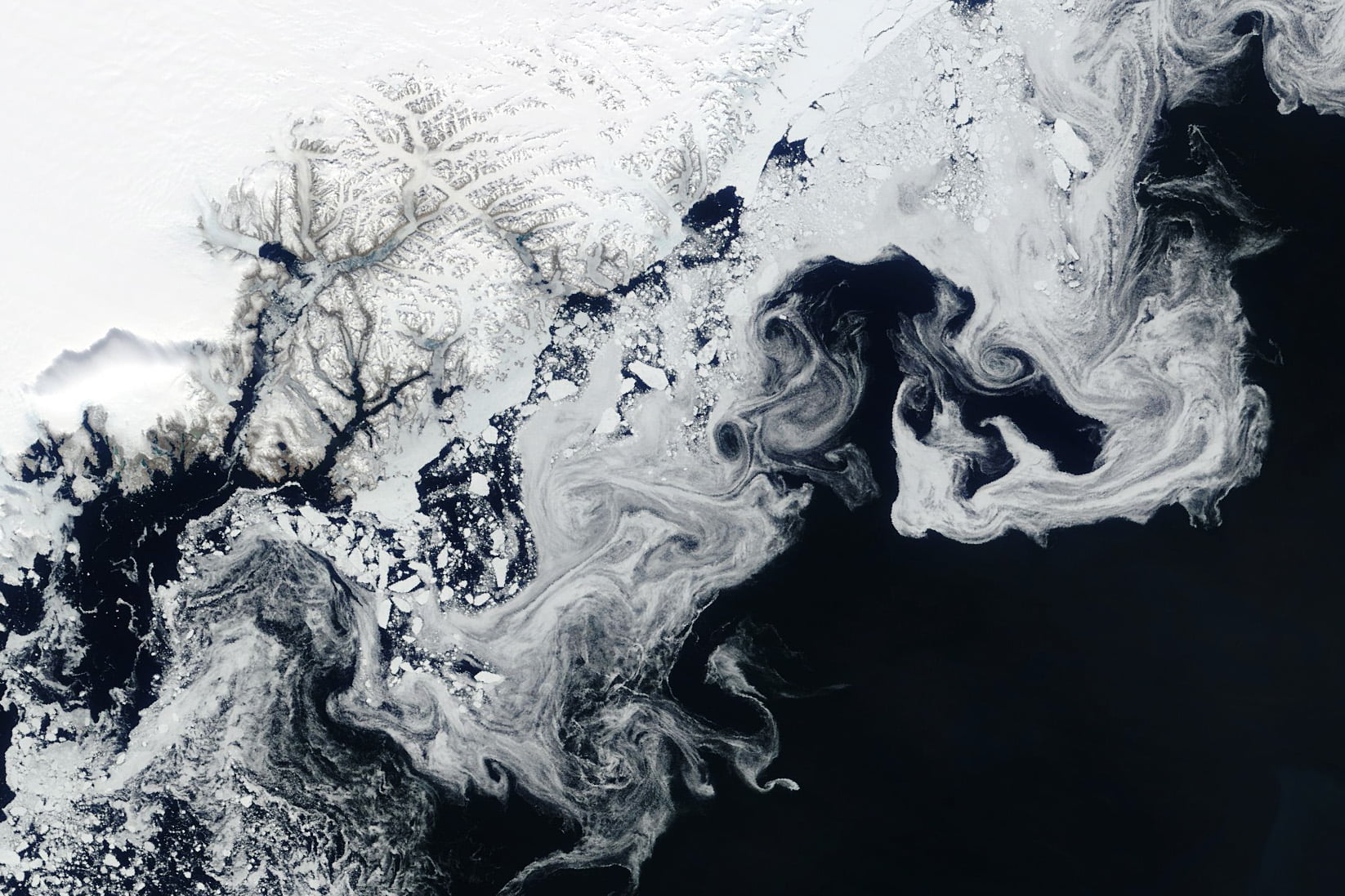
Fragments of sea ice tumble and swirl in this satellite image of Greenland’s east coast. In spring, Arctic sea ice journeys down the Fram Strait between Greenland and Svalbard. Along the way, large ice floes break — and melt — into smaller pieces. Large pieces of sea ice are visible closer to the coastline, but the smaller individual floes get, the wispier they appear in the satellite image. In the haziest portions of the image, the ice may be only meters across. In recent years, less and less Arctic sea ice has survived the journey southward, shifting the temperature and salinity of Arctic contributions to global ocean circulation. (Image credit: W. Liang; via NASA Earth Observatory)
Blocking Bubbles
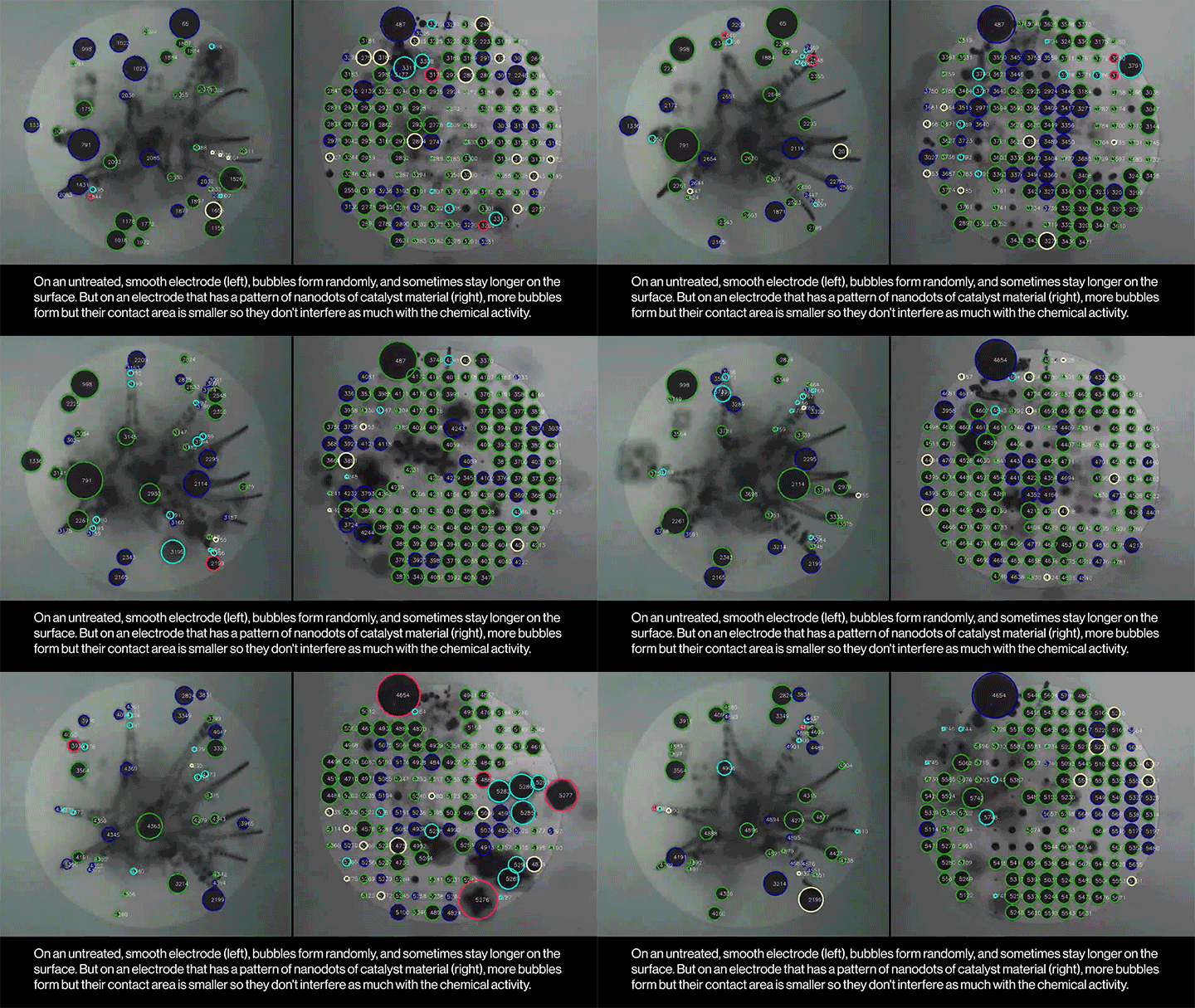
Many industrial processes, including those producing aluminum and “green” hydrogen, use electrodes to speed up chemical reactions. Unfortunately, bubbles that form on the electrode reduce its efficiency anywhere from 10 to 25 percent by blocking parts of the electrode. The assumption has been that any area shadowed by bubbles is blocked, but a recent study shows that’s not the case. Instead, it’s only the electrode area in direct contact with the bubble that’s blocked.
To show this, researchers looked at a smooth electrode where bubbles formed randomly (left) and a nanotextured one with many spots where bubbles could form (right). In the animation above, bubble shadows are highlighted with circles. There are clearly more bubbles on the nanotextured electrode, but it actually performs better than the smooth electrode because the bubble contact area is smaller. (Image and research credit: J. Lake et al.; via MIT News)

Erie Algal Bloom
Blue-green algae bloom in Lake Erie’s summer conditions. Unfortunately for those looking to spend summer on the water, the dominant organism in this bloom produces a toxin that “can cause liver damage, numbness, dizziness, and vomiting.” Bloom season can last from late June into October, depending on the how many nutrients get washed into the lake and when wind mixes the lake water in the fall. A new hyperspectral instrument aboard NASA’s PACE spacecraft will identify bloom species from space, helping scientists track, understand, and predict blooms like these. (Image credit: W. Liang; via NASA Earth Observatory)

Eerie Aurora
This surreal image comes from an aurora on Halloween 2013. Photographer Ole C. Salomonsen captured it in Norway during one of the best auroral displays that year. The shimmering green and purple hues are the glow of oxygen and nitrogen in the upper atmosphere reacting to high-energy particles streaming in from the solar wind. These geomagnetic storms can disrupt GPS satellites, compromise radio communication, and even corrode pipelines, but they also create these stunning nighttime displays. (Image credit: O. Salomonsen; via APOD)

The Great Red Spot’s Cycle
First spotted by humanity in 1664, Jupiter‘s Great Red Spot is a seemingly endless storm. Strictly speaking, there is debate as to whether observations prior to 1831 were of the same storm, but there’s no denying that the storm has raged unabated since regular observations began in the first half of the nineteenth century. Despite its longevity, the Great Red Spot is not unchanging. Overall, its major axis is shrinking, making the storm more circular over time. The storm also has a 90-day cycle in which its size, shape, and brightness vary, as seen below. Researchers note that the changes are relatively subtle — at least to the eye — but now that they’ve been identified, it may be possible to use amateur astronomers’ data to track these variations more closely. (Image credits: GRS – K. Gill/NASA, snapshots – A. Simon et al.; research credit: A. Simon et al.; via Gizmodo)
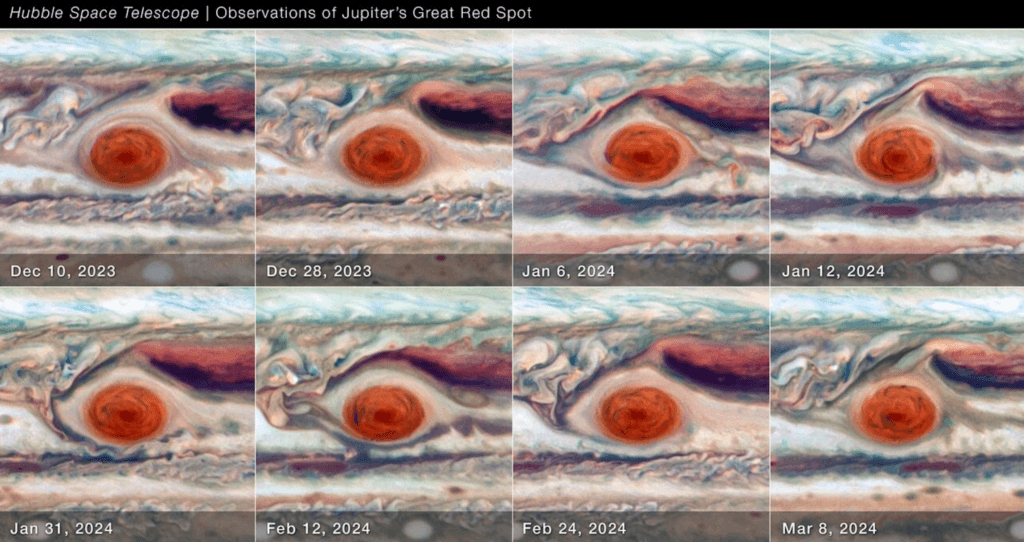
Over a 90 day cycle, Jupiter’s Great Red Spot oscillates in size, shape, and other characteristics. 
Self-Cleaning With Salt Critters
Even freshwater contains trace salts and minerals that cause scaly buildups as they evaporate. Getting rid of the scale usually requires toxic chemicals and/or lots of scrubbing, neither of which are desirable at the industrial level. At the same time, we’re extremely limited in the amount of freshwater that we have available; only about 1% of Earth’s water is liquid and fresh. If we could use salt water in more industrial processes, that would preserve freshwater for drinking and agriculture. But how do we tackle the scaly buildup?

(A) On microtextured surfaces, salt from evaporating drops can work its way into the gaps, destroying the superhydrophobicity of the surface. (B) In contrast, nanotextured surfaces give the salt nowhere to adhere, resulting in “salt critters” that grow upward and detach. Enter “salt critters.” Researchers found that when salt water evaporated from microtextured surfaces designed to shed water, salt would eventually build up in the gaps, breaking the hydrophobic effect and allowing scale to build up. In contrast, a nanotextured surface left nowhere for the salt to adhere. On these surfaces, evaporating salt water built jellyfish-like salt critters that rose from the surface and, eventually, broke off and rolled away, leaving the surface pristine. (Image credit: S. McBride; research credit: S. McBride et al.; via Physics Today)
.png)