One of the tried and true cooking tips my mother gave me when I was younger was to test the temperature of my griddle before making pancakes by splashing a few drops of water on it. If it was hot enough that the water skittered across the surface before evaporating, then it was ready. Aside from being a way to make great pancakes, this tip demonstrates an everyday application of the Leidenfrost effect. When the surface of the pan is significantly higher than the boiling point of the water, the part of the water drop that hits the pan is vaporized, creating a thin layer of water vapor on which the rest of the droplet rests. The vapor serves as an insulator, protecting the rest of the water drop from the heat of the pan, as well as a lubricant, allowing the drop slip and slide easily across the surface. The same effect lets the brave plunge a hand into liquid nitrogen without damage, but they have to be quick, otherwise their hand will cool to the point that the liquid nitrogen contacts it without a protective layer of nitrogen. (In that case, a nasty case of frostbite may be the least of one’s worries. We do NOT recommend trying this one at home.)
Search results for: “art”

Drops Through Drops
The splashes from droplets impacting jets create truly mesmerizing liquid sculptures. Corrie White is one of the masters of this type of high-speed macro photography. Her work captures the instantaneous battles between viscosity, surface tension, and inertia. The fantastic structure seen here through the falling droplets is created by a series of drops timed so that the later ones strike the Worthington jet produced by the initial drop’s impact. (Photo credit: Corrie White)
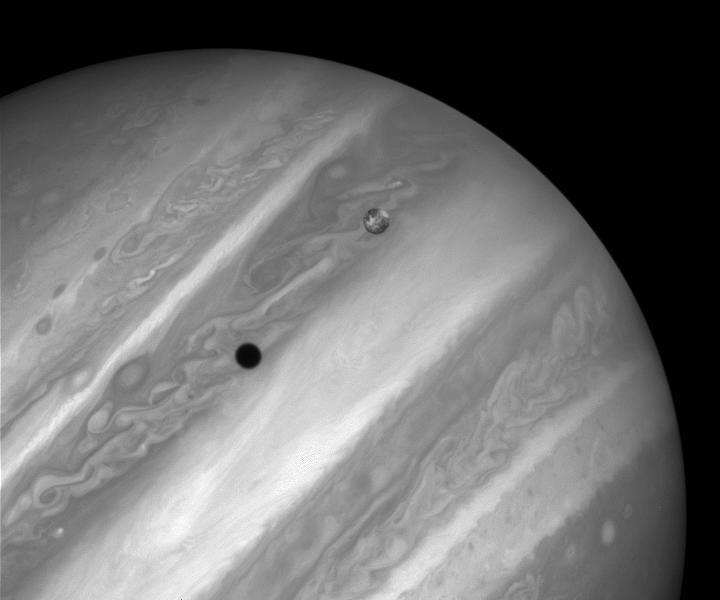
Where Jupiter Got Its Swirls
When layers of a fluid are moving at different relative velocities, they shear against one another. This shear can trigger the Kelvin-Helmholtz instability, which develops as a waves along the interface. Here Hubble captures Kelvin-Helmholtz waves along the cloud bands of Jupiter, but such clouds are also not uncommon here on Earth. (Photo credit: J. Spencer and NASA)

Reader Question: Rocket Propulsion
staunchreality-deactivated20120 asks:
Hey there – Love the blog. Most interesting science blog I follow 🙂 This may be a silly question – is propulsion through space purely a function of exit velocity and catching gravity slingshots around planets, or is there enough of anything to push against for rocket propulsion?
Thanks! Glad you enjoy the blog. And your question is not silly at all.
Whether in the atmosphere or not, rocket engines always operate on the same principle: Newton’s 3rd law. For every force exerted, there is an equal and opposite reaction force. For a rocket, this means that the momentum of the rocket exhaust provides forward momentum–thrust–for the rocket. When acting in an atmosphere, the exhaust doesn’t push against the atmosphere in order to move the rocket–in fact, rockets have to overcome aerodynamic drag when in the atmosphere, which opposes their thrust.

While the operating principle of a rocket remains the same regardless of its surrounding, the ambient pressure (essentially zero in space and non-zero in an atmosphere) does affect the efficiency of the rocket’s nozzle, which can affect the exit velocity of the exhaust, and, thus, the efficiency of the rocket. Under ideal conditions, the exhaust should exit the nozzle at the same pressure as the ambient conditions–whatever they are. If the exhaust pressure is lower than the ambient, the exhaust can separate from the nozzle, causing instabilities in the flow and potentially damaging the nozzle. On the other hand, if the exhaust pressure is too high, then there is exhaust that could be turned into thrust that is going to waste. Unfortunately, matching the exhaust pressure to the ambient pressure is a function of the geometry of the nozzle, which is usually fixed. Engineers of rockets intended to fly from within the atmosphere to space usually have to pick a particular altitude to design around and deal with the inefficiencies while the rocket flies at other ambient conditions.
Outside of the physical mechanics of how thrust is produced, propulsion in space is dominated by the influence of orbital mechanics. Once in an orbit, a spacecraft will stay on that orbital path without expending any thrust. To change between orbits, it is necessary for the spacecraft–rocket or otherwise–to change its velocity–typically referred to as delta-v–by firing an engine or thruster. It’s also possible to change orbits using the gravity of other celestial bodies (Jupiter is a popular one) to change a spacecraft’s delta-v without expending propellant. However, fluid dynamics don’t play a big role in the process aside from the problems of fuel sloshing aboard the spacecraft and the actual mechanism by which thrust is produced.

That said, if anyone is interested in getting a better feel for how orbit mechanics work, I have two recommendations. The first is to watch this video of water droplets “orbiting” a charged knitting needle aboard the ISS. And the second is to play the game Osmos. It is like rocket propulsion and orbit mechanics in action!
(Photo credits: NASA, The Aerospace Corporation, Hemisphere Games)

Supersonic Flow Around a Cylinder
This numerical simulation shows unsteady supersonic flow (Mach 2) around a circular cylinder. On the right are contours of density, and on the left is entropy viscosity, used for stability in the computations. After the flow starts, the bow shock in front of the cylinder and its reflections off the walls and the shock waves in the cylinder’s wake relax into a steady-state condition. About halfway through the video, you will notice the von Karman vortex street of alternating vortices shed from the cylinder, much like one sees at low speeds. The simulation is inviscid to simplify the equations, which are solved using tools from the FEniCS project. (Video credit: M. Nazarov)
Circulation Around an Airfoil
As a followup to yesterday’s question about ways to explain lift on an airfoil, here’s a video that explains where the circulation around the airfoil comes from and why the velocity over the top of the wing is greater than the velocity around the bottom. Kelvin’s theorem says that the circulation within a material contour remains constant for all time for an inviscid fluid. Before the airplane moves, the circulation around the wing is zero because nothing is moving. As shown in the video, as soon as the plane moves forward, a starting vortex is shed off the airfoil. As the plane flies, our material contour must still contain the starting position and thus the starting vortex. However, in order to keep the overall circulation in the contour zero, the airfoil carries a vortex that rotates counter to the starting vortex. This is the mechanism that accelerates the air over the top of the wing and slows the air around the bottom. Now we can apply Bernoulli’s principle and say that the faster moving air over the top of the airfoil has a lower pressure than the slower moving air along the bottom, thus generating an upward force on the airfoil. (submitted by jessecaps)
Reader Question: How Airfoils Produce Lift
doughboy3-deactivated20120305 asks:
I’m a Undergrad Aeronautical Engineering student. I’m curious as to your opinion as to how airfoils produce lift. I know the usual theory told in this situation. However my aerodynamics professor says that there are many things going on during the flow around an airfoil. I’m hoping to get a better idea of the different mechanisms responsible for lift.
There’s a common misconception of Bernoulli’s principle that’s often used to explain how an airfoil creates lift (which I assume is the “usual theory” to which you refer), and while there are many correct (or, perhaps, more correct) ways of explaining lift on an airfoil, I think the only opinions involved are as to which explanation is best. After all, opinions don’t keep a plane in the air, physics does!
I tackled the air-travels-farther-over-the-top misconception and presented one of my preferred ways of looking at the situation in a previous post; in short, the airfoil’s shape causes a downward deflection of the flow, which, by Newton’s 3rd law, indicates that the air has exerted an upward force on the airfoil. There’s a similar useful video from Cambridge on the topic here.
Another explanation I have heard used concerns circulation and its ability to produce lift (see the Kutta-Joukowski theorem for the math). In this case, it’s almost easier to think about lift on a cylinder instead of lift on a more complicated shape like an airfoil. If you spin a cylinder, you’ll find that the circulation around that object results in a force perpendicular to the flow direction. This is called the Magnus effect and, in addition to explaining why soccer balls sometimes curve strangely when kicked, has been used to steer rotor ships. One of my undergrad aero professors used to do a demonstration where he’d wrap a string around a long cardboard cylinder and demonstrate how, by pulling the string, the cylinder’s spinning produced lift, making the cylinder fly up off the lectern and attack the unsuspecting students.
An airfoil doesn’t spin, but its shape produces the same type of circulation in the flow field. Without delving into the mathematics, it’s actually possible through conformal mapping and the Joukowski transform to show that the potential flow field around a spinning cylinder is identical to that around a simple airfoil shape! Although that mathematical technique is not all that useful in a world where we can calculate the inviscid flow around complicated airfoils exactly, it’s still pretty stunning that we can analytically solve potential flow around (and thus estimate lift for) a host of airfoil shapes on the back of an envelope.
In short, your aerodynamics professor is right in saying that there are many things going on during the flow around an airfoil. If you get a roomful of aerodynamicists together and ask them to explain how airfoils generate lift, you would be faced with a lively discussion with about as many competing explanations as there are participants. As you learn more in your classes, you’ll gain a better intuitive feel for how it works and you’ll learn more of the nuances, which will help you understand why there is no one simple-to-understand explanation that we use!**
** Lest I confuse someone into thinking that aerodynamicists don’t know how airfoils produce lift, let me add that the argument here is over how best to explain the production of lift, not over how the lift is produced. We have the equations to describe the flow and we can solve them. We know that lift is there and why. We simply like to argue over how to explain it to people without all the math.
Supersonic Stellar Jets
Astronomers studying stellar jets–massive outflows of gases and particles pouring from the poles of newborn stars–are finding reasons to turn to fluid dynamicists to understand the timelapse videos they’ve stitched together from multiple exposures from the Hubble telescope. Usually astronomical events unfold on such a slow timescale that our only view of them is as a snapshot frozen in time. Stellar jets can move relatively quickly, though, with portions of the jet flowing at supersonic speeds. Over the course of Hubble’s lifetime, these jets have been imaged multiple times, allowing astronomers to create movies that reveal swirling eddies and shock wave motion previously unseen. (submitted by sakalgirl)

“Tidal Wave” vs. “Tsunami”
This is part of the trouble when the same term has a scientific meaning and a lay meaning. See also: fluid.
Inside a Blender
[original media no longer available]
High-speed video visualizes the complicated flow field inside a blender. Note that the video is placed in reverse for artistic effect. This flowfield is clearly too turbulent for reversible flow. That said, it is possible to mix two fluids and then unmix them, under the right circumstances.