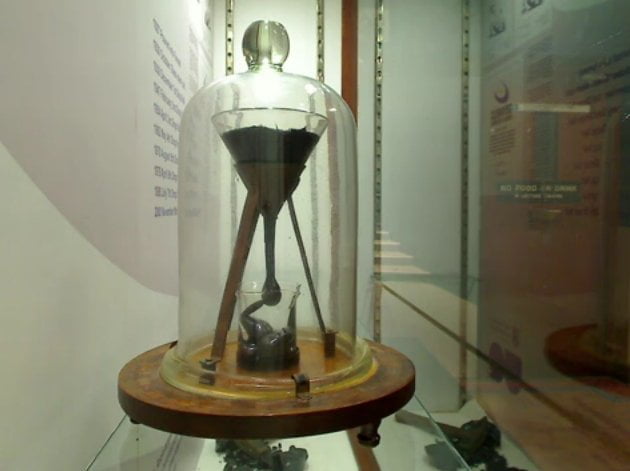
Sometimes everyday materials are more fluid than they seem. In 1927, Professor Thomas Parnell of the University of Queensland started what is now the longest continuously running laboratory experiment when he filled a sealed glass funnel with a sample of heated tar pitch. After allowing 3 years for the pitch to settle, the funnel’s stem was unsealed and the pitch has been slowly dripping ever since. Now, over 80 years later, the ninth drop is still just forming. No one has witnessed the fall of a pitch drop but the odds are good that someone will catch the ninth drop now that it has its own webfeed. The experiment, which won an Ig Nobel Prize in 2005, demonstrates the incredibly high viscosity of pitch, which the researchers estimated at 11 orders of magnitude larger than water at room temperature. (submitted by jshoer)
Search results for: “art”

Breaking Water with Sound
Previously we saw how vibration could atomize a water droplet, breaking it into a spray of finer droplets. Here astronaut Don Pettit shows us what the process looks like in microgravity using some speakers and large water droplets. At low frequencies the water displays large wavelength capillary waves and vertical vibrations. Higher frequencies–like the earthbound experiment on much smaller droplets–cause fine droplets to eject from the main drop when surface tension can no longer overcome their kinetic energy. (submitted by aggieastronaut, jshoer and Jason C)
(Source: /)Portrait of Gas Giants
[original media no longer available]
Here raw footage from NASA’s Cassini and Voyager missions has been combined in a stunning portrait of Saturn and Jupiter. Watch as tiny moons create gravity waves in the rings of Saturn and observe the complicated relative motion between the cloud bands on Jupiter and the swirls and vortices that result. Fluid dynamics are truly everywhere. (Video credit: Sander van den Berg; submitted by Daniel B)

How Are Sea Waves Created?
There are many different kinds of sea waves, some of which have fluid dynamical origins and some of which don’t. For example, tsunamis are caused by the sudden displacement of the ocean floor caused by earthquakes and the tides are caused by the pull of the moon on Earth’s oceans. But many of the waves we are accustomed to seeing are caused by the wind moving across open water, whether in the ocean, in a lake or a sea, or even a river or pond. When the wind blows across the free surface of the water, the difference in velocity between the two fluids causes shearing and the development of surface waves as a result of the Kelvin-Helmholtz instability. (Incidentally, this is why other examples of the K-H instability look so much like ocean waves.)
These wind-generated waves can take several forms. Ripples–or capillary waves–remain visible only as long as the wind is blowing. But under steady conditions, or after the wind has affected a large enough area, waves can form that will persist at the surface even if the wind stops blowing. At that point, even though the wind generated the waves, it is gravity that allows them to persist. This is the source of most of the waves we see on large bodies of water. (Photo credit: Travis Weins)
Convective Cells
Convective cells form as fluid is heated from below. As the fluid near the bottom warms, its density decreases and buoyancy causes it to rise while cooler fluid descends to replace it. This fluid motion due to temperature gradients is called Rayleigh-Benard convection and the cells in which the motion occurs are called Benard cells. This particular type of convection is essentially what happens when a pot is placed on a hot stove, so the shapes are familiar. Similar shapes also form on the sun’s photosphere, where they are called granules.

Reader Question: Fire as a Fluid?
Reader David L asks:
I understand that fire is a form of energy rather than a fluid in the physical/tangible sense. However, is it possible for fire to exhibit fluid-like behaviours to a certain extent.
In other words, could the dynamic properties of fire be described with pseudo-variables analogical to variables that describe a physical fluid (i.e. viscosity, density, Re, etc.)?
Actually, combustion is a major topic of research among fluid dynamicists. Since the part of fire that we identify as visible flame is a reacting mixture of gas and some solid particles, it moves according to the same equations of motion as any other gas. However, when studying combustion thermodynamical equations and chemical reactions must also be tracked in addition to mass and momentum, which makes modeling fire very difficult. Combustion plays a major role in internal flows like those in car, jet, and rocket engines. (Photo credit: master.blitzy)
“Ferroux”
In this video, artist Afiq Omar mixes ferrofluid with soap, alcohol, milk, and other liquids to create a surrealistic fluidic dance. In addition to using different fluid mixtures, I suspect he accomplishes many effects using several different permanent magnets and electromagnets to vary the magnetic fields around the ferrofluid mixtures. (Video credit: Afiq Omar; via Wired)
Frozen Fluid Illusion
This video creates the illusion of a jet of water frozen in mid-air. The effect is achieved by vibrating the water at the frequency of the speaker, then filming at a frame rate identical to the vibrational frequency. Thus the water pulses at the exact rate that the camera captures images, making the water appear stationary even though it is moving. (submitted by Simon H)
Rogue Wave Recreated
For years, mariners have reported occurrences of rogue waves–sudden, isolated waves many times larger than the surrounding surface waves. Until 1995, when a rogue wave was first measured, debate raged as to whether such waves even existed. Scientists have since agreed that nonlinear models of wave interaction are the most likely source of the amplification necessary to create rogue waves. Since the Navier-Stokes equations that govern hydrodynamics are so difficult to solve, scientists have looked to simpler nonlinear wave equations, like the nonlinear Schroedinger equation that governs optics, to generate rogue-wave-like behavior. While the equation gives insight into how a given wave system will evolve, it is still necessary to determine what initial conditions can lead to the formation of a rogue wave. All manner of random conditions exist in the ocean, but to recreate the behavior in a simplified system, we must know which initial conditions are the right ones. Akhmediev et al presented a theoretical perspective on the initial conditions that might lead to rogue wave amplification, and now, for the first time, researchers have been able to create a rogue wave in a wave tank. That little blip that sinks the Lego pirate ship is a great accomplishment toward understanding a phenomenon whose very existence was in question less than twenty years ago. (Video credit: A Chabchoub, N Hoffmann, and N Akhmediev; via Gizmodo; for more, see APS Viewpoints and Akhmediev et al)
Brine Shrimp Swimming
For small creatures, swimming is dominated by viscosity. Here researchers use particle image velocimetry (PIV) to explore the flow field around brine shrimp. Its motion is divided into two vorticity-generating phases–the wide power stroke where the shrimp generates most of its forward motion and the recovery stroke where the shrimp returns its starting position while generating as little motion and drag as it can. (Video credit: B. Johnson, D. Garrity, L. Dasi)
