
These images show the laminar mixing that occurs when a flat plate moves up and down in an otherwise motionless fluid. Each face-like snapshot represents a different point in time. The longer the plate oscillates, the more elaborate the “faces” become. (Photo credit: S. Brunton)
Search results for: “art”

“Oil in Water”
There’s beauty even in something as simple as two immiscible fluids–oil and water–colliding. (Video credit: Shawn Knol)

Transition to Turbulence
Smoke introduced into the boundary layer of a cone rotating in a stream highlights the transition from laminar to turbulent flow. On the left side of the picture, the boundary layer is uniform and steady, i.e. laminar, until environmental disturbances cause the formation of spiral vortices. These vortices remain stable until further growing disturbances cause them to develop a lacy structure, which soon breaks down into fully turbulent flow. Understanding the underlying physics of these disturbances and their growth is part of the field of stability and transition in fluid mechanics. (Photo credit: R. Kobayashi, Y. Kohama, and M. Kurosawa; taken from Van Dyke’s An Album of Fluid Motion)
High-Speed Ferrofluid
High-speed video captures the behavior of a ferrofluid trapped between two magnets. Ferrofluids contain tiny ferromagnetic particles suspended in a carrier fluid like oil or water. The distinctive peaks and valleys of a ferrofluid subject to a strong magnetic field is due to the normal-field instability and is a result of the fluid minimizing its magnetic energy.
Visualizing Fish Wakes
This novel flow visualization technique uses dilute solutions of the tobacco mosaic virus (TMV). These rod-shaped particles align with shear and produce a birefringent interference pattern visible when viewed between crossed polarizing filters. The intensity of the light is related to the magnitude of shear. The technique is benign to the fish but enables researchers to see fluid motion around fish that other techniques cannot capture. #
Mapping Flames
Combustion remains a fascinating and only partially understood phenomenon. Here scientists work to map a flame in three dimensions using high-speed cameras and digital reconstruction. (submitted by Chi M)
Making Waves
A standing wave is created in a wave tank by fixing a wall at one end and moving the other wall–the wave generator–at a frequency such that the outgoing waves are superposed on those reflecting back from the wall. This doubles the amplitude of the wave. In the standing wave (also called clapotis), the surface rises and falls in a mirrored pattern: troughs become crests become troughs and so on. When the wave generator is turned off, the standing wave’s energy dissipates and eventually the tank stills. The sloshing motion that persists in the meantime is known as a seiche, which commonly occurs in nature in lakes, seas, bays, and any partially enclosed body of water. Some definitions include tides as a form of seiche due to the periodic nature of the moon’s force on Earth’s waters. See this animation of a seiche for more. (submitted by Daniel)
Voyager Explores the Edge of the Solar System
Though unconventional by our terrestrial concepts of fluids, the solar wind and its interaction with objects in and around our solar system can be considered a form of fluid dynamics. This NASA video discusses discoveries made by the Voyager spacecrafts as they leave our solar system and pass into interstellar space. The solar wind, a rarefied stream of charged particles, streams outward from the Sun at supersonic speeds. Eventually, the pressure from the interstellar medium surrounding the solar system is sufficient to slow the solar wind to subsonic speeds, causing a termination shock much like the hydraulic jump that forms in a kitchen sink when you turn the faucet on.
Convection Visualization
Here on Earth a fascinating form of convection occurs every time we put a pot of water on the stove. As the fluid near the burner warms up, its density decreases compared to the cooler fluid above it. This triggers an instability, causing the cold fluid to drift downward due to gravity while the warm fluid rises. Once the positions are reversed, the formerly cold fluid is being heated by the burner while the formerly hot fluid loses its heat to the air. The process continues, causing the formation of convection cells. The shapes these cells take depend on the fluid and its boundary conditions. For the pot of water on the stove and in the video above, the surface tension of the air/water interface can also play a role in modifying the shapes formed. The effects caused by the temperature gradient are called Rayleigh-Benard convection. The surface tension effects are sometimes called Benard-Marangoni convection.

Jovian Storms
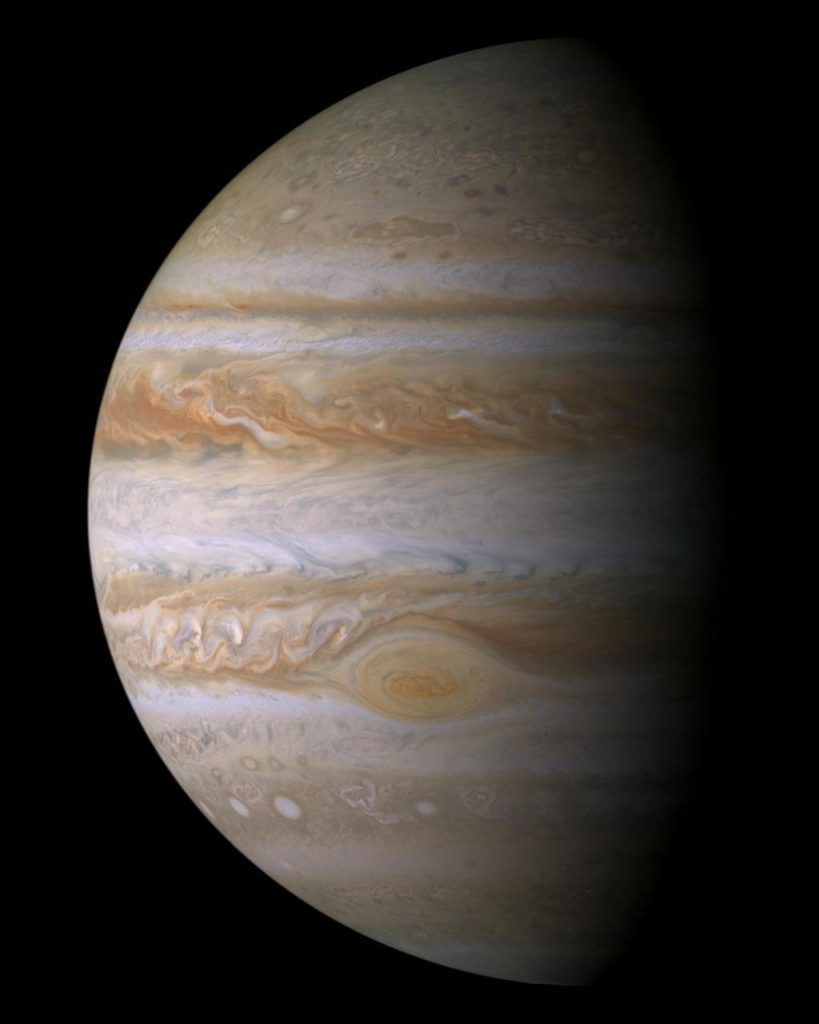
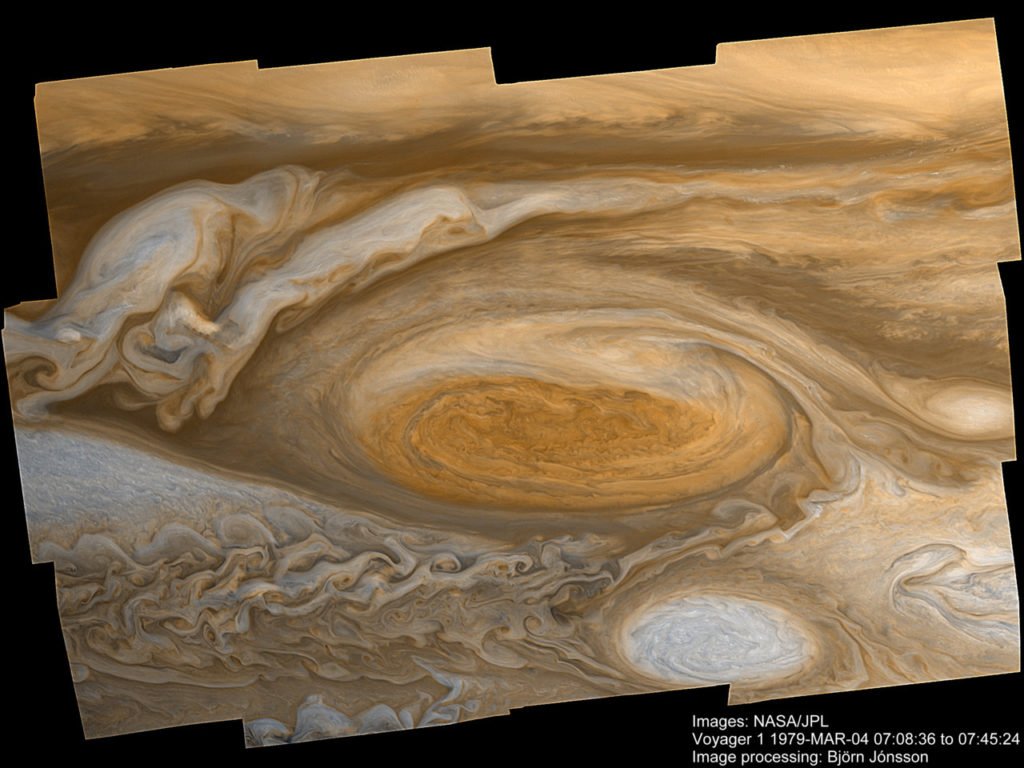
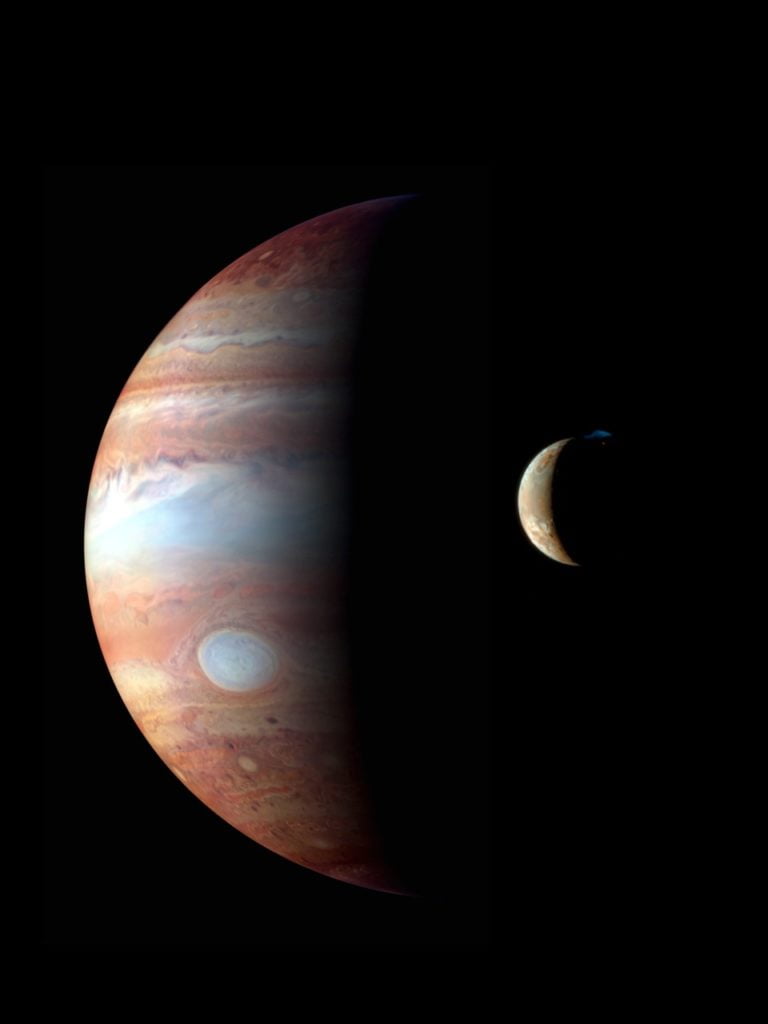
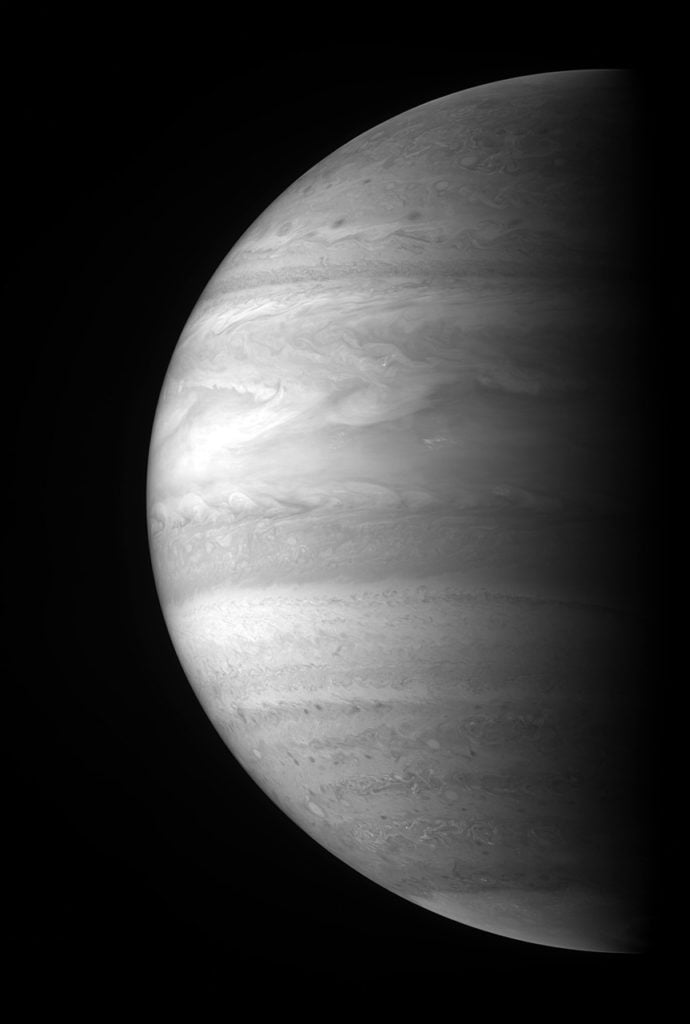


Home to storms capable of lasting for a hundred years or more, Jupiter’s atmosphere is a highly turbulent place. Currently, no comprehensive theory exists to explain the symmetry of Jupiter’s bands of clouds and the persistence of vortices such as the Great Red Spot, however, the mixing and stratification visible on the planet remains a beautiful reminder of the power of fluid dynamics. (Photo credits:Cassini – 1, 2, Voyager 1, New Horizons – 1, 2)