Search results for: “art”

  • Roll Cloud Over Chicago

    Roll Cloud Over Chicago

    A cold front passing through Chicago last week triggered a roll cloud, shown in the timelapse above. These clouds look like spinning horizontal tubes and form in areas where cool, sinking air displaces warmer, moist air to higher altitudes. The moist air is forced up along the cloud’s leading edge, causing it to cool and condense into cloud. Air on the trailing edge sinks downward again, warming and dissipating the cloud. The clouds are a visible form of soliton, or solitary wave, traveling through the atmosphere. They go by several other names, too, including Morning Glory clouds and arcus clouds. (Image credit: A. King; via Colossal)

  • Bioluminescent Shrimp

    Bioluminescent Shrimp

    Trevor Williams and Jonathan Galione of Tdub Photo captured these beautiful images of bioluminescent shrimp along the Japanese coast. The duo collected the tiny shrimp and poured them over and near rocks to create the effect they wanted. With their blue light, the shrimp act like tracer particles in the water, and with long exposures, the photos track the movements of the shrimp and waves. Technically speaking, they trace out pathlines – the trajectory that a specific fluid (or shrimp) particle takes in a flow. It’s a lovely way of capturing the water’s dynamic motion in a still photo. (Image credit: Tdub Photo; via Colossal)

  • Featured Video Play Icon

    Where Does the Sun End?

    How do you define the edge of our sun? There’s a distinct surface to it, but our star is also surrounded by the corona, an even hotter region of plasma twisted by magnetic fields. The corona is sort of like the sun’s atmosphere. Farther out in the solar system, we receive a constant barrage of charged particles, known as the solar wind, that streams out from the sun. So where does the corona end and the solar wind begin?

    Scientists have been studying the flow structure of the solar wind in search of an answer to this question, and they’ve found that there’s a clear transition point about 32 million kilometers from the sun. At this distance, the sun’s magnetic field weakens to the point where it no longer exerts the same hold on the solar particles and they begin to move turbulently, behaving more like a gas than a plasma. With special measurements and image processing, scientists were able to actually see this flow change in the solar wind! (Video/image credit: NASA; research credit: C. DeForest et al.; via FlowViz)

  • Featured Video Play Icon

    Microburst

    Earlier this week a Columbus, OH TV station tower camera caught this awesome timelapse footage of several microbursts in a thunderstorm. A microburst is a sudden, localized downdraft inside the storm. You can see a clear microburst starting at about 0:30 seconds. Note how it flares up and out as it hits the ground, eventually settling around the time a rainbow appears on the left edge of the frame. These strong winds moving down then curling out can be dangerous, both to structures on the ground and to any aircraft unfortunate enough to be taking off or landing in the storm. (Video credit: WCMH; submitted by
    A. Bcstractor)

  • Leidenfrost Atop Gasoline

    Leidenfrost Atop Gasoline

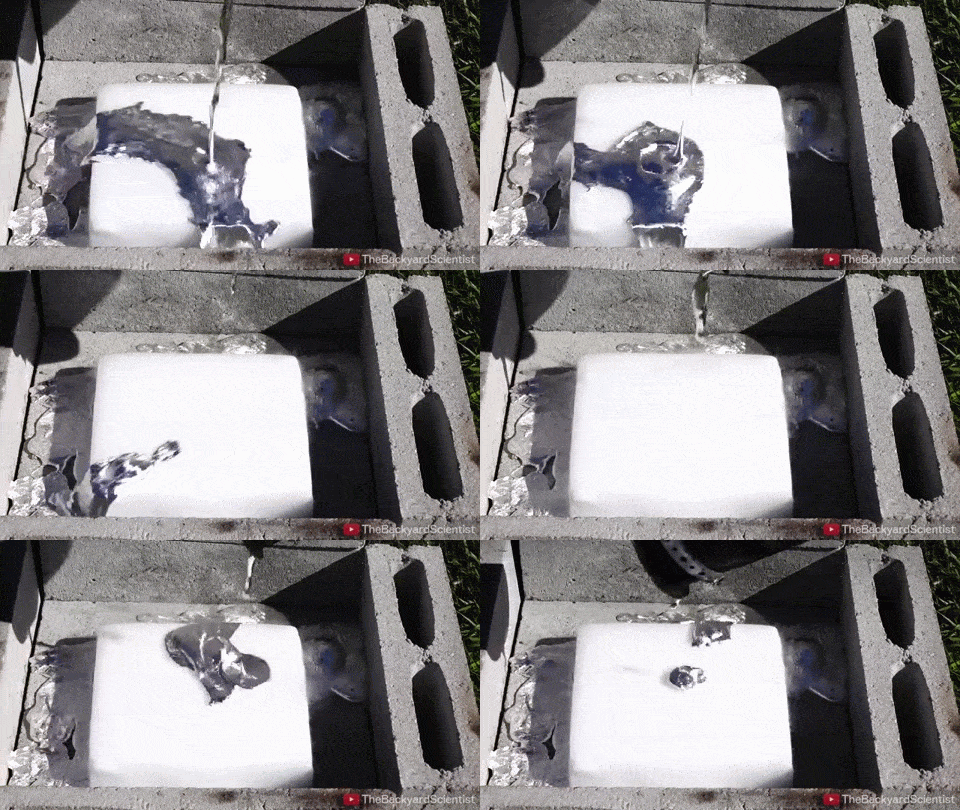
    The animations above show a little of what happens when you pour a spoonful of liquid nitrogen onto a container of gasoline. A couple of things are happening simultaneously here. First of all, the liquid nitrogen is experiencing the Leidenfrost effect. Because of the extreme difference in temperature between the gasoline (~20 degrees C) and the liquid nitrogen (-196 degrees C), part of the nitrogen is evaporating immediately, creating a vapor layer that insulates the remainder of the liquid nitrogen and allows it to float above the gasoline surface. The same thing happens to water drops on a very hot skillet.

    The extreme cold of the nitrogen also seems to have formed some ice that’s further protecting the nitrogen drop. I’m not 100% sure what that would be made of, though – a mixture of water and gasoline?

    Finally, there’s the simultaneous evaporation of the liquid nitrogen and the sublimation of the ice. This is the white vapor we see propelling and spinning the ice/drop. Note the “bounce” that happens in the top animation. The drop never actually impacts the wall. When it gets close, the escaping vapors are affected by the wall and start pushing the drop in a new direction! Check out the whole video below. (Image credit: carsandwater; via Gizmodo)

  • Where Jupiter’s Heat Comes From

    Where Jupiter’s Heat Comes From

    Exactly what goes on in Jupiter’s atmosphere has confounded scientists for decades. Its upper atmosphere – essentially the only part we can observe – is hundreds of degrees warmer than solar heating can account for. Although it has bright auroras at its poles, that energy is trapped at high altitudes by the same rotational effects that create Jupiter’s stunning bands.

    Observations of Jupiter’s Great Red Spot, a storm that’s lasted for hundreds of years, may provide clues as to where all the extra heat is coming from. Spectral mapping shows that the area over the Spot is over 1000K warmer than the rest of the upper atmosphere. Because of its isolated location, the best explanation for the Great Red Spot’s extra heat comes from below: scientists suspect that the raging storm is generating so much turbulence and such a deafening roar that these gravity and acoustic waves propagate upward and heat the atmosphere above. If so, a similar coupling mechanism to the clouds below may account for the widespread warmth in Jupiter’s upper atmosphere. (Image credit: NASA; research credit: J. O’Donoghue et al.)

  • Featured Video Play Icon

    Quantum Droplets

    Over the past decade, fluid dynamicists have been investigating tiny droplets bouncing on a vibrating fluid. This seemingly simple experiment has remarkable depth, including the ability to recreate quantum behaviors in a classical system. In this video, some of the researchers demonstrate their experimental techniques, including how they vary the frame rate relative to the bouncing of the drops. At the right frame rate, this sampling makes the droplets appear to glide along with their ripples, giving us a look at a system that is simultaneously a particle (drop) and wave (ripple). (Video credit: D. Harris et al.)

  • Capturing SLS

    Capturing SLS

    NASA’s recent full-scale ground test of their Space Launch System (SLS) rocket was notable for more than just the engine. It was an opportunity to use a new high dynamic range, high speed camera prototype,

    HiDyRS-X, to capture the rocket’s exhaust in detail never seen before. Usually the extreme brightness of the rocket exhaust makes it impossible to see any structure in the flow without completely obscuring the ground equipment. With this camera, however, engineers can see how the engine, exhaust, and surroundings all interact. Be sure to check out the full video. I particularly like watching how the rocket’s exhaust entrains dust and sand from the ground nearby.  (Image credit: NASA, source; submitted by Chris P. and Matt S.)

  • Soap Film Wakes

    Soap Film Wakes

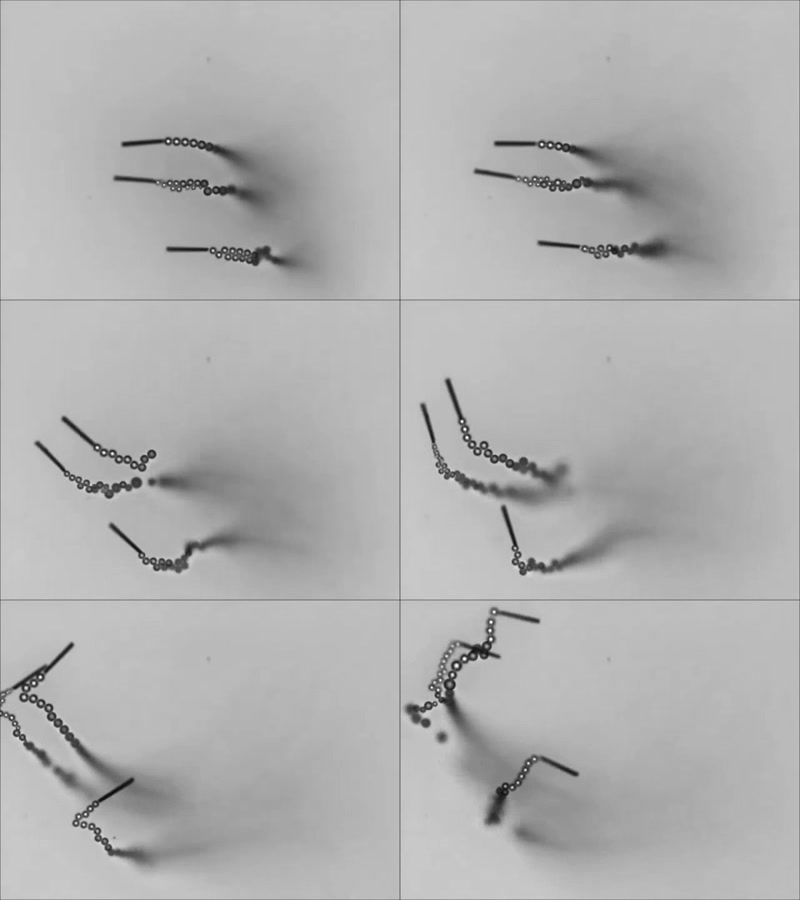
    Soap films can create remarkable flow visualizations when illuminated with monochromatic (single color) light. Each of the photos above shows a flow moving from left to right with a small object near the left creating an obstruction. In the top two images, the objects are cylinders; in the lower one it’s a flat plate tilted at 45 degrees. All of the objects shed vortices as the flow moves past. These vortices alternate in direction – the first spins clockwise, the next counter-clockwise, then clockwise again and so on. This pattern is known as a von Karman vortex street and can even show up in the atmosphere! (Image credit: D. Araya et al.)

  • Rio 2016: The Swimming Pool Controversy

    Rio 2016: The Swimming Pool Controversy

    Statistical analysis suggests possible current in the Rio Olympics swimming pool

    Several news outlets, beginning with The Wall Street Journal, are reporting that the swimming pool in Rio may have had a current that biased athletes’ performances. This is based on a statistical analysis of athlete performances across the meet, conducted by Indiana University’s Joel Stager and his coworkers. According to WSJ, Stager et al. analyzed times of athletes in the preliminary, semifinal, and final races of the 50m, 800m, and 1500m events and found consistent evidence that swimmers in the higher numbered lanes swam faster when moving toward the starting block and swimmers in the lower numbered lanes swam faster when moving toward the turn end of the pool. A separate analysis by Barry Revzin at Swim Swam came to similar conclusions about the direction and magnitude of lane effect in Rio.

    Past questions about lane bias

    This is not the first time questions have been raised about a current-induced bias in competition pools. In fact, Stager and his colleagues published an analysis in 2014 that suggested a similar bias in the pool used for the 2013 World Championships in Barcelona. That pool was a temporary pool built specifically for the competition by Myrtha Pools and was disassembled immediately after, before Stager et al.’s analysis was published.

    A more recent paper by Stager and his colleagues found that lane bias seems to be more prevalent in temporary pools than in permanent ones. The Rio Olympics pool, like the 2013 Worlds pool, is a temporary pool also built by Myrtha Pools.

    Myrtha Pools responds to the criticism 

    Myrtha responded to both WSJ and Swim Swam by sharing videos (1, 2) of their current test, which was conducted before the competition and on Day 3 of competition. The videos show a floating object in one of the outside lanes; neither video shows any noticeable movement of the object.

    Fluid dynamics and swimming pool design

    Competitive swimming pools are complicated recirculating systems that can contain special structures intended to minimize interactions between competitors. Myrtha has built many special event pools in recent years, including ones where the results did not show a bias. According to their website, Myrtha has fluid dynamicists on staff and uses computational fluid dynamics (CFD) to analyze pool performance during design, although they only show examples of freeform pools – not competition pools.

    In fact, I have found remarkably few CFD analyses of swimming pools in the literature. Most papers seem to focus on distribution of disinfectants in pools or in predicting evaporation rates – both practical problems but ones with limited relevance to this particular question.

    So, is there a current in the Rio pool?

    It’s tough to say with certainty that there is a current in Rio’s pool. The performance analyses by Stager et al. and by Revzin do show anomalies in the times of athletes in Rio based on their swim lane, and they show that those anomalies do not exist in many other recent competitions.

    I also do not think Myrtha’s current test constitutes evidence of a lack of current. Their floating object is only indicative of conditions at the air-water interface. Swimmers ride lower in the water and spend significant time completely underwater. Lane markers may also damp any flow effects near the surface.

    I think introducing dye underwater in the pool would do more to reveal any flow that may exist, and this would be a worthwhile test to conduct prior to the deconstruction of the Rio Olympic pool. Additionally, it would be wonderful to see a CFD analysis of the swimming pool, but this would require significant detail about the pool’s design (inlet and outlet locations, etc.) some of which is likely proprietary information.

    Neither dye visualization nor CFD simulation will change the results of this competition, but it may help reveal underlying issues in temporary pool designs so that any bias can be avoided in future competitions.

    (Image credit: Rio City Government)

    Special thanks to @MicahJGreen for bringing this story to my attention and to Dave B. for his assistance.