One of the challenges in engineering and operating wind turbines is that full-scale turbines rarely behave as predicted in smaller-scale laboratory experiments and simulations. One way to reconcile these differences (and discover what our experiments and simulations are missing) is to take the experiments out into the field. One research group has done this by using snowfall to visualize the flow around wind turbines. In this video, they share some of their observations, which include interactions of tip vortices with one another and with the vortex from the tower. My favorite part starts around 1:50 where you can observe tip vortices leap-frogging one another behind the wind turbine! (Video credit: Y. Liu et al.)
Search results for: “art”

CYGNSS


Yesterday marked the launch of a new constellation of eight microsatellites, the Cyclone Global Navigation Satellite System (CYGNSS), designed to monitor hurricanes in Earth’s tropics. The constellation will provide unprecedented capability to monitor conditions inside hurricanes–information that will hopefully help scientists improve hurricane prediction models. Each CYGNSS microsat monitors GPS signals that it receives from the GPS satellite system and from the reflection of that signal off the Earth. By comparing these signals, the satellites can determine wave heights in the ocean, and from that wave information, they can measure surface wind speeds. By peering inside the hurricane as it forms and travels, scientists hope they will be better able to estimate not only a hurricane’s path but how strong it will be when it makes landfall. (Image credits: NASA)

Freezing Drops
A water droplet deposited on a cold surface freezes from the bottom up. As anyone who has made ice cubes knows, water expands when it freezes. But watch the outline of the drop carefully. The drop isn’t expanding radially outward while it freezes. Instead the remaining liquid part of the drop forms what’s known as a spherical cap, a shape like the sliced-off top of a sphere. Surface tension creates that spherical shape, but the water still has to expand when it freezes. The result? The last bit of the drop freezes into a point! This means that surface tension maintains the drop’s spherical shape, for the most part, and all the expansion the water does takes place vertically. (Video credit: D. Lohse et al.)

“Oil Spill”


In “Oil Spill” artist Fabian Oefner explores the shapes and colors of oil floating atop water. An old adage tells us that oil and water don’t mix, but this is not perfectly true. Especially in low concentrations, oil can mix slightly with water, which is why the edges of Oefner’s creations become fuzzy and break down. For the most part, though, the thin layer of oil spreads across the water’s surface, its slight variations in thickness casting the different iridescent colors we observe – just the same as a soap bubble’s iridescence. The colorful patterns are a snapshot of motion in the oil; in some places it radiates outward, pulled by the stronger surface tension of water. In other places it forms plumes and swirls that may be the result of temperature variations or other disquiet motion in the surrounding water or air. (Image credits: F. Oefner)

Jovian Poles


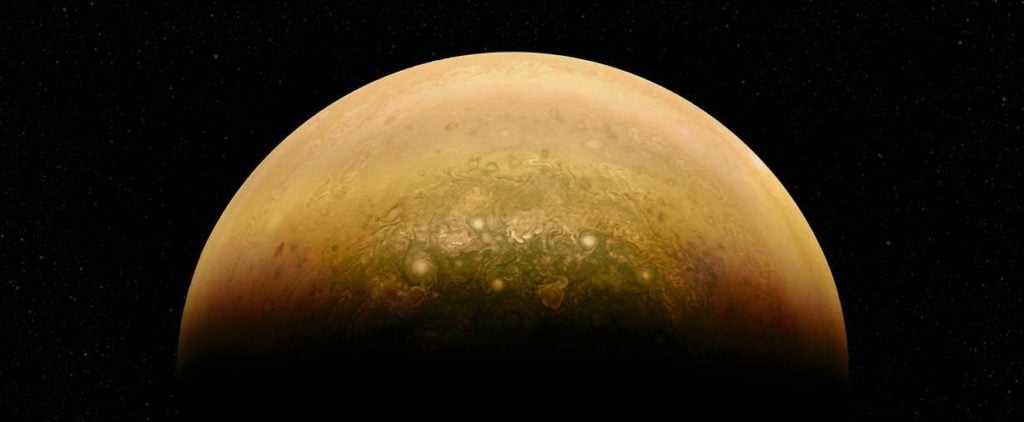


NASA’s Juno mission has been revealing a side of Jupiter we’ve never seen before. We all recognize the familiar stripes of the planet’s cloud bands, but its poles are entirely different. Unlike Saturn with its hexagonal polar vortex, Jupiter’s poles are a swirling tapestry of turbulent vortices – full of features that citizen scientists are helping to reveal. All of the images in this post were created by citizen scientists helping to process raw images from Juno, and you can contribute, too! The Juno mission solicits input from the public on where and what should be imaged, in addition to providing raw images individuals can process and repost. Check it out at the JunoCam website and become part of the science! (Image credits: All images – NASA/SwRI/MSSS + R. Tkachenko, Orion76; A. Mai)

Water Bottle Flipping Physics

Water bottle flipping has become quite the craze, and in a recent video The Backyard Scientist presented his own take on the subject, testing whether you could flip a bottle with mercury rather than water. As it turns out, fluid dynamicists have studied this topic, too, by dropping partially-filled elastic spheres containing water, isopropyl alcohol, and glycerin. The key physics here comes from the sloshing of liquid inside the container. When the elastic ball bounces, energy that would otherwise go into the sphere’s rebound instead gets distributed into sloshing the fluid inside. The result is that the sphere bounces less on its subsequent impacts.
Interestingly, the researchers found that the properties of the fluid inside the ball made very little difference to its rebound height. Instead, the most important feature was the volume of fluid in the container. Balls filled to approximately 30% of their volume had the most damping – that’s totally consistent with the best water bottle flips, which use bottles about 1/3rd full.
The main difference between flipping a bottle and dropping a ball is what goes on in the first bounce. When a bottle hits a surface, the liquid inside has already been disturbed by the bottle’s rotation. For a ball being dropped, that first impact is what disturbs the fluid. So while a water-filled ball’s first rebound will reach nearly the same height as an empty ball, the spinning water bottle is, in effect, already on its second bounce. The motion of the fluid inside the bottle acts as a damper, allowing the bottle to stick the landing. (Image credit: Mercury Bottle Flip – The Backyard Scientist, source; Water Ball Bounce – The Splash Lab, source; research credit: T. Killian et al.)

Laser Goggles for Parrotlets


Many experimental techniques in fluid dynamics use lasers. One such technique, particle image velocimetry (PIV), introduces tiny particles into the flow and uses a laser to illuminate the particles. By taking pictures in rapid succession and comparing them, researchers can measure the velocity in different parts of the flow. This technique is incredibly powerful but it’s rarely used to study topics like animal flight, except using mechanical substitutes for live animals.
Part of the reason researchers don’t typically use live animals in this type of experiment is that these very powerful lasers can blind people or animals that aren’t properly protected. So to protect their test subject, Stanford researchers designed and built a special pair of laser safety goggles for their parrotlet. This let the bird fly safely despite the lasers and enabled the researchers to measure flow around realistic bird flight conditions. (Image credit: Stanford News, source, and E. Gutierrez; research credit: E. Gutierrez et al.; submitted by Simon H. via Wired)
Linear Dunes
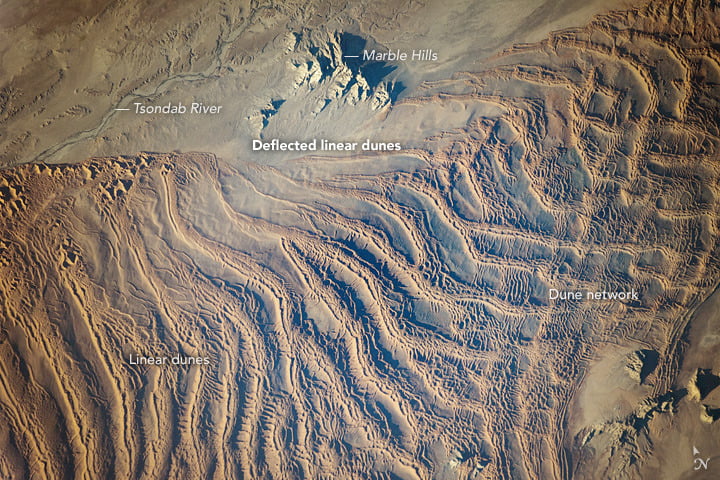
The Namib desert of southern Africa is home to some of the most stunning dunes on Earth. They are primarily linear dunes, which form parallel to the winds that form them. On the left side of the image, the dunes are aligned north-to-south along the direction of the southerly winds that blow through this area. Toward the center of the image, however, the dunes are deflected by strong seasonal winds blowing from the east. On the far right, the dunes break from a linear pattern to one with rectangular criss-crossings. This is a mixture of old and new dunes, evidence that the dominant direction of the wind has shifted over time. (Image credit: NASA Earth Observatory)
Mixing Fresh and Salty
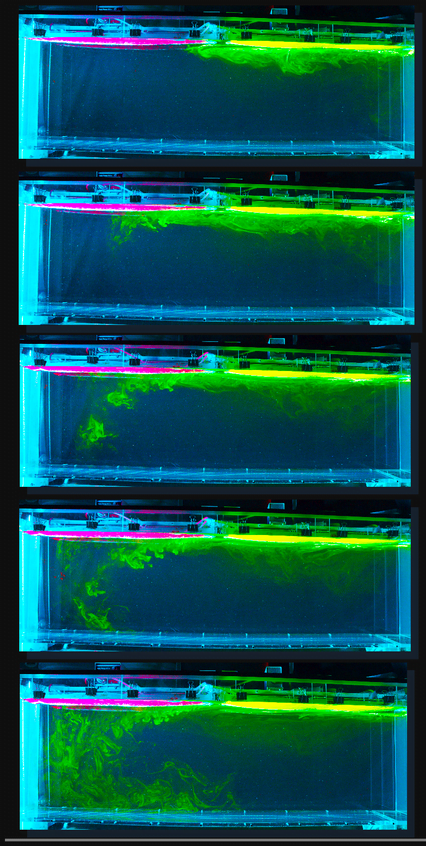
Earth’s oceans are a complex and dynamic environment, but fortunately, we can simulate some of their physics on a smaller scale in the laboratory. The time series of images above show how fresh and salty waters mix. On the right side of the image is fresh water with its top layer dyed green. On the left is salty water dyed pink. Initially, the fresh water spreads horizontally toward the salty region in a smooth and laminar fashion. As the fresh water picks up salt, it gets denser and starts sinking, ultimately forming a turbulent plume that will push all the way back across the tank. For more images, check out the full poster. (Image credit: P. Passaggia et al.)
“Chemical Poetry”


In “Chemical Poetry” artists Roman Hill and Paul Mignot use fluid dynamics to create incredible and engaging visuals. With a stunningly close eye to fluids mixing and chemicals reacting, their imagery feels like gazing on primordial acts of creation or destruction. There’s even a sequence that feels like you’re watching an explosion in slow-motion, but there’s no CGI in any of it. This is just the beauty of physics laid bare, revealing the dances driven by surface tension, the undulations of a fluid’s surface, and the dendritic spread of one fluid into another – all cleverly lit and filmed for maximum effect. It is well worth taking the time to watch the whole video and check out more of their work. (Image/video credit and submission: NANO; GIFs via freshphotons)
