
In sandy deserts, winds can build a vast network of dunes whose shapes depend on the winds that built them. This photograph, taken by an astronaut aboard the International Space Station, shows part of a Saharan dune field known as the Grand Erg Oriental. Of the five basic types of sand dunes, this field features all but one. The predominant winds of the region build most of the dunes into long, straight chains separated by interdune flats some 150 meters lower in elevation. Within the chains, there are linear dunes, created by winds blowing nearly parallel to the dune’s long axis. In places where winds tend to change directions, several linear dunes may merge to form star dunes, like the one just below and right of center in the image. Transverse dunes form perpendicular to the predominant wind direction. The one shown in the upper left of this image may have formed when multiple crescant-shaped barchan dunes merged. (Image credit: NASA, via NASA Earth Observatory)
Search results for: “art”

Cloud Chambers
Cloud chambers were one of the first methods used to study radioactive decay and cosmic particles. Such chambers are filled with a cool, supersaturated cloud of alcohol vapor. When high-energy particles pass through, they collide with atoms in the chamber, ionizing them. Those ions then serve as nucleation sites for the alcohol vapor, creating a condensation streak that marks the particle’s passage. In some respects, they’re similar to the contrails that form behind airplanes. What you’re seeing is not the particle itself but evidence that it went by. YouTuber Nick Moore built his own cloud chamber. Learn more about it and see lots more great footage of it in action in the full video below. (Image and video credit: N. Moore)

Water on Mars
Recurring slope lineae (RSL) are seasonal features on Mars that leave behind gullies similar to those left by running water on Earth. Their discovery a few years ago has prompted many experiments at Martian conditions to determine how these features form. At Martian surface pressures and temperatures, it’s not unusual for water to boil. And that boiling, as some experiments have shown, introduces opportunities for new transport mechanisms.
Researchers found that water in “warm” (T = 288 K) sand boils vigorously, ejecting sand particles and creating larger pellets of saturated sand. Water continues boiling out of the pellets once they form, creating a layer of vapor that helps levitate them as they flow downslope. The effect is similar to the Leidenfrost effect with drops of water sliding on a hot skillet; there’s little friction between the pellet and the surface, allowing it to travel farther.
The mechanism is quite efficient in experiments under Earth gravity and would be even more so under Mars’ lower gravity. It also requires less water than alternative explanations. The pellets that form are too small to be seen by the satellites we have imaging Mars, but the tracks they leave behind are similar to the RSL seen above. (Image credit: NASA; research credit: J. Raack et al., 1, 2; via R. Anderson; submitted by jpshoer)
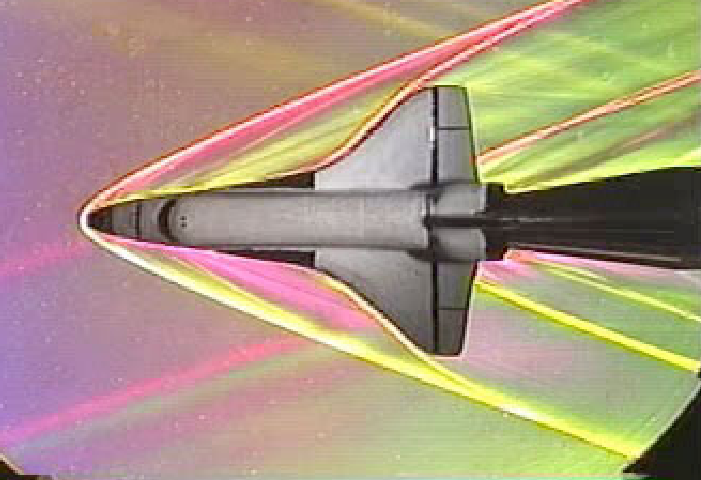
Space Shuttle Sonic Booms
The Space Shuttle had a famous double sonic boom when passing overhead during re-entry. This schlieren flow visualization of a model shuttle at Mach 3 reveals the source of the sound: the fore and aft shock waves on the vehicle. The nose of the shuttle generates the strongest shock wave since it is the first part of the vehicle the flow interacts with. This initial shock wave turns the flow outward and around the shuttle. The second boom comes from the back of the shuttle and serves to turn the flow back in to fill the wake behind the shuttle. (The actual shock wave would look a little different than this one because there’s no sting holding the shuttle like there is with the model.) The other major shock wave comes from the shuttle’s wings, but, at least for this Mach number, the wing shock wave merges with the bow shock, making the two indistinguishable. (Image credit: G. Settles, source)

“Dance Dance”


Artist Thomas Blanchard is no stranger to fluid dynamics. His previous short films focused on mixtures of oil and paint, but in “Dance Dance,” flowers are front and center. There are obvious splashes of color and clouds of diffusion toward the end of the video, but fluid dynamics are there throughout. The oozing, inexorable march of ice crystallizing over petals and leaves has a fluidity that’s heightened by timelapse. It’s a reminder that this phase change is unsteady and full of shifts too subtle to notice in real-time. In the second act, we see flowers blossoming in timelapse, bursting open dramatically before settling in with a subtle shift of their stamens. Motions like these are driven by the flow of fluids inside the plant. By shifting small concentrations of chemicals, plants drive the water in their cells via osmosis. This pumps up cells that cause the petals to spread and unfurl. (Video and image credit: T. Blanchard; via Colossal)
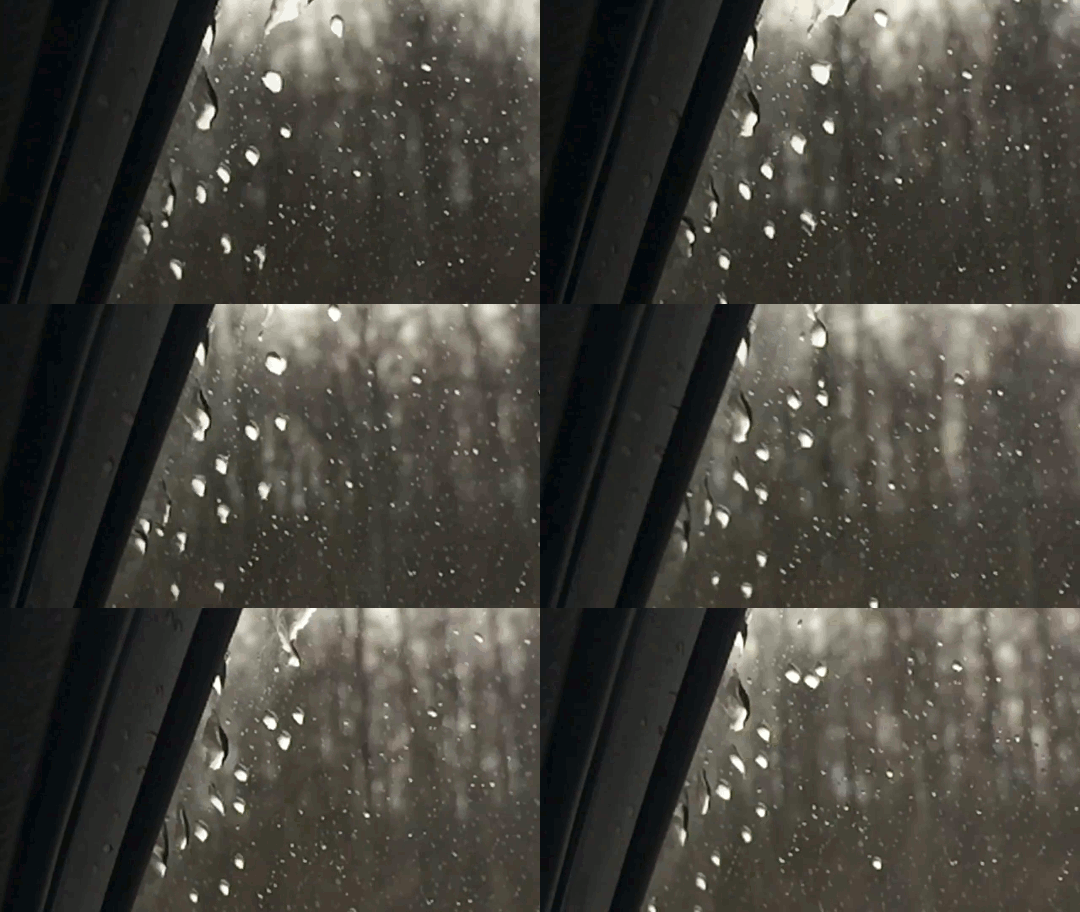
Rain on Car Windows

As a child, I loved to ride in the car while it was raining. The raindrops on the window slid around in ways that fascinated and confused me. The idea that the raindrops ran up the window when the car moved made sense if the wind was pushing them, but why didn’t they just fly off instantly? I could not understand why they moved so slowly. I did not know it at the time, but this was my early introduction to boundary layers, the area of flow near a wall. Here, friction is a major force, causing the flow velocity to be zero at the wall and much faster – in this case roughly equal to the car’s speed – just a few millimeters away. This pushes different parts of large droplets unevenly. Notice how the thicker parts of the droplets move faster and more unsteadily than those right on the window. This is because the wind speed felt by the taller parts of the droplet is larger. Gravity and the water’s willingness to stick to the window surface help oppose the push of the wind, but at least with large drops at highway speeds, the wind’s force eventually wins out. (Image credit: A. Davidhazy, source; via Flow Viz)

Jovian Polar Vortices
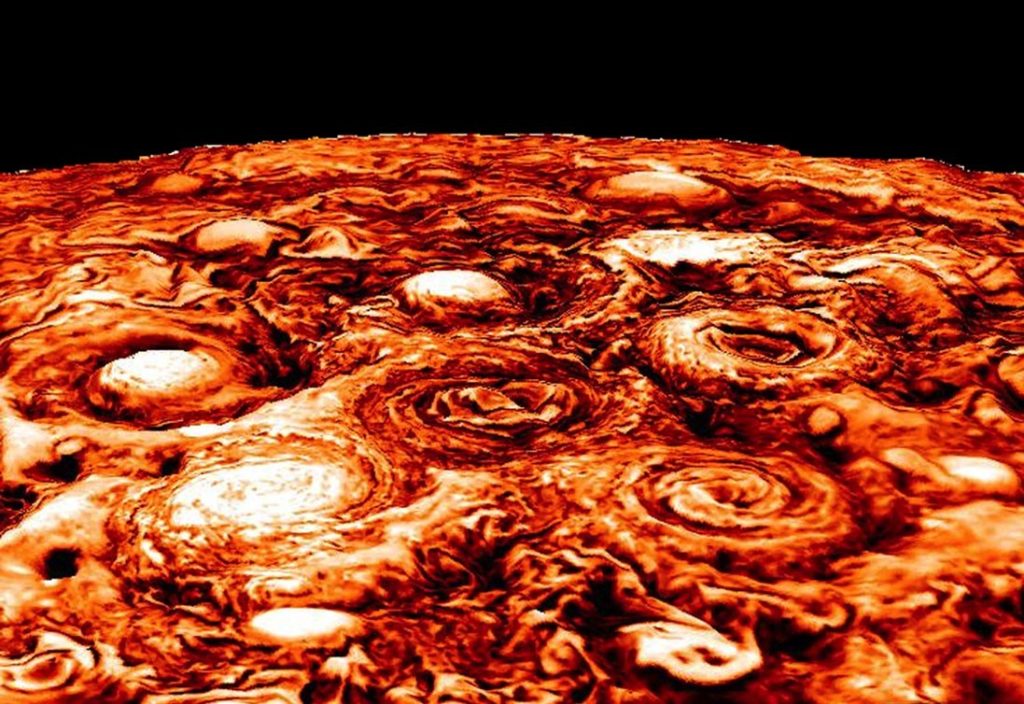

Jupiter’s atmosphere is full of enduring mysteries, and its poles are no exception. Instruments aboard the Juno spacecraft have gotten a better look at Jupiter’s North and South poles than any previous mission, and what they’ve found raises even more questions. Both of Jupiter’s poles feature a central cyclone ringed by other, similarly-sized cyclones. The North pole has eight outer cyclones (top image), while the South pole has five (bottom image), shown above in infrared. Despite being close enough that their spiral arms intersect, the cyclones don’t seem to be merging into something like Saturn’s polar hexagon. For now, scientists don’t know how this arrangement formed or why it persists, but the longer Juno can study the vortices up close, the more we’ll learn. (Image credit: NASA/JPL-Caltech/SwRI/ASI/INAF/JIRAM; research credit: A. Adriani et al.; submitted by Kam-Yung Soh)

Castle-like Clouds
An astronaut captured this towering cloud over Andros Island from orbit aboard the ISS. This is a cumulus castellanus cloud, named for the castle-like crenelations at its top. Castellanus clouds form in areas with strong vertical updrafts, often due to cloud-level atmospheric instabilities rather than heating at the Earth’s surface. These clouds frequently proceed rain or even thunderstorms. What distinguishes castellanus from other types of cumulonimbus clouds is their shape: castellanus clouds have protrusions that are taller than they are wide – like the castles for which they are named. (Image credit: NASA / Expedition 48; via NASA Earth Observatory)

Modons
The spin of the Earth creates myriad eddies in our oceans, most of which move slowly westward at a speed dependent on their latitude. You can see many in the animation above as green and red rings slowly marching to the left. According to theory, it’s possible for two of these eddies to combine to become more than the sum of their parts; under the right conditions, the two conjoined eddies could become a modon, which, like a vortex ring, is capable of traveling far faster than its parental eddies. Despite the theory, however, no one had ever observed a modon in nature.
A new paper uses satellite imagery to identify nine modons in different locations around the world. One is shown above. Watch the eastern coast of Australia carefully, and you’ll see a modon form. It moves much faster than its surroundings, first southward toward Tasmania, then quickly eastward toward New Zealand. Thin black circles mark the two eddies that make up the modon. The strength and speed of these features makes them capable of pulling significant water mass with them. This suggests that they may play a role in ocean life, transporting water of different temperatures and nutrient content into regions it would not otherwise reach. (Image and research credit: C. Hughes and P. Miller; via Gizmodo)
Skiing, Avalanches, and Freezing Bubbles

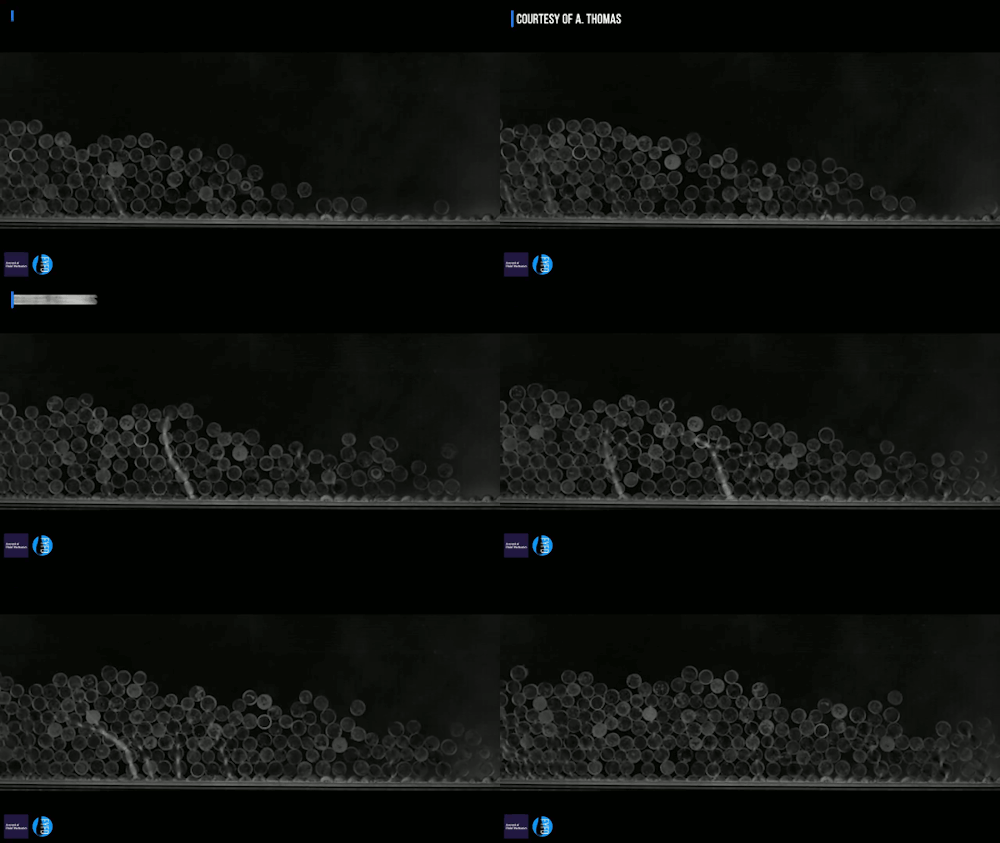

To wrap up our look at Olympic physics, we bring you a wintry mix of interviews with researchers, courtesy of JFM and FYFD. Learn about the research that helped French biathlete Martin Fourcade leave PyeongChang with 3 gold medals, the physics of avalanches, and how bubbles freeze.
If you missed any of our previous Olympic coverage, you can find our previous entries on the themed series page, and for more great interviews with fluids researchers, check out our previous collab video. (Video credit: T. Crawford and N. Sharp; image credits: GettyImages, T. Crawford and N. Sharp)
.gif)