Category: Research

  • Loopy Networks and Bird Lungs

    Loopy Networks and Bird Lungs

    When mammals breathe, air flows back and forth inside our lungs. But in birds that inhale and exhale get transformed into one-directional flow inside their lungs. To figure out how, researchers built loopy networks of pipes that turn oscillating flow into unidirectional flow.

    The simplest structure that does this is shown above. The main loop is driven by a pump that oscillates back and forth. A second loop connects through two T-junctions, oriented at 90-degrees to one another. Watch the particles in each loop carefully. Those in the bottom loop move back and forth, driven by the oscillating pump. But the particles in the upper loop only move in one direction! The key to this, the researchers found, are vortices that form at the T-junctions (last image). When the flow in the main loop changes direction, it creates vortices that block flow along one arm of the T-junction, thereby isolating the upper loop. (Image credit: bird – A. Mckie, others – Q. Nguyen et al.; research credit: Q. Nguyen et al.; via APS Physics; submitted by Kam-Yung Soh)
  • Viscoelastic Coiling

    Viscoelastic Coiling

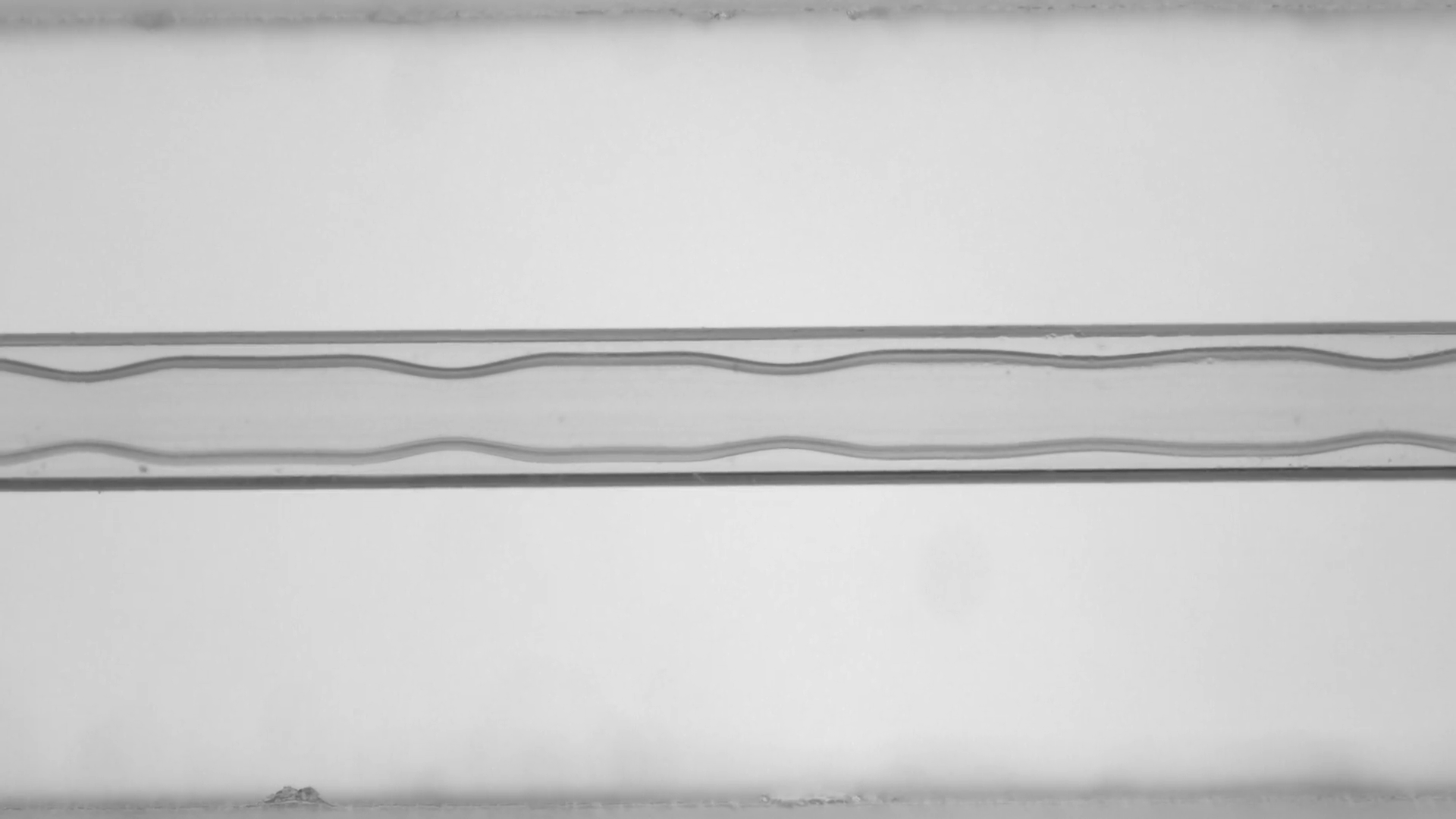
    Drizzle honey or syrup from high enough, and you’ll see it coil like a liquid rope. This feature of viscous fluids also extends to polymer-filled viscoelastic fluids. But recent work shows that the elasticity of these fluids delays the onset of coiling; put differently, if you pour two fluids of comparable viscosity, the viscoelastic one will have to fall farther before it will start coiling. The authors also found that the coiling frequency for a viscoelastic fluid is smaller than a viscous one, given the same experimental conditions. (Image credit: flo222; research credit: Y. Su et al.)

  • Iceberg Melting Depends on Shape

    Iceberg Melting Depends on Shape

    Not all icebergs melt equally. Through a combination of experiment and numerical simulation, researchers have shown that an iceberg’s shape underwater strongly affects how it melts. Specifically, icebergs in a flow melt more quickly on the front and side surfaces and slower on the underside. This means that narrow icebergs that project deep into the water will melt faster than wider, shallow ones. Currently, climate models don’t account for this variation, but the researchers hope their work will help build more accurate models for future studies. (Image credit: iceberg – C. Matias, experiment – E. Hester et al.; research credit: E. Hester et al.; see also APS Physics)

    Snapshots of a model iceberg as it melts.
  • Inside Hydroplaning

    Inside Hydroplaning

    When a tire spins over a wet roadway, pressure at the front of the tire generates a lifting force; if that lift exceeds the weight of the car, it will start hydroplaning. To prevent this, the grooves of a tire’s tread are designed to redirect the water. Now researchers have visualized flow inside these grooves for the first time, using a version of particle image velocimetry (PIV). PIV techniques use fluorescent particles to track the flow.

    The results reveal a complicated, two-phase flow inside the tire grooves. As seen in the images above, bubble columns form inside the tire grooves. The team’s results suggest that the bubble columns depended on groove width, spacing, and intersections with other grooves. They also saw evidence of vortices inside some grooves. (Image credit: tires – S. Warid, others – D. Cabut et al.; research credit: D. Cabut et al.; via Physics World; submitted by Kam-Yung Soh)

  • A Macro View of Weathering

    A Macro View of Weathering

    Water constantly weathers sedimentary rock, both physically — through abrasion — and chemically — through dissolution and recrystallization. Now researchers have gotten their first view of this weathering at the Ångstrom level by observing porous rocks with environmental transmission electron microscopy as they interact with both water vapor and liquid water.

    As expected, the experiments with liquid water showed that water dissolved the rocks and substantially changed the geometry of the rock’s pores. But the experiments also showed significant weathering from water vapor alone. The researchers found that water vapor formed a film on the surface of the rock’s pores in a process known as adsorption. This film substantially decreased the size of each pore and created strain in the rock. Once the water vapor was removed, the rock’s pores were notably altered, supporting the idea that this adsorption was, itself, a form of weathering. (Image credit: M. Kosloski; research credit: E. Barsotti et al.; via AGU EOS; submitted by Kam-Yung Soh)

  • Swapping Emulsions

    Swapping Emulsions

    Chemically speaking, oil and water don’t mix. But with a little fluid mechanical effort, it’s possible to make them an emulsion — a mixture of oil droplets in water or water droplets in oil. Researchers in the Netherlands discovered that the viscosity of these emulsions depends critically on which of those mixtures you have.

    To create their emulsions, the team used a tank consisting of two concentric cylinders. When the inner cylinder spins, it creates a well-understood flow field between the inner and outer cylinder. By varying the ratio of oil to water in the tank, they could explore a wide range of emulsions. They found that the emulsion’s viscosity changed dramatically when the emulsion shifted from oil droplets in water to water droplets in oil, something known as a catastrophic phase inversion. During this switch the viscosity dropped from 3 times higher than pure water to 2 times lower! (Image credit: A_Different_Perspective; research credit: D. Bakhuis et al.; via APS Physics; submitted by Kam-Yung Soh)

  • Decelerating Jets

    Decelerating Jets

    For more than a century, scientists have been fascinated by the jet that forms after a drop impacts a liquid. In this study, researchers tracked fluorescent particles in the fluid to understand the velocity and acceleration of flow inside the jet. They found that, within the first 10ms after the jet appears, it decelerates at up to 20 times the gravitational acceleration. That’s much too fast for gravity to cause, pointing instead to the critical importance of surface tension in dictating the behavior of these fast-moving jets. (Image and research credit: C. van Rijn et al.; via APS Physics; submitted by Kam-Yung Soh)

  • Whiskey Webs

    Whiskey Webs

    Unlike scotch whisky, when American bourbon whiskeys are diluted, they form unique web-like evaporation patterns. These differences arise in part from the way the liquors are aged: scotch is aged in re-used barrels, whereas bourbons require aging in a new, charred American white oak barrel*.

    During aging, the whiskey picks up water-insoluble chemicals from the barrel. When water is added to the bourbon, it helps transport those insoluble components to the surface of a droplet, where they form a monolayer of fatty acid chains (Image 2; in green). As evaporation continues and the droplet gets smaller, the molecules at the shrinking surface collapse inward, forming the rigid web structure we see left behind. The patterns that form act as a kind of fingerprint for the bourbon. Check out some of the brand-to-brand variations over at the researchers’ Whiskey Webs site. (Image and research credit: S. Williams et al.; via Physics Today)

    * In case you were wondering, this is actually a legal requirement in order to be considered bourbon. Bourbons must also be made from a grain mixture that is >50% corn.

  • Featured Video Play Icon

    Insect-Inspired Flight

    Insects are incredibly agile and resilient fliers, capable of colliding and recovering without damage. Engineers are only beginning to capture these characteristics in their robots. Here, engineers use a soft actuator — a rubber cylinder coated in carbon nanotubes — to drive their robot’s flight. When voltage is applied across the carbon nanotubes, the rubber squeezes and stretches, causing the robot’s wings to flap. These soft actuators are far less fragile than hard ones, allowing the robots to take hits and keep flapping, much like the real insects. (Image and video credit: MIT News; research credit: K. Chen et al.)

  • Meltwater Tracking Via Seal

    Meltwater Tracking Via Seal

    Monitoring meltwater from Antarctic glaciers is critical for understanding our changing climate, but such remote and inaccessible regions are tough to collect data in. So researchers are turning to local workers to help them gather data. By collecting and analyzing data from seal tags, researchers have mapped new seasonal variations in meltwater flows around Pine Island Glacier. Although the seals are somewhat tough collaborators — they rarely swim exactly where the researchers would like them to — their winter activities are revealing data researchers could never have collected on their own. (Image credit: Y. Rzhemovskiy; research credit: Y. Zheng et al.; via Gizmodo)