Tag: cavity

  • Paris 2024: Diving

    Paris 2024: Diving

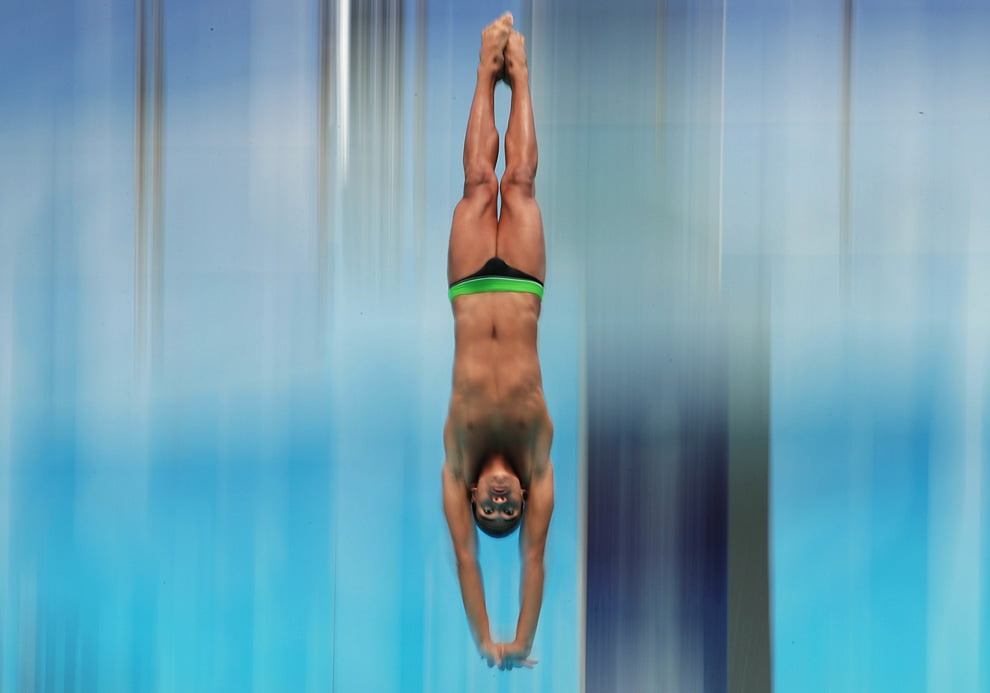
    In competition diving, athletes chase a rip entry, the nearly splash-less dive that sounds like paper tearing. Part of a successful rip dive comes in the impact, where divers try to open a small air cavity with their hands that their entire body then enters. But the other key component happens below the surface, where divers bend at the hips once underwater. This maneuver enlarges the air cavity underwater and disrupts the formation of a jet that would typically shoot back upwards. Done properly, the result is an entry with little to no splash at the surface and a panel full of pleased judges. (Image credits: top – A. Pretty/Getty Images, other – E. Gregorio; research credit: E. Gregorio et al.; via Science News; submitted by Kam-Yung Soh)

    Sequence of images showing a synthetic diver bending underwater to disrupt splash formation.
    Sequence of images showing a synthetic diver bending underwater to disrupt splash formation.

    Related topics: Rip entry physics, how pelicans dive safely, and how boobies plunge dive

    This post marks the end of our Olympic coverage for this year’s Games, but if you missed any previous entries, you can find them all here.
  • Surviving Rainfall

    Surviving Rainfall

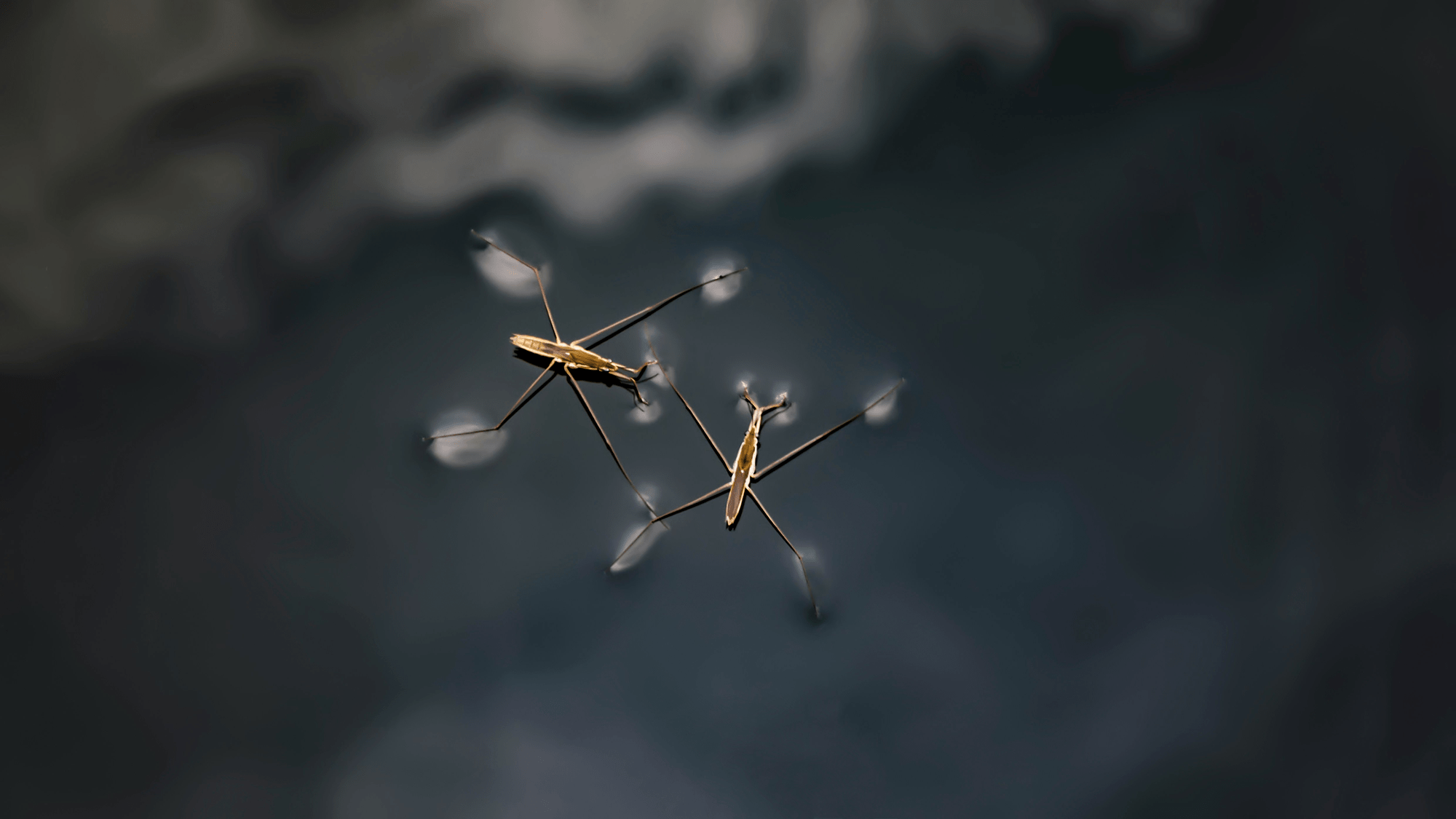
    Water striders spend their lives at the air-water boundary, skittering along this interfacial world. But what happens when falling rain destroys their flat existence? That’s the question that motivated today’s research study, which looks water striders subjected to artificial rain.

    Although the water drops themselves are far heavier than the insects, the water doesn’t strike hard enough to injure the insects. Neither a direct impact nor the forces from a neighboring impact, the researchers found, were enough to pose a problem for the water strider’s exoskeleton. Instead, they’re more likely to get flung or submerged, as follows:

    The initial impact of a raindrop creates a large crater. Depending on the position of the insect relative to the point of impact, this may fling the insect away or pull it down into the cavity.
    The initial impact of a raindrop creates a large crater. Depending on the position of the insect relative to the point of impact, this may fling the insect away or pull it down into the cavity.

    When the drop hits, it creates a big crater in the water’s surface. Insects to the outside of the splash get flung outward, while those closer to the point of impact ride the crater wall downward. As the crater collapses, it forms a thick jet that pushes nearby water striders up with it.

    As the initial cavity collapses, it creates a large jet that can push the strider into the air.
    As the initial cavity collapses, it creates a large jet that can push the strider into the air.

    As that initial jet collapses, it forms a second crater, which — being smaller and narrower — collapses much faster than the first one. That action, researchers found, often submerges a water strider caught in the crater.

    The first jet's collapse creates a second crater, and it's this one that tends to trap and submerge the water striders underwater.
    The first jet’s collapse creates a second crater, and it’s this one that tends to trap and submerge the water strider underwater.

    Fortunately for the insect, their water-repellent nature means they’re covered in a thin bubble of air that lets them survive several minutes underwater. That’s time enough for the water strider to rescue itself. (Image credit: top – H. Wang, animations – D. Watson et al.; research credit: D. Watson et al.; via APS Physics)

  • Shaking on Impact

    Shaking on Impact

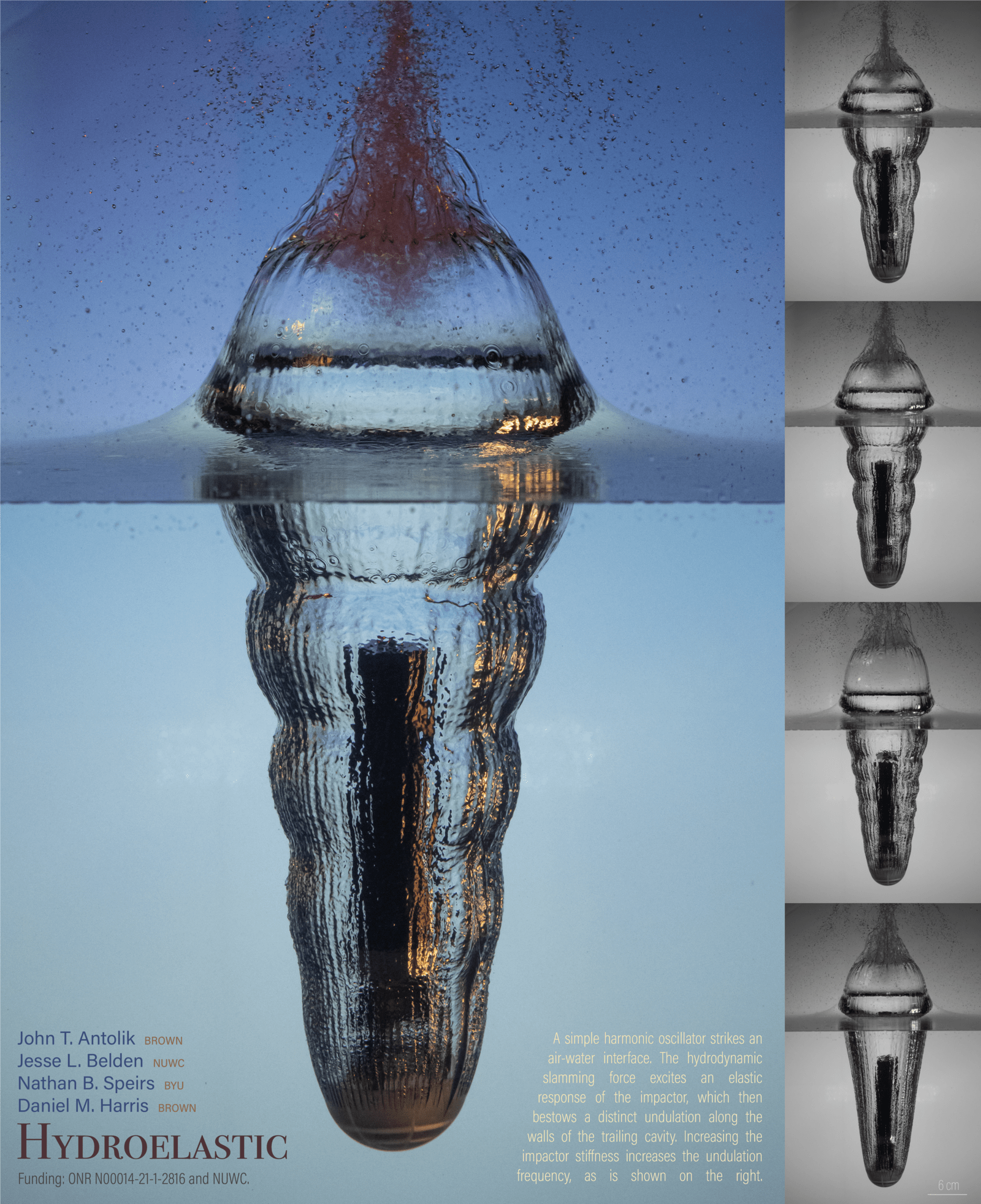
    When objects impact water with enough speed, they create a smooth-walled, air-filled cavity around and behind them. Here, the impacting object is one with some give, like a spring. The initial impact squishes the object, setting it to oscillating along its length. The result is a wavy cavity. The stiffer the object, the more frequent the waves. (Image credit: J. Antolik et al.)

  • The Best of FYFD 2023

    The Best of FYFD 2023

    A fresh year means a look back at what was popular last year on FYFD. Usually, I give a numeric list of the top 10 posts, but this year the analytics weren’t as clear. So, instead, I’m combining from a few different sources and presenting an unordered list of some of the site’s most popular content. Here you go:

    I’m really pleased with the mix of topics this year; many of these topics are straight from research papers, and others are artists’ works. At least one is both. From swimming bacteria to star-birthing nebulas, fluid dynamics are everywhere!

    If you enjoy FYFD, please remember that it’s a reader-supported website. I don’t run ads and it’s been years since my last sponsored post. You can help support the site by becoming a patronmaking a one-time donationbuying some merch, or simply by sharing on social media. And if you find yourself struggling to remember to check the website, remember you can get FYFD in your inbox every two weeks with our newsletter. Happy New Year!

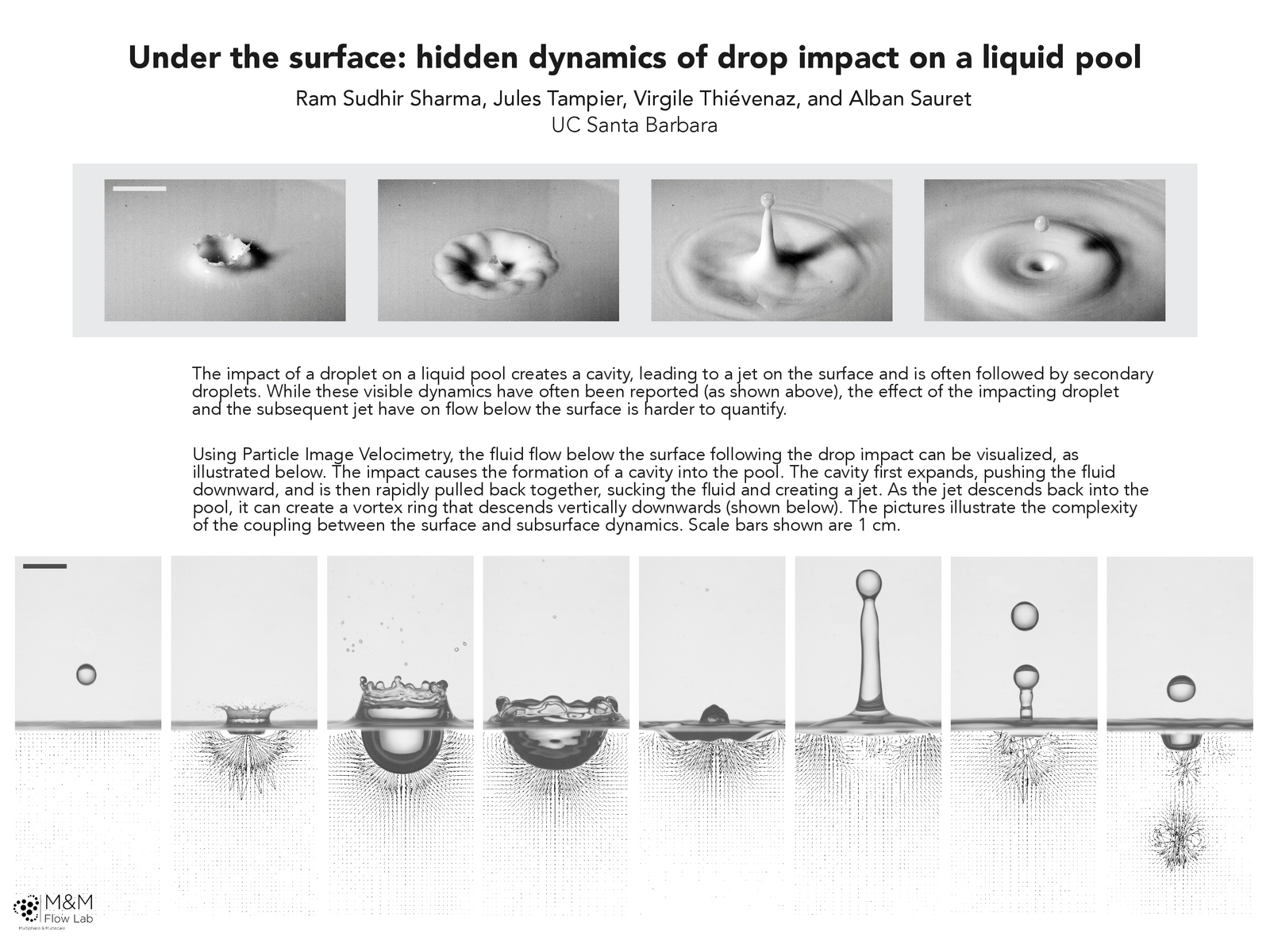
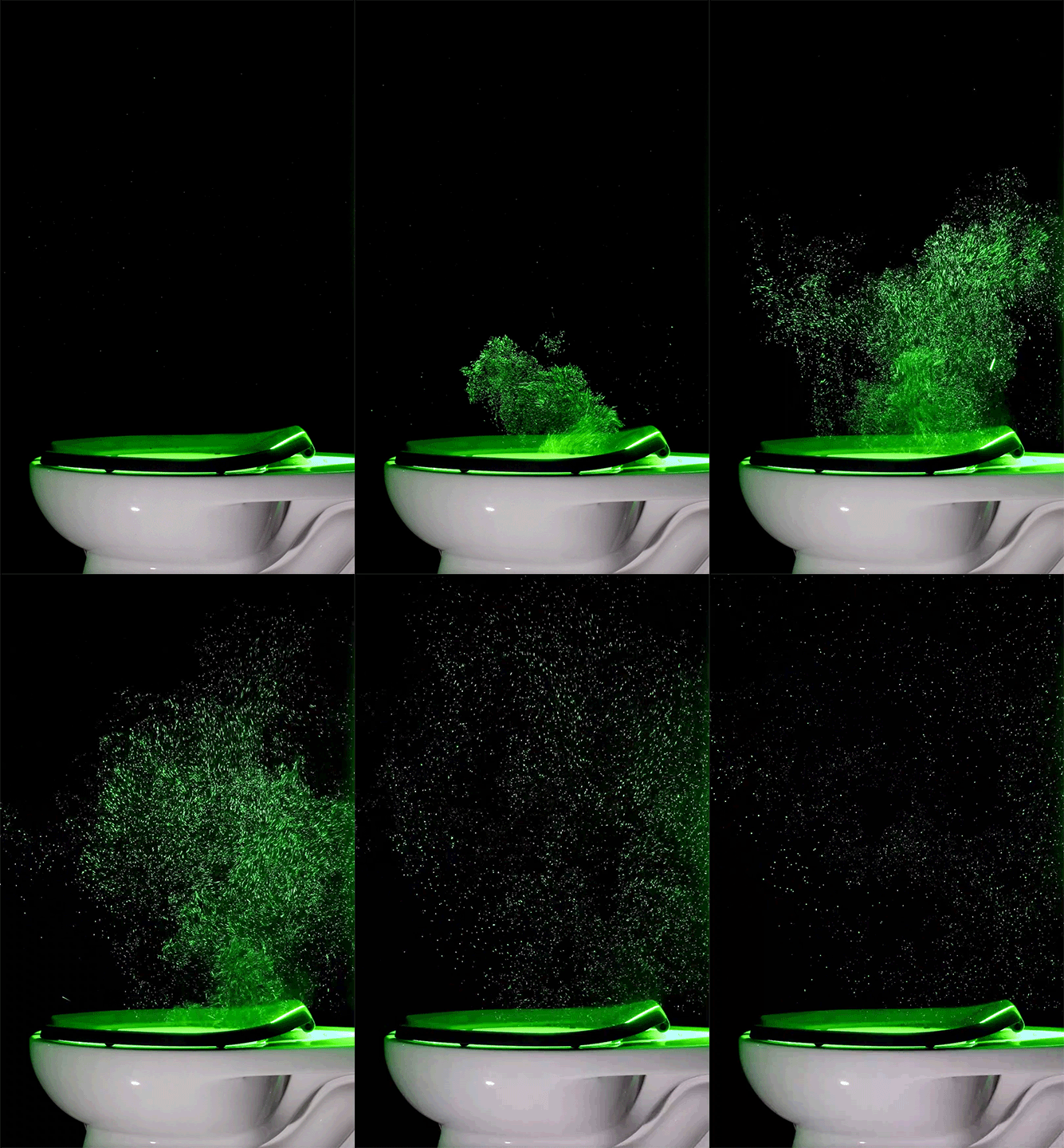
    (Image credits: sphinx – S. Boury et al., ear model – S. Kim et al., maze – S. Mould, dandelion – S. Chaudhry, water tank – P. Ammon, e. coli – R. Ran et al., drop impact – R. Sharma et al., Leidenfrost – L. Gledhill, toilet – J. Crimaldi et al., engine sim – N. Wimer et al., rivers – D. Coe, fin – F. Weston, snake – P. Schmid, nebula – J. Drudis and C. Sasse, flames – C. Almarcha et al.)

  • Featured Video Play Icon

    Bouncing Bullets Off Water

    With the right shot, it’s possible to skip a bullet off water, as shown in this video from the Slow Mo Guys. The angle of the bullet relative to the water needs to be quite shallow, as this sets the bullet up for the hydrodynamic lift needed to skip. Physically, the mechanism for skipping a bullet is similar to rock-skipping. The bullet’s impact creates a cavity that the bullet rides. With the right conditions, the cavity orients the bullet upward, creating the lift needed to skip. (Video and image credit: The Slow Mo Guys)

  • Diving Together

    Diving Together

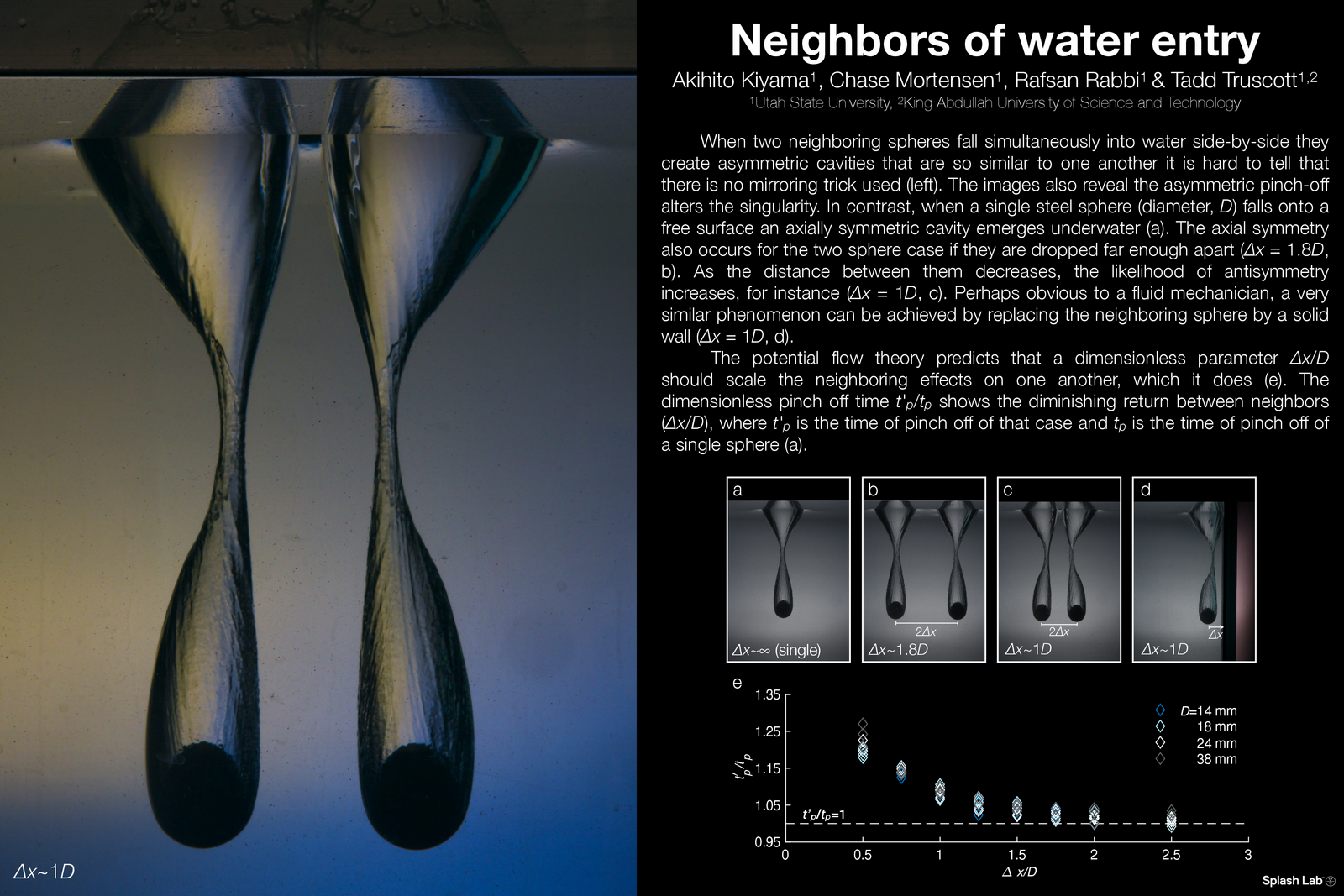
    Two spheres dropped into water next to one another form asymmetric cavities. A single ball’s cavity is perfectly symmetric, and so are two spheres’, provided they are far enough apart. But for close impacts, the spheres influence one another, creating a mirror image. The same asymmetric cavity also forms when a sphere is dropped near a wall. In fluid dynamics, this trick — using two mirrored objects in place of a wall — is used to make calculating certain flows easier! (Image credit: A. Kiyama et al.)

  • Listening to the Sizzle

    Listening to the Sizzle

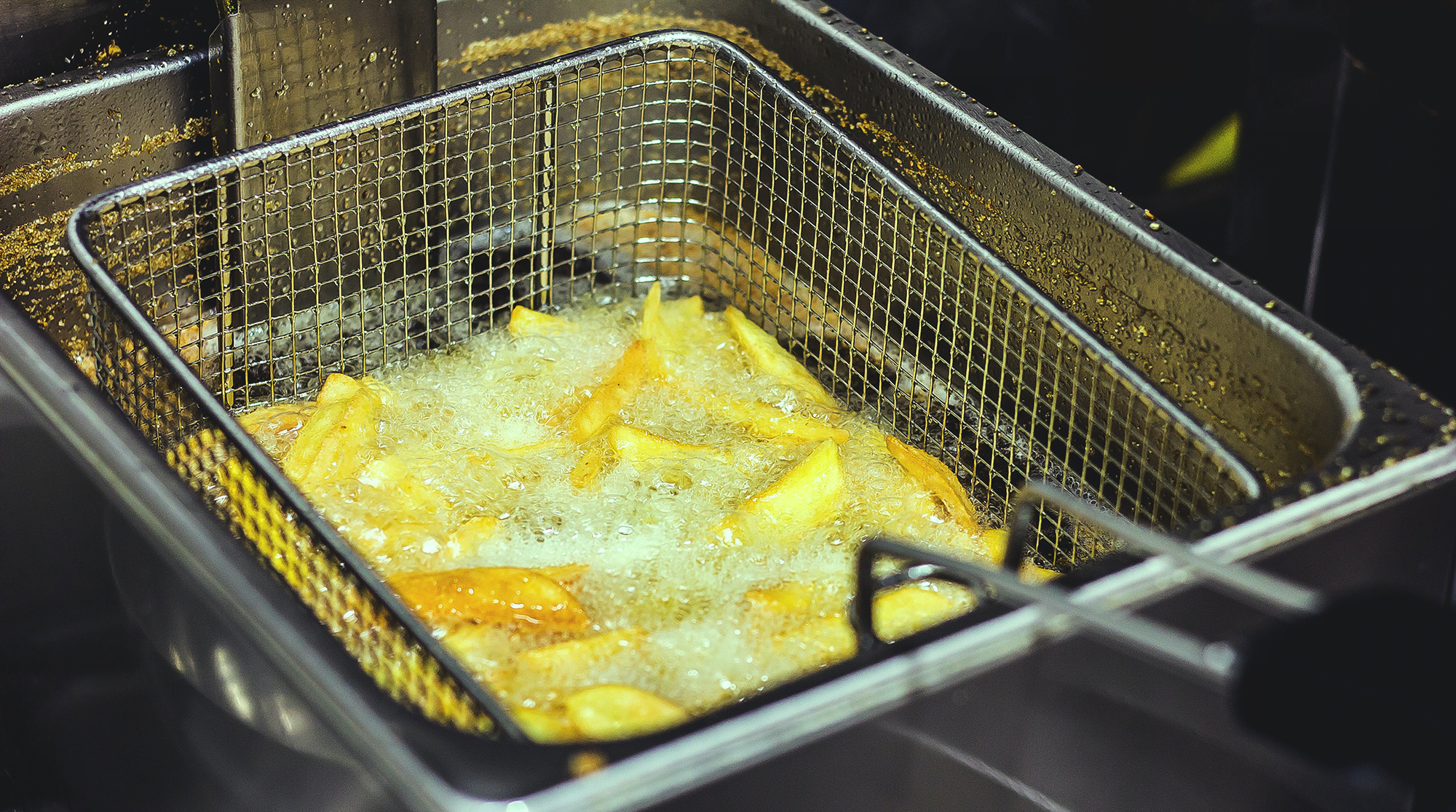
    The sizzle of frying food is familiar to many a cook, and that sound actually conveys a surprising amount of information. In this study, researchers suspended water droplets in hot oil and observed their behavior, both with high-speed video and with microphones. They found that these vaporizing drops created three types of cavities in the oil: an exploding cavity that breaks the surface, an elongated cavity that remains submerged, and an oscillating cavity that breaks up well below the surface. All three cavities flung oil droplets upward, and all three were acoustically distinct from one another. That means, as the authors suggest, that it might be possible to measure the aerosol droplets generated during frying simply by listening! (Image credit: fries – W. Dharma, others – A. Kiyama et al.; research credit: A. Kiyama et al.; via Cosmos; submitted by Kam-Yung Soh)

  • Entraining Bubbles

    Entraining Bubbles

    If you stand on a bridge and watch the current flow past pylons below, you’ll see disturbances marking the wakes. Dragging a rod – or an oar – at a high enough speed through the water creates something similar: a wavy cavity in the fluid surface that surfs along behind the rod. The faster you pull the rod, the harder you’ll have to work, until that wake becomes so turbulent that it begins entraining air bubbles, like the tiny ones seen above. Once entrainment starts, the drag coefficient drops somewhat, presumably due to changes in the pressure distribution around the rod. The characteristics of air entrainment change with object size as well. Larger rods can entrain air through the cavity and not just in the wake. (Image and research credit: V. Ageorges et al.)

  • Featured Video Play Icon

    Reducing the Force of Water Entry

    As anyone who’s jumped off the high board can tell you, hitting the water involves a lot of force. That’s because any solid object entering the water has to accelerate water out of its way. This is why gannets and other diving birds streamline themselves before entering the water. But even for non-streamlined objects, like a sphere, there are ways to reduce the force of impact.

    This video explores three such techniques, all of which involve disturbing the water before the sphere enters. In the first, the sphere is dropped inside a jet of fluid. Since the jet is already forcing water down and aside when the sphere enters, the acceleration provided by the sphere is less and so is the force it experiences.

    The second and third techniques both rely on dropping a solid object ahead of the one we care about. In the second case, a smaller sphere breaks the surface ahead of the larger one, allowing the big sphere to hit a cavity rather than an undisturbed surface. Like with the jet, the first sphere’s entry has already accelerated fluid downward, so there’s less mass that the bigger sphere has to accelerate, thereby reducing its impact force.

    In the third case, the first sphere is dropped well ahead of the second, creating an upward-moving Worthington jet that the second sphere hits. In this case, there’s water moving upward into the sphere, so how could this possibly reduce the force of entry? The key here is that the water of the jet wets the sphere before it enters the pool. Notice how very little air accompanies the second sphere compared to the first one. That’s because the second sphere is already wet. It’s also been slowed down by the jet so that it enters the water at a lower speed, all of which adds up to a lower force of entry. (Image and research credit: N. Speirs et al.)

  • Oil-on-Water Impact

    Oil-on-Water Impact

    Although many people have studied droplet impacts over the years, there’s been remarkably little work done with oil-on-water impacts. One of the things that makes this situation different is that the oil and water are completely immiscible, which means we can see aspects of the impact process that are invisible with, say, water-on-water impacts.

    The animation above shows an underwater view of the oil droplet’s impact. The energy of the initial impact creates an expanding crater and an unstable crown splash. That crown splash contains both water and oil. After it ejects some droplets, the rim stabilizes, but we can still see small perturbations along its edge as it starts to retract. In the water, high surface tension damps out these perturbations. Not so for the oil! As the crater retracts, the small disturbances along the rim get stretched into mushroom-shaped fingers that point inward toward the impact site. Because the index of refraction is different between oil and water, we can see the fingers clearly near the end of the animation. (Image and research credit: U. Jain et al.; submitted by Utkarsh J.)