Among vertebrates, pterosaurs were the first to achieve powered flight. Early pterosaurs have tail vanes — similar in appearance to the frills seen on some lizards — but later species lost this feature. Whether the tail vanes helped in flight or served a display purpose is an open question among paleontologists. One group, in a recent pre-print, studied the vanes’ fossilized interior structure and found a cross-linked lattice that provided internal tension to the vanes. That means the vanes could potentially be held stiff, even in the face of aerodynamic forces that would cause untensioned surfaces to flutter. The result suggests that the tail vanes could have helped early fliers steer, even if evolution later moved that function (along with display) to other parts of the body. (Image credit: Sviatoslav-SciFi; research credit: N. Jagielska et al.; via jshoer)
Category: Research

Jamming Soft Grains
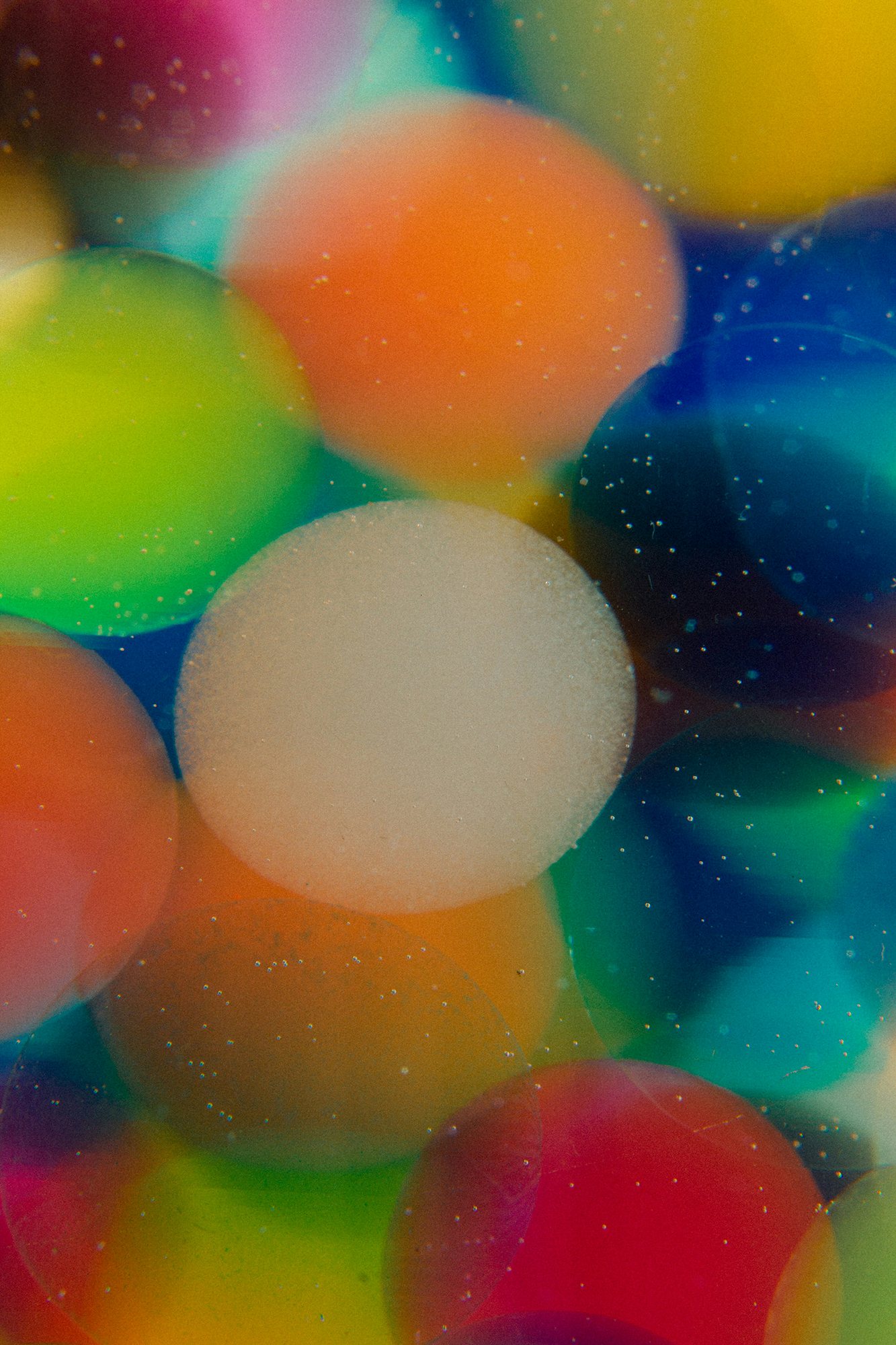
Hard granular materials — sand, gravel, glass beads, and so on — can flow, but, in narrow regions or under large forces, they can also jam up, essentially turning into a solid. Soft particles can also flow and jam, but do so under different conditions than hard particles. One group of researchers used a custom-built rheometer to measure jamming in soft particles like the hydrogel beads pictured here. They found that they could extend existing models for jamming in hard particles, but they had to rescale the mathematics to account for the way soft particles change their shape under pressure. (Image credit: Girl with red hat; research credit: F. Tapia et al.; via APS Physics)

Water Suspected Beneath Mars
The surface features of Mars — crossed by river deltas and sedimentary deposits — indicate a watery past. Where that water went after the planet lost its atmosphere 3 – 4 billion years ago is an open question. But a new study suggests that quite a bit of that water moved underground rather than escaping to space.
The research team analyzed seismic data from the Mars InSight Lander. Marsquakes and meteor strikes on the Red Planet send seismic waves through the planet’s interior. The waves’ speed and other characteristics change as they pass through different materials, and by comparing different waves picked up from the same originating source, scientists can back out what the waves passed through on the way to the detector. In this case, the team concluded that the data best fit a layer of water-filled fractured igneous rock 11.5 – 20 kilometers below the surface. They estimate that the water trapped in this subsurface layer is enough to cover the surface of the planet in a 1 – 2 kilometer deep ocean. (Image credit: NASA/JPL-Caltech; research credit: V. Wright et al.; via Physics World)

Shaped Splashes
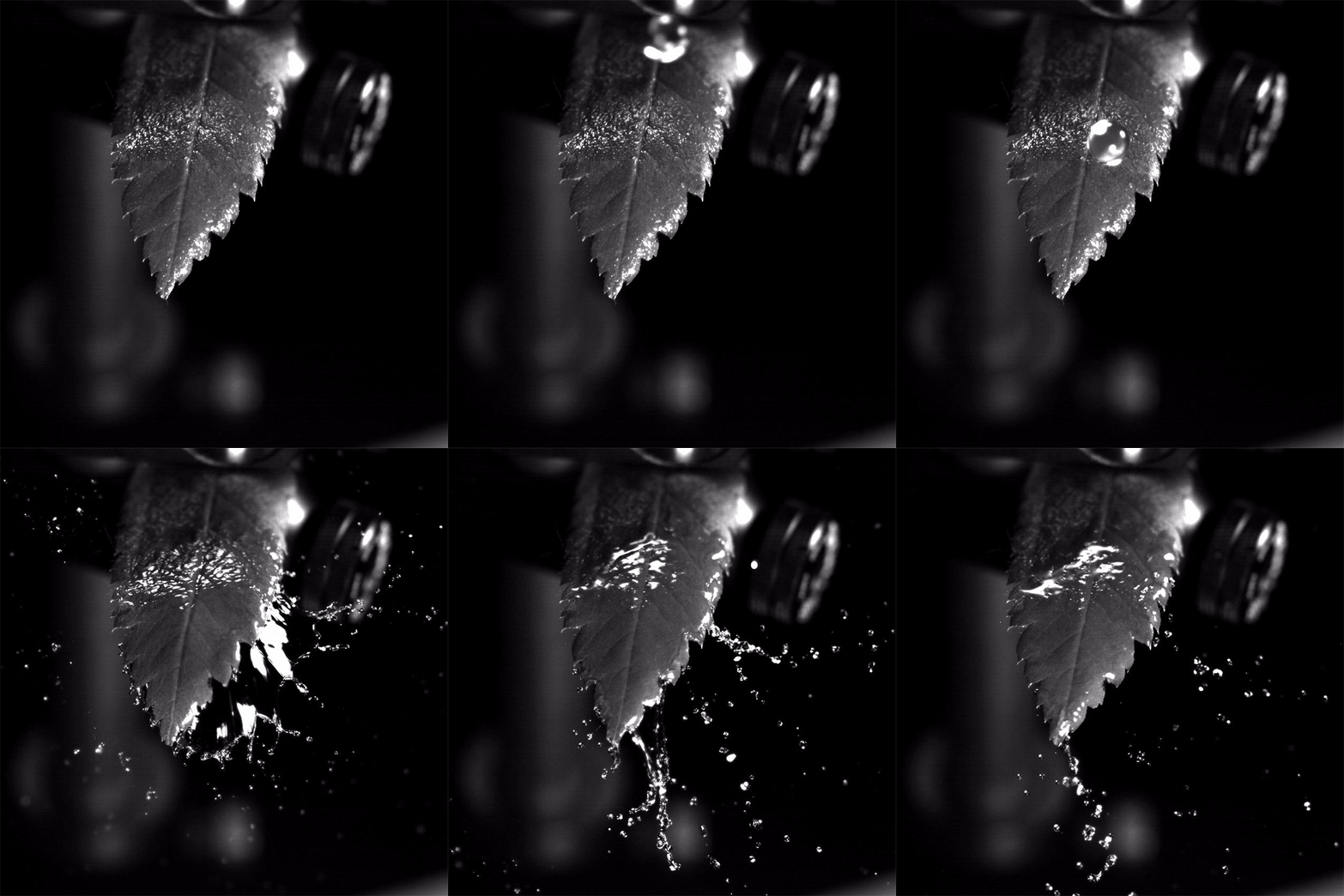
When a raindrop hits a leaf, it spreads out into a rimmed sheet that breaks up into droplets. These tiny drops can carry dust, spores, and even pathogens as they fly off. But many leaves aren’t smooth-edged; instead they have serrations or teeth. How does that affect a splash? That’s the question at the heart of today’s study.
A water drop hits a star-shaped pillar and breaks up. To simplify from a leaf’s shape, the team studied water dropping onto star-shaped pillars. As seen above and below, the pillar’s edge shaped the splash sheet, with the sheet extending further in the edge’s troughs. This asymmetry extends into the rim also, concentrating the liquid — and the subsequent spray of droplets — along lines that extend from the edge’s troughs and peaks.
A viscous water-glycerol drop hits a star-shaped pillar, spreads, and breaks into droplets. The team found that, in addition to sending drops along a preferred direction, the shaped edge made the droplets larger and faster than a smooth edge did. (Image and research credit: T. Bauer and T. Gilet)

Catching Krill With Bubble Nets
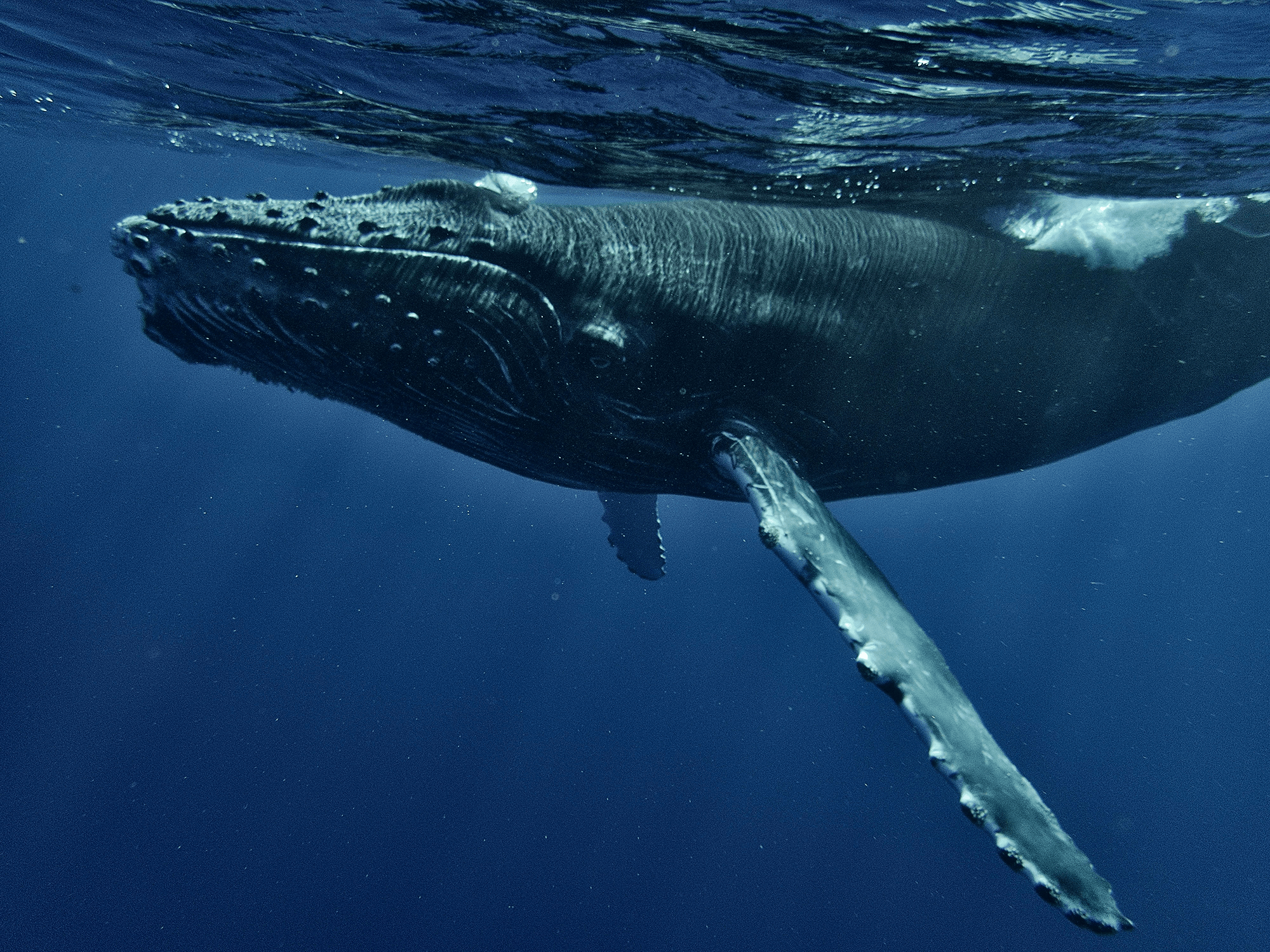
On their own and in groups, some humpback whales enclose their prey in bubbly columns before feeding. The whales build these bubble nets intentionally, swimming in a ring at a constant speed while producing bursts of air from their blowhole. After observing hundreds of bubble nets created by dozens of whales, researchers concluded that whales actively tune the nets, using more rings, closer bubble spacing, or deeper extents to suit their needs. Once they’ve completed the net, whales lunge up through the center, mouth open, collecting their food.
In their study, the team found that building bubble nets is no more energy intensive for whales than typical lunge-feeding. However, the prey concentration in a bubble net means that hunting there nabs more food per lunge. The authors argue that the way humpback whales build and use bubble nets qualifies them as tool users on par with many fellow mammals, as well as some birds, fish, and insects. (Image credit: C. Le Duc; research credit: A. Szabo et al.; via Gizmodo)

Synchronizing Cilia
Just like human swimmers, microswimmers have to coordinate their motion to swim. But unlike humans, swimmers like the freshwater alga Chlamydomonas reinhardtii doesn’t have a brain to help it synchronize its cilia. To investigate how these microswimmers manage their stroke, researchers built a biorobot with mechanically linked segments that mimic the alga’s swimming once a motor sets the robot vibrating.

When the robot’s base is allowed to rotate, the cilia synchronize in the freestyle-like R-mode. When allowed to move along an axis, the biorobot’s cilia synchronize in the X-mode, which resembles the breaststroke. The researchers found two strokes that mirrored the real-life alga. In one, allowing the robot’s base to rotate produced a freestyle-like stroke they called R-mode. The other came from allowing the robot’s base to move forward and backward, which created a breaststroke-like X-mode. In the wild, only the X-mode provides helpful motion, but, oddly enough, the researchers found this mode was the most energy intensive. (Image credit: top – J. Larson, others – Y. Xia et al.; research credit: Y. Xia et al.; via APS Physics)

An Exoplanet With Earth-Like Temperatures
Although researchers have identified thousands of exoplanets in the last 25 years, most of them are far larger and far hotter than Earth. But a team recently announced the discovery of a temperate neighbor, Gliese 12 b, some 40 light years away. Gliese 12 b is a rocky Venus-sized planet orbiting the cool red dwarf star Gliese 12. Based on the star’s energy output and the planet’s characteristics, the team estimate its equilibrium temperature — about how hot it would be without an atmosphere — as 42 degrees Celsius. (For comparison, Earth’s average surface temperature is 15 degrees Celsius and rising.) The next goal will be to determine whether Gliese 12 b has an atmosphere and, if so, what it’s made up of. (Image credit: NASA/JPL-Caltech/R. Hurt; research credit: S. Dholakia et al.; via Gizmodo)

Measuring Microfibers in Turbulence
Microplastic pollution is on the rise, especially in waterways. Microfibers — millimeters in length but only microns in diameter — are especially prevalent, as they get washed out of synthetic clothing. Collecting these pollutants first requires understanding how they move and cluster in turbulent flows. Researchers investigated that using a small water channel and high-resolution cameras.
The team followed microfiber strands as they moved through turbulence, paying special attention to how the fibers tumbled (rotating about their short axis) and spin (rotating around their long axis). How much fibers tumbled depended on the turbulence level; with more intense turbulence, the fibers tumbled more. Rates of spinning, they found, were consistently even higher than those for tumbling. By better understanding how microfibers behave in turbulence, we’ll be able to, for example, predict how far plastics will travel before settling to the ocean floor. (Image credit: Adobe Stock Photos; research credit: V. Giurgiu et al.; via APS Physics)

Measuring Ocean Upwelling
Large-scale ocean circulation is critical to our planet’s health and climate. In this process, seawater near the poles cools and sinks into the deep ocean, carrying dissolved carbon and nutrients with it. Later, that cold water gets pushed back up to the surface elsewhere, where it warms, and the cycle repeats. Although the theory behind this circulation has been around for decades, it’s been difficult to observe the rise, or upwelling, of water from the depths. But a recent study used a fluorescent, non-toxic dye to measure upwelling directly.
Researchers deployed 200 liters of dye just above the floor of a marine canyon near Ireland, then monitored the dye’s movement for several days at a depth of 2200. They found that turbulence along the slope of the canyon drove upwelling at speeds of about 100 meters per day, much faster than global rates. The authors suggest that this kind of topographically-enhanced upwelling could be a major factor in setting overall ocean circulation. (Image credit: visualization – NASA, ship – S. Nguyen; research credit: B. Wynne-Cattanach et al.; via Physics World)

Curved Rocks Hit Harder
Intuition suggests that a flat rock will hit the water with greater force than a spherical one, and experiments uphold that. But a flat rock, interestingly, doesn’t produce the greatest impact force. Instead, it’s a slightly curved rock that experiences peak impact forces. Researchers found this happens because of the thin layer of air that coats the front of the impacting object. For flat faces, this layer is relatively thick and provides a cushioning effect that reduces the peak force and spreads out the impact. In contrast, a slightly curved convex surface traps a thinner air layer, and that lack of cushioning maximizes the impact force. (Image credit: J. Wixom; research credit: J. Belden et al.; via APS Physics)