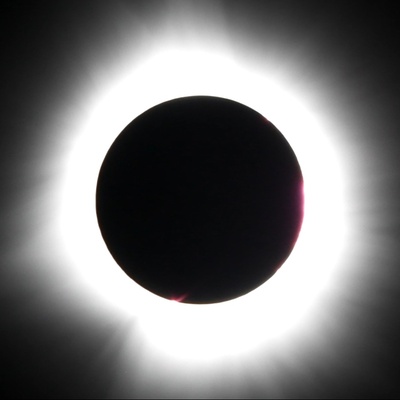
In mid-January 2022, the Hunga Tonga-Hunga Ha’apai (HTHH) volcano had one of the most massive eruptions ever recorded, destroying an island, generating a tsunami, and blanketing Tonga in ash. Volcanologists are accustomed to monitoring nearby seismic equipment for signs of an imminent eruption, but researchers found that the HTHH eruption generated a surface-level seismic wave picked up by detectors 750 kilometers away about 15 minutes before the eruption began. They propose that the seismic wave occurred when the oceanic crust beneath the caldera fractured. That fracture could have allowed seawater and magma to mix above the volcano’s subsurface magma chamber, creating the explosive trigger for the eruption. Their finding suggests that real-time monitoring for these distant signals could provide valuable early warning of future eruptions. (Image credit: NASA Earth Observatory; research credit: T. Horiuchi et al.; via Gizmodo and AGU News)
Category: Research

Inside a Big Cat’s Roar
The roars of big cats — tigers, lions, jaguars, and leopards — carry long distances. In part, this reflects the animals’ size: large lungs exhale lots of air through a large voice-box, whose vibrations resonate in a large throat. But size alone does not make the roar. Below are examples of two big cat voice-boxes. On the left is the nonroaring snow leopard; on the right is the voice-box of a roaring jaguar. The red boxes labeled “VF” mark each cat’s vocal folds. Nonroaring cats have triangular folds, while roaring ones have thick square or rectangular vocal folds. These rectangular folds are more aerodynamically efficient, allowing them to produce a wider range of output levels. They’re also more resilient to the intense forces of a roar, thanks to the cushioning effect of fat deposits inside them. If interested, you can learn more over at Physics Today. (Image credit: tiger – T. Myburgh, voice box – E. Walsh and J. McGee; research credit: E. Walsh and J. McGee)

The vocal folds (VF) of nonroaring cats are triangular (left), whereas roaring cats have rectangular vocal folds (right). 
A Magnetic Tsunami Warning
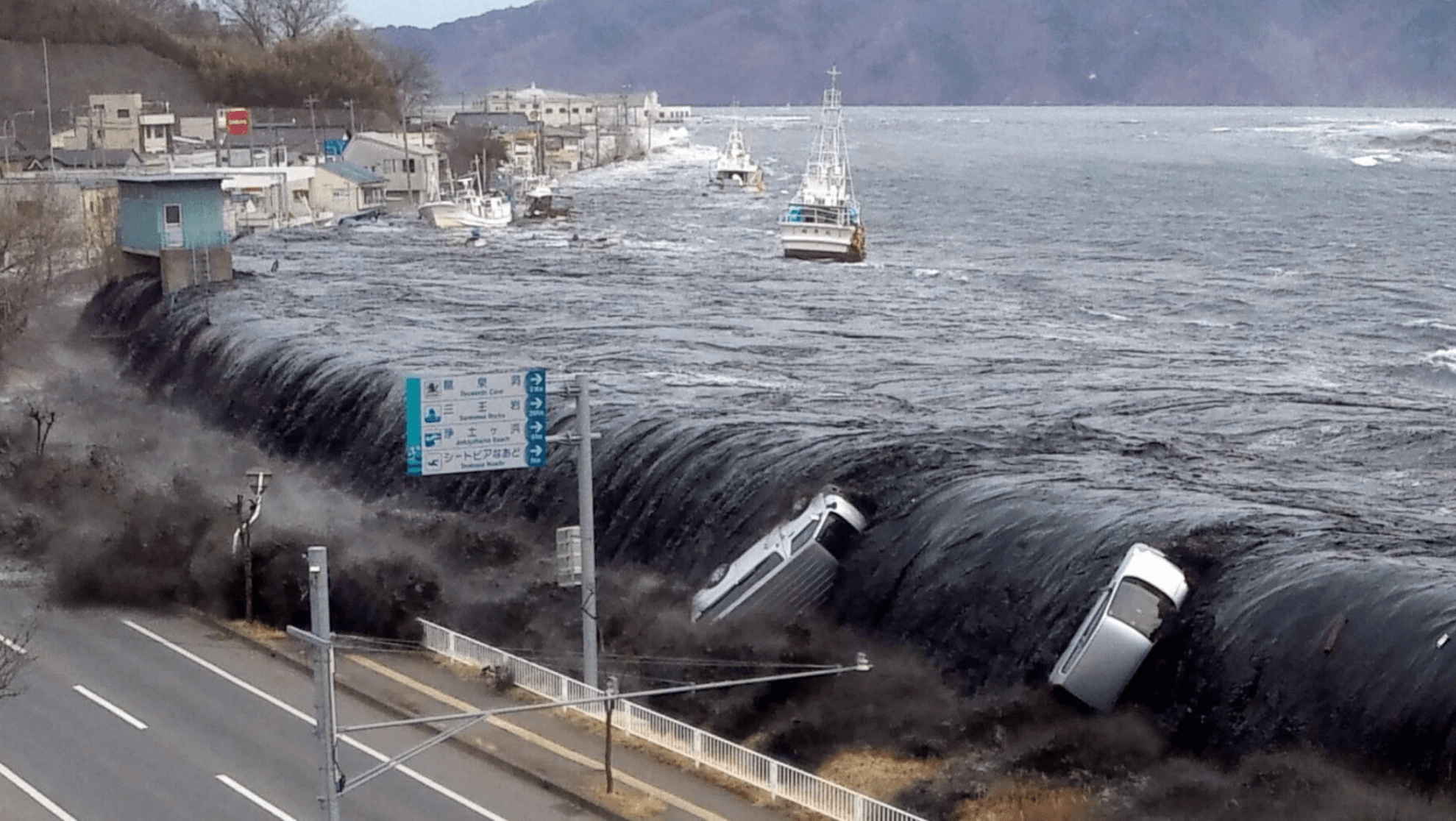
Tsunamis are devastating natural disasters that can strike with little to no warning for coastlines. Often the first sign of major tsunami is a drop in the sea level as water flows out to join the incoming wave. But researchers have now shown that magnetic fields can signal a coming wave, too. Because seawater is electrically conductive, its movement affects local magnetic fields, and a tsunami’s signal is large enough to be discernible. One study found that the magnetic field level changes are detectable a full minute before visible changes in the sea level. One minute may not sound like much, but in an evacuation where seconds count, it could make a big difference in saving lives. (Image credit: Jiji Press/AFP/Getty Images; research credit: Z. Lin et al.; via Gizmodo)

Growing Flexible Stalactites
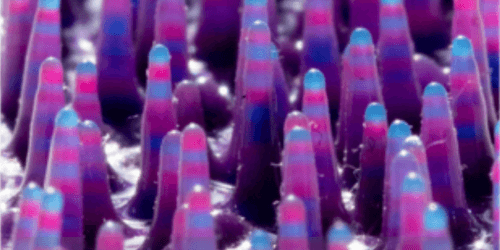
Icicles and stalactites grow little by little, each layer a testament to the object’s history. Here, researchers explore a similar phenomenon, grown from a dripping liquid. They’re called “flexicles” in homage to their natural counterparts, and they start from a thin layer of elastomer liquid. Though it begins as a liquid, elastomer solidifies over time.

Timelapse video showing the formation of an initial layer of flexicles from a dripping elastomer. To form flexicles, the researchers spread a layer of elastomer on an upside-down surface and allow gravity to do its thing (above). Thanks to the Rayleigh-Taylor instability, the dense elastomer forms a pattern of drips that, after hardening, creates a pebbled surface. Subsequent layers of elastomer will drip from the same spots as before, slowly growing longer flexicles (below). The team envisions using them for soft robotics, but, personally, I just really want poke at them and wiggle them. (Image and research credit: B. Venkateswaran et al.; via APS Physics)

A stitched composite photo showing flexicles on a cylinder growing layer by layer. 
Reinterpreting Uranus’s Magnetosphere
NASA launched the Voyager 2 probe nearly 50 years ago, and, to date, it’s the only spacecraft to visit icy Uranus. This ice giant is one of our oddest planets — its axis is tilted so that it rotates on its side! — but a new interpretation of Voyager 2’s data suggests it’s not quite as strange as we’ve thought. Initially, Voyager 2’s data on Uranus’s magnetosphere suggested it was a very extreme place. Unlike other planets, it had energetic energy belts but no plasma. Now researchers have explained Voyager 2’s observations differently: they think the spacecraft arrived just after an intense solar wind event compressed Uranus’s magnetosphere, warping it to an extreme state. Their estimates suggest that Uranus would experience this magnetosphere state less than 5% of the time. But since Voyager 2’s data point is, so far, our only look at the planet, we just assumed this extreme was normal. (Image credit: NASA; research credit: J. Jasinski et al.; via Gizmodo)

A Dandelion-Like Supernova Remnant
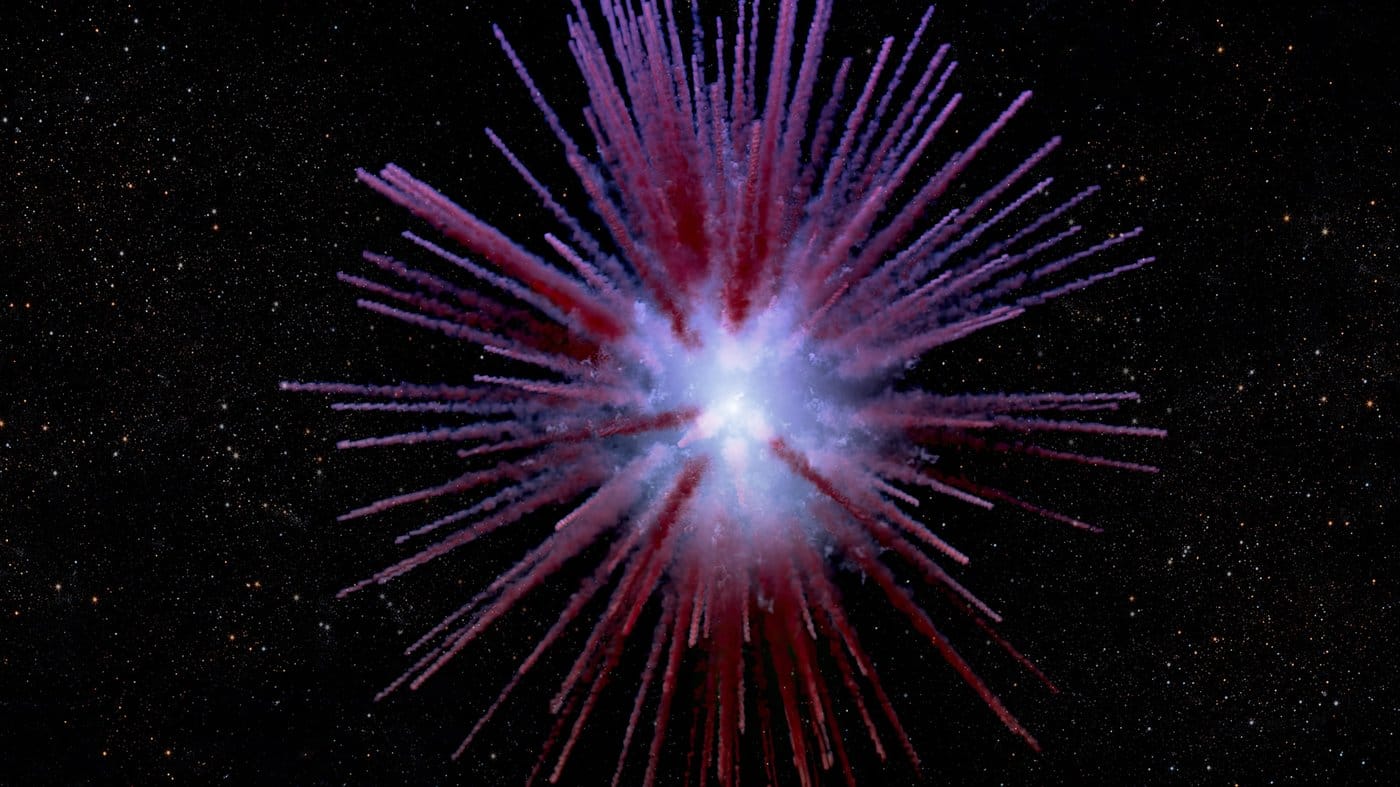
In 1181 CE, astronomers in China and Japan recorded a new, short-lived star in the constellation Cassiopeia. After burning for nearly six months, this historic supernova disappeared from the naked eye. It was only in 2013 that an amateur astronomer identified a nebula in the vicinity of that supernova, and, in the years since, astronomers have collected evidence that identifies the object, known as Pa 30, as the remnants of that 1181 supernova. Now, astronomers have mapped the supernova remnant, revealing an unusual dandelion-like structure (shown in an artist’s conception above and below). Filaments of sulfur project outward from a dusty central region that houses the remains of the original star. Normally, a supernova destroys its original star, but this was a Type Iax supernova, a “failed” explosion that left behind a hot, inflated star that may eventually cool into a white dwarf star.
Why the supernova remnant has this strange shape remains unclear. Scientists speculate that shock waves may have helped concentrate sulfur into these clumpy filaments. The material’s velocity suggests a ballistic trajectory (meaning, essentially, that it has neither sped up nor slowed down since the original explosion). Winding the trajectory backwards pegs their origin to 1181, helping confirm that Pa 30 is, indeed, the remains of that 1181 supernova. (Image and video credit: W.M. Keck Observatory/A. Makarenko; research credit: R. Fesen et al.; via Gizmodo)

“There is a crack in everything…”


When millimeter-sized drops of water infused with nanoparticles dry, they leave behind complex and beautiful residues. As water continues evaporating, the residues warp, bend, and crack. In this video, researchers set their science to the music of Leonard Cohen. The results resemble blooming flowers and flying water fowl. If you’d like to learn more about the science behind the art, check out the two open-access papers linked below. (Video and image credit: P. Lilin and I. Bischofberger; submitted by Irmgard B.; see also P. Lilin and I. Bischofberger and P. Lilin et al.)

How Magnetic Fields Shape Core Flows
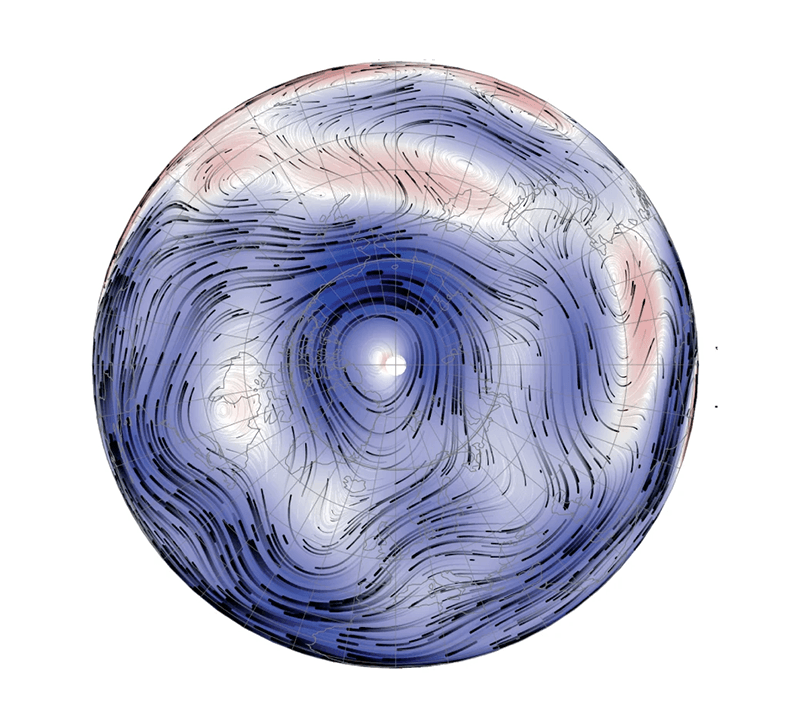
The Earth’s inner core is a hot, solid iron-rich alloy surrounded by a cooler, liquid outer core. The convection and rotation in this outer core creates our magnetic fields, but those magnetic fields can, in turn, affect the liquid metal flowing inside the Earth. Most of our models for these planetary flows are simplified — dropping this feedback where the flow-induced magnetic field affects the flow.
The simplification used, the Taylor-Proudman theorem, assumes that in a rotating flow, the flow won’t cross certain boundaries. (To see this in action, check out this Taylor column video.) The trouble is, our measurements of the Earth’s actual interior flows don’t obey the theorem. Instead, they show flows crossing that imaginary boundary.
To explore this problem, researchers built a “Little Earth Experiment” that placed a rotating tank (representing the Earth’s inner and outer core) filled with a transparent, magnetically-active fluid inside a giant magnetic. This setup allowed researchers to demonstrate that, in planetary-like flows, the magnetic field can create flow across the Taylor-Proudman boundary. (Image credit: C. Finley et al.; research credit: A. Pothérat et al.; via APS Physics)

Ember Bursts Spread Wildfires
In a wildfire, a burst of embers lofted upward can travel far, starting a new spot fire when they land. Although large ember bursts only happen occasionally, researchers found that these events — with orders of magnitude more embers than usual — play an outsized role in wildfire spread. In their experiments, researchers observed a bonfire with high-speed cameras to track ember bursts, and they also collected fallen embers from around their fire. They found large (>1 mm) embers could travel much further than current fire models predicted, carried by rare but powerful updrafts that coincided with large bursts. Their work indicates that wildfire models need a better way to simulate these kinds of events that are far from the fire’s baseline state but which occur often enough and with enough impact that they can spread fires. (Image credit: C. Cook; research credit: A. Peterson and T. Banerjee; via Physics World)

Seeking Mars’ Past
Although Mars is quite dry and inhospitable today, our rovers continue to search for evidence of a past Mars that could have sustained life. A recent study suggests that, at least in Gale Crater, the opportunities for life to flourish may have been short-lived. In particular, the team looked at carbonates found by the Curiosity rover. These minerals contain varying amounts of carbon and oxygen isotopes that can hint at the conditions the carbonates formed under. The team found a high proportion of heavier isotopes, which suggest one of two possible formation paths. In the first, Gale Crater underwent wet-dry cycles that alternated between more- and less-habitable conditions for life. The second possibility is a cryogenic past, where most of the local water was locked in ice, and life would have had to survive — if possible — in small pockets of extremely salty water. Neither possibility is a great one for the kinds of life we’re accustomed to. (Image credit: NASA; research credit: D. Burtt et al.; via Gizmodo)