Sandfish lizards can “swim” through granular flows like sand using an undulating, sinusoidal motion. Having studied this motion, engineers have built a robot that swims similarly through large glass beads and have now created a numerical simulation of the physics that matches the measured forces on the swimmer to within 8%. This type of flow is, in some respects, tougher than actual fluids because individual particles have to followed, while in most of fluid mechanics, we can use the continuum assumption to treat a liquid or gas as a continuous medium. #
Category: Research

Dancing Droplets
When a droplet falls onto a larger pool of the same liquid, it briefly sits on a layer of air that prevents coalescence. When that air drains away, the coalescence cascade–in which the droplet breaks into progressively smaller droplets until fully absorbed–begins. But if you vibrate the pool of liquid, the droplet bounces, effectively injecting more air between it and the pool. This prevents coalescence. What’s really neat here is that the researchers demonstrate this effect with arrays of droplets dancing in formation.
Geometrical Droplet Splashes
Sadly, this video shows no droplet impacts on a heart-shaped post, but maybe you can imagine what it would look like after seeing other geometrical shapes. Happy Valentine’s Day, guys!
Dr. Seussian Mystery Fluid Could Have Saved Top Kill
Dr. Seussian Mystery Fluid Could Have Saved Top Kill
Wired article about using non-Newtonian fluids to plug leaking oil wells as we featured previously.
Ants as a Fluid
The collective behavior of ants can mirror the flow of a viscous fluid. It would be interesting to see if any such parallels carry over to the flocking of birds or schooling of fish. The latter two behaviors are thought to increase aero- and hydrodynamic efficiency for the group. #

Plugging an Oil Leak
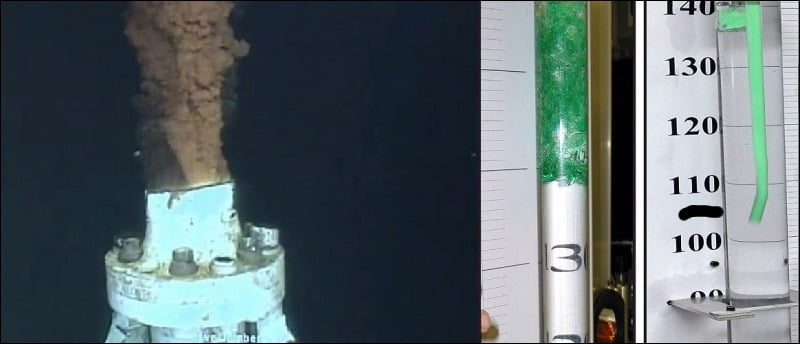
Recent research indicates that adding cornstarch to drilling mud increases the likelihood that a “top-kill” procedure will plug a leaking oil well. Adding cornstarch to water (or mud) turns it into a non-Newtonian fluid with viscoelastic properties that prevent the instabilities that lead to turbulent breakup. On the left, an underwater photo of the Deepwater Horizons leak; in the center, colored water breaks into turbulence when descending into oil; on the right, water with cornstarch maintains its coherence when pumped downward into the oil. # (PDF of research paper)

Wake of a Rising Sphere
This flow visualization shows the wake left by a freely rising sphere. Observations of rising and falling spheres date at least back to Newton, who observed that the inflated hog bladders he used “did not always fall straight down, but sometimes flew about and oscillated to and fro while falling”. That vibration is caused by the vortices seen here in the wake. There are actually four vortices shed per oscillation cycle–two primary vortices (marked P) and two secondary vortices (marked S). #
Frost on Superhydrophobic Surfaces
Frost formation and ice adhesion on superhydrophobic surfaces
For anyone with further interest in the ice formation on superhydrophobic surfaces story we posted recently, the published paper is currently offered by AIP for free. #

Chaos in Suspension
In science, the term chaotic is used to describe a system whose behavior is highly sensitive to initial conditions. This means that the end state can vary widely based on small changes at the start–also commonly known as the butterfly effect. Many fluid dynamical systems are chaotic, especially turbulent ones. Above are a series of photos showing the suspension of particles in a horizontally rotating cylinder. In parts A-D, the speed of rotation of the cylinder is increased, resulting in dispersion of the particles. As rotation rate is increased further, interesting concentration patterns form. #

Frosting on Superhydrophobic Surfaces
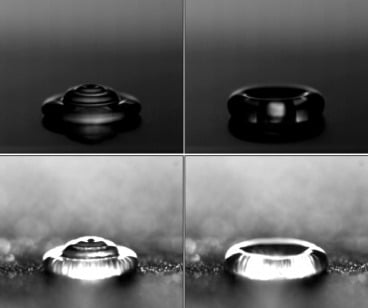
Icing on airplane wings can be disastrous for lift and control, and thus how ice initially forms on a wing is an active area of research. New work shows that superhydrophobic (water-fearing) surfaces may actually promote ice buildup. Superhydrophobic surfaces are prone to frosting–collecting ice that forms directly from a vaporous state–and that fine layer of frost is conducive to further ice buildup from a liquid state. The photo above shows a water droplet striking a dry superhydrophobic surface (top) and a frosted superhydrophobic surface (bottom). (via Gizmodo) #