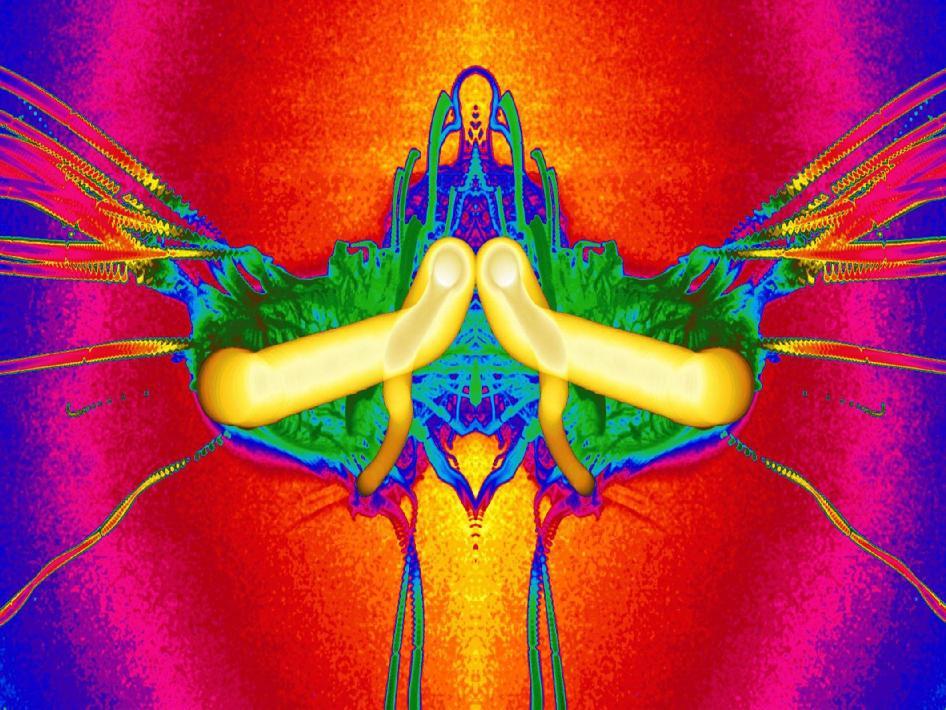
This computational fluid dynamics (CFD) simulation shows the start-up of a two-dimensional, ideal rocket nozzle. Starting a rocket engine or supersonic wind tunnel is more complicated than its subsonic counterpart because it’s necessary for a shockwave to pass completely through the engine (or tunnel), leaving supersonic flow in its wake. Here the situation is further complicated by turbulent boundary layers along the nozzle walls. (Video credit: B. Olson)
Category: Research

Microgravity Marangoni
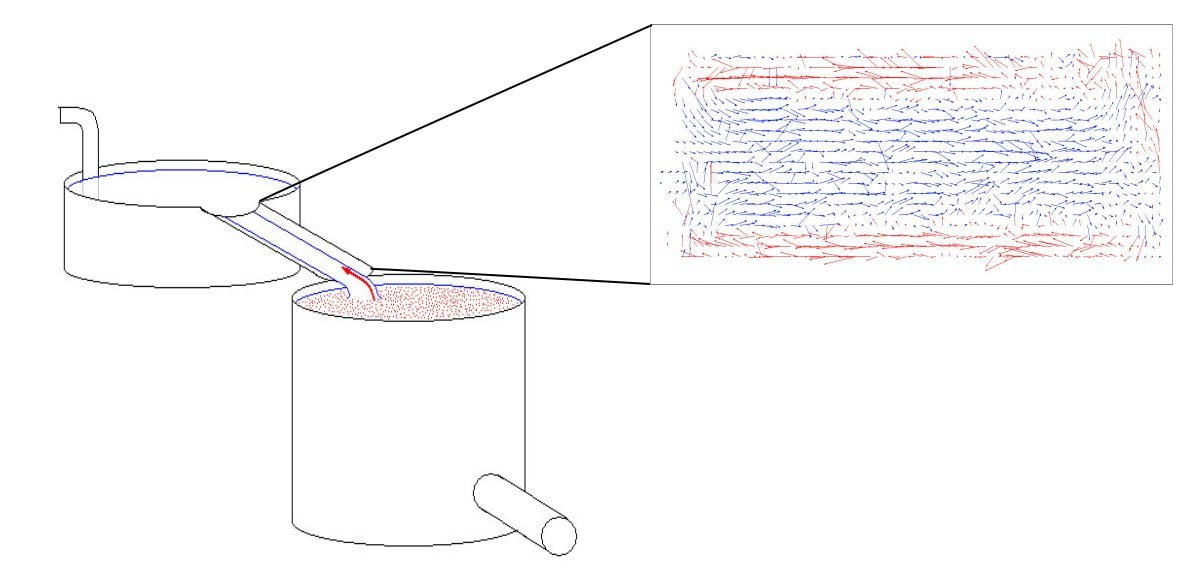
Astronauts are preparing an experiment on the Marangoni effect, in which a variation in surface tension can cause mass flow, for flight aboard the International Space Station. The effect, also responsible for causing tears of wine, will benefit from study in microgravity because competing effects like gravity-induced sedimentation and buoyant convection will be negligible. Astronaut Ron Garan reports more on the upcoming experiment on the Fragile Oasis blog.

Tubercles and Turbines
The flippers of humpback whales include bumps–called tubercles–on their leading edges. The tubercles create vortices that prevent the boundary layer from separating, which causes stall and a loss of lift. New research shows that adding similar bumps to the leading edge of tidal turbine blades results in greater energy production at low flow speeds compared to conventional designs. See Scientific American for more. #

Bristling Scales Give Sharks Speed
The shortfin mako shark is one of the ocean’s fastest and most agile hunters, thanks in part to flexible scales along its body. As water flows around the shark’s body, the scales bristle to angles in excess of 60 degrees. This causes turbulence in the boundary layer along the shark’s body and prevents boundary layer separation which would otherwise increase the shark’s drag. In this respect, the scales serve much the same purpose as dimples on a golf ball. (Abstract, National Geographic article) #

Pterosaur Aerodynamics
The pterosaur was an enormous prehistoric reptile that flew with wings of living membrane stretched over a single long bone, unlike any of today’s flying creatures. New research using carbon fiber wing analogues and wind tunnel testing suggests that the pterosaur would have been a slow, soaring flyer well adapted to using thermals for lift. Once on a thermal, the pterosaur could coast, perhaps for hours at a time, with little to no flapping necessary. See the research paper or the Scientific American article for more. #

Calcium Plasma on the Sun
This high-resolution photo of our sun shows the structure of calcium plasma on the surface of the sun. Plasmas are governed by the same physics as our familiar earthbound fluids but are also extremely sensitive to magnetic fields. Their branch of fluid dynamics is often referred to as magnetohydrodynamics (MHD), where the Navier-Stokes equations have to be solved in conjunction with Maxwell’s equations. (via Bad Astronomy)

Oil Chandeliers
What you see above is a composite of images of an oil droplet falling into alcohol from two different heights. The top row of images is from a height of 25 mm and the bottom from a height of 50 mm. The first droplet forms an expanding vortex ring which breaks down via the Rayleigh-Taylor instability due to its greater density than the surrounding alcohol. The second droplet impacts the alcohol with greater momentum and is initially deformed by viscous shear forces. Eventually it, too, breaks down by the Rayleigh-Taylor mechanism. This image is part of the 2010 Gallery of Fluid Motion. # (PDF)

Swimming in Corn Syrup
Highly viscous laminar flows exhibit kinematic reversibility, meaning: if you move the fluid one direction and then execute the same motion in the opposite direction, every fluid particle will return to its initial, undisturbed position. Above, you see a swimming device attempting to move through corn syrup by flapping. Because of this kinematic reversibility, it cannot propel itself. For the same reason, many microscopic organisms do not utilize flapping to move.