
Take a look at the physics of a pint of Guinness, including the formation of foam, the circulation of bubbles, and the importance of nitrogen and surfactants. The Physics of Fluids paper the host refers to is available here. (And, yes, I will admit to debating the physics occurring in my pint glass while in a pub.) # (via Martin)
Category: Research

Astronomical Jets
Researchers have pieced together Hubble images of jets from newborn stars into timelapse movies that reveal the interstellar fluid mechanics responsible for the formation of stars like our sun. These jets stream out clumps of matter that has fallen on the new star. When faster moving eddies impact slower ones, bow shocks can form, much like shockwaves running before an airplane. See more HD video of these jets and bow shocks here. #
Simulating Turbulence
Turbulent flows are complicated to simulate because of their many scales. The largest eddies in a flow, where energy is generated, can be of the order of meters, while the smallest scales, where energy is dissipated, are of the order of fractions of a millimeter. In Direct Numerical Simulation (DNS), the exact equations governing the flow are solved at all of those scales for every time step–requiring hundreds or thousands of computational hours on supercomputers to solve even a small domain’s worth of flow, as on the airplane wing in the video. Large Eddy Simulation (LES) is another technique that is less computationally expensive; it calculates the larger scales exactly and models the smaller ones. The video shows just how complicated the flow field can look. The red-orange curls seen in much of the flow are hairpin vortices, named for their shape, and commonly found in turbulent boundary layers.
How Coffee Rings Form
Coffee rings (an ubiquitous feature of academia) are formed by the deposition of particles as the liquid evaporates. When a coffee drop evaporates, capillary action draws the coffee particles toward the edges of the drop, where they congregate into a ring. Research now suggests that this is due to the spherical nature of the particles. Ellipsoidal particles, in contrast, clump together and result in a uniform stain once their carrier liquid evaporates. The effect seems to be due to the particles’ effects on surface tension; the ellipsoidal particles deform the surface of the droplet as it evaporates such that they are not pulled to the edges. Adding a surfactant, like soap, that decreases surface tension caused the ellipsoidal particles to form rings just as the spherical particles do. (submitted by Neil K) #

Underwater Cloaking
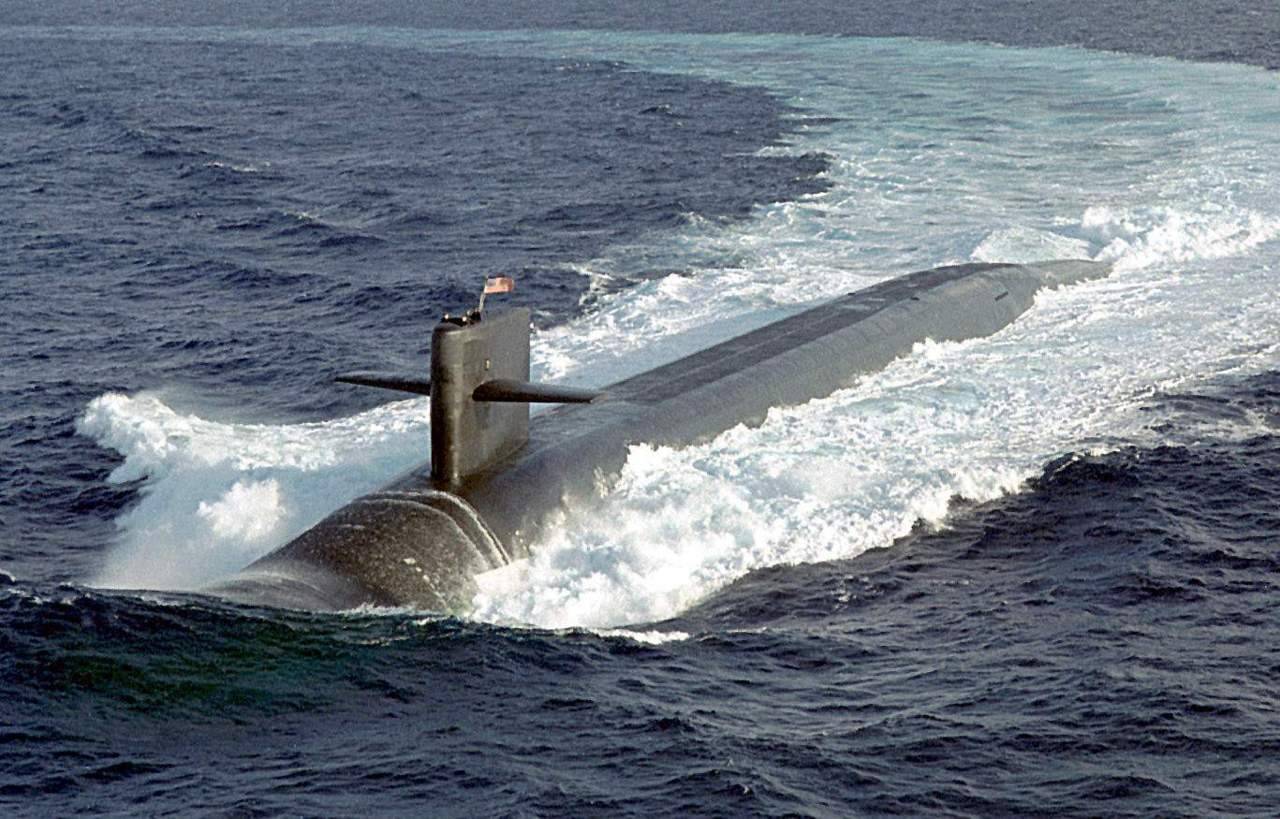
Researchers have suggested that it may be possible to cloak submerged objects as they move through a fluid using layers of mesh and micro-pumps. By redirecting the fluid so that it enters and leaves the mesh surrounding the object in the same speed and direction that it entered, it is theoretically possible to have zero drag and no wake. So far researchers have only simulated this set-up computationally using a sphere with 10 layers of mesh. It’s also unfortunately limited in size and speed: a vehicle 1 cm across could only remain wake-free at speeds below 1 cm/s. (Photo credit: Michael J Rinaldi) #
The Dance of Jets and Droplets
Placing a prism upside down in a bath of silicone oil creates a trapped bubble of air inside the prism. When oscillated above a critical amplitude, the corners of the prism, the oil, and the air perform an intricate dance of bubbles, singularities, jets, and droplets. Read more in the research paper. #
Glorious Coronal Mass Ejection
In early June, NASA’s Solar Dynamics Observatory recorded a stunning coronal mass ejection, in which larger than usual quantities of cool (relatively speaking) plasma erupted from the surface of the sun and rained back down along magnetic field lines. Plasma is an ionized gas-like state of matter subject to the same laws that govern more familiar fluids like water or air, with the additional caveat that, being electrically conductive, plasmas also obey Maxwell’s equations. #
Computational Shock Compression
[original media no longer available]
Computational modeling can help verify and visualize experimental results, as in this video of supersonic flow. Oak Ridge National Laboratory produced the work as part of a project using shock compression and turbines to capture carbon dioxide gas. Shock waves and velocity profiles are shown throughout the computational field, and velocity isosurfaces paint a telling portrait of the complicated flow pattern. Wired Science features other award-winning simulation videos, many of which also feature fluid dynamics. #
To Splash or Not to Splash?
Hydrophobic surfaces tend to repel water while hydrophilic ones attract it. This video explores the effects that hydrophobic and hydrophilic surface coatings can have on spheres when dropped in water. There are noticeable differences in splash formation and wake shape. For more, see this research paper.
Vertical Axis Wind Turbines
Conventional wind turbines feature horizontal axis propellers which must be placed far apart from one another to avoid wake interference. Researchers have found that using vertical axis wind turbines specially arranged to utilize the wake of one turbine to improve the efficiency of its neighbor can produce far more energy per square meter of land. The inspiration for this arrangement came from fish, which also derive benefits from the drafting that occurs in their schools. #
.jpg)