Smoke introduced into the boundary layer of a cone rotating in a stream highlights the transition from laminar to turbulent flow. On the left side of the picture, the boundary layer is uniform and steady, i.e. laminar, until environmental disturbances cause the formation of spiral vortices. These vortices remain stable until further growing disturbances cause them to develop a lacy structure, which soon breaks down into fully turbulent flow. Understanding the underlying physics of these disturbances and their growth is part of the field of stability and transition in fluid mechanics. (Photo credit: R. Kobayashi, Y. Kohama, and M. Kurosawa; taken from Van Dyke’s An Album of Fluid Motion)
Category: Research

Playing Pac-Man with Water Droplets
The vibrations of a plate in the horizontal and vertical directions can be used to control the motion of a drop placed on the surface. Here a droplet of water on a superhydrophobic surface is controlled by joystick a la Pacman. For more, see papers here and here.
Visualizing Fish Wakes
This novel flow visualization technique uses dilute solutions of the tobacco mosaic virus (TMV). These rod-shaped particles align with shear and produce a birefringent interference pattern visible when viewed between crossed polarizing filters. The intensity of the light is related to the magnitude of shear. The technique is benign to the fish but enables researchers to see fluid motion around fish that other techniques cannot capture. #

The Disintegrating Bowl
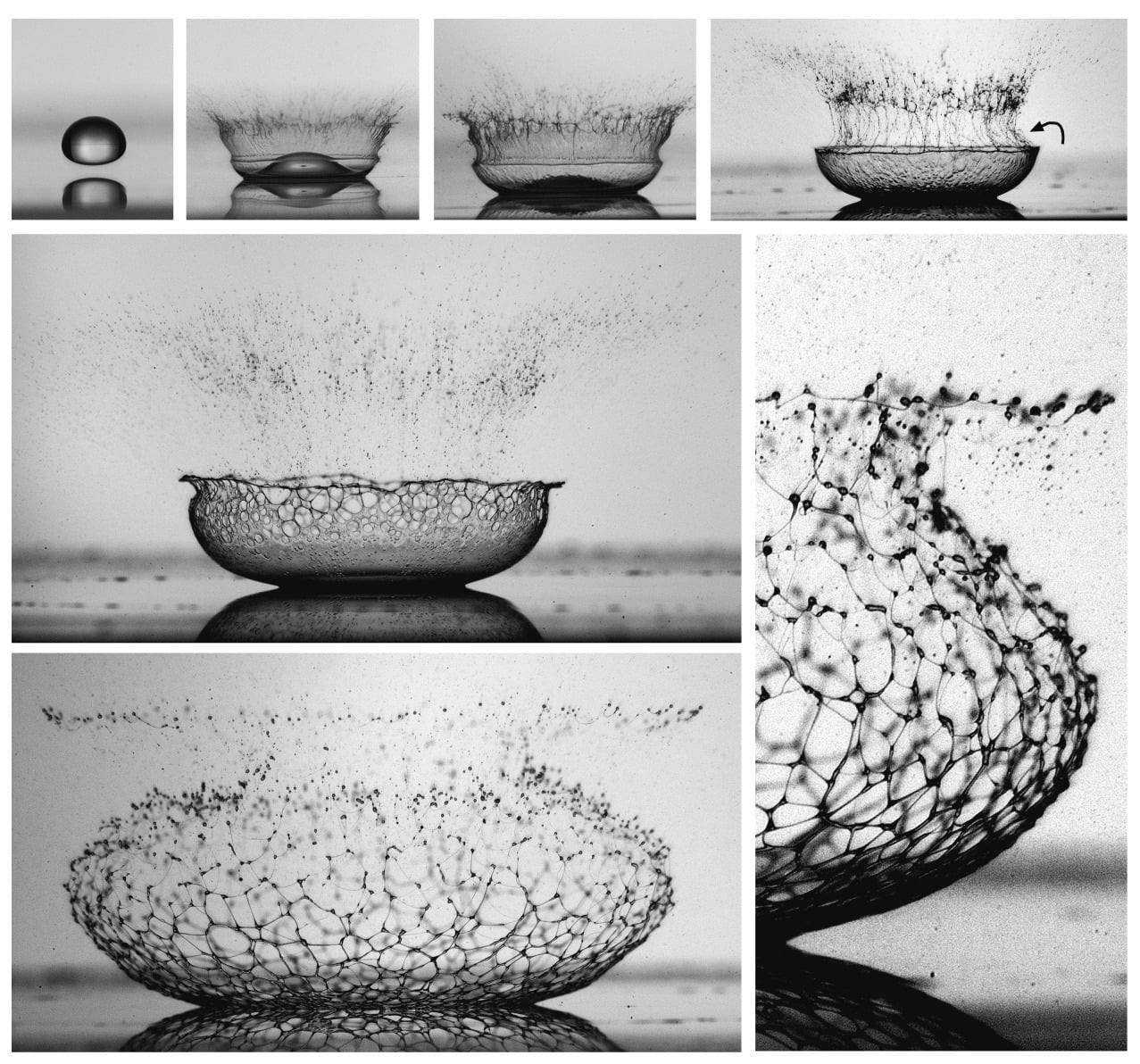
A viscous fluid droplet impacts a thin layer of ethanol, which has a lower surface tension than the viscous fluid. A spray of tiny ethanol droplets is thrown up while a bowl-shaped crown of the viscous fluid forms. As the ethanol droplets impact the bowl, the lower surface tension of the ethanol causes fluid to flow away from points of contact due to the Marangoni effect. This outflow causes holes to form in the crown, forming a network of thin fluid ligaments. For more, see this paper (PDF) and video. (Photo credit: S.T. Thoroddson et al)
Mapping Flames
Combustion remains a fascinating and only partially understood phenomenon. Here scientists work to map a flame in three dimensions using high-speed cameras and digital reconstruction. (submitted by Chi M)

Jump Rope Aerodynamics
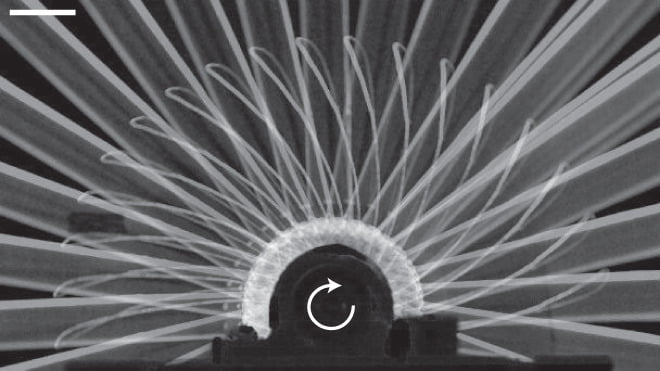
Researchers have used high-speed video and numerical simulation to capture the effects of aerodynamics on jump roping. After videoing an athlete jumping rope and constructing a jump roping robot (shown above imaged multiple times with a strobe light), they found that the U-shaped tip of the jump rope bends away from the direction of motion. When they built a computer model capable of deforming the jump rope based on its drag, they found the same behavior. They concluded that the “best” jump ropes are lightweight, short, and have small diameters to maximize speed and minimize the drag. #
Air Injection Patterns
This timelapse video demonstrates the pattern variations occurring when air is injected into a wet granular mixture in a Hele-Shaw cell. When the filling fraction–the percentage of the total volume between the glass sheets taken up by grains–is relatively small, the pattern formed by the injected air develops continuously and looks similar to Saffman-Taylor fingering seen in pure fluids. When the filling fraction is larger, however, the pattern forms in an intermittent fashion with new stick-slip bubbles of air forming as narrow sections of granular material slip and give way. #
Voyager Explores the Edge of the Solar System
Though unconventional by our terrestrial concepts of fluids, the solar wind and its interaction with objects in and around our solar system can be considered a form of fluid dynamics. This NASA video discusses discoveries made by the Voyager spacecrafts as they leave our solar system and pass into interstellar space. The solar wind, a rarefied stream of charged particles, streams outward from the Sun at supersonic speeds. Eventually, the pressure from the interstellar medium surrounding the solar system is sufficient to slow the solar wind to subsonic speeds, causing a termination shock much like the hydraulic jump that forms in a kitchen sink when you turn the faucet on.
Bullet Shock Wave and Cavitation
A 9mm bullet impacts a falling jet of water. High-speed video reveals the formation of a shock wave inside the jet. Because this shock wave is confined inside the jet, it causes strong secondary cavitation–the bubble that seems to explode in front of the bullet.