One of the joys of science is the sense of discovery that can come even from looking at something seemingly simple. Take, for example, a water droplet sitting on a plate. If you slowly tilt the plate, the droplet’s shape will shift until a critical angle where it starts sliding down the plate. But what happens to two initially different droplets? As this video shows, tilting two droplets of initially different shapes and returning them to horizontal causes the droplets to assume the same shape. There’s a universal behavior at work here–like nature has a kind of reset button that makes gravity and surface tension work together such that a droplet will assume a preferred shape. For an experimentalist, it’s certainly a handy way to create repeatable experiments! (Video credit: M. Musterd et al.)
Category: Research

Deforming Soap Films
It’s the time of year when new Gallery of Fluid Motion videos start popping up online. We’ve already featured several and no doubt there will be more to come. Today’s post is a submission from Saad Bhamla, who gave this introduction to the work:
Soap bubbles occupy the rare position of delighting and fascinating both young children and scientific minds alike. Sir Isaac Newton, Joseph Plateau, Carlo Marangoni and Pierre-Gilles de Gennes, not to mention countless others, have discovered remarkable results in optics, molecular forces and fluid dynamics from investigating this seemingly simple system.
This video is a compilation of curiosity-driven experiments that systematically investigate the surface flows on a rising soap bubble. From childhood experience, we are familiar with the vibrant colors and mesmerizing display of chaotic flows on the surface of a soap bubble. These flows arise due to surface tension gradients, also known as Marangoni flows or instabilities. In this video, we show the surprising effect of layering multiple instabilities on top of each other, highlighting that unexpected new phenomena are still waiting to be discovered, even in the simple soap bubble.
As illustrated in the video, raising a bubble beneath the soap film moves surfactants in the film, which causes local differences in surface tension. Any time a difference in surface tension exists, fluid will flow from areas of low surface tension to ones with higher surface tension. This is called the Marangoni effect. On a soap bubble, this is visible in the chaotic swirling colors we see. In this system, Bhamla and his co-author found that by raising the bubble in steps, they could “freeze” the Marangoni-induced patterns created by the previous motion. (Video credit and submission: S. Bhamla et al.)
Visualizing Vortices
Flow visualization can be a valuable tool for understanding fluid dynamics. In this video, we see how it can help elucidate the mechanisms of flapping flight. By dyeing vortices from the leading edge in red rhodamine and vortices from the trailing edge in green fluorescein, it’s possible to distinguish their competing effects for wings of different size. The speed and efficiency of a flapping wing depends on the vortices it sheds–these provide its lift and thrust. On a short wing, the leading edge vortex is significant and spins in a counter-clockwise (positive) direction. When it reaches the trailing edge, it meets a vortex spinning clockwise (negative). The interference of the two vortices weakens the shed vortex, thereby slowing the wing. Lengthening the wing weakens the leading edge vortex, which reduces its interference at the trailing edge and makes the longer wings more efficient. (Video credit: T. Mitchel et al.; via @AlbanSauret)

Nectar-Eating Bats


Nectar-eating bats have evolved to use several methods to drink. Some bats, like the Pallas’ long-tongued bat (top), use a lapping method. Hair-like papillae on the bat’s tongue increase the contact area with the nectar, helping to draw the fluid up in viscous globs as the bat repeatedly dips its tongue into the nectar. The orange nectar bat (middle and bottom), in contrast, has a tongue with a long central groove. This bat’s tongue stays submerged as it drinks. Researchers hypothesize that muscle action along the tongue, combined with capillary action in the narrow groove, allow the bat to actively pump nectar up to its mouth. It’s worth noting that the edges of the bat’s tongue do not curl around to touch, so the bat is definitely not using suction as one would with a straw. (Image credit: M. Tschapka et al., source)
Extinguishing Flames
Putting out fires can be a difficult, water-intensive task. In this video, scientists demonstrate how using a non-Newtonian fluid can make it easier to extinguish and suppress flames. Where water tends to splatter and scatter against an object, a yield-stress fluid can cling and coat to smother the flame. The fluid used here is water with a 0.1% polymer additive, which is enough to significantly change the fluid’s rheological properties. Pre-treating flammable objects with the fluid is also effective at suppressing combustion, raising additional possibilities for using such techniques in fighting the spread of wildfires. (Video credit: B. Blackwell et al.)
Pollock-Style Physics
Here on FYFD, we like to show off the artistic side of fluid dynamics. But some researchers are actively studying how artists use fluid dynamics in their art. In this video, they examine one of Jackson Pollock’s painting techniques, in which filaments of paint were applied by flinging paint off a paintbrush. Getting the technique to work requires a fine balance of forces and effects. Firstly, the paint must be viscous enough to hold together in a filament when flung. Secondly, the centripetal acceleration of the rotation must be high to both form the catenary filament and throw it off the brush. And, finally, the Reynolds number needs to be high enough to add some waviness and instability to the filament so that it looks interesting once it hits the canvas. Also be sure to check out the group’s previous work exploring Siqueiros’s painting techniques. (Video credit: B. Palacios et al.)

Flowing Water on Mars?


Scientists have known for years that Mars once had liquid water on its surface, and they have many contemporary examples of frozen water ice on the Red Planet. But this week NASA announced the strongest evidence yet that liquid water still flows on Mars. Researchers have observed from orbit dark line-like features called recurring slope lineae (RSL) that develop, darken, and grow seasonally in many locations on Mars. The appearance of these features coincides with warmer surface temperatures (above -23 degrees Celsius), and the lines fade again when temperatures cool. Although scientists suspected the dark lines might be related to flowing water, the evidence remained circumstantial until spectral observations of multiple sites indicated that the darker features contained hydrated salts. In other words, briny salt water is still flowing at or near the Martian surface. (Image credits: NASA)

Healing Soap Films
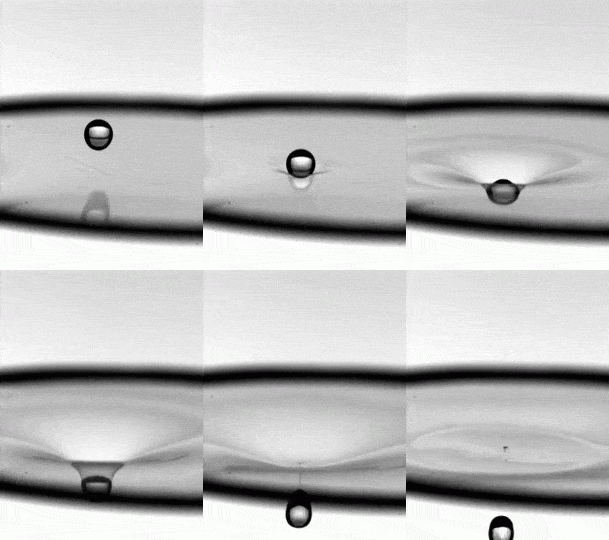
As fragile as a soap bubble seems, these films have remarkable powers of self-healing. The animation above shows a falling water droplet passing through a soap film without bursting it. An important factor here is that the water droplet is wet–passing a dry object through a soap film is a quick way to burst it, as those who have played with bubbles know. The droplet’s inertia deforms the soap film, creating a cavity. If the drop’s momentum were smaller, the film could actually bounce the droplet back like a trampoline, but here the droplet wins out. The film breaks enough to let the drop through, but its cavity quickly pinches off and the film heals thanks to the stabilizing effect of its soapy surfactants. (Image credit: H. Kim, source)
Miniature Bursting Bubbles
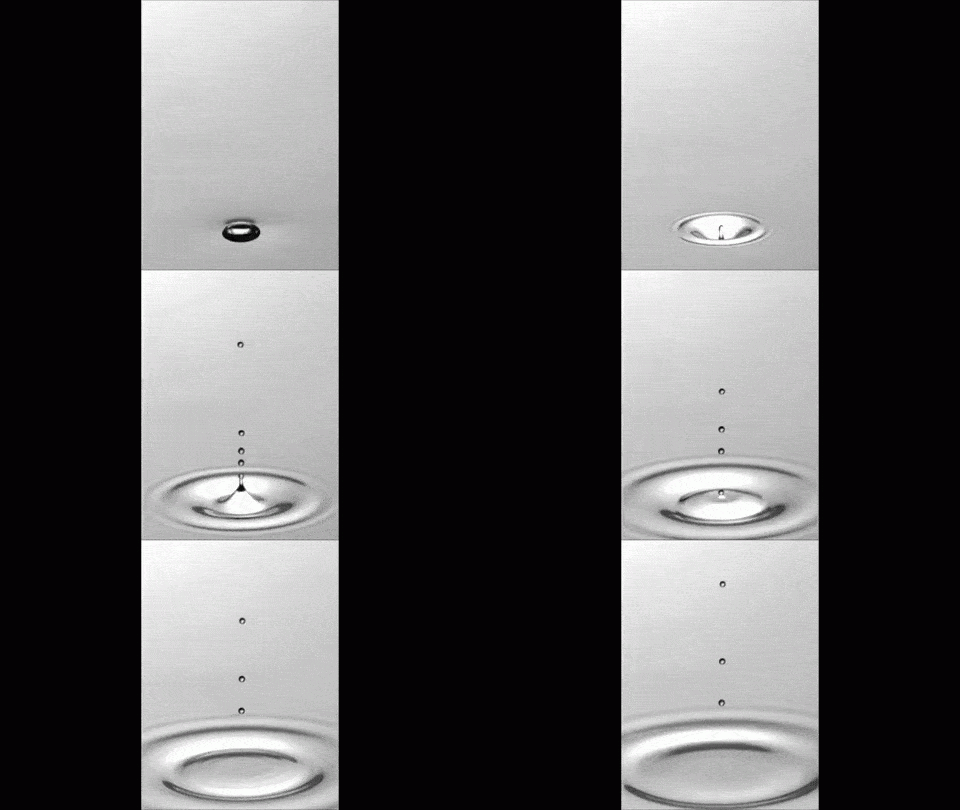
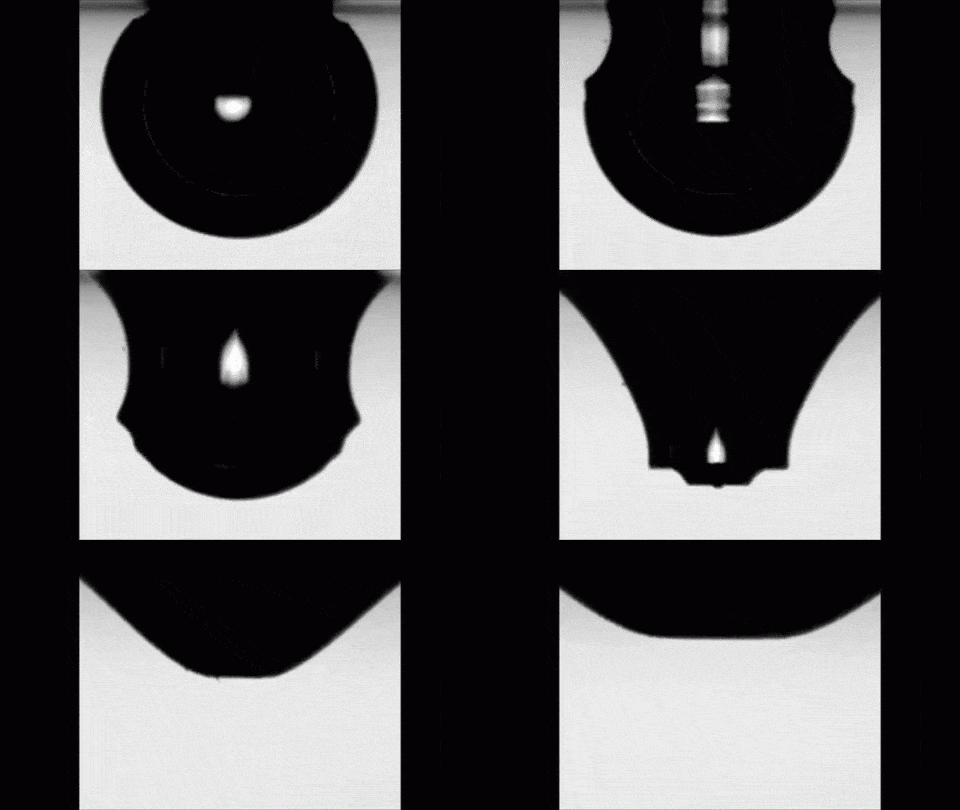
Fizzy drinks like soda or champagne contain dissolved carbon dioxide which forms bubbles when the pressure inside its container is released. The tiny bubbles rise to the surface where the liquid film covering them can rupture, creating a small cavity at the surface. The cavity collapses in a matter of milliseconds (bottom animation). Above the surface, the cavity reverses its curvature to create a liquid jet (top animation) which can expel multiple tiny droplets. These droplets can tickle a drinker who hovers too close, but they also carry and distribute the aroma molecules that are part of the experience of a drink like champagne. (Image credit: E. Ghabache et al., source)
(Today’s topic brought to you by my impending nuptials to my favorite physicist/spacecraft engineer.)
Printing in Glass
A group at MIT have created a new 3D printer that builds with molten glass. This allows them to manufacture items that would difficult, if not impossible, to create with traditional glassblowing or other modern techniques. One of the coolest aspects of this technique is that it can use viscous fluid instabilities like the fluid dynamical sewing machine to create different effects with the glass. You can see this around 1:56 in the video. Varying the height of the head and the speed at which it moves will cause the molten glass to fall and form into different but consistent coiling patterns. All in all, it’s a very cool application for using some nonlinear dynamics! (Video credit: MIT; via James H. and Gizmodo)