Category: Phenomena

  • Featured Video Play Icon

    Running Out of Sand?

    Headlines over the past few years have suggested that the world is running out of sand — specifically, that we’re running out of the angular sand grains preferred for concrete. Grady breaks down this idea in this Practical Engineering video, showing that the issue is more complicated than the shape of a sand grain. Yes, angular sand grains make stronger concrete than rounded ones for the same ingredient ratios. But concrete’s water content is also a major factor for strength, and rounded sand grains need less water to form a spreadable, workable concrete. Using less water also makes for stronger concrete.

    And though we may be short on some types of sand in certain places, sand is a manufacturable substance. We have machines and processes capable of breaking rocks into sand. It’s more a matter of choosing between the economics of mining and manufacturing. (Video and image credit: Practical Engineering)

  • Featured Video Play Icon

    The Taum Sauk Dam Failure and Its Legacy

    Managing an electrical grid is all about balancing the electricity that plants can supply with the instantaneous demands of consumers. If there’s more power available than people need, it needs to get stored somehow. And for decades, the best way to store that excess supply has been in hydroelectric reservoirs like at the Taum Sauk Dam. These facilities pump water to a reservoir at a higher elevation when there’s extra electrical power available, and, when more power is needed, release that water to run through hydroturbines.

    But storing water atop a mountain comes with unusual challenges for dam, and the 2005 failure of the Taum Sauk Dam facility highlights some important lessons for engineers. As Grady lays out in this Practical Engineering video, there was no single mistake that led directly to the dam’s failure. Instead, post-collapse investigations found a series of seemingly minor issues that, together, led to catastrophe. It’s well worth watching, especially for engineers; we could all use an occasional reminder that a “quick stopgap measure” isn’t enough. (Video and image credit: Practical Engineering)

  • Featured Video Play Icon

    Convection in Blue

    Convection cells like these are all around us — in the clouds, on the Sun, and in our pans — but we rarely get to watch them in action. Convection results from densities differing in different areas of a fluid. Under gravity’s influence, having a dense fluid over a lighter one is unstable; the dense fluid will always sink and the lighter one will rise. When that motion has to take place across a large surface area, we often end up with cells like the ones seen here.

    Convection cells in an alcohol-paint mixture.
    Convection cells in an alcohol-paint mixture.

    What drives the density differences in the fluid? That depends. Often there’s a temperature difference that drives warmer fluid to rise and cool fluid to sink. But that’s not always the source of convection. Evaporating a volatile chemical — like alcohol — out of a mixture can also create the density differences needed for convection. That may be the source of the convection we see here in a mixture of paint and alcohol. (Video and image credit: W. Zhu; via Nikon Small World in Motion)

  • Herding Sheep

    Herding Sheep

    Flocks of birds, schools of fish, and herds of sheep all resemble fluids at times, and physicists have been trying to recreate their collective motion for decades. Many of these models simplify the animals into particles that follow simple rules based on the direction and speed of their neighbors. Over time, the models have grown more complex; for example, some might differentiate a “sheepdog” particle from “sheep” particles. And some models even tweak the “sheep” to account for the personality traits that real sheep show, like how skittish they behave toward a sheepdog. Physics World has a neat overview of several studies in this vein. (Image credit: E. Osmanoglu; via Physics World)

  • Featured Video Play Icon

    Who Killed the Colorado River?

    From its source high in the snowy Rocky Mountains, the Colorado River runs through two countries and five states on its way to the Gulf of California. Or at least it used to. The river hasn’t met the sea in decades. All that water disappeared into a complicated web of poor management, short-sighted policies, and human infrastructure, as this video from PBS Terra explores. Unfortunately, while the details vary, this story is not unique, and many rivers around the world are no longer completing their journey. The good news is that we can still change that and rehabilitate the landscapes we’ve lost. (Video and image credit: PBS Terra)

  • Sea Ice Swirls

    Sea Ice Swirls

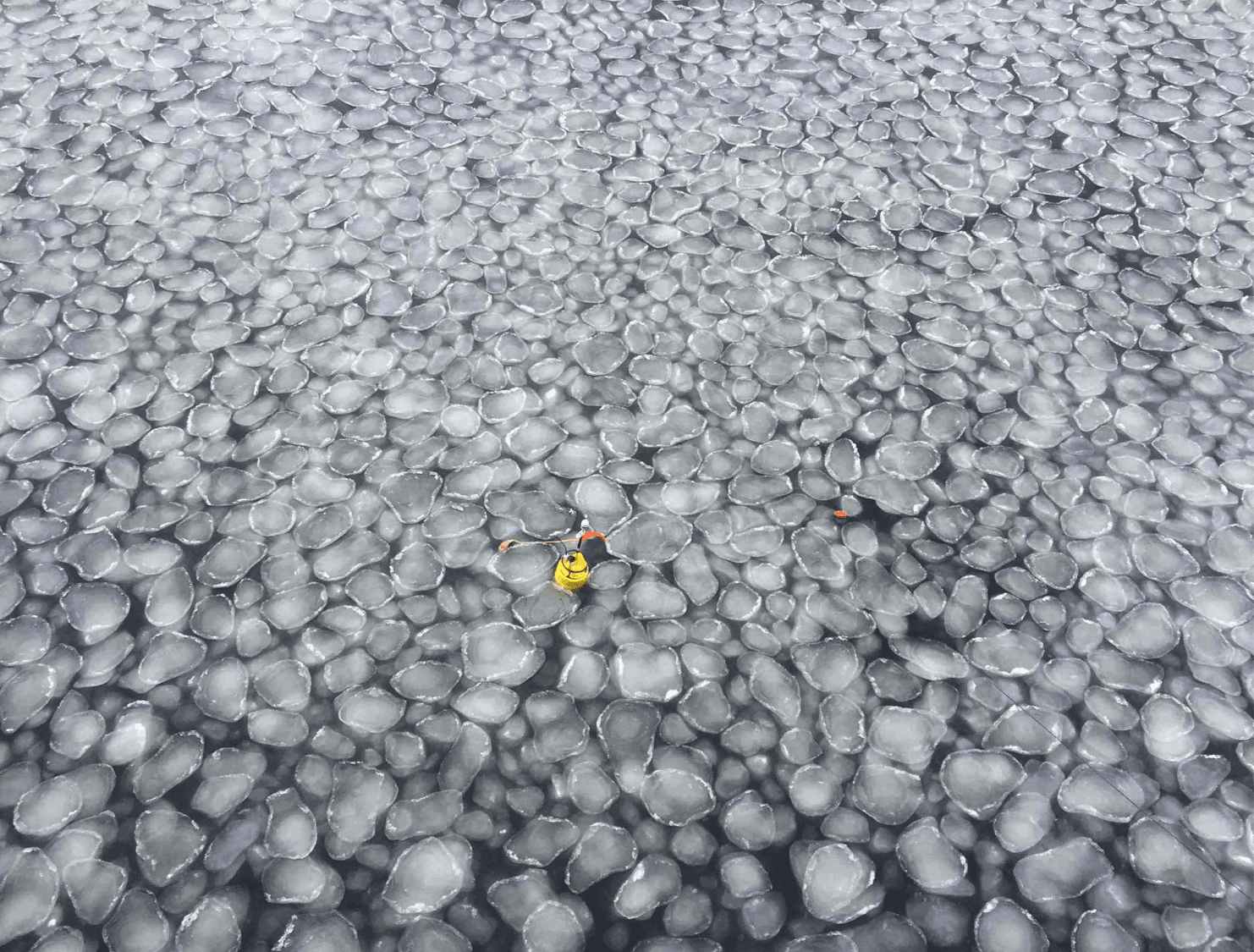
    Fragments of sea ice tumble and swirl in this satellite image of Greenland’s east coast. In spring, Arctic sea ice journeys down the Fram Strait between Greenland and Svalbard. Along the way, large ice floes break — and melt — into smaller pieces. Large pieces of sea ice are visible closer to the coastline, but the smaller individual floes get, the wispier they appear in the satellite image. In the haziest portions of the image, the ice may be only meters across. In recent years, less and less Arctic sea ice has survived the journey southward, shifting the temperature and salinity of Arctic contributions to global ocean circulation. (Image credit: W. Liang; via NASA Earth Observatory)

  • A Comet’s Two Tails

    A Comet’s Two Tails

    The bright tail of a comet doesn’t actually stream out behind it. Instead, the tail points away from the sun, showing off all the ice, dust, and gas blown off the comet by the solar wind. Because the tail is tied to the sun’s direction and not the comet’s trajectory, comets sometimes have a second tail, called the anti-tail. The anti-tail consists of material that came off the comet previously, so it does mark the comet’s previously traveled path. In this image of Comet Tsuchinshan-ATLAS from October 2024 the dimmer anti-tail points opposite of the brighter tail. That means the comet’s direction of travel is diagonally upward, from right to left. Since that aligns with its bright tail, we can tell that the comet is moving away from the sun in this photo. (Image credit: B. Fulda; via APOD)

  • Erie Algal Bloom

    Erie Algal Bloom

    Blue-green algae bloom in Lake Erie’s summer conditions. Unfortunately for those looking to spend summer on the water, the dominant organism in this bloom produces a toxin that “can cause liver damage, numbness, dizziness, and vomiting.” Bloom season can last from late June into October, depending on the how many nutrients get washed into the lake and when wind mixes the lake water in the fall. A new hyperspectral instrument aboard NASA’s PACE spacecraft will identify bloom species from space, helping scientists track, understand, and predict blooms like these. (Image credit: W. Liang; via NASA Earth Observatory)

  • Featured Video Play Icon

    Marangoni Blossoms

    When surface tension varies along an interface, fluids move from regions of low surface tension to higher surface tension, a behavior known as the Marangoni effect. Here, a drop of (dyed) water is placed on glycerol. The two fluids are miscible, but water has much a lower viscosity and density yet a higher surface tension. The drop’s interface quickly becomes unstable; viscous fingers form along the edge as the less viscous water pushes into the more viscous glycerol. Eventually, the surface-tension-driven Marangoni flow breaks those fingers off into lip-like daughter drops. The researchers also show how the interplay between viscosity and surface tension affects the size of fingers that form by varying the water/glycerol concentration. (Image and video credit: A. Hooshanginejad et al.)

  • Featured Video Play Icon

    A Plasma Arc Lights

    Plasma lighters — as their name indicates — use plasma in place of burning butane. Plasma — our universe’s most common state of matter — is a gas that’s been stripped of its electrons, ionizing it so that it’s electrically and magnetically active. In these lighters (as well as other plasma generators), a high-voltage current jumps between two nodes to ignite the spark. In effect, it’s a tiny lightning bolt you can hold in your hand. (Though I don’t recommend that you try to literally hold it; plasma burns suck.) (Video and image credit: J. Rosenboom; via Nikon Small World in Motion)

    An arc of plasma from a plasma lighter.
    An arc of plasma from a plasma lighter dances.