Category: Phenomena

  • Featured Video Play Icon

    How CO2 Gets Into the Ocean

    Our oceans absorb large amounts of atmospheric carbon dioxide. Liquid water is quite good at dissolving carbon dioxide gas, which is why we have seltzer, beer, sodas, and other carbonated drinks. The larger the surface area between the atmosphere and the ocean, the more quickly carbon dioxide gets dissolved. So breaking waves — which trap lots of bubbles — are a major factor in this carbon exchange.

    This video shows off numerical simulations exploring how breaking waves and bubbly turbulence affect carbon getting into the ocean. The visualizations are gorgeous, and you can follow the problem from the large-scale (breaking waves) all the way down to the smallest scales (bubbles coalescing). (Video and image credit: S. Pirozzoli et al.)
    Fediverse Reactions
  • Featured Video Play Icon

    A Pitcher Plant’s Rain-Triggered Trap

    Pitcher plants all use slippery rims and sticky digestive juices to capture and trap their insect prey. But two species of pitcher plant independently evolved an extra trap: a rain-activated springboard lid. Both the Seychelles pitcher plant and the slender pitcher plant — separated geographically by 6000 kilometers — have a springy, near-horizontal “lid” that sticks out over their pitcher. The underside of the surface is slippery, though less so than the pitcher’s lip and walls. Unsuspecting ants crawl under the lid, confident that they can keep their footing, and then — bang — a rain drop hits the springboard. That impact catapults the insect directly into the drink. There’s no escaping now.

    How did two widely separated, independently evolving plants both settle on this technique? Scientists think it was random chance. Pitcher plants are highly variable in their pitcher size, shape, and features. The scientists suggest that by trying lots of random combinations, these two species hit upon a particular arrangement that works really well for them. (Video and image credit: Science)

    Fediverse Reactions
  • Instabilities in Competition

    Instabilities in Competition

    When two liquid jets collide, they form a thin liquid sheet with a thicker rim. That rim breaks into threads and then droplets, forming a well-known fishbone pattern as the Plateau-Rayleigh instability breaks up the flow. This poster shows a twist on that set-up: here, the two colliding jets vary slightly in their velocities. That variability adds a second instability to the system, visible as the wavy pattern on the central liquid sheet. The sheet’s rim still breaks apart in the usual fishbone pattern, but the growing waves in the center of the sheet eventually that structure apart as well. (Image credit: S. Dighe et al.)

    Fediverse Reactions
  • Featured Video Play Icon

    Mapping the Oceans With Seals

    Elephant seals are harbingers — canaries in the coal mine — for climate change. A long-running experiment tracks northern elephant seal populations using a combination of sensor tags and field measurements. With the miniaturization of sensors, a tagged seal can provide a wealth of data for scientists: foraging paths, temperature and salinity data, behavioral patterns, ecological data, and even information on the species around the seal. This video delves into this treasure trove, explaining how and what we’re learning from this species, especially as they navigate our changing climate. (Video and image credit: Science)

    Fediverse Reactions
  • The Underwater Effects of Volcanoes

    The Underwater Effects of Volcanoes

    Although volcanoes are typically located in or near the ocean, we’ve spent relatively little effort studying how eruptions affect the marine environment. A recent research voyage aimed to change that by studying the Patagonian Sea near the site of the 2008 Chaitén eruption. Marked by massive ashfalls that, when mixed with heavy rains, created huge mudslides, the 2008 eruption was the Chaitén volcano’s first in 9,000 years.

    The researchers mapped the seafloor near the volcano, finding massive dunes shaped by strong currents. Using a remotely operated vehicle, the team surveyed and sampled the seafloor, collecting sediments reaching back some 15,000 years. They also located ash from the 2008 eruption over 24 kilometers from the volcano. With their data, they hope to understand both how the recent eruption changed the marine environment as well as how older eruptions affected the area. (Image credits: volcano – USGS, dunes – Schmidt Ocean Institute; see also Schmidt Ocean Institute; via Ars Technica)

    Composite image showing the massive underwater dunes off the coast.
    Composite image showing the massive underwater dunes off the coast.

    P.S. – This Friday, January 24th from 12 to 1:30pm Eastern I’m moderating a panel discussion on the Traveling Gallery of Fluid Motion and how art and science can work together in public outreach. Register here to join. It’s free!

    Fediverse Reactions
  • Featured Video Play Icon

    The Mystery of the Binary Droplet

    What goes on inside an evaporating droplet made up of more than one fluid? This is a perennially fascinating question with lots of permutations. In this one, researchers observed water-poor spots forming around the edges of an evaporating drop, almost as if the two chemicals within the drop are physically separating from one another (scientifically speaking, “undergoing phase separation“). To find out if this was really the case, they put particles into the drop and observed their behavior as the drop evaporated. What they found is that this is a flow behavior, not a phase one. The high concentration of hexanediol near the edge of the drop changes the value of surface tension between the center and edge of the drop. And that change is non-monotonic, meaning that there’s a minimum in the surface tension partway along the drop’s radius. That surface tension minimum is what creates the separated regions of flow. (Video and image credit: P. Dekker et al.; research pre-print: C. Diddens et al.)

  • Blooming in Blue

    Blooming in Blue

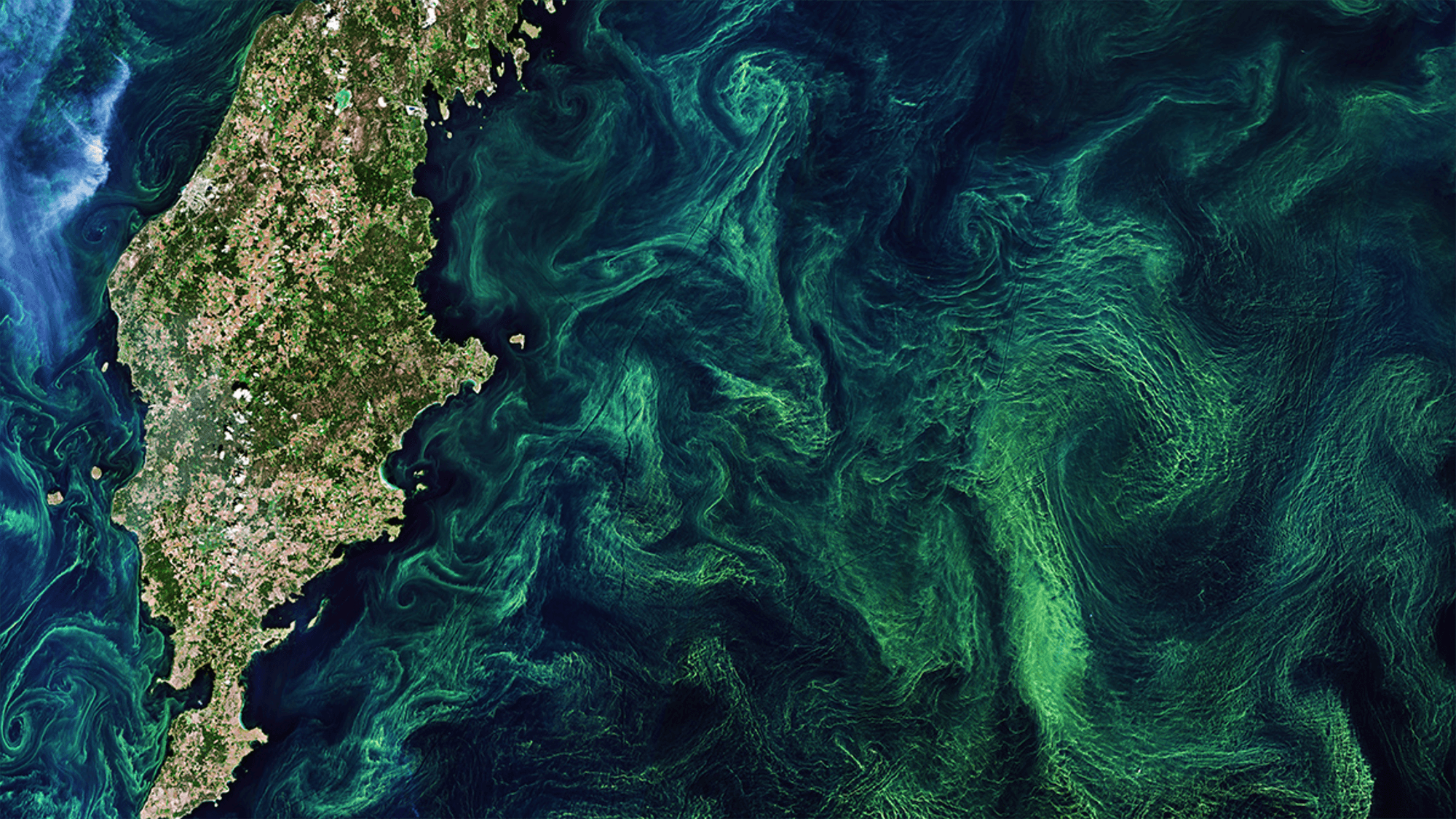
    Summers in the Barents Sea — a shallow region off the northern coasts of Norway and Russia — trigger phytoplankton blooms like the one in this satellite image. The blue shade of the bloom suggests the work of coccolithophores, a type of plankton armored in white calcium carbonate. This type of plankton thrives in the warm, stratified waters of the late summer. Earlier in the year, the water tends to be nutrient-rich and well-mixed, conditions which favor diatom plankton species instead. Their blooms appear greener in satellite images. (Image credit: W. Liang; via NASA Earth Observatory)

    Fediverse Reactions
  • Featured Video Play Icon

    Cavitation Near Soft Surfaces

    Collapsing cavitation bubbles are sometimes used to break up kidney stones, and they may find other uses in medicine as well. Here, researchers investigate the collapse of laser-triggered cavitation bubbles near tissue-mimicking hydrogel. The bubbles take on a very different form than they do near solid surfaces. Near hydrogel, the bubbles become mushroom-shaped. During their collapse, they release a rainy microjet that moves at nearly 2,000 meters per second! Even at 5 million frames per second, the jet is practically a blink-and-you-miss-it phenomenon. (Image and video credit: D. Preso et al.)

    Fediverse Reactions
  • Featured Video Play Icon

    How Cooling Towers Work

    Power plants (and other industrial settings) often need to cool water to control plant temperatures. This usually requires cooling towers like the iconic curved towers seen at nuclear power plants. Towers like these use little to no moving parts — instead relying cleverly on heat transfer, buoyancy, and thermodynamics — to move and cool massive amounts of water. Grady breaks them down in terms of operation, structural engineering, and fluid/thermal dynamics in this Practical Engineering video. Grady’s videos are always great, but I especially love how this one tackles a highly visible piece of infrastructure from multiple engineering perspectives. (Video and image credit: Practical Engineering)

    Fediverse Reactions
  • Jets, Shocks, and a Windblown Cavity

    Jets, Shocks, and a Windblown Cavity

    As material collapses onto a protostar, these young stars often form stellar jets that point outward along their axis of rotation. Made up of plasma, these jets shoot into the surrounding material, their interactions creating bright parabolic cavities like the one seen here. This is half of LDN 1471; the protostar’s other jet and cavity are hidden by dust but presumably mirror the bright shape seen here. (The protostar itself is the bright spot at the parabola’s peak.) Although the cavity is visibly striated, it’s not currently known what causes this feature. Perhaps some form of magnetohydrodynamic instability? (Image credit: NASA/Hubble/ESA/J. Schmidt; via APOD)

    Fediverse Reactions