Category: Phenomena

  • Martian Auroras

    Martian Auroras

    Auroras happen when energetic particles — usually from the solar wind — interact with the atmosphere. Here on Earth, they’re most often found near the poles, where our strong global magnetic field converges, funneling particles down from space. Our neighbor Mars has no global magnetic field. Instead, its magnetic field is a hybrid of two sources: 1) induced magnetism from electric currents in the ionosphere and 2) patches of magnetized iron-rich crust. Together, they form an uneven and changeable field that deflects the solar wind less than one Mars radius above the planet’s surface. In contrast, Earth deflects the solar wind about 10-20 Earth radii away.

    Discrete auroras (left panel) occur when electrons plunge down into the atmosphere on magnetic lines coming from Mars’ patchy crust. Global diffuse auroras (center panel) are caused by energetic solar storms that light up the whole atmosphere, sometimes for days at a time. In proton auroras (right panel), incoming solar protons steal electrons from native Martian hydrogen to form high-energy hydrogen atoms that cannot be magnetically deflected. Instead, they penetrate the planet’s bow shock and plunge into the atmosphere, creating a daytime aurora. (Image credit: UAE Space Agency/EMM/EMUS and NASA/MAVEN/IUVS; via Physics Today)

  • Featured Video Play Icon

    Breaking Down a Water-Powered Timer

    In his latest “cutaway” video, Steve Mould takes a look at how you can nest siphons to create a system that periodically flushes itself. This kind of water-powered timer is useful in, say, public restrooms with a urinal system that collectively flushes every once in a while. In the video, Mould talks through each step of the system and some of the challenges he ran into when trying to create a pseudo-2D version of it. As is often the case with these videos, it’s a strangely satisfying process to watch. (Video and image credit: S. Mould)

  • A Triangular Prominence

    A Triangular Prominence

    Our Sun is a maelstrom of light and heat, a constant battlefield for plasma and magnetic fields. This recent prominence, captured by Andrea Vanoni and others, bore a striking triangular shape. This fiery outburst — larger than our entire planet — formed and broke up over the course of a single day. The wavy solar surface features in the lower part of the image are solar fibrils, magnetically confined tubes of hot plasma. What changing magnetic fields might allow them to burst forth in a glorious candle of their own? (Image credit: A. Vanoni; via APOD)

  • Featured Video Play Icon

    The Art of French Drains

    Civil engineers face a constant challenge trying to protect their structures from water — both above and below the ground. Subsurface water can build up enough pressure to lift and damage structures, so engineers use subsurface infrastructure — like French drains — to control the water underground. Despite the name (and my title pun), French drains have nothing to do with France. Instead, they are named for Henry French, an author who described their construction and use in the 19th century. These drains use a combination of rocks, mechanical filters, and perforated pipeline to guide subsurface water and drain it away from foundations. (Video and image credit: Practical Engineering)

  • Featured Video Play Icon

    Engineering the City of Venice

    In 452, Roman refugees established what became the city of Venice across a series of low-lying marshy islands in a lagoon. With no solid ground available, Venice has needed clever engineering for its infrastructure, as discussed in this Primal Space video. That started with building the first piles — which still survive to this day — by driving long timbers down into harder clay levels. Because these wooden poles sit entirely below the water and are capped with stone foundations, they are preserved against rotting.

    As Venice grew over the next thousand years, its citizens had other infrastructure problems to solve. When fresh water needs outstripped what could be delivered by boat from the mainland, Venetians redesigned the substructure of each square to capture, filter, and store rainwater. And to wash away waste, they designed tunnels that use gravity and the daily tides to flush out sewage. (Video and image credit: Primal Space)

  • Swirls of Green and Teal

    Swirls of Green and Teal

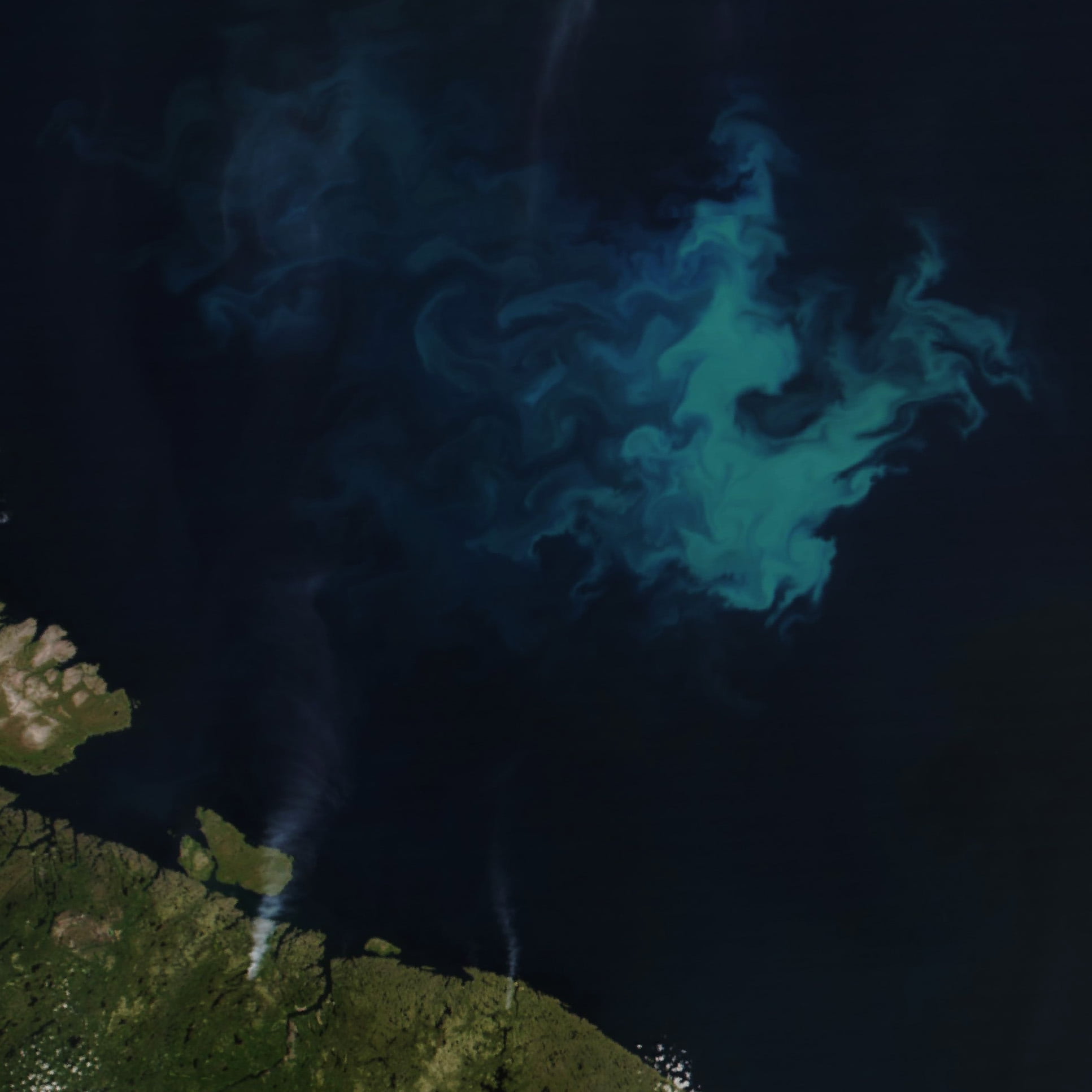
    Captured in March 2024, this satellite image of the Gulf of Oman comes from an instrument aboard the PACE spacecraft. The picture of a phytoplankton bloom is not quite natural-color, at least not as our eyes would see it. Instead, engineers combined data taken from multiple wavelengths and adjusted it to bring out the fine details. It’s not what we’d see by eye, but every feature you see here is real.

    Traditionally, the only way to identify the species of a phytoplankton bloom like this one is by taking a sample directly. But PACE’s instruments can detect hundreds of wavelengths of light, offering enough color detail that scientists may soon be able to identify and track phytoplankton species by satellite image alone. I wonder if distinguishing species could also provide some quantitative flow visualization from a series of these images. In the meantime, at least we can enjoy the view! (Image credit: J. Knuble; via NASA Earth Observatory)

  • Origins of Salt Polygons

    Origins of Salt Polygons

    Around the world, dry salt lakes are crisscrossed by thousands of meter-wide salt polygons. Although they resemble crack patterns, these structures are actually the result of convection occurring in the salty groundwater beneath the soil. I have covered the physics previously, but this new article by several of the researchers gives a behind-the-scenes glimpse of the investigation itself and how they uncovered the true explanation. (Image credit: S. Liu, see also: Physics Today)

  • Gigantic Jets

    Gigantic Jets

    Stormy skies feature much more than the forked cloud-to-ground lightning we’re used to seeing. This composite image shows a rare and recently-recognized type of lightning known as a gigantic jets. This type of lightning travels from the top of thunderclouds, around 16 km in altitude, up to the ionosphere at about 90 km. Their bottoms look a bit like blue jets, while their upper reaches look like red sprites, two other types of unusual lightning. The mechanism behind gigantic jets is a topic of ongoing research, but your best chance at seeing them is watching a distant thunderstorm from a clear vantage. (Image credit: Li X.; via APOD)

  • Featured Video Play Icon

    “Plants That Explode”

    We often think of plants as passive and stationary, but the truth is that some plants move faster than we can even see. In this “True Facts” video, Ze Frank takes a look at a whole host of fast-moving plants, including horsetail plant spores that walk and jump, trebuchet-like bunchberry dogwood, vortex-ring-shooting moss, and moisture-driven self-digging seeds. These plants all use clever mechanisms that leverage water to spread the plant’s reproductive material at little to no energy cost to the plant itself. (Video and image credit: Z. Frank)

  • Trapped in a Taylor Column

    Trapped in a Taylor Column

    The world’s largest iceberg, A23a, is stuck. It’s not beached; there are a thousand meters or more of water beneath it. But thanks to a quirk of the Earth’s rotation, combined with underwater topology, A23a is stuck in place, spinning slowly for the foreseeable future. A23a is trapped in what’s known as a Taylor column, a rotating column of fluid that forms above submerged objects in a rotating flow. You can see the same dynamics in a simple tabletop tank.

    Pirie Bank sticks up from the seafloor, which sets up a stationary column of rotating water that iceberg A23a is now stuck in.
    Pirie Bank sticks up from the seafloor, which sets up a stationary column of rotating water that iceberg A23a is now stuck in.

    When a tank (or planet) is rotating steadily, there’s little variation in flow with depth. With an obstacle at the deepest layer — in this case, an underwater rise known as the Pirie Bank — water cannot pass through that lowest layer. And that deflection extends to all the layers above. The water above Pirie Bank just stays there, as if the entire column is an independent object. Caught inside this region, A23a will remain imprisoned there. How long will that last? There’s no way to know for sure, but a scientific buoy in another nearby Taylor column has been hanging out there for 4 years and counting. (Image credit: A23a – D. Fox/BAS, diagram – IBSCO/NASA; via BBC News; submitted by Anne R.)