If your Christmas holiday was a little too green (like mine was), Science Friday has just the activity for you – grow your own snowflakes! With a few materials you probably already have and some dry ice from the store, you can grow and observe ice crystals at home. Although these crystals form from water vapor instead of water droplets like proper snowflakes, they do exhibit different structures depending on temperature and humidity, just the way natural snowflakes do. (Video credit: Science Friday/F. Lichtman)
Category: Phenomena

Growing Snowflakes
It’s easy to miss the beauty of a snowflake if you don’t take a close look. These tiny crystals form when water freezes onto a dust particle or other nucleation site, and they grow as water vapor freezes on to the nucleus. The structured appearance of a snowflake comes from the bonds formed between water molecules, but the exact type and shape of crystal formed–not all snowflakes are six-sided!–depends on the local temperature and humidity during freezing. This microscopic timelapse video by Vyacheslav Ivanov lets you watch the process in action. (Video credit: V. Ivanov; via io9)

Stepping on Lava
What happens when you step on lava? (First off, don’t try this yourself.) Lava is both very dense and very viscous, so, as illustrated in the animation above, it does not give all that much under pressure. If you were to fall on it, you’d land, sink a little bit, and then get burned. It’s also interesting to note that the lava springs back after being indented. Basaltic lava like that found in Hawaii, where this clip originates, does have viscoelastic properties, which might explain the elasticity of the deformed fluid. (Image credit: A. Rivest, source video; via Gizmodo)
Simplified Schlieren Set-up
Schlieren photography offers a glimpse into flows that are usually invisible to the human eye. With a relatively simple set-up–a light source, collimating mirror(s), and a razor blade–it becomes possible to see differences in density. The technique lets one visualize temperature-driven flows like the buoyant convection from a flame or other heat source, and it can also be used to visualize shock waves and sound. The video above has several neat schlieren demos, including some non-air examples using hydrogen (lighter than air) and sulfur hexafluoride (denser than air), both of which are transparent to the naked eye. (Video credit: Harvard University, via Jennifer Ouellette)
Foggy Canyon
Timelapse photography reveals the tide-like motions of fog that filled the Grand Canyon last week. This unusual meteorological condition was created by a temperature inversion. Usually air near the ground is warmest and the atmosphere cools as the altitude increases. But occasionally a mass of warm air will trap a layer of cooler air beneath it. In the case of the Grand Canyon, cool foggy air was capped by a warmer air mass, resulting in a sea of fog. Depending on the conditions, temperature inversions can create other distinctive weather patterns like cloud streets or even supercell thunderstorms. (Video credit: Vox; via Flow Visualization)

Phytoplankton Flow Viz
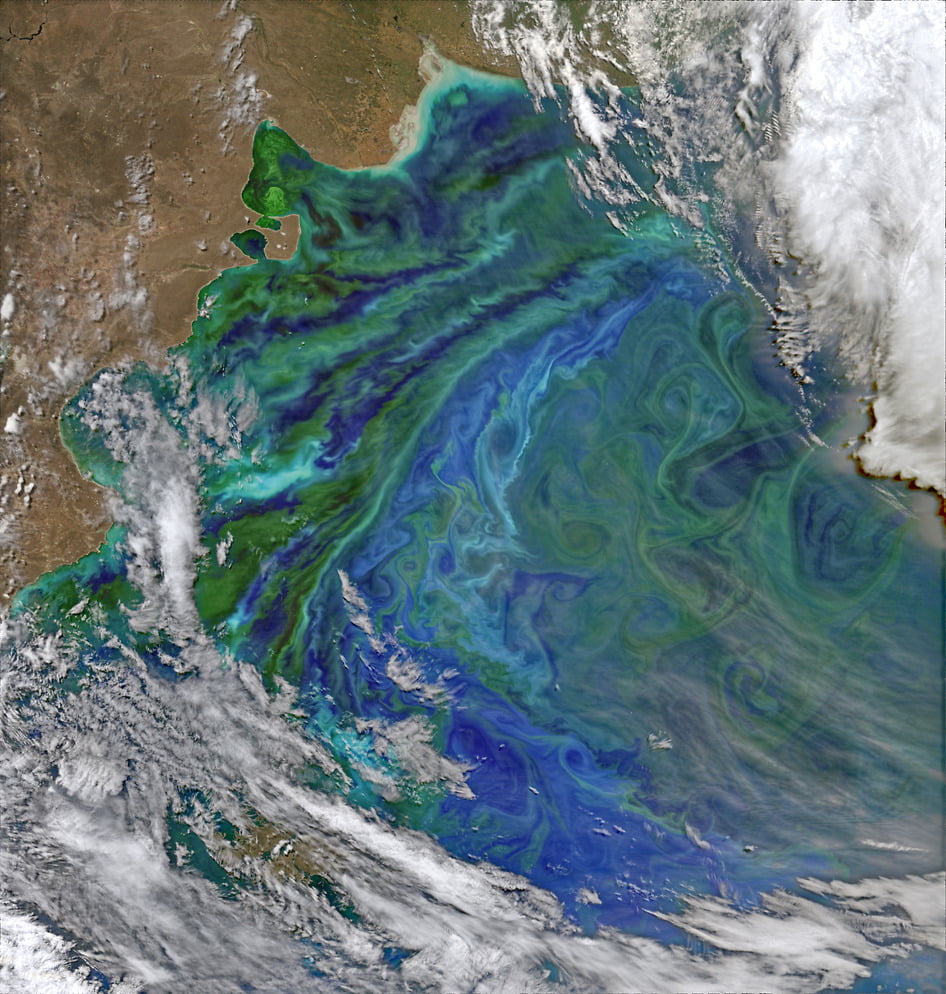
Nutrient-rich waters off Patagonia in South America blossom with phytoplankton in this satellite image. When present in large quantities, these microscopic photosynthesizers lend a green hue to the water. They act as seed particles in the flow, highlighting the currents and flow that carry them. If you check out the full resolution version of the photo, you can admire the rich detail in the whorls of ocean mixing. There even seem to be Kelvin-Helmholtz-like instabilities creating trains of vortices along the interface between separate bands. (Photo credit: NASA/ASU; via SpaceRef; submitted by jshoer)

Frog Tongues and Parrot Laser Safety Goggles


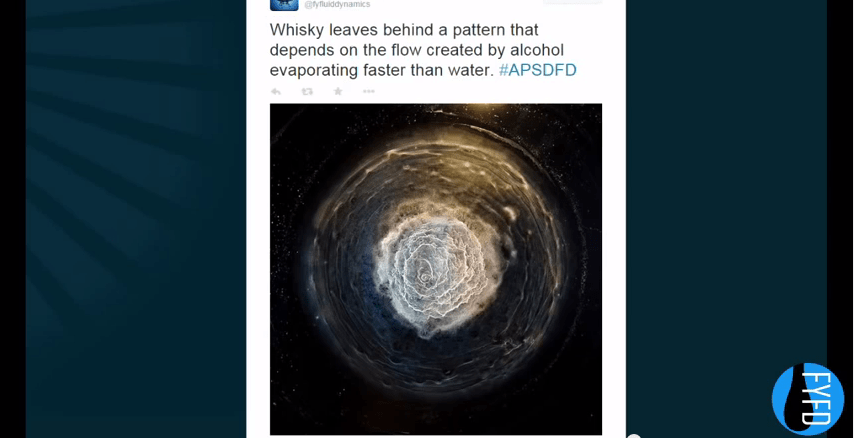
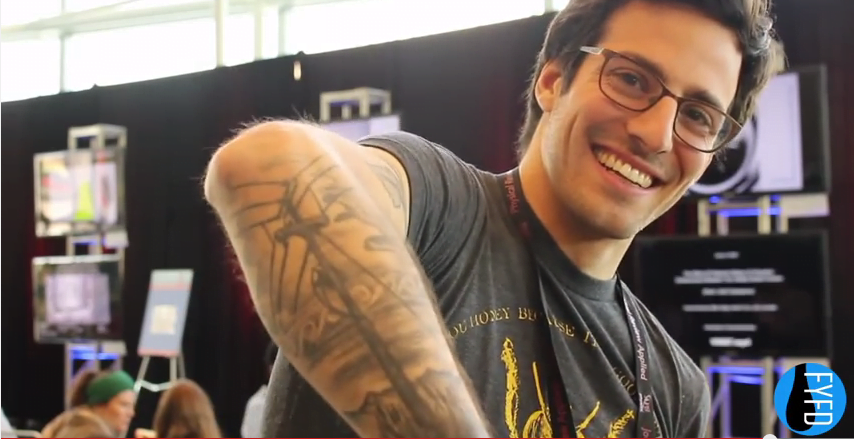
What do frog tongues, whisky, tattoos, and parrot laser safety goggles have in common? They’re all a part of the latest FYFD video! Check out my behind-the-scenes look at the biggest fluid dynamics conference of the year and find out what science everyone was talking about. (Image credits: N. Sharp, source video)
Half Vortex Rings
Vortices are one of the most common structures in fluid dynamics. In this video, Dianna from Physics Girl explores an unusual variety of vortex you can create in a pool. Dragging a plate through the water at the surface creates a half vortex ring, which can be tracked either by the surface depressions created or by using food dye for visualization. Vortex rings are quite common, but a half vortex ring is not. The reason is that, ignoring viscous effects, a vortex filament cannot end in a fluid. The vortex must close back on itself in a loop, or, like the half vortex ring, the ends of the vortex must lie on the fluid boundary. It is possible to break vortex lines like those in smoke rings, but the lines will reattach, creating new vortex rings–just as they do in these vortex knots. (Video credit: Physics Girl; submitted by Tom)

Filter-Feeding
Sponges are filter-feeding marine animals that rely on water flow to obtain their nutrients and remove waste. By injecting non-toxic fluorescein dye at their base, one can visualize the flow they induce in the water. Only seconds after the dye is introduced, the sponges have pumped it in, through, and out. Different parts of the sponge filter particles of various sizes for food. Oxygen and carbon dioxide are transported, respectively, into and out of cells via diffusion. In this way, the sponge’s pumping fulfills digestive, respiratory, and excretory functions. (Image credit: Jonathan Bird’s Blue World, source video; submitted by Jason C)

Wave Clouds

Coming home from APS DFD, I looked out the window as we flew east over the last of the Rockies and caught these wave clouds. Air flowing west to east gets disturbed by the mountains, which creates internal waves in the atmosphere. Generally, these are invisible–though they can cause some of the turbulence you feel when flying. In this case, water vapor has condensed at the crests of the internal waves, creating a pattern of cloudy and clear stripes to mark the waves. The internal waves damped out by the time we flew a couple hundred miles east of Denver, but for awhile conditions were just right. (Photo credit: N. Sharp)