Category: Phenomena

  • Daily Fluids, Part 3

    Daily Fluids, Part 3

    A lot of the fluid dynamics in our daily lives centers around the preparation and consumption of food. (And in its digestion afterward, but that’s another story!) Here are a few examples of fluid dynamics you might not have realized you’re an expert on:

    Low Reynolds Number Flows
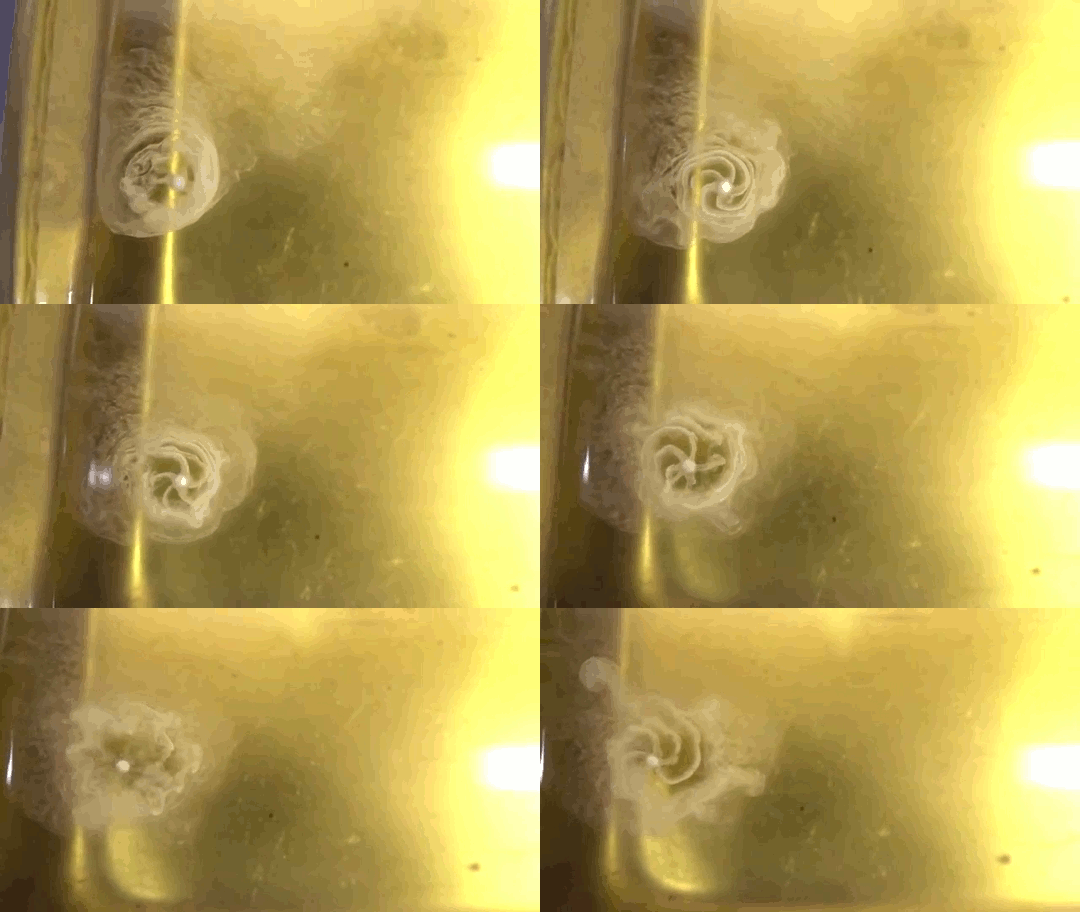
    This is a fancy way of discussing the motion of syrup, honey, and other thick and viscous fluids we interact with in our lives. These flows are typically slow moving and exhibit some neat properties like coiling or being possible to unstir.

    Immiscible Fluids
    Oil and water don’t mix, a fact anyone familiar with salad dressings or marinades is well aware of. The way around this is to shake them up! This disperses droplets of the oil within the water (or vinegar or whatever) to create an emulsion. While not truly mixed, it does make for more pleasant eating.

    Multiphase Flows
    Multiphase flows are ones containing both liquid and gaseous states. Boiling is an example we often see in our daily lives, though carbonated beverages, water sprayers, and sneezes are other common ones.

    Leidenfrost Effect
    The Leidenfrost effect occurs when liquid is introduced to a surface that is much, much hotter than its boiling point. Part of the liquid instantly vaporizes, leaving droplets to skitter around on a thin vapor layer. This is most often seen around the stove and in skillets. (And, yes, it does qualify as a multiphase flow!)

    Tune in all week for more examples of fluid dynamics in daily life. (Image credit: S. Reckinger et al., source)

    P.S. – I’m at VidCon (@vidconblr) this year! If you are, too, come say hi and get an FYFD sticker 😀

  • Daily Fluids, Part 2

    Daily Fluids, Part 2

    We play with fluid dynamics all the time, though we don’t always think of it as such. Here are a few ways it shows up in the ways we play:

    Aerodynamics
    This is the study of air moving past an object.  Whether you’re throwing a paper plane, flying a kite, or riding a bike, aerodynamics has an impact on what you’re doing.

    Lift
    Skipping a rock won’t work unless its impact generates some lift, but we see lift in lots of other places, too, from birds and planes to racecars and sailboats.

    Magnus Effect
    The Magnus effect relates to lift forces on a spinning object. It can affect the way a frisbee flies, but we see it a lot in ball-related sports, too. The flight of golf balls, volleyballs, baseballs, and soccer balls can all be significantly impacted by the Magnus effect. Check out these videos for a primer on the Magnus effect and the reverse Magnus effect.

    Bubbles
    Everybody loves playing with bubbles. But they may have more of a impact than you realize, whether it’s in making the foam on your latte, enhancing the aroma of your champagne, or making your joints pop.

    Tune in all week for more examples of fluid dynamics in daily life. (Image credit: S. Reckinger et al., source)

  • Daily Fluids, Part 1

    Daily Fluids, Part 1

    Just getting cleaned up and ready for the day involves a lot of fluid physics. Here are a few of the phenomena you may see daily without realizing:

    Plateau-Rayleigh Instability
    This behavior is responsible for the dripping of your faucet. More specifically, it’s the reason that a falling jet breaks up into droplets. It works on rain, too!

    Forced Convection
    Everyone is familiar with a winter wind making them colder or hot air from a dryer getting the moisture off their hands. These are examples of forced convection – heat transfer by driving a fluid past a solid. Another common example? The fans in your computer!

    Liquid Atomization
    This is the process of breaking a liquid into lots of tiny droplets. Aside from any aerosol can ever, this phenomenon is also key to your daily shower and internal combustion in your car.

    Archimedes Principle
    This might be one of my favorite bits of the whole video because it hearkens back to some of my own earliest fluid dynamics exposure. Archimedes Principle says that buoyancy is equal to the weight of the fluid a body displaces. My mom (a science teacher) taught me about this one in the bathtub! It’s key to everything that ever floated, including us!

    Tune in all week for more examples of fluid dynamics in daily life. (Image credit: S. Reckinger et al., source)

  • Featured Video Play Icon

    A Day in the Life of a Fluid Dynamicist

    Today I’m sharing one of my favorite videos from last year’s Gallery of Fluid Motion. It’s a short film entitled “A Day in the Life of a Fluid Dynamicist.” Although some parts of it probably only apply to fluid dynamicists (Navier-Stokes equations, anyone?) a lot of the activities depicted are common to everyone. The film does a nice job of highlighting some of the many examples of fluid dynamics that we come across in our daily lives. As a film by scientists made for scientists, though, you may find some of the terminology obscure. Never fear! This week on FYFD, I’ll be breaking down some of the film’s segments, explaining what they mean, and showing you just how much fluid dynamics you experience every day! (Video credit: S. Reckinger et al.)

  • Vortices in the Wind

    Vortices in the Wind

    Heard Island, a remote patch of rock in the southwestern Indian Ocean, peeks its head above the marine cloud layer. The volcanic island disrupts the atmosphere enough to generate a von Karman vortex street, a line of alternating vortices shedding from either side of the island. Usually these vortices would march in a straight line downstream from their source. But here strong winds from the south have blown a bunch of its vortices northward, creating an unusual kink in the island’s wake. (Image credit: J. Schmaltz/LANCE EOSDIS Rapid Response; via NASA Earth Observatory)

  • Visualizing Smell

    Visualizing Smell

    Every day we’re surrounded by an invisible world of smells. Like the fluorescein dye in the animation above, these odors drift and swirl in the background flow. What you may not have stopped to consider when you smell the roses, though, is how the very act of sniffing changes the scent. When you inhale, filaments of the odor are drawn into your nose, and, likewise, when you exhale, your breathe mixes with the scent and sends it swirling outward in turbulent eddies. To see more about the science of scent, check out PBS News Hour’s full video below. (Video credit: PBS News Hour; GIF via skunkbear)

  • Bubble Tricks

    [original media no longer available]

    Everyone remembers playing with soap bubbles as a child, but most of us probably never became as adept with them as magician Denis Lock. In this video, Lock shows off some of the clever things one can do with surface tension and thin films. My favorite demo starts at 1:25, when he constructs a spinning vortex inside a bubble. He starts with one big bubble and adds a smaller, smoke-filled one beneath it. Then, using a straw, he blows off-center into the large bubble. This sets up some vorticity inside the bubble. When he breaks the film between the two bubbles, the smoke mixes into the already-swirling air in the larger bubble. Then he pokes a hole in the top of the bubble. Air starts rushing out the deflating bubble. As the air flows toward the center of the bubble, it spins faster because of the conservation of angular momentum and a miniature vortex takes shape.  (Video credit: D. Lock/Tonight at the London Palladium/ via J. Hertzberg)

  • Swimming at Microscale

    Swimming at Microscale

    Tiny organisms live in a world dominated by viscosity. There’s no coasting or gliding. If a microorganism stops swimming, friction will bring it to a halt in less than the space of a hydrogen atom! To make matters worse, simply flapping an appendage forward and backward will get them nowhere. As we’ve seen before, these highly viscous laminar flows are reversible, meaning that a backward power stroke is simply undone by a mirrored forward recovery stroke. Instead, microorganisms like the paramecium swimming above are covered in tiny hairlike cilia which beat asymmetrically. They extend to their full length during the power stroke, but they stay bent during the forward recovery stroke. That asymmetry guarantees that they move more fluid backward than forward, thereby letting the paramecium make progress. (Image credit: C. Baroud, source)

  • Shelf Cloud

    Shelf Cloud

    Sydney, Australia was treated to a spectacular meteorological show over the weekend when an impressive shelf cloud swept over the city. These timelapses show the dramatic leading edge of the incoming thunderstorm. Notice how the cloud streams upward along the shelf. The storm is driven by this updraft of warm moist air, which rises until it is capped by the troposphere. At this point, the air spreads, creating an anvil-like shape, and cools. The moisture drawn up at the storm’s front will condense, freeze, and fall as rain or hail. When the updraft weakens, the storm will be dominated by the downdraft of the falling precipitation and eventually peter out. (Image credit: W. Reed and H. Vann, source; via J. Hertzberg)

  • Featured Video Play Icon

    Why Fishing with Dynamite is So Harmful

    In some countries, there are still people using dynamite to catch fish. This practice is incredibly destructive, not just to adult fish but to the entire marine ecosystem. A blast wave traveling through air loses some its energy to the compression of the gas. Water, on the other hand, is incompressible, so the blast wave’s energy just keeps going, expanding its destructive radius. Many fish contain swim bladders, gas-filled organs the fish use to regulate their depth. When a shock wave passes through the fish, the gas in the swim bladder will expand and contract violently, much like the balloons shown underwater in the animation below. This typically ruptures the swim bladder and surrounding tissues.

    Fish without swim bladders will often hemorrhage after being struck by a blast wave. The sudden changes in pressure create bubbles in the dissolved gases collected in their gills. Those bubbles tear apart the fish’s blood vessels.

    Blasting is effective but entirely indiscriminate. It kills adults and juveniles of all species, not just the ones a fisherman can sell. Simultaneously, it destroys the slow-growing coral reefs that are key habitats for these populations. It’s an incredibly short-sighted practice that guarantees there will be no fish to catch in years to come. (Video credit: National Geographic; image credit: M. Rober, source; research credit: K. Dunlap, pdf)