Dust devils, like fire tornadoes and waterspouts, form from warm, rising air. As the sun heats the ground to temperatures hotter than the surrounding atmosphere, hot air will begin to rise. When it rises, that air leaves behind a region of lower pressure that draws in nearby air. Any vorticity in that air gets intensified as it gets pulled toward the low pressure area. It will start to spin faster, exactly like a spinning ice skater who pulls in his arms. The result is a spinning vortex of air driven by buoyant convection. On Earth, dust devils are typically no more than a few meters in size and can only pick up light objects like leaves or hay. On Mars, dust devils can be hundreds of meters tall, and, though they’re too weak to do much damage, they have helpfully cleaned off the solar panels of some of our rovers! (Image credit: T. Bargman, source; via Gizmodo)
Category: Phenomena

Martian Ripples

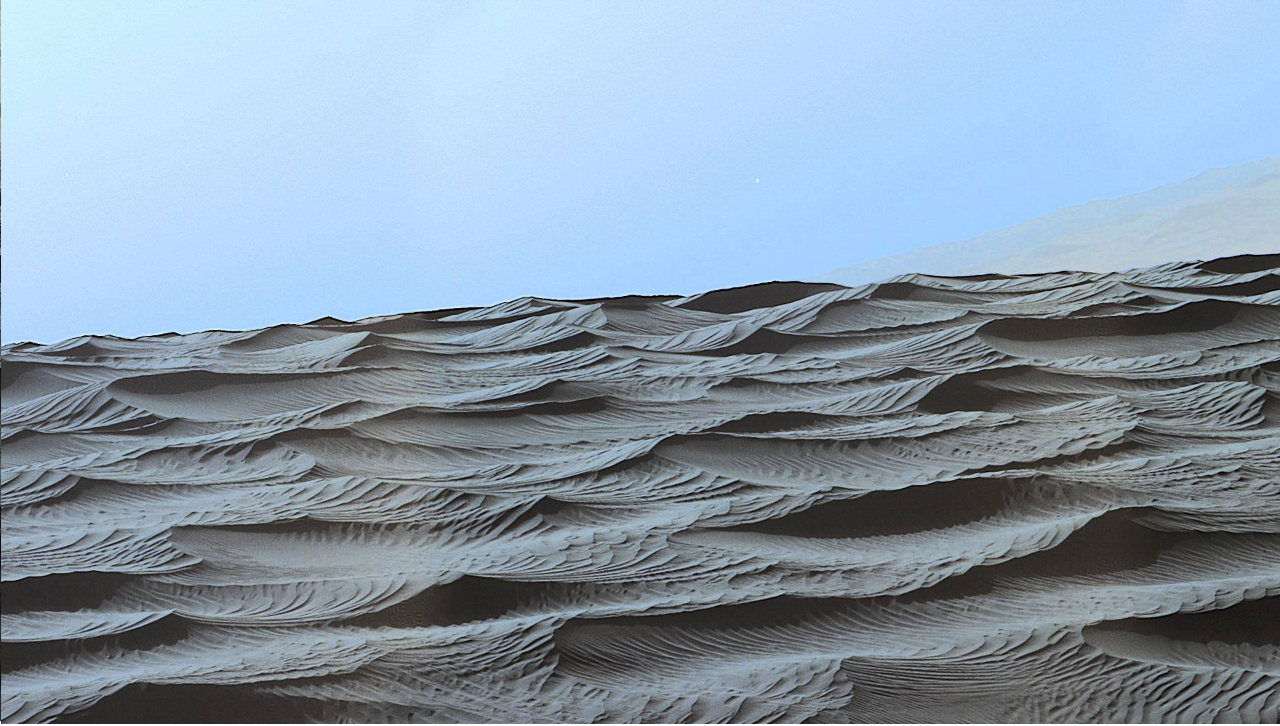
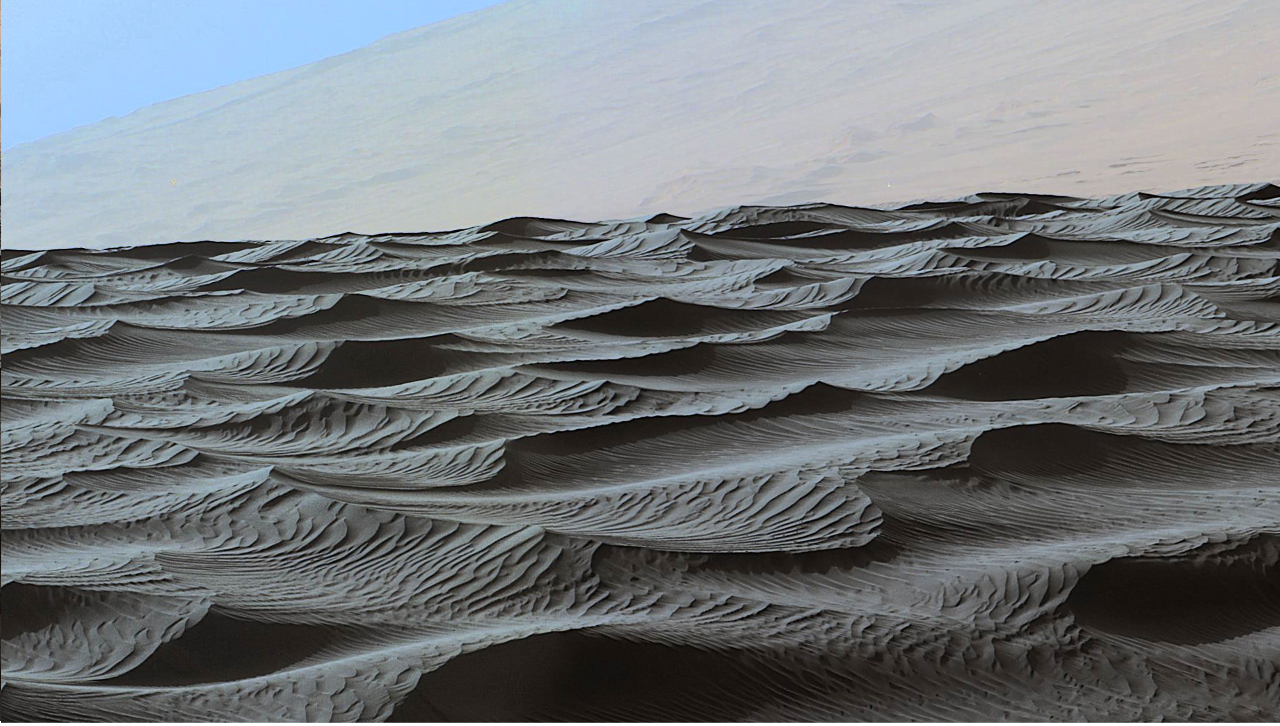
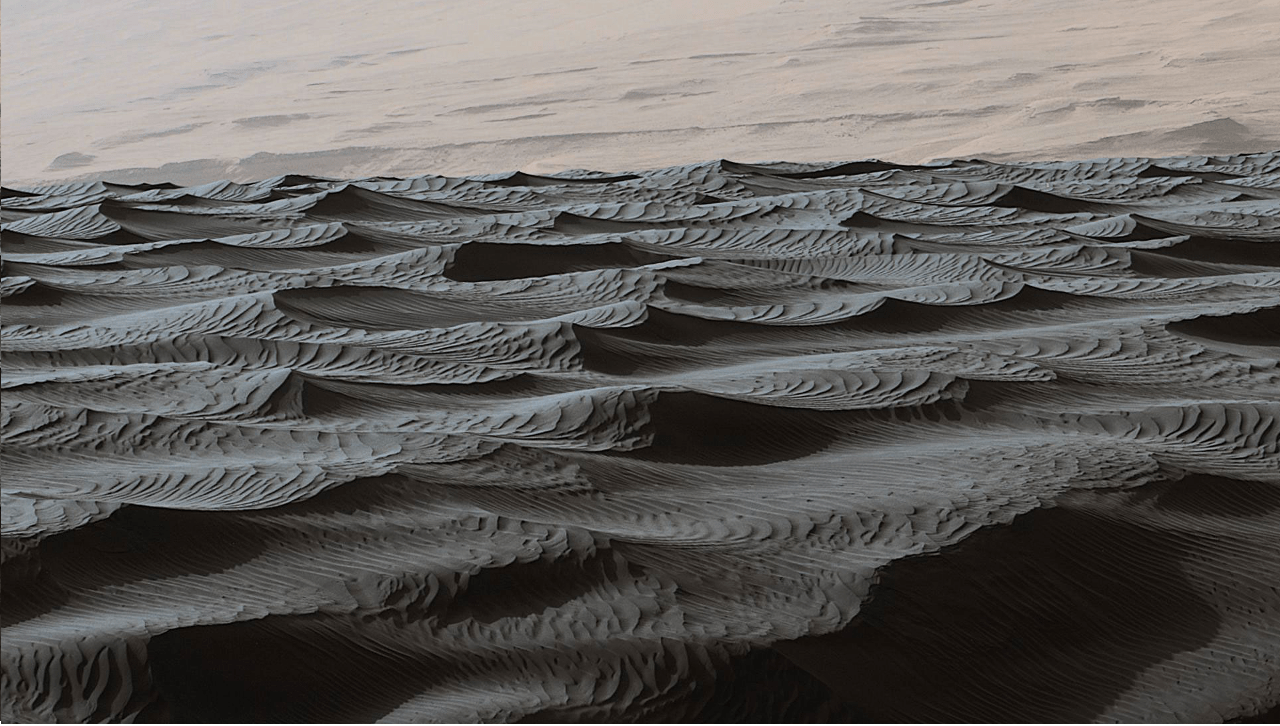

Earth and Mars both feature fields of giant sand dunes. The huge dunes are shaped by the wind and miniature avalanches of sand, and their surface is marked by small ripples less than 30 centimeters apart. These little ripples are formed when sand carried by the wind impacts the dunes. But Martian dunes have a second, larger kind of ripple, too. These sinuous, curvy ripples lie about 3 meters apart and cast the dark shadows seen in the images above. On Earth we see ripples like these underwater, where water drags sand along the surface. On Mars, the same process is thought to play out with the wind, and so scientists have named these wind-drag ripples. (Image credit: NASA/JPL/MSSS; via APOD, full-res; submitted by jshoer)

Quarry Smashing
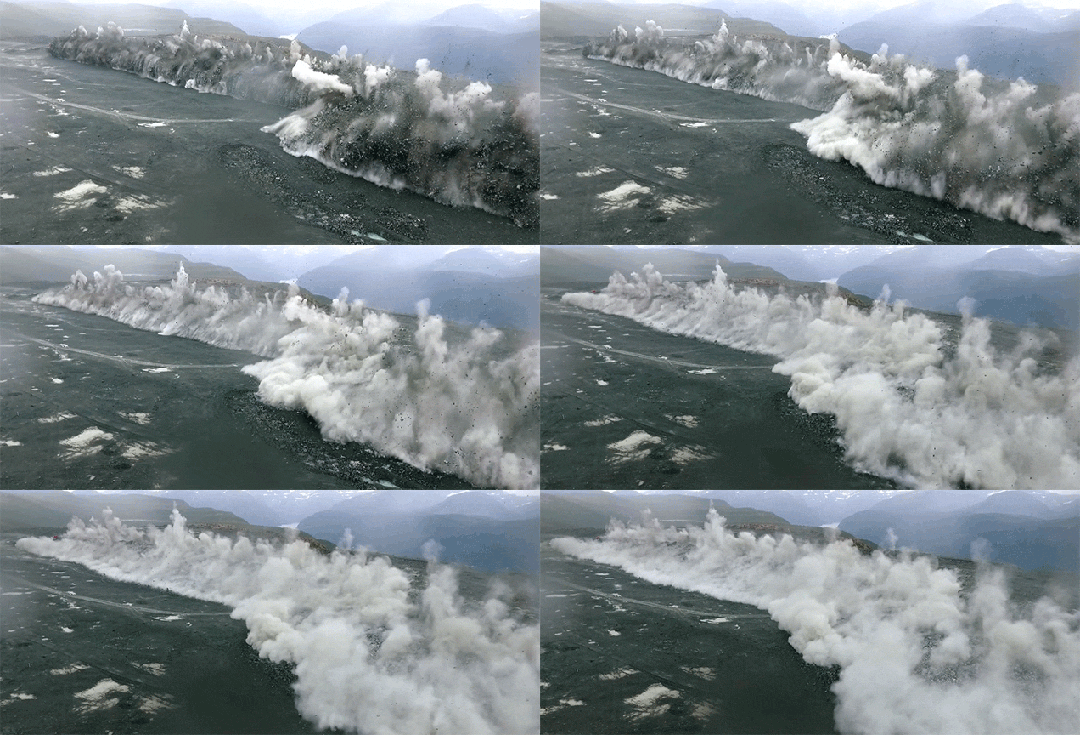
Despite appearances, this is not a crashing ocean wave. In fact, it’s a planned explosion at a quarry, and that wave is more than 360,000 tons of rock and 68 tons of explosive pouring down. The scale of this is hard to imagine, and the physics of a ocean breaker and a massive wave of rocks and gas are similar enough that it’s no wonder our brains interpret them as the same event. Visual effects artists have been using this trick for decades. Rather than simulate the motion of a true fluid, many CGI effects are created from digital particles that, much like the rocks above, are similar enough to fool our eyes and our brains. (Image credit: K. Venøy, source; via Gizmodo)

Crash Course Hydrostatics
Crash Course Physics has just put out an episode on fluids at rest (a.k.a. hydrostatics). For those who are unfamiliar, Crash Course is an educational YouTube channel that offers fun, instructional videos on a large and ever-growing array of topics. In this video, they tackle a lot of important basics for fluids, including the principles behind hydraulics, how to measure pressure, and how buoyancy works. It’s pretty densely packed, and, if you’re learning the concepts for the first time, you’ll probably pause and rewatch some segments, but even if you’re familiar with the topics, it’s a nice refresher. (Video credit: Crash Course Physics)

Turbulence in the Solar Wind
One of the key features of turbulent flows is that they contain many different length scales. Look at the plume from an erupting volcano, and you’ll see eddies that are hundreds of meters across as well as tiny ones on the order of millimeters. This enormous difference in scale is one of the major challenges in simulating turbulent flows. Since energy enters at the large scale and is passed to smaller and smaller scales before being dissipated at the tiniest scales of the flow, properly simulating a turbulent flow requires resolving all of these length scales. This is especially challenging for applications like the solar wind – the stream of charged particles that flows from the sun and gets diverted around the Earth by our magnetic field. The image above shows some of the turbulence in our solar wind. The structures seen in the flow range from the size of the Earth all the way to the scale of electrons! (Image credit: B. Loring, Berkeley Lab)
Flamethrowing
Humans have long been fascinated by staring into flames, and the Slow Mo Guys carry on the grand tradition here with 4K, high-speed video of a flamethrower. Like firebreathers, a flamethrower’s fire is the result of a spray of tiny, volatile droplets of fuel. Once ignited, the spray becomes a turbulent jet of flames. Turbulent flows are known for having both large and small-scale structure, and there’s some really great close-ups showing this around the 2:00 mark. Also watch the edges of the flame, where the nearby air has gotten hot enough to shimmer. You can see how the trees in the background ripple and blur as the fire heats up the air and changes its density and refractive index. (Video credit: The Slow Mo Guys)

Arriving at Jupiter


Today all eyes turn to Jupiter where NASA’s Juno spacecraft will enter orbit around the gas giant. In preparation, Hubble and ground-based telescopes have been observing Jupiter in both the visible (upper right) and infrared (upper left) spectrum. The lower image shows a 1:5 scale model of Juno and a full-size replica of one of its solar panels; note the mannequin in the lower right corner for scale.
Juno is entering one of the harshest environments in the solar system with intense magnetic fields that trap lethal amounts of radiation around the planet. The lovely blue auroras Hubble sees around Jupiter’s poles are a never-ending hailstorm of solar wind particles hitting Jupiter’s atmosphere. Juno will be studying the structure of Jupiter’s magnetosphere, gravitational field, and its interior, hopefully helping scientists explain how the planet formed and the role it played in the formation of our solar system. (Image credits: infrared Jupiter – ESO/L. Fletcher; Jovian auroras – Hubble/ESA; Juno model and solar panel – N. Sharp)

Resonating Bowls
Rub your hands on the handles of a Chinese resonance bowl and you can generate a spray of tiny droplets. The key to this, as the name suggests, is vibration. Rubbing the handles vibrates the bowl, causing small oscillations in the bowl’s shape that are too small for us to see. But those vibrations do produce noticeable ripples on the water in the bowl. When you hit the right frequency and amplitude, those vibrations disturb the water enough that the up-and-down vibration at the surface actually ejects water droplets. The vibration of the bowl affects water near the wall most strongly, which is why that part of the bowl has the strongest reaction. It takes even larger amplitude vibrations to get droplets jumping in the middle of the bowl, but you can see that happening in this video of a Tibetan singing bowl. (Image/video credit: Crazy Russian Hacker, source)

Rayleigh-Taylor Waves
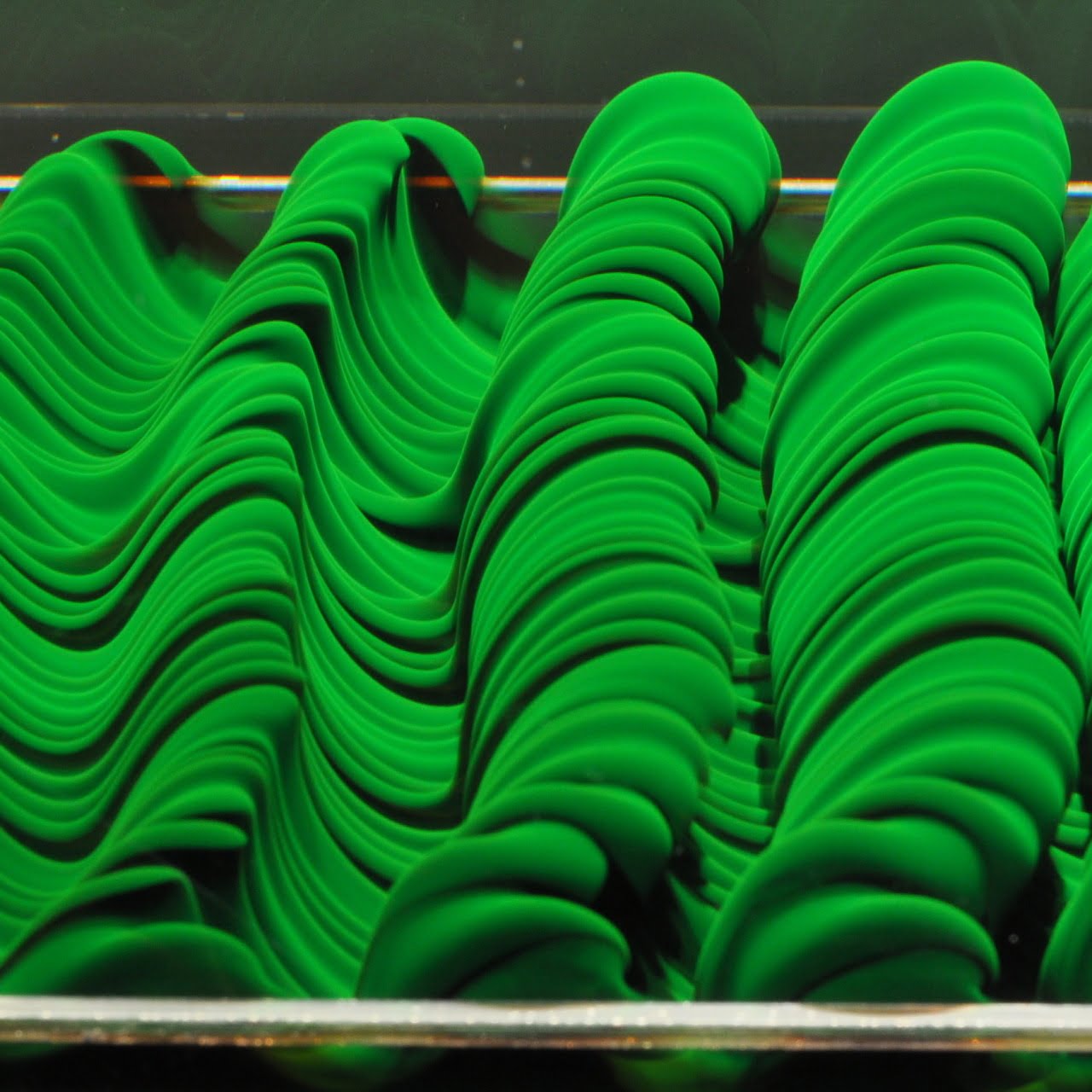
Here on Earth, placing a denser fluid over a lighter one creates an unstable equilibrium. Thanks to gravity, the heavier, denser fluid wants to sink and the lighter fluid wants to rise. Any small disturbance will kick this into action, just like a tiny nudge can send a ball rolling down the hill. For the fluid, that nudge manifests as waviness in the interface between the two fluids. That waviness will quickly grow into billows like those shown above as the Rayleigh-Taylor instability takes over and the heavy (clear) fluid trades places with the lighter (green) fluid. You’ve probably witnessed this effect yourself when pouring milk into iced coffee. To see it in action, check out the video of this experiment or my FYFD video on the Rayleigh-Taylor instability. (Image credit: M. Davies Wykes)

Daily Fluids, Part 4
Inside or outside, we encounter a lot of fluid dynamics every day. Here are some examples you might have noticed, especially on a rainy day:
Worthington Jets
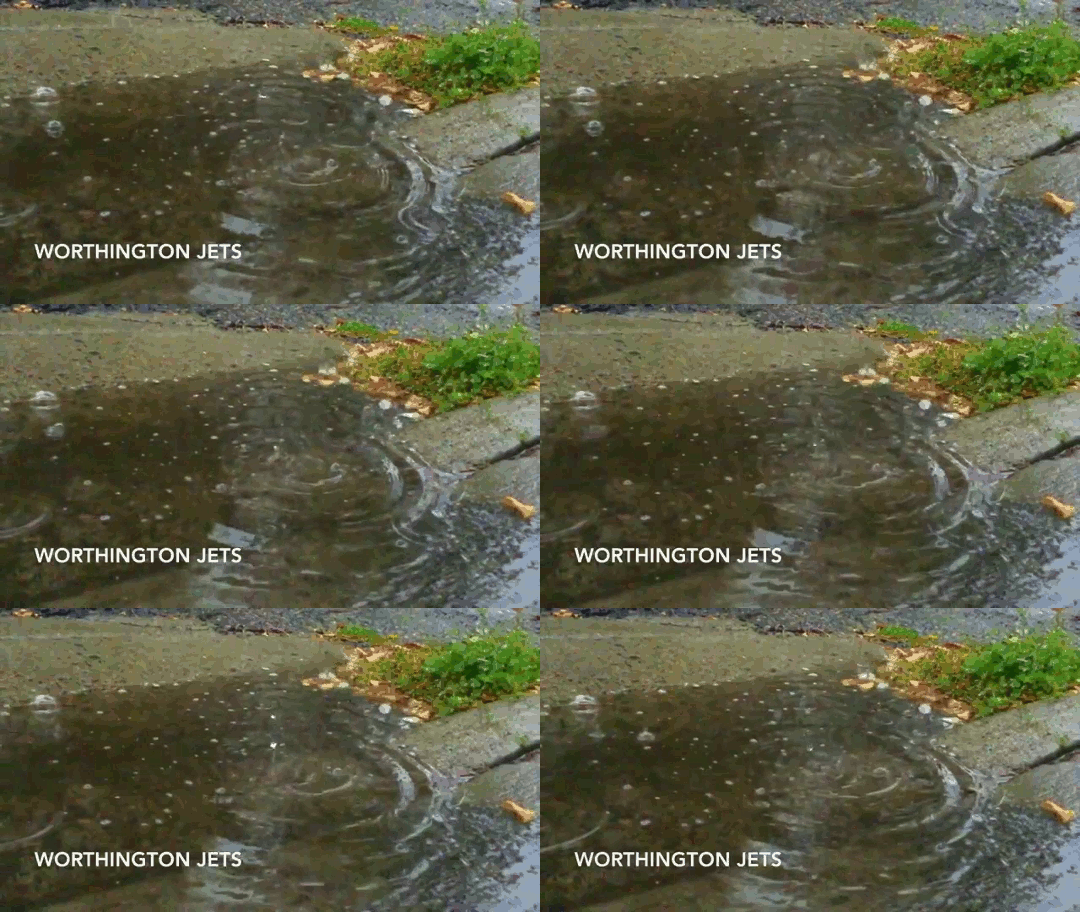
After a drop falls into a pool, there’s a column-like jet that pops up after it and sometimes ejects another small drop. This is known to fluid dynamicists as a Worthington jet, but really it’s something we all see regularly, especially if you watch rain falling onto puddles or look really closely at your carbonated drink.Crown Splash
Like the Worthington jet, crown splashes often follow a drop’s impact into another liquid. But they can also show up when slicing or stomping through puddles!Free Surface Dynamics
Anytime you have a body of water in contact with a body of air, fluid dynamicists call that a free surface. How the interface between the two fluids shifts and transforms is fascinating and complicated. Waterfalls are a great example of this, but so are ocean waves or even the ripples from tossing a rock into a pond.Hydrophobic Surfaces
Water-repellent surfaces are called hydrophobic. Water will bead up on the surface and roll off easily. While many manmade surfaces are hydrophobic, like the teflon in your skillet, so are many natural surfaces. Many leaves are hydrophobic because plants want that water to fall to the ground where their roots can soak it up. Keep an eye out as you wash different vegetables and fruits and see which ones are hydrophobic!Check out all of this week’s posts more examples of fluid dynamics in daily life. (Image credit: S. Reckinger et al., source)