Playing with a vortex cannon is a ton of fun, and they are remarkably easy to make. You can knock over cups or card houses, create art, or just try your best Big Bad Wolf impression. Or you can supersize things like one group in the Czech Republic did and build a 3m vortex cannon capable of firing 100m! (Seriously, watch it in action here.) And if you’d like to learn more about how vortex rings form and why they’re useful in nature and engineering, check out my vortex ring video. (Image credit: Laborky Cz, source; via Gizmodo)
Category: Phenomena

Making Droplets
If you’ve ever wondered how fluid dynamicists create those tiny perpetually bouncing droplets they study, wonder no further. A typical method, shown here, is to use a simple toothpick. First, you take a shallow container of silicone oil and vibrate it vertically. Then you dip the tip of the toothpick into the oil and pull it out, stretching the oil into a long filament. When it detaches from the toothpick, a droplet will start to form at the tip of the filament as it falls back toward the pool. But the bouncing of the surface is enough to keep the new drop from coalescing back into the pool, leaving the little drop to bounce along on its liquid trampoline. (Image credit: S. Lapointe)

Jovian Poles
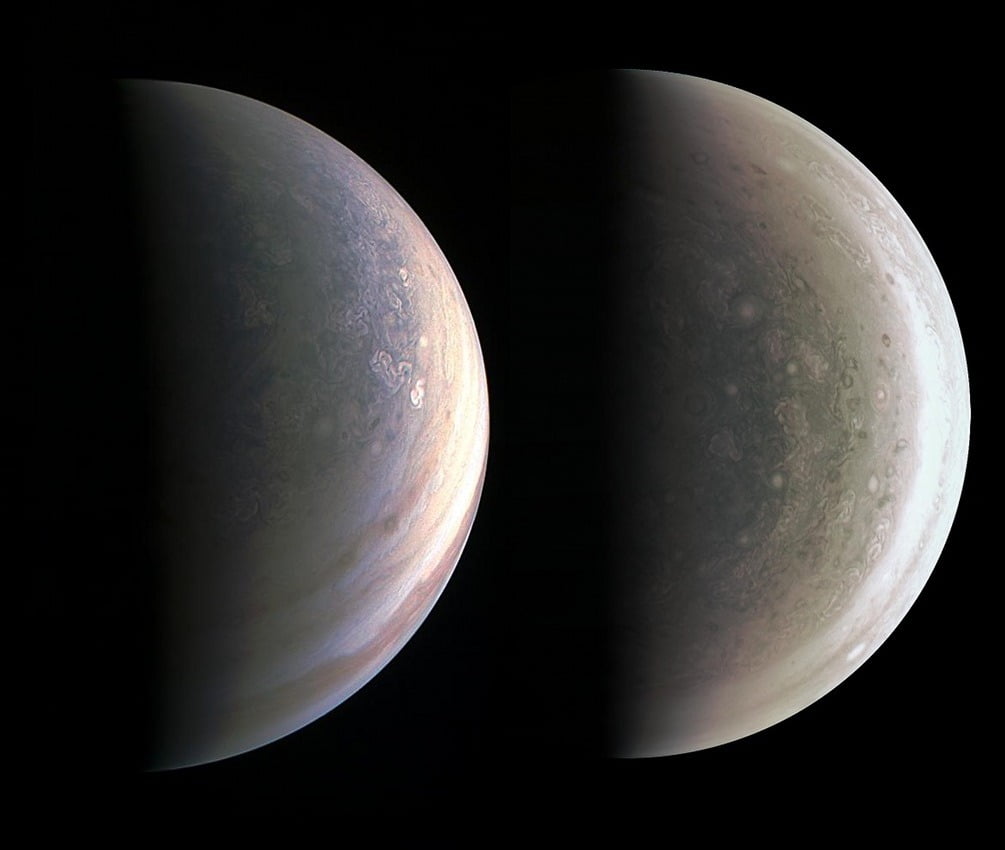
We’re used to viewing Jupiter from its equator, where bands of light and dark clouds dominate the picture. From its poles, Jupiter looks very different, as these recent images from Juno show. Jupiter’s north pole is shown on the left and its south pole on the right. Both are awash in vortices. There’s another great black-and-white image of the south pole here, where the vortices really stand out. Jupiter’s atmosphere contains both cyclones, which rotate counterclockwise in the northern hemisphere and clockwise in the southern hemisphere, and anticyclones, which behave in the reverse. Unlike in Earth’s atmosphere, anticyclones dominate on Jupiter, especially among storms more than 2000 km across. (Image credit: NASA/JPL/Juno Mission; via APOD)
P.S. – Tomorrow night is the Ig Nobel Prize Ceremony, and I’ll be giving one of their 24/7 lectures. If you’d like to tune in and hear me describe fluid dynamics in 24 seconds + 7 words, there will be a webcast here.

Soap Film Turbulence
The brilliant colors of a soap film reveal the fluid’s thickness, thanks to a process known as thin film interference. The twisting flow of the film depends on many influences: gravity pulls down on the liquid and tends to make it drain away; evaporation steals fluid from the film; local air currents can push or pull the film; and the variation in the concentration of molecules – specifically the surfactants that stabilize the film – will change the local surface tension, causing flow via the Marangoni effect. Together these and other effects create the dancing turbulence captured above. (Video credit: A. Filipowicz)

Shear Across the Water
This photo series shows the development of a Kelvin-Helmholtz instability. It’s formed when two layers of fluid move past one another at different speeds. In this case, the two fluids meet off the back of a flat plate (seen at the left of the top image) when fast-moving flow from the top of the plate encounters slower fluid beneath. Friction and shear between the fluid layers causes billows to rise up and form waves very similar to those on the ocean (wind across the water works the same way!). Those waves turn over into vortex-like spirals and keep mixing until they break down into turbulence. This pattern crops up pretty frequently, especially in clouds. (Image credit: G. Lawrence)
Droplet Bounce
Water droplets don’t always immediately disappear into a pool they’re dropped onto. If the droplet is small and doesn’t have much momentum, it will join the pool gradually through a process known as the coalescence cascade, seen here in high speed video. The droplet bounces off the surface, then settles. A thin layer of air is caught between it and the pool. Slowly the weight of the drop pushes that air out until there is contact between the drop and pool. Before the drop can merge completely, though, surface tension pinches it off, creating a smaller daughter droplet. Ripples caused by the merger help bounce the little droplet, which repeats the same process until the tiniest droplet merges completely. (Video credit: B. ter Huume)

“Catacomb of Veils”


Burning Man’s “Catacomb of Veils”, the largest sculpture burned in the 2016 event, produced a series of smoke tornadoes as it blazed. Like dust devils or fire tornadoes, these vortices are driven by hot, buoyant air rising – in this case, from the fire. As the surrounding air moves in toward the fire, any rotational motion, or vorticity, in the air is intensified due to conservation of angular momentum. That concentrates it into a vortex, which becomes visible when it picks up smoke. Simultaneously, the wind was blowing in a consistent direction, sending any new vortices generated marching downstream. You can watch even more vortices and some slow-motion footage of the burning in the full video by Mark Day. (Image credit: M. Day, source; submitted by Larry B)
Happy 50th, Star Trek!
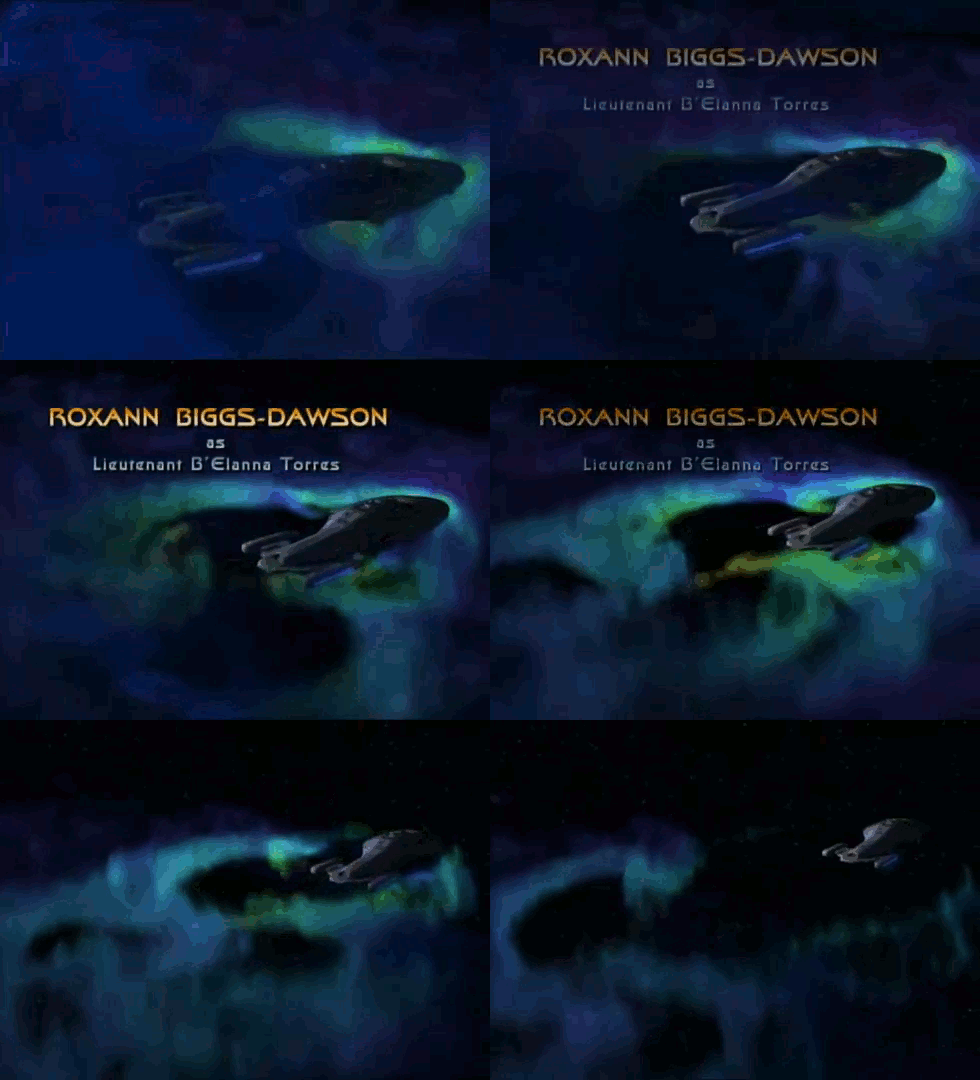
Today’s post is largely brought to you by the fact that I have been sick the past four days and my fiance and I have been bingeing on Star Trek Voyager. At some point, we began wondering about the sequence from 0:30-0:49 in which Voyager flies through a nebula and leaves a wake of von Karman vortices. Would a starship really leave that kind of wake in a nebula?

My first question was whether the nebula could be treated as a continuous fluid instead of a collection of particles. This is part of the continuum assumption that allows physicists to treat fluid properties like density, temperature, and velocity as well-defined quantities at all points. The continuum assumption is acceptable in flows where the Knudsen number is small. The Knudsen number is the ratio of the mean free path length to a characteristic flow length, in this case, Voyager’s size. The mean free path length is the average distance a particle travels before colliding with another particle. Nebulae are much less dense than our atmosphere, so the mean free path length is larger (~ 2 cm by my calculation) but still much smaller than Voyager’s length of 344 m. So it is reasonable to treat the nebula as a fluid.
As long as the nebula is acting like a fluid, it’s not unreasonable to see alternating vortices shed from Voyager. But are the vortices we see realistic relative to Voyager’s size and speed? Physicists use the dimensionless Strouhal number to describe oscillatory flows and vortex shedding. It’s a ratio of the vortex shedding frequency times the characteristic length to the flow’s velocity. We already know Voyager’s size, so we just need an estimate of its velocity and the number of vortices shed per second. I visually estimated these as 500 m/s and 2.5 vortices/second, respectively. That gives a Strouhal number of 0.28, very close to the value of 0.2 typically measured in the wake of a cylinder, the classical case for a von Karman vortex street.
So far Voyager’s wake is looking quite reasonable indeed. But what about its speed relative to the nebula’s speed of sound? If Voyager is moving faster than the local speed of sound, we might still see vortex shedding in the wake, but there would also be a bow shock off the ship’s leading edge. To answer this question, we need to know Voyager’s Mach number, its speed relative to the local speed of sound. After some digging through papers on nebulae, I found an equation to estimate speed of sound in a nebula (Eq 9 of Jin and Sui 2010) using the specific gas constant and temperature. Because nebulae are primarily composed of hydrogen, I approximated the nebula’s gas constant with hydrogen’s value and chose a representative temperature of 500 K (also based on Jin and Sui 2010). This gave a local speed of sound of 940 m/s, and set Voyager’s Mach number at 0.53, inside the subsonic range and well away from any shock wave formation.
Of course, these are all rough estimates and back-of-the-envelope fluid dynamics calculations, but my end conclusion is that Voyager’s vortex shedding wake through the nebula is realistic after all! (Video credit: Paramount; topic also requested by heuste11)
Happy 50th anniversary, Star Trek! Some of my earliest memories of TV are of watching TNG with my parents. Star Trek taught me that curiosity and scientific inquiry were vital and valuable, and that anyone could grow up to be a scientist, engineer, and leader. Thank you for such an inspiring and hopeful vision for humanity’s future!
And, seriously, those von Karman vortices are awesome.
Hearing in Space
Everyone knows that, in space, no one can hear you scream. Sound is a wave that requires a medium to travel through, and if space is empty, there’s no medium to carry that sound. Except, as Mike from The Point Studios explains, empty is a relative term. Space is full of dust and gas and plasma, just not as full of that matter as we’re used to. Thus, the question of whether sound can travel through space turns into a matter of scale. If the scale–the wavelength–of a sound is much larger than the distance between molecules, then the sound can propagate. So there CAN be sound in space – it just has to have a very long wavelength and, thus, a very low frequency. Check out the video for the full story! (Video credit: The Point Studios)

Roll Cloud Over Chicago
A cold front passing through Chicago last week triggered a roll cloud, shown in the timelapse above. These clouds look like spinning horizontal tubes and form in areas where cool, sinking air displaces warmer, moist air to higher altitudes. The moist air is forced up along the cloud’s leading edge, causing it to cool and condense into cloud. Air on the trailing edge sinks downward again, warming and dissipating the cloud. The clouds are a visible form of soliton, or solitary wave, traveling through the atmosphere. They go by several other names, too, including Morning Glory clouds and arcus clouds. (Image credit: A. King; via Colossal)