Category: History

  • Aerodynamic Flight Testing

    Aerodynamic Flight Testing

    Flight testing models has a long history in aerodynamics. Above you see a Curtiss JN-4 biplane in flight with a model wing suspended below the fuselage. This test was conducted circa 1921 by NASA’s predecessor, NACA. At the time, of course, computational simulations were non-existent, and, although wind tunnels existed, presumably they could not recreate the exact circumstances needed for the test. Available wind tunnels might have lacked the power to reach the speeds engineers wanted, or they could have been too small for the model or had too many disturbances compared to the pristine flight environment. Any or all of these concerns can drive decisions to use flight testing instead of ground tests.

    Flight testing in aerodynamics is still used today, albeit sparingly. The second image shows a crew of Texas A&M graduate students (including yours truly) with a swept wing model we were about to test with a Cessna O-2 aircraft. By this point (roughly 10 years ago), we had wind tunnels capable of overlapping the conditions we could achieve in flight, but flight testing still gave us a larger range of conditions than working solely in the wind tunnel. (Image credits: JN-4 – NASA, O-2 – M. Woodruff; via Rainmaker1973; submitted by Marc A.)

  • The Skipping Dambusters

    The Skipping Dambusters

    During World War II, the Allies developed “dambuster” bombs that skipped repeatedly off the surface of the water before striking their target. The goal was to cleverly bypass their enemies’ defenses both above and below the surface. Although the original dambusters used spinning spheres, the ricochet physics works for many other configurations as well; essentially, the physics are identical to rock-skipping. Conventional bullets can also skip off the water, though the required angle for skipping depends strongly on the shape of the bullet. If the geometry of the bullet impact doesn’t generate enough hydrodynamic lift, there will be no skip. (Image credit: Barnes Wallis Foundation, source; research credit: V. Murali and S. Naik, pdf; submitted by Marc A.)

  • The Great Smog of London

    The Great Smog of London

    Our atmosphere is active and ever-changing – except when it isn’t. Some areas, including many cities, are prone to what’s known as a temperature inversion, where a layer of cooler air gets trapped underneath a warmer one. Because this means that a dense layer is caught under a less dense one, the situation is stable and – absent other changes in circumstances – will stick around. There are several ways this can happen, including overnight when areas near the ground cool faster than the atmosphere higher up.

    When temperature inversions persist, they can trap pollutants and create health hazards. One of the worst of these recorded occurred in December 1952 in London. An anticyclone created a temperature inversion over the city that trapped smoke from coal burned to warm homes and reduced visibility – sometimes even indoors – to only a meter or two. Thousands of people died from the respiratory effects of the five-day smog, and it prompted major efforts to improve emissions and air quality. Temperature inversions cannot be avoided, but the Great Smog of London taught us the necessity of reducing their danger.  (Image credit: Getty Images)

  • When the Mediterranean Flooded

    When the Mediterranean Flooded

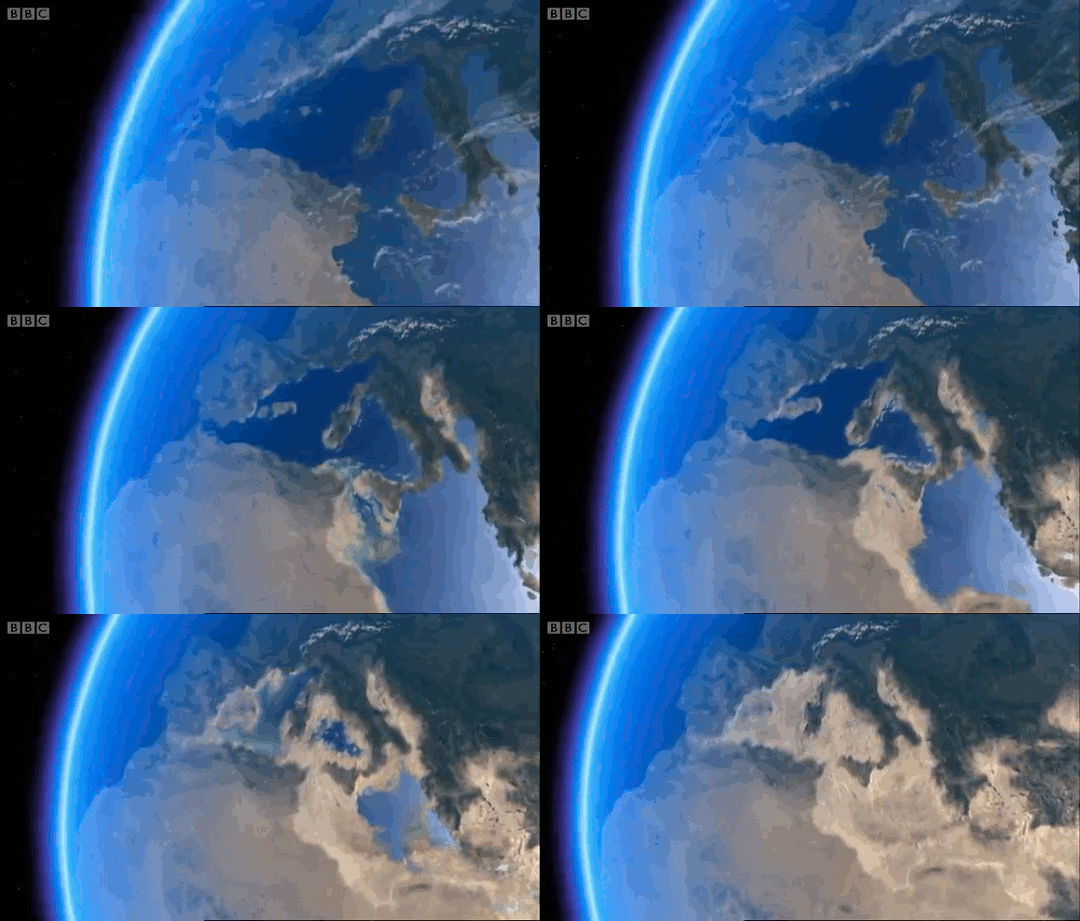
    Around 6 million years ago, the African and Eurasian plates moved together, cutting the Mediterranean Sea off from the Atlantic. Without an influx of water from the Atlantic, evaporation began removing more water from the Mediterranean than rivers could replace. The sea dried out almost completely over the course of a couple thousand years.

    About 5.3 million years ago, the Straits of Gibraltar reopened, creating a massive flood into the Mediterranean known as the Zanclean Flood. Water rushed down the straits and into the Mediterranean at speeds as high as 40 m/s (90 mph). At its peak, the Zanclean Flood is estimated to have reached rates 1000 times greater than the volumetric flow rate of the Amazon River.

    A similar breach flood occurred in the Black Sea within the past 10,000 years when the Bosporus became unblocked. That flood likely had a devastating impact on Neolithic societies in the area and may be the inspiration for the floods described in the Epic of Gilgamesh and the Bible. (Image credit: BBC, source)

  • Molasses Flood Press

    Molasses Flood Press

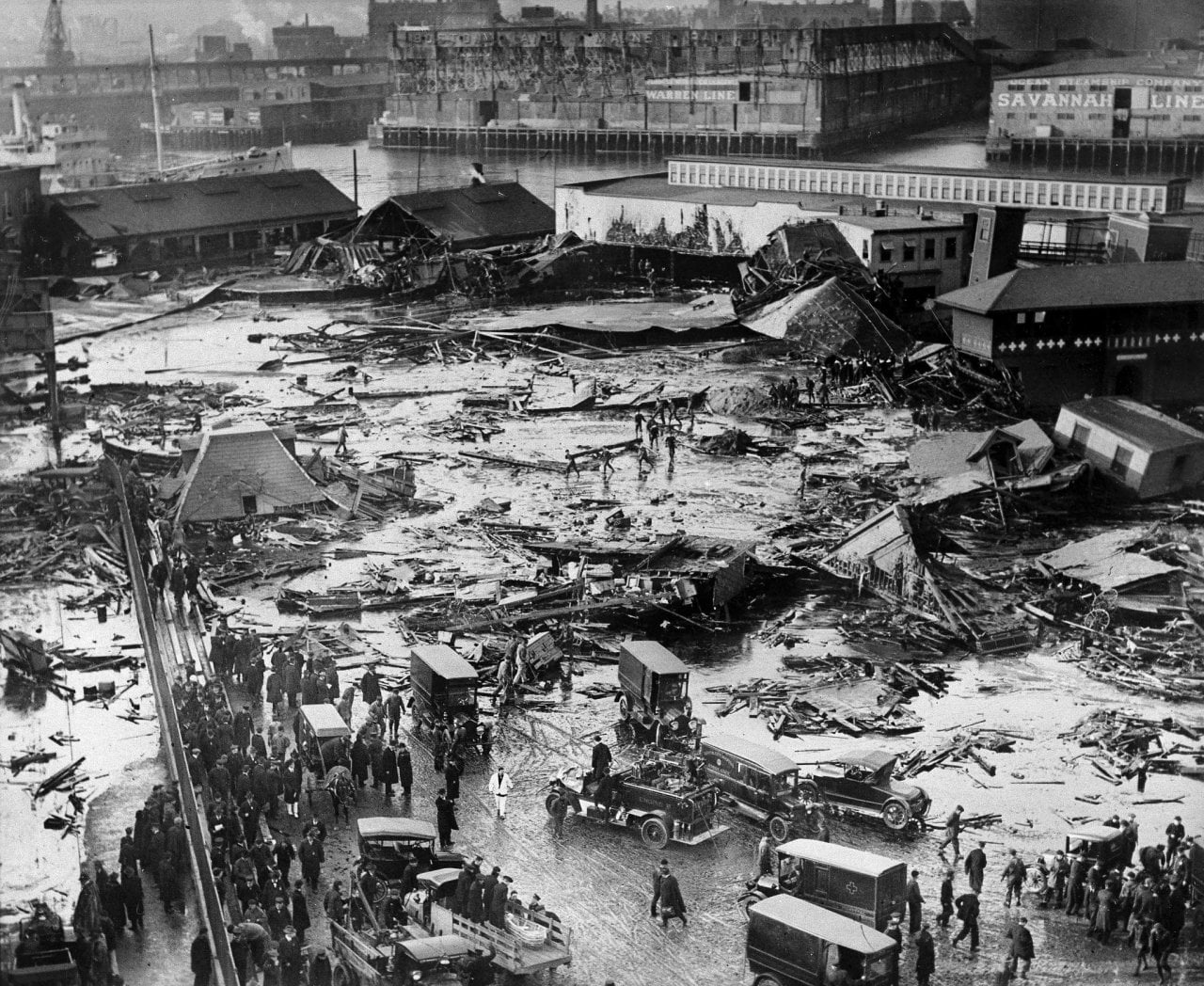
    My Molasses Flood project has gotten a bunch of press since my presentation earlier this week, including in the New York Times, the Associated Press, New Scientist, and on CBC’s “As It Happens”. There’s more links to recent articles on the revamped About page – I’ll continue filling out the “FYFD in the News” section sometime after the holiday weekend!

    I also just want to take a moment to thank all of you for your continued interest and support. I couldn’t keep this up without you! (Image credit: Associated Press)

  • Krakatoa

    Krakatoa

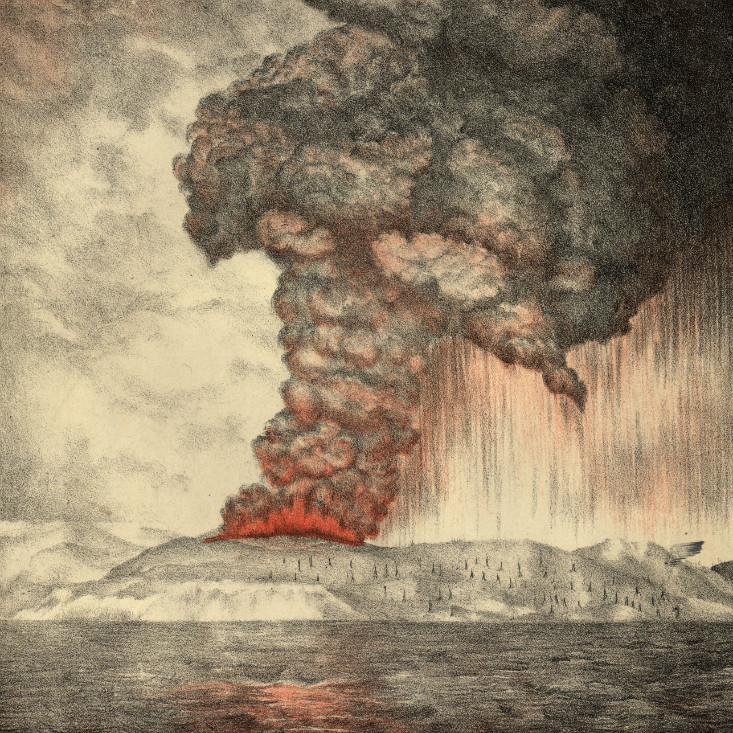
    Volcanoes seem to be a common topic these days. Yesterday Nautilus published a great piece by Aatish Bhatia on the 1883 eruption of Krakatoa, which tore the island apart and unleashed a sound so loud it was heard more than 4800 km away:

    The British ship Norham Castle was 40 miles from Krakatoa at the time of the explosion. The ship’s captain wrote in his log, “So violent are the explosions that the ear-drums of over half my crew have been shattered. My last thoughts are with my dear wife. I am convinced that the Day of Judgement has come.“

    In general, sounds are caused not by the end of the world but by fluctuations in air pressure. A barometer at the Batavia gasworks (100 miles away from Krakatoa) registered the ensuing spike in pressure at over 2.5 inches of mercury. That converts to over 172 decibels of sound pressure, an unimaginably loud noise. To put that in context, if you were operating a jackhammer you’d be subject to about 100 decibels. The human threshold for pain is near 130 decibels, and if you had the misfortune of standing next to a jet engine, you’d experience a 150 decibel sound. (A 10 decibel increase is perceived by people as sounding roughly twice as loud.) The Krakatoa explosion registered 172 decibels at 100 miles from the source. This is so astonishingly loud, that it’s inching up against the limits of what we mean by “sound.” #

    Those are some mindbogglingly enormous numbers. Aatish does a wonderful job of explaining the science behind an explosion whose effects ricocheted through the atmosphere for days afterward. Check out the full article over at Nautilus.  (Image credit: Parker & Coward, via Wikipedia)

  • Wing-Warping

    Wing-Warping

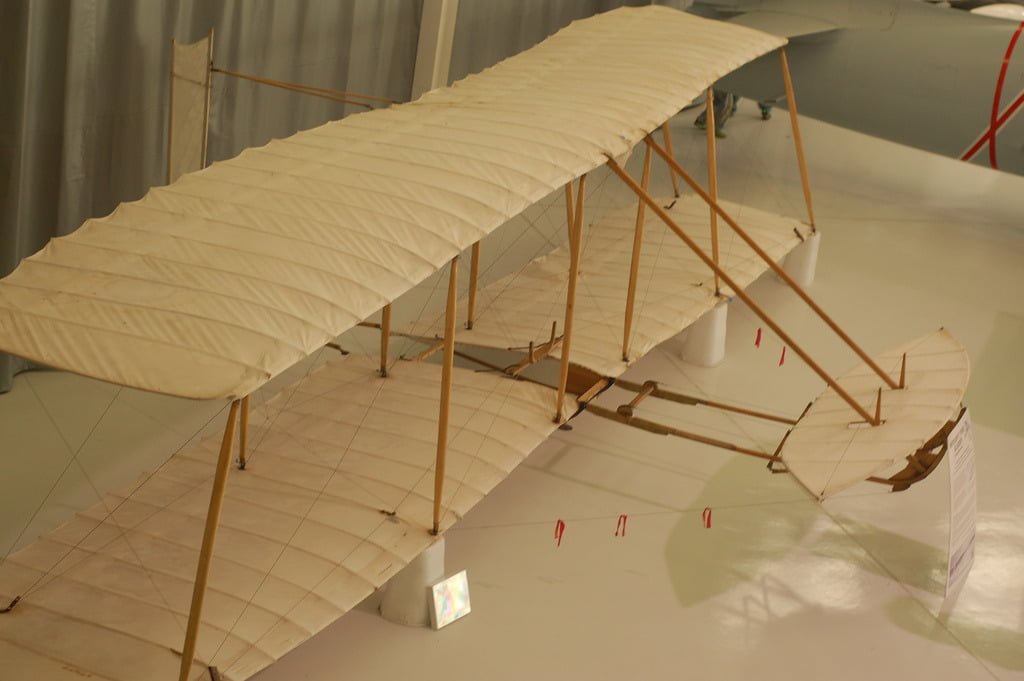
    This replica of the Wright brothers’ 1902 glider demonstrates one of the important innovations the brothers contributed toward powered heavier-than-air flight. To control an aircraft in roll, the Wright brothers developed the idea of wing-warping. The pilot would lie in the cradle (center of image) and shift his body to one side. A system of wires and pulleys would then twist the wings from their rear edge, pulling one side down and the other up. This deflection is akin to changing the wing’s angle of attack. Deflecting the right wingtip downward increased the lift on the right side of the glider, while simultaneously the upward deflection on the left decreased the lift on that side. This causes the glider to bank, or roll, with the right wing up, thereby generating a leftward turn. The lift differential also caused a drag differential, though, with increased drag on the lifted (right, in this case) wing. That extra drag tended to pull the aircraft’s nose rightward, a condition known as adverse yaw. To counter it, the Wright brothers installed a steerable rudder and linked it to the wing-warping mechanism, allowing them to turn with much less effort than other conventional craft. Although wing-warping has been replaced with ailerons, the control principles remain the same. For more, watch this demo of the wing warping mechanism on a 1903 Wright Flyer replica. (Image credit: C. Devers)

  • AEDC 16-ft Supersonic Tunnel

    AEDC 16-ft Supersonic Tunnel

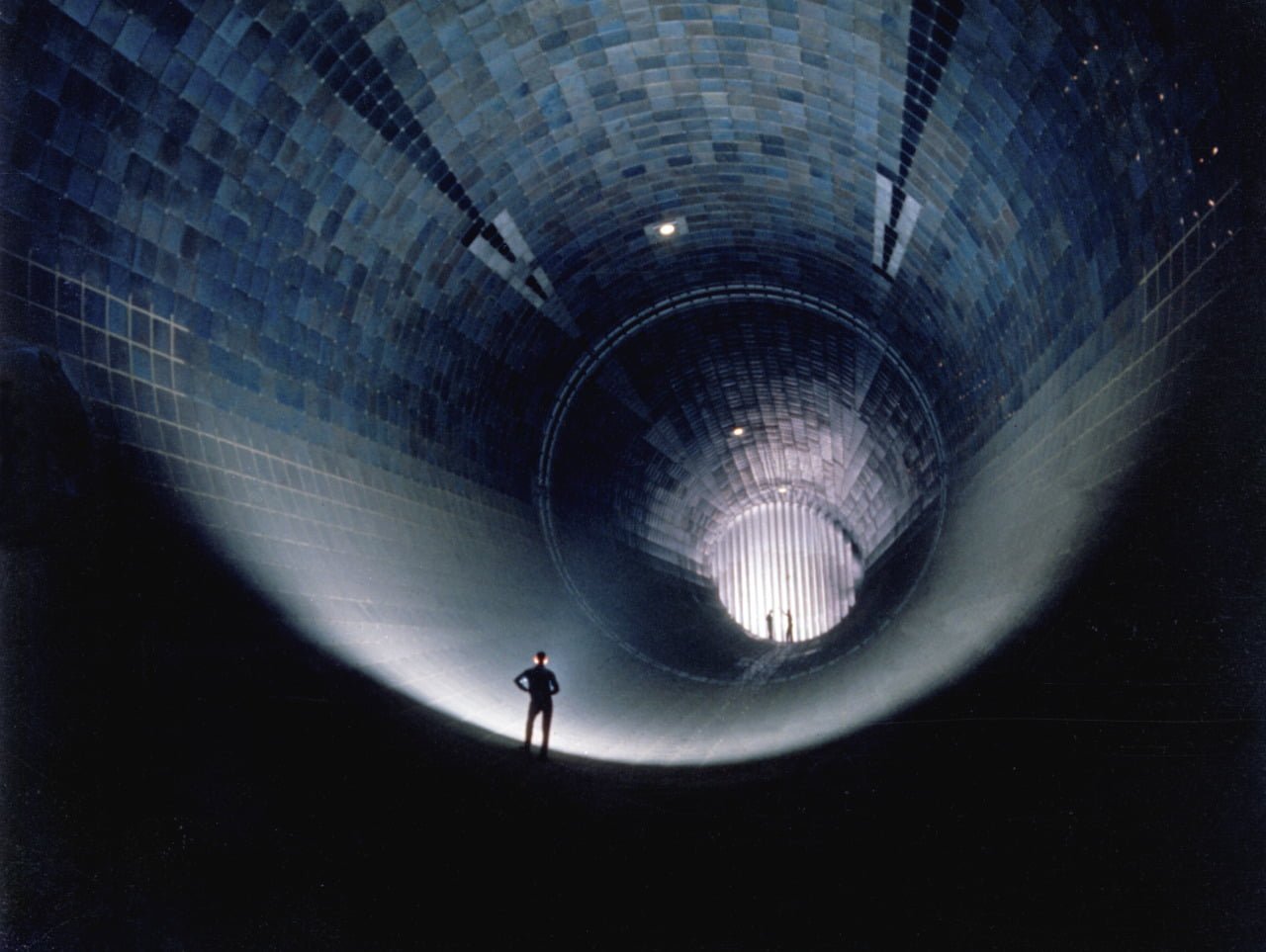
    This 1960 photo shows three men standing inside Arnold Engineering Development Complex’s 16-ft supersonic wind tunnel facility. The wind tunnel was capable of Mach numbers between 1.60 and 4.75 through a test section 4.8 meters wide and 20.2 meters long. It served as a large-scale testing facility for aircraft and propulsion systems. Like many large-scale and high-speed wind tunnel facilities in the United States, it is no longer active. In recent years, many unique wind tunnel facilities at NASA, military bases, and universities have been closed down, depriving researchers and engineers of the ability to include large-scale testing in their design and development of new technologies. These facility closures leave a substantial gap between the speeds and Reynolds numbers achievable in small-scale experiments and computational fluid dynamics and those experienced in flight. (Photo credit: P. Tarver)

  • Fluid Dynamics and the Nobel Prize

    Fluid Dynamics and the Nobel Prize

    Last night marked the 2013 Ig Nobel Prize Award Ceremony, in which researchers are honored for work that “makes people LAUGH and then THINK”. Historically, the field of fluid dynamics has been well-represented at the Ig Nobels with some 13 winners across the fields of Physics, Chemistry, Mathematics, and–yes–Fluid Dynamics since the awards were introduced in 1991. This is in stark contrast to the awards’ more famous cousins, the Nobel Prizes.

    Since the introduction of the Nobel Prize in 1901, only two of the Physics prizes have been fluids-related: the 1970 prize for discoveries in magnetohydrodynamics and the 1996 prize for the discovery of superfluidity in helium-3. Lord Rayleigh (a physicist whose name shows up here a lot) won a Nobel Prize in 1904, but not for his work in fluid dynamics. Another well-known Nobel laureate, Werner Heisenberg, actually began his career in fluid dynamics but quickly left it behind after his doctoral dissertation: “On the stability and turbulence of fluid flow.”

    This is not to suggest that no fluid dynamicist has done work worthy of a Nobel Prize. Ludwig Prandtl, for example, revolutionized fluid dynamics with the concept of the boundary layer (pdf) in 1904 but never received the Nobel Prize for it, perhaps because the committee shied from giving the award for an achievement in classical physics. General consensus among fluid dynamicists is that anyone who can prove a solution for turbulence using the Navier-Stokes equation will likely receive a Nobel Prize in addition to a Millennium Prize. In the meantime, we carry on investigating fluids not for the chance at glory, but for the joy and beauty of the subject. (Image credits: Improbable Research and Wikipedia)

  • Featured Video Play Icon

    The Sinking of the Lusitania

    In 1915, the early days of submarine warfare, the RMS Lusitania was sunk off the coast of Ireland by a torpedo. Eyewitnesses reported a second, more powerful explosion just after the torpedo strike–possibly a boiler or powder explosion–that contributed to the ship sinking in only 18 minutes, resulting in nearly 1200 lives lost. Researchers at Lawrence Livermore National Laboratory have tackled the historic mystery, combining computational efforts with experimentation and historical research to reconstruct the physics of what happened. The full documentary airs tonight on the National Geographic Channel as “Dark Secrets of the Lusitania”. (submitted by Stephanie N)