In 1915, the early days of submarine warfare, the RMS Lusitania was sunk off the coast of Ireland by a torpedo. Eyewitnesses reported a second, more powerful explosion just after the torpedo strike–possibly a boiler or powder explosion–that contributed to the ship sinking in only 18 minutes, resulting in nearly 1200 lives lost. Researchers at Lawrence Livermore National Laboratory have tackled the historic mystery, combining computational efforts with experimentation and historical research to reconstruct the physics of what happened. The full documentary airs tonight on the National Geographic Channel as “Dark Secrets of the Lusitania”. (submitted by Stephanie N)
Category: History

Sally Ride
Today FYFD takes a brief aside from fluid dynamics to mark the passing of Sally Ride, the first U.S. woman to travel to space. A physicist by training, Ride served as a mission specialist on STS-7 and STS-41G, shuttle missions that included deploying satellites as well as conducting scientific experiments. After her career with NASA, Ride returned to physics as a faculty member at the University of California, San Diego and dedicated herself to motivating children and young adults–most especially women–to pursue careers in science, math, and engineering. She was an inspiration and role model to more than a generation; her courage and her passion for science touched many lives, including my own. Godspeed, Dr. Ride.

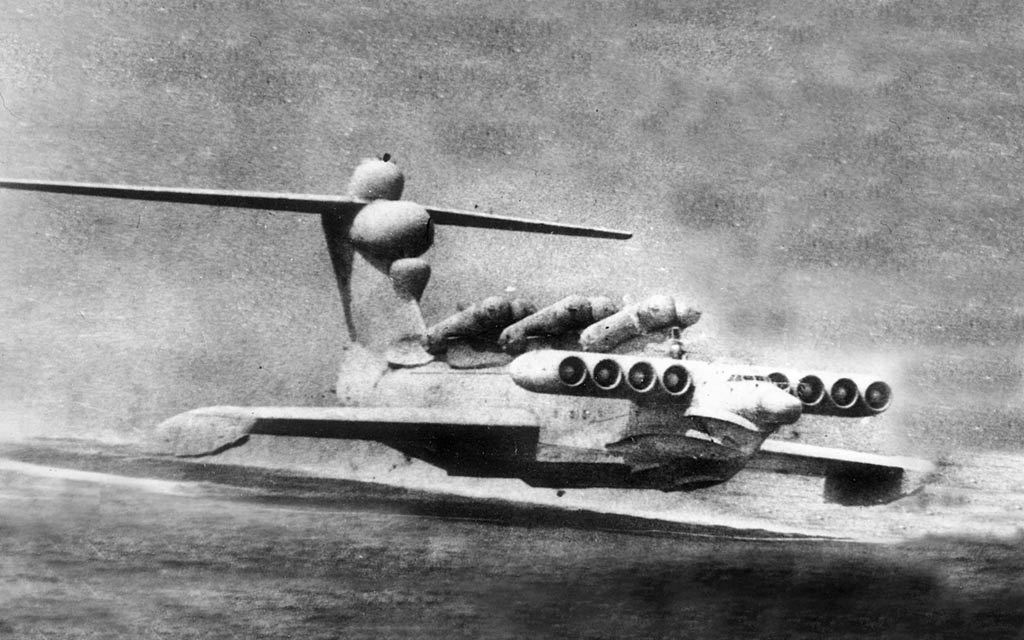
The Ekranoplan
The ekranoplan, the monster of the Caspian Sea, was a Soviet-era aircraft nearly 74 meters in length and weighing 380,000 kgs fully loaded. (In contrast, the C-17 is 53 m long and weighs 265,350 kg fully loaded.) This enormous craft relied on ground effect to stay aloft, where it was capable of 297 knots. Flying close to the ground or water increases the possible lift on wings through a “cushioning effect” that increases pressure on the lower wing surface and by disrupting the formation of wingtip vortices which typically reduce lift through downwash.

Wright Brothers’ Wind Tunnel
A large part of the Wright Brothers’ ultimate success in creating the first powered heavier-than-air craft came as a result of work done in their homemade wind tunnel, shown above. In the aftermath of the failure of their 1901 Glider, the brothers decided that the lift and drag data they had used from Otto Lilienthal must be inaccurate. They built this wind tunnel and its force balances to measure lift and drag on two hundred different airfoils themselves and were rewarded with far more successful flights with their 1902 Glider, which led directly to the Wright Flyer in the following year. #
Godspeed, Discovery!
The space shuttle, despite three decades of service, remains a triumph of engineering. Although it is nominally a space vehicle, fluid dynamics are vital throughout its operation. From the combustion in the engine to the overexpansion of the exhaust gases; from the turbulent plume of the shuttle’s wake to the life support and waste management systems on orbit, fluid mechanics cannot be escaped. Countless simulations and experiments have helped determine the forces, temperatures, and flight profiles for the vehicle during ascent and re-entry. Experiments have flown as payloads and hundreds of astronauts have “performed experiments in fluid mechanics” in microgravity. Since STS-114, flow transition experiments have even been mounted on the orbiter wing. The effort and love put into making these machines fly is staggering, but all things end. Godspeed to Discovery and her crew on this, her final mission!

Reader Question: Rotor Ships
lazenby asks:
Can you explain how the magnus effect makes rotor ships move?
When a spinning body is placed in a flow, the body experiences a force perpendicular to the direction of the flow. This is called the Magnus effect and is, for example, why baseballs, soccer balls, and tennis balls veer from the path we expect them to take. To understand why a spinning body experiences this force, take a look at the streamlines around a rotating cylinder.
In this picture, the flow goes from left to right and the cylinder is spinning in the clockwise direction. The red dots represent the stagnation points of the flow. Air over the top of the cylinder gets accelerated by the spinning, shown here by the narrowing of space between streamlines. On the underside of the cylinder, the surface is moving in the opposite direction of the air, which decelerates the flow. We know from Bernoulli that this means there is low pressure on the top of the cylinder and high pressure on the bottom. As a result, the cylinder experiences a upward force – lift! You can explore the effect of rotation on the streamlines yourself using this neat demo from Wolfram.
Rotor ships, invented in the 1920s, used this effect for ship’s propulsion. They used a regular motor to begin moving, and, once they had some wind, used motors to spin giant cylinders on the deck. As the rotors spun, the ships were pushed in a direction perpendicular to the wind. They could apparently tack 20-30 degrees into the wind while conventional ships could only manage 45 degrees. Unfortunately, so much energy was required to spin the rotors that the design was pretty inefficient and never caught on.

Archimedes
Archimedes may be the world’s most famous fluid mechanician. The story of his discovery of the principles of buoyancy (and his subsequent running naked through the streets proclaiming “Eureka!”) is classic. His other famous fluid-related invention is the Archimedes screw, a type of pump still used today in applications from moving granular flows to maintaining blood flow in heart patients. Scientific American is currently featuring a book excerpt about Archimedes and his contributions to physics and math. It’s well-worth a read. #

Bell’s Powered Kite
Inventor Alexander Graham Bell is best known for the telephone but also made many contributions to early aeronautics. This man-carrying kite, the Cygnet III, was a powered kite with a “wing” made of 3,393 tetrahedral cells; it managed enough lift to fly on March 1, 1912. National Geographic is featuring photos from the early days of flight courtesy of the Smithsonian National Air and Space Museum. They’re well worth checking out. #

Langley’s Transonic Dynamics Tunnel
NASA Langley’s Transonic Dynamics Tunnel (TDT) recently celebrated 50 years of operation. It’s 16 x 16 ft test section has hosted models of many aircraft, including the Lockheed Electra, the C-141, the F-15, the F-16, and the FA-18 shown above. The tunnel is primarily utilized for aeroelastic studies of flutter, a potentially catastrophic phenomenon where aerodynamic forces couple to a structure’s natural modes of vibration. (via JediOliver and NASA_Langley)