Though we may not often consider it, our bodies are full of fluid dynamics. Blood flow is a prime example, and, in this video, researchers describe their simulations of flow through the left side of the heart. Beginning with 3D medical imaging of a patient’s heart, they construct a computational domain – a meshed virtual heart that imitates the shape and movements of the real heart. Then, after solving the governing equations with an additional model for turbulence, the researchers can observe flow inside a beating heart. Each cycle consists of two phases. In the first, oxygenated blood fills the ventricle from the atrium. This injection of fresh blood generates a vortex ring. Near the end of this phase, the blood mixes strongly and appears to be mildly turbulent. In the second phase, the ventricle contracts, ejecting the blood out into the body and drawing freshly oxygenated blood into the atrium. (Video credit: C. Chnafa et al.)
Year: 2014

Tip Vortex
Smoke released from the end of a test blade shows the helical pattern of a tip vortex from a horizontal-axis wind turbine. Like airplane wings, wind turbine blades generate a vortex in their wake, and the vortices from each blade can interact downstream as seen in this video. These intricate wakes complicate wind turbine placement for wind farms. A turbine located downstream of one of its fellows not only has a decreased power output but also has higher fatigue loads than the upstream neighbor. In other words, the downstream turbine produces less power and will wear out sooner. Researchers visualize, measure, and simulate turbine wakes and their interactions to find ways of maximizing the wind power generated. (Photo credit: National Renewable Energy Laboratory)

Fireworks Taking Off
Aerial fireworks are essentially semi-controlled exploding rockets. Here Discovery Channel shares high-speed video of fireworks taking off. The turbulent billowing exhaust on the ground is reminiscent of other rocket launches. The tube-launched firework clip is a great example of an underexpanded nozzle. The pressure of the gases in the tube is higher than the ambient air, so when the gases escape, the exhaust fans out to equalize the pressure. And, finally, the explosion that propels the colorful chemicals outward forms jets that can affect the final form of the display. To my American readers: Happy 4th of July! And be safe! (Video credit: Discovery Slow-Down)
Soap Film Grass
In the summer months, a breeze can set long grasses waving in an impressive display. Similar behaviors are seen in aquatic plants during tides. Researchers simulate the behavior in two-dimensions using a flowing soap film and nylon filaments. Flow visualization reveals the strong differences between flow above and between the grass. Vortices recirculate between the filaments at speeds much slower than the flow overhead. The instantaneous interaction of the high-speed freestream, the unsteady vortices, and the resistance of the grass results in familiar synchronous waves of grain. (Video credit: R. Singh et al.)

Reader Question: Rib Vortices
Reader tarastarr1 asks:
For the (awesome) wave gif and explanation, I think the asker was wondering about that little branch-like projection you can see in the top-middle part of the gif right after the camera submerges. Your explanation of the wave is great, but now I’m also wondering: if the wave is so powerful, how can that little jet form?
I think you’re probably right about the original question. I actually didn’t even notice that tiny vortex until after the post went up today! I think the little vortex is probably similar to the rib vortices I referenced at the end of the last post. If there happened to be some small localized rotation in the water initially, the wave’s passage would stretch it out. Stretching a vortex causes it to spin faster, exactly the way that an ice skater pulling her arms in causes her to spin faster – conservation of angular momentum! In that situation, the wave’s passage actually strengthens the vortex rather than destroying it.
Reader Question: Wave Vortex
Reader unquietcode asks:
I saw this post recently and it made me wonder what’s going on. If you look in the upper right of the frame as the camera submerges, you can see a little vortex of water whirring about. Even with the awesome power of the wave rolling forward a little tornado of water seems able to stably form. Any idea what causes this phenomenon?
This awesome clip was taken from John John Florence’s “& Again” surf video. What you’re seeing is the vortex motion of a plunging breaking wave. As ocean waves approach the shore, the water depth decreases, which amplifies the wave’s height. When the wave reaches a critical height, it breaks and begins to lose its energy to turbulence. There are multiple kinds of breaking waves, but plungers are the classic surfer’s wave. These waves become steep enough that the top of the wave overturns and plunges into the water ahead of the wave. This generates the vortex-like tube you see in the animation. Such waves can produce complicated three-dimensional vortex structures like those seen in this video by Clark Little. Any initial variation in the main vortex gets stretched as the wave rolls on, and this spins up and strengthens the rib vortices seen wrapped around the primary vortex. (Source video: B. Kueny and J. Florence)

Measuring Wind Speed by Satellite
Weather modeling and forecasting in recent decades have benefited enormously from the availability of more data. For example, satellites now measure wind speeds over the open ocean, instead of data simply coming from isolated ships and buoys. The satellites do this by measuring the roughness of the ocean using radar or GPS signals bounced off the ocean surface. From this researchers can construct a map of wave height and direction like the one in the animation above. For a large body of water, waves are primarily generated by wind shearing the water at the interface. The waves we see are a result of the Kelvin-Helmholtz instability between the wind and ocean. Because this is a well-known behavior, it is possible to connect the waves we observe with the wind conditions that must have generated them. (Image credit: ESA; animation credit: Wired; submitted by jshoer)
Specialized’s Win Tunnel
Awhile back, I mentioned that bike manufacturer Specialized had built their own wind tunnel to test cycling equipment. In this video, they provide a walk-through of their facility. Although there are features unique to this tunnel and its intended purpose, much of what Chris and Mark describe is standard for any subsonic wind tunnel. The story begins upstream in the inlet and contraction, where air is pulled into the tunnel. Honeycomb flow straighteners direct the incoming air, followed by a series of mesh screens. These screens break up any turbulent eddies, which helps smooth and laminarize the flow. The test section is where measurements occur, whether on cyclists or other models. This part of the tunnel is usually equipped with many sensors and specialized equipment, like the balance shown. These allow researchers to measure quantities like force, velocity, pressure, and/or temperature. Then the wind tunnel widens gradually in a diffuser, which slows down the air and helps prevent disturbances from propagating upstream. Finally, the fans at the back provide the source of low-pressure that drives the air flow. (Video credit: Specialized Bicycles; submitted by J. Salazar)

Reader Question: Fractals and Turbulence

Reader 3d-time asks:
Hi, there is a guy, at my college, who is doing a master’s degree thesis in turbulence. He says he uses fractals and computational methods. Can you explain how fractals can be used in fluid dynamics?
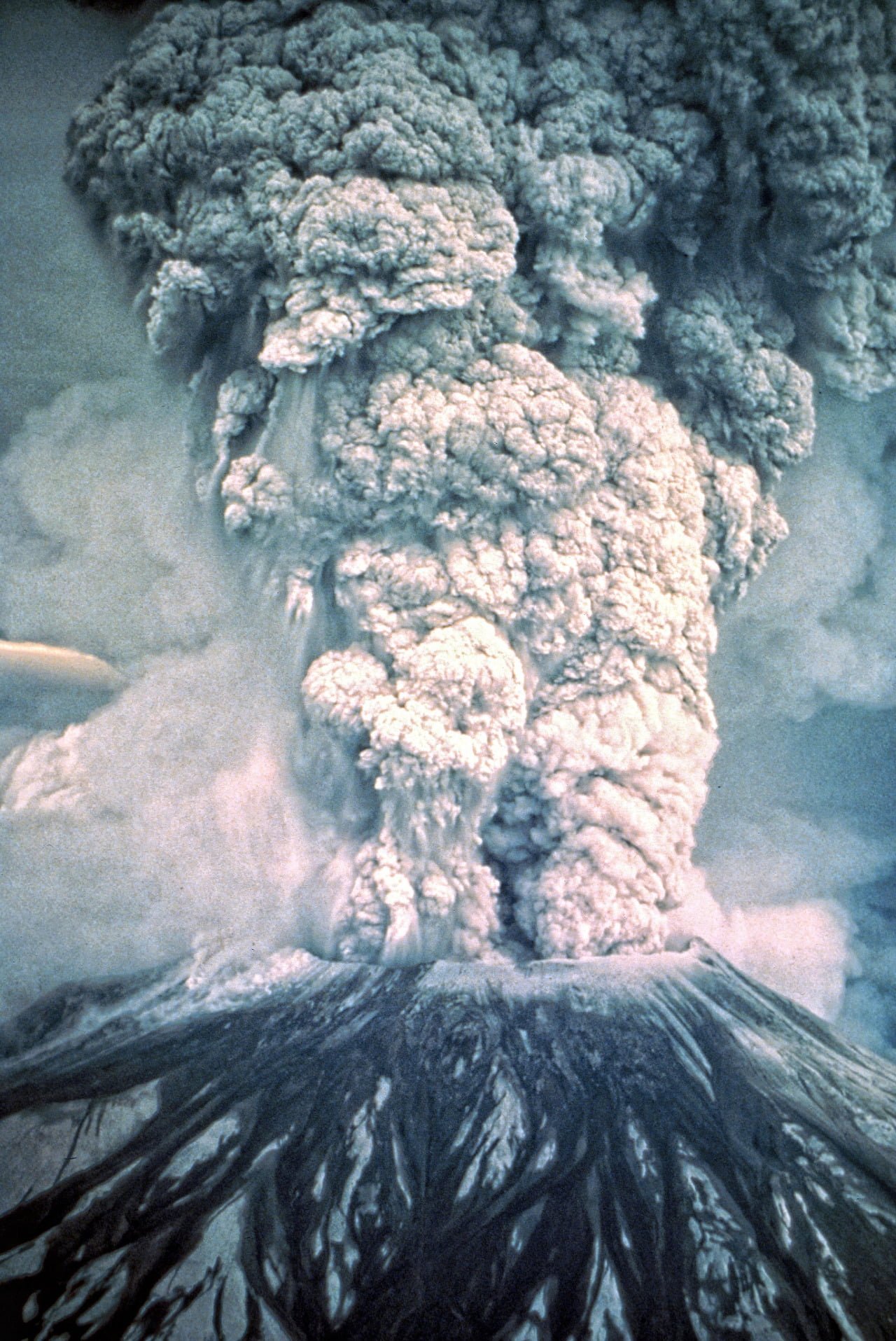
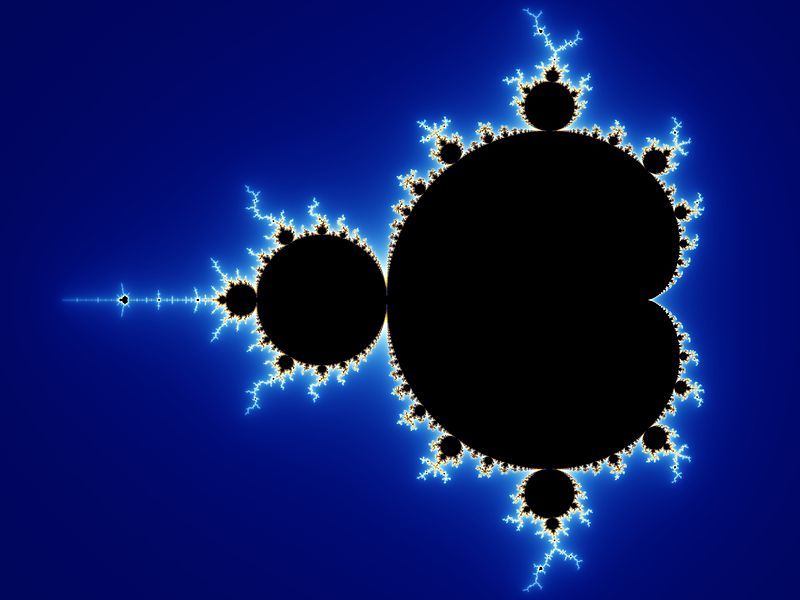
That’s a good question! Fractals are a relatively recent mathematical development, and they have several features that make them an attractive tool, especially in the field of turbulence. Firstly, fractals, especially the Mandelbrot set shown above, demonstrate that great complexity can be generated out of simple rules or equations. Secondly, fractals have a feature known as self-similarity, meaning that they appear essentially the same regardless of scale. If you zoom in on the Mandelbrot set, you keep finding copy after copy of the same pattern. Nature, of course, doesn’t have this perfect infinite self-similarity; at some point things break down into atoms if you keep zooming in. But it is possible to have self-similarity across a large range of scales. This is where turbulence comes in. Take a look at the turbulent plume of the volcanic eruption in the photo above. Physically, it contains scales ranging from hundreds of meters to millimeters, and these scales are connected to one another by their motion and the energy being passed from one scale to another. There have been theories suggested to describe the relationship between these scales, but no one has yet found a theory truly capable of explaining turbulence as we observe it. Both the self-similarity and the complex nature of fractals suggest they could be useful tools in finally unraveling turbulence. In fact, Mandelbrot himself wrote several papers connecting the two concepts. Perhaps your friend will help find the next hints! (Image credit: U.S. Geological Survey, Wikimedia)
Steam Hammer
The steam hammer phenomenon–and the closely related water hammer one–is a violent behavior that occurs in two-phase flows. Nick Moore has a fantastic step-by-step explanation of the physics, accompanied by high-speed footage, in the video above. Pressure and temperature are driving forces in the effect, beginning with the high-temperature steam that first draws the water up into the bottle. As the steam condenses into the cooler water, the steam’s pressure drops, drawing in more water. Eventually it drops low enough that the incoming water drops below the vapor pressure. This triggers some very sudden thermodynamic changes. The drop in pressure vaporizes incoming water, but the subsequent cloud cools rapidly, which causes it to condense but also drops the pressure further. Water pours in violently, cavitating near the mouth of the bottle because the acceleration there drops the local pressure below the vapor pressure again. The end result is a flow that’s part-water, part-vapor and full of rapid changes in pressure and phase. As you might imagine, the forces generated can destroy whatever container the fluids are in. Be sure to check out Nick’s bonus high-speed footage to appreciate every stage of the phenomenon. (Video credit and submission: N. Moore)