Supercritical fluids exist at temperatures and pressures above the critical point, in a region of the phase diagram where there is no clear boundary between the liquid and gaseous state. Supercritical fluids have some of the properties of each state: they can move as freely as a gas, but they are still capable of dissolving materials like a liquid does. They also have no surface tension because there is no interface between liquid and solid. These properties make supercritical fluids very useful in industrial applications, including decaffeination and chemical deposition. Interestingly, the temperatures and pressures on Venus are so high that scientists think the atmosphere at the surface is a supercritical fluid. (Video credit: SCFED Project)
Year: 2014

Mach Diamonds
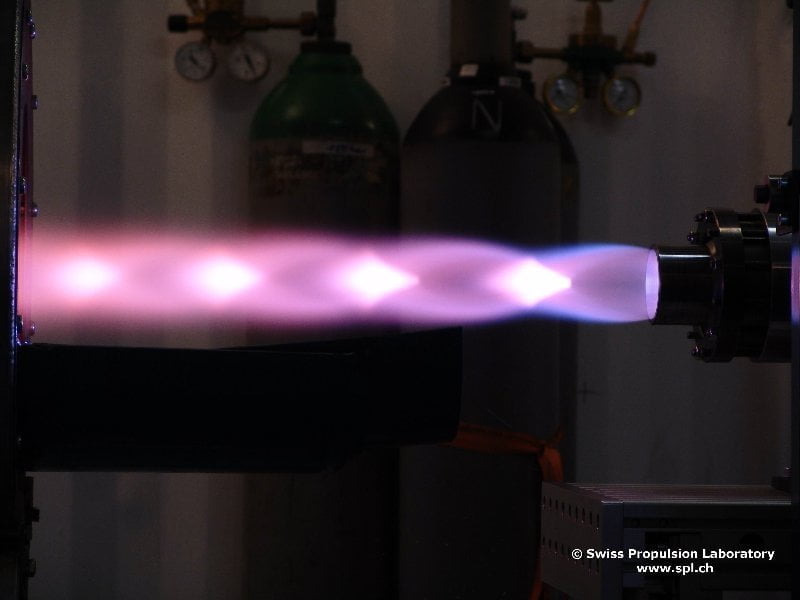
Rocket engines often feature a distinctive pattern of diamonds in their exhaust. These shock diamonds, also known as Mach diamonds, are formed as result of a pressure imbalance between the exhaust and the surrounding air. Because the exhaust gases are moving at supersonic speeds, changing their pressure requires a shock wave (to increase pressure) or an expansion fan (to decrease the pressure). The diamonds are a series of both shock waves and expansion fans that gradually change the exhaust’s pressure until it matches that of the surrounding air. This effect is not always visible to the naked eye, though. We see the glowing diamonds as a result of ignition of excess fuel in the exhaust. As neat as they are to see, visible shock diamonds are actually an indication of inefficiencies in the rocket: first because the exhaust is over- or under-pressurized, and, second, because combustion inside the engine is incomplete. (Photo credit: Swiss Propulsion Laboratory)

The Upside-Down Jellyfish
The upside-down jellyfish, Cassiopea, rests its bell against the ocean floor and points its frilly oral arms up toward the sun for the benefit of the symbiotic algae living on it. In return, the algae provide some of the nutrients the jellyfish needs. The rest it obtains by filter feeding for zooplankton. The video above shows how a combination of flow visualization and simplified computational modeling can reveal the jellyfish’s methods for eating. A simple pulsing bell has limited fluid flow in the region of the jellyfish’s mouths, but the addition of a permeable layer (representative of the oral arms) significantly enhances mixing. (Video credit: T. Rodriguez et al.)

Wave Tank
A new wave tank facility opening at the University of Edinburgh promises new capabilities to simulate ocean wave behavior. The circular 25m diameter wave tank is lined with 168 wave makers and is equipped with 28 submerged flow-drive units. Together, these allow the tank to simultaneously simulate nearly any wave type as well as tidal currents up to 1.6 m/s. The facility is intended for 1/20th scale modeling; projected to full-size, this means that the tank is capable of making waves representative of 28 m high ocean waves and tidal currents in excess of 12 knots. It’s expected to be particularly valuable in the development and testing of wave and tidal motion generators for clean energy. For more, see BBC News and FloWave’s own website. (Image credit: Brightspace/BBC News; submitted by srikard)

The Atmospheric River
Atmospheric rivers are long, narrow corridors of concentrated water vapor transport in the atmosphere. They often occur when winds from storms over the ocean draw moisture together and project it ahead of a cold front. The phenomenon was only recognized in the 1990s, but subsequent research has shown that atmospheric river conditions account for many instances of heavy rainfall and flooding in areas along the West Coast of the United States. Forecasters can now recognize the phenomenon in forecast models, allowing them to predict potential flood-inducing rainfall days in advance. To learn more, check out NOAA’s atmospheric river Q&A. (Image credit: NOAA)
Granular Jets
Object impacts in water and other fluids often create cavities that generate jets when they collapse. But impacts on granular materials can produce similar results, forming a cavity, a splash corona, and, under the right circumstances, a jet. This Sixty Symbols video explores the effect of grain size (and thus weight) on the formation of such a rebound jet. Ultimately, the jet behavior is driven by air. When the granular material is poured, air gets trapped between the grains. The impact compresses the grains, forcing the previously trapped air up and out through the cavity created by the impact. Interestingly, once the air pressure is low enough, jet creation is suppressed, not unlike splash suppression in liquids. (Video credit: Sixty Symbols/Univ. of Nottingham)

Tear Films
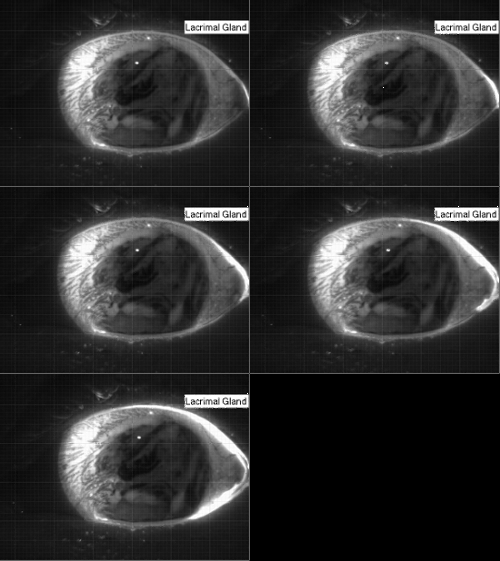
The human eye has a thin tear film over its surface to maintain moisture and provide a smooth optical surface. The film consists of multiple layers: a lipid layer at the air interface to decrease surface tension and delay evaporation; an aqueous middle layer; and an inner layer of hydrophilic mucins that keep the film attached to the eye. The entire film is a few microns thick, with the lipid layer estimated to be only 50-100 nm thick and the mucin layer just a few tenths of a micron. The aqueous portion of the tear film is supplied from the lacrimal gland in the corner of the eye. In the animation above, the fresh aqueous fluid is fluorescent. It gathers in the corner of the eye several seconds after a blink due to reflex tearing. The tear fluid then flows around the outer edges of the eye until the subject blinks and the fresh tear gets distributed throughout the film. (Research credit: L. Li et al.; original video)
Kelvin-Helmholtz in the Lab
The Kelvin-Helmholtz instability looks like a series of overturning ocean waves and occurs between layers of fluids undergoing shear. This video has a great lab demo of the phenomenon, including the set-up prior to execution. When the tank is tilted, the denser dyed salt water flows left while the fresh water flows to the right. These opposing flow directions shear the interface between the two fluids, which, once a certain velocity is surpassed, generates an instability in the interface. Initially, this disturbance is much too small to be seen, but it grows at an exponential rate. This is why nothing appears to happen for many seconds after the tilt before the interface suddenly deforms, overturns, and mixes. In actuality, the unstable perturbation is present almost immediately after the tilt, but it takes time for the tiny disturbance to grow. The Kelvin-Helmholtz instability is often seen in clouds, both on Earth and on other planets, and it is also responsible for the shape of ocean waves. (Video credit: M. Hallworth and G. Worster)

Forming a Jet
Many situations can generate high-speed liquid jets, including droplet impacts, vibrated fluids, and surface charges. In each of these cases, a concave liquid surface is impulsively accelerated, which causes the flow to focus into a jet. The image above shows snapshots of a microjet generated from a 50 micron capillary tube visible at the right. This jet formed when the meniscus inside the capillary tube was disturbed by a laser pulse that vaporized fluid behind the interface. Incredibly, the microjets generated with this method can reach speeds of 850 m/s, nearly 3 times the speed of sound in air. Researchers have found the method produces consistent results and suggest that it could one day form the basis for needle-free drug injection. You can read more in their freely available paper. (Photo credit: K. Tagawa et al.)

AEDC 16-ft Supersonic Tunnel
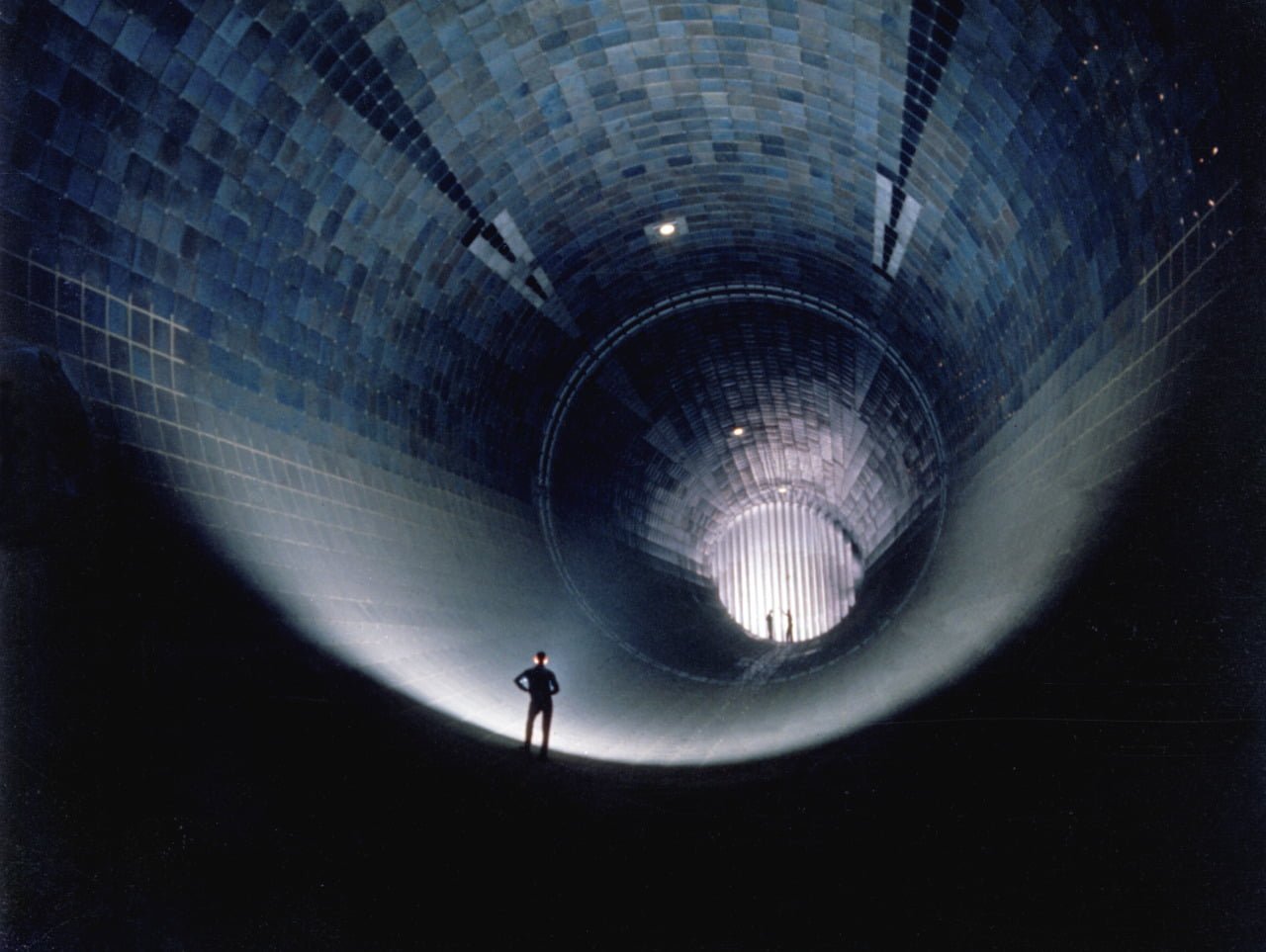
This 1960 photo shows three men standing inside Arnold Engineering Development Complex’s 16-ft supersonic wind tunnel facility. The wind tunnel was capable of Mach numbers between 1.60 and 4.75 through a test section 4.8 meters wide and 20.2 meters long. It served as a large-scale testing facility for aircraft and propulsion systems. Like many large-scale and high-speed wind tunnel facilities in the United States, it is no longer active. In recent years, many unique wind tunnel facilities at NASA, military bases, and universities have been closed down, depriving researchers and engineers of the ability to include large-scale testing in their design and development of new technologies. These facility closures leave a substantial gap between the speeds and Reynolds numbers achievable in small-scale experiments and computational fluid dynamics and those experienced in flight. (Photo credit: P. Tarver)