When you lift a glass of champagne or sparkling wine at midnight tonight, your nose and mouth will be greeted by a plethora of aromas, flavors, and sensations propagated by the tiny bubbles in the drink. Carbon dioxide dissolved in the wine gathers in a stream of tiny bubbles that rise at the center of the glass. (The bubbles form at the center because champagne glasses are often etched in a ring there to provide nucleation points where the bubbles can grow.) This stream of rising bubbles generates vortical motion in the glass that helps carry the carbon dioxide to the surface, where it is released when the bubbles burst. In the tall, thin champagne flute these vortices mix the entire contents of the glass, but, in a wider coupe, the vortices are confined to the center, leaving a stiller region along the glass’s edges. For those who find that a freshly poured flute of champagne stings their noses–a side effect of the high gaseous carbon dioxide concentration just after decanting–the wider coupe lowers the concentration at the glass’s lip and may provide a more pleasant experience for toasting the new year. (Image credit: F. Beaumont et al.)
Year: 2014

Grow Your Own Snowflakes
If your Christmas holiday was a little too green (like mine was), Science Friday has just the activity for you – grow your own snowflakes! With a few materials you probably already have and some dry ice from the store, you can grow and observe ice crystals at home. Although these crystals form from water vapor instead of water droplets like proper snowflakes, they do exhibit different structures depending on temperature and humidity, just the way natural snowflakes do. (Video credit: Science Friday/F. Lichtman)

Manipulating Fluids
Combining water-repelling superhydrophobic surfaces with water-loving hydrophilic surfaces allows scientists and engineers to manipulate common fluids. Here a hydrophilic track surrounded by a superhydrophobic background collects and distributes drops of dyed water. The wetting characteristics of the surface combined with surface tension in the liquid drives the flow. No pumping or power input is necessary. This kind of manipulation of droplets can be especially useful in biomedical applications where fast-acting, low-cost devices could be used to diagnose diseases or measure blood glucose levels. (Image credit: A. Ghosh et al., via NSF; see also source video)

Splashy Heroines


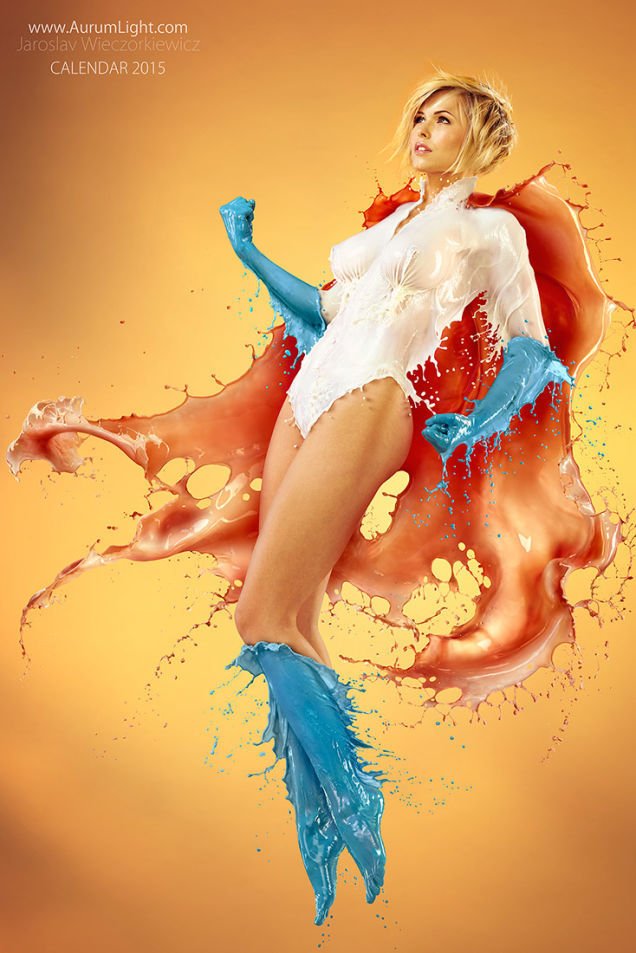

In his latest work, photographer Jaroslav Wieczorkiewicz used splashing liquids to create fantastical superheroine costumes. The splashes are all real, composited together in post-production from hundreds of individual splashes. He uses cold whole milk as his base liquid, sometimes supplementing with dye or paint for color. There’s also a behind-the-scenes video showing how the pictures are made, but, fair warning, it’s in German with some English subtitles and does contain nudity (link). (Image credits: J. Wieczorkiewicz; via Gizmodo)
Growing Snowflakes
It’s easy to miss the beauty of a snowflake if you don’t take a close look. These tiny crystals form when water freezes onto a dust particle or other nucleation site, and they grow as water vapor freezes on to the nucleus. The structured appearance of a snowflake comes from the bonds formed between water molecules, but the exact type and shape of crystal formed–not all snowflakes are six-sided!–depends on the local temperature and humidity during freezing. This microscopic timelapse video by Vyacheslav Ivanov lets you watch the process in action. (Video credit: V. Ivanov; via io9)

Viscous Droplet Impacts
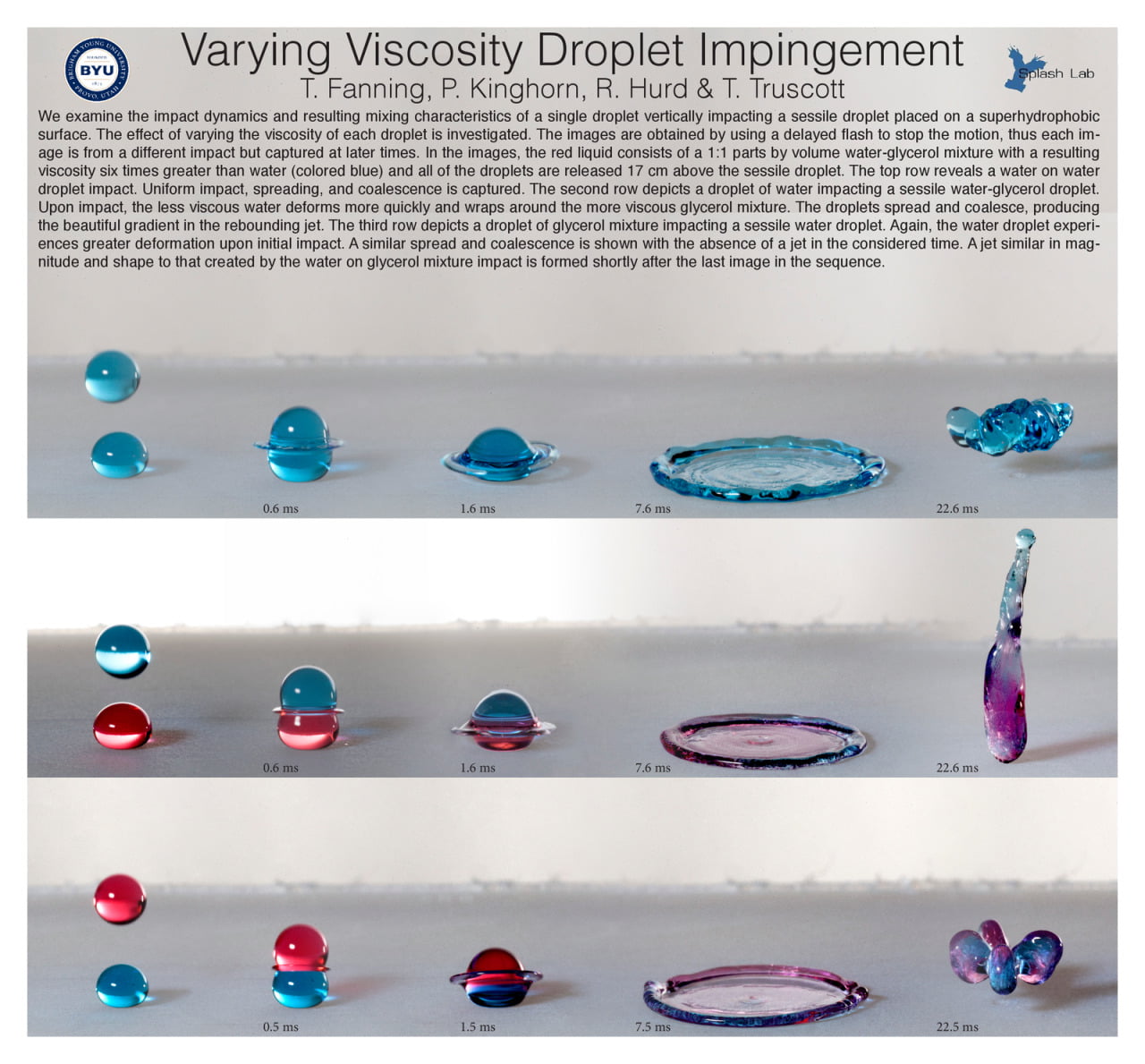
Viscosity can have a notable effect on droplet impacts. This poster demonstrates with snapshots from three droplet impacts. The blue drops are dyed water, and the red ones are a more viscous water-glycerol mixture. When the two water droplets impact, a skirt forms between them, then spreads outward into a sheet with a thicker, uneven rim before retracting. The second row shows a water droplet impacting a water-glycerol droplet. The less viscous water droplet deforms faster, wrapping around and mixing into the other drop before rebounding in a jet. The last row switches the impacts, with the more viscous drop falling onto the water. As in the previous case, the water deforms faster than the water-glycerol. The two mix during spreading and rebound slower. In the last timestep shown, the droplet is still contracting, but it does rebound as a jet thereafter. (Image credit: T. Fanning et al.)
“Marco Polo” Theme
Netflix’s new original series “Marco Polo” has a distinctive and fluidsy title sequence. The artistic team at the Mill created the effect by painting images in water atop dense paper before introducing Japanese sumi-ink. Using high-speed photography, they filmed the diffusion of the ink into the water as it reveals the larger picture. There’s a great behind-the-scenes break down and video over at their blog. (Video credit: The Mill, submitted by jshoer)

Propagating Flames
Like many flows, flames can be unstable and undergo a transition from orderly laminar flow to chaotic turbulent flow. The timelapse image above shows the propagation of a flame front travelling downward. Each blue line represents the forwardmost position of the flame at a specific time. The flame is essentially two-dimensional, held between two glass plates separated by a 5-mm gap. The V-like points in the flame front are called cusps, and if you look closely, you can see cusps forming and even merging as the flame moves downward. Also notice how the flame front is more uniform near the top of the image, but, by the bottom, it has split into many more cusps. This is one of the indications that the flame is unstable. Check out the full poster-version of the image in the Gallery of Fluid Motion. (Photo credit: C. Almarcha et al., original poster)

Stepping on Lava
What happens when you step on lava? (First off, don’t try this yourself.) Lava is both very dense and very viscous, so, as illustrated in the animation above, it does not give all that much under pressure. If you were to fall on it, you’d land, sink a little bit, and then get burned. It’s also interesting to note that the lava springs back after being indented. Basaltic lava like that found in Hawaii, where this clip originates, does have viscoelastic properties, which might explain the elasticity of the deformed fluid. (Image credit: A. Rivest, source video; via Gizmodo)
Simplified Schlieren Set-up
Schlieren photography offers a glimpse into flows that are usually invisible to the human eye. With a relatively simple set-up–a light source, collimating mirror(s), and a razor blade–it becomes possible to see differences in density. The technique lets one visualize temperature-driven flows like the buoyant convection from a flame or other heat source, and it can also be used to visualize shock waves and sound. The video above has several neat schlieren demos, including some non-air examples using hydrogen (lighter than air) and sulfur hexafluoride (denser than air), both of which are transparent to the naked eye. (Video credit: Harvard University, via Jennifer Ouellette)