Any time there is relative motion between a solid and a fluid, a small region near the surface will see a large change in velocity. This region, shown with smoke in the image above, is called the boundary layer. Here air flows from right to left over a spinning spheroid. At first, the boundary layer is laminar, its flow smooth and orderly. But tiny disturbances get into the boundary layer and one of them begins to grow. This disturbance ultimately causes the evenly spaced vortices we see wrapping around the mid-section of the model. These vortices themselves become unstable a short distance later, growing wavy before breaking down into complete turbulence. (Photo credit: Y. Kohama)
Year: 2013

Under the Waves

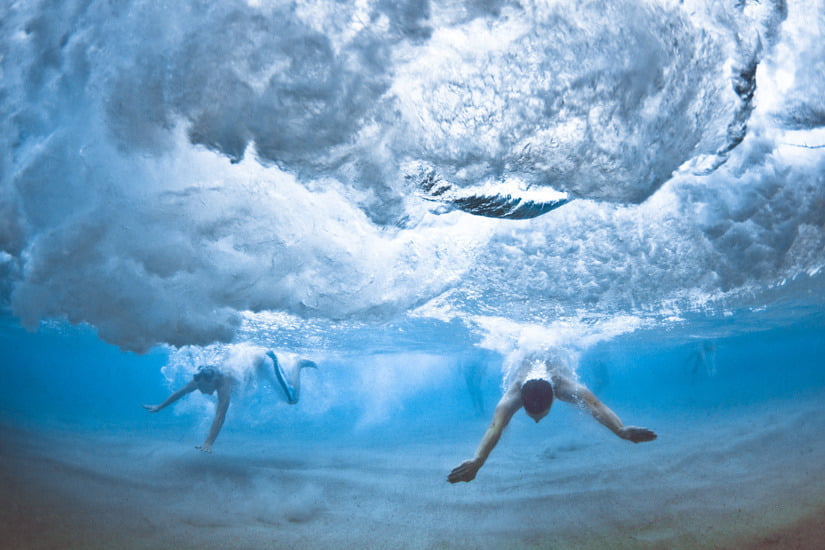


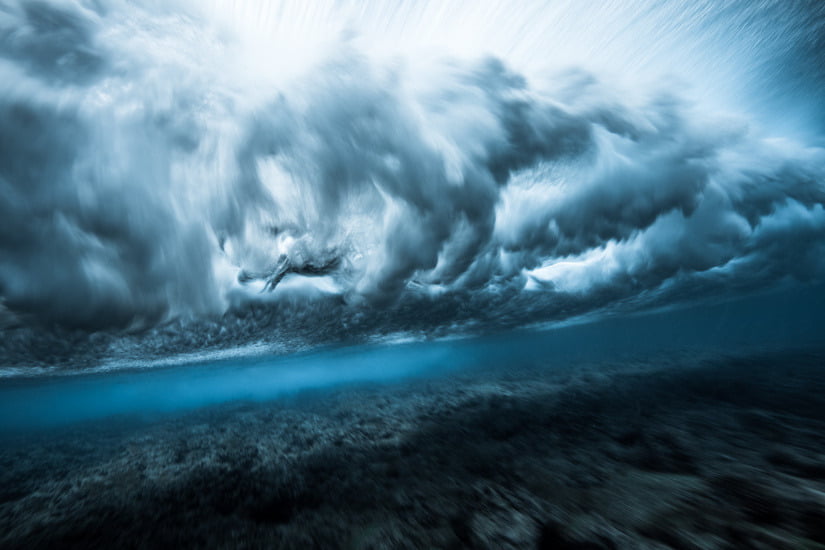
When I was a kid, I liked to dive underwater in the pool and sit at the bottom, looking up at the peculiar dancing sky the water made overhead. Photographer Mark Tipple takes it further, capturing images of the ocean from below the surface as waves roll in. His photos show swimmers and surfers diving to escape a roiling wave that, from below, bears a surreal similarity to the underside of a thundercloud in a summer storm. This is part of the beauty of fluid dynamics. Despite their differences, water and air obey the same physics. (Photo credits: Mark Tipple; via io9)

Frozen Methane Bubbles
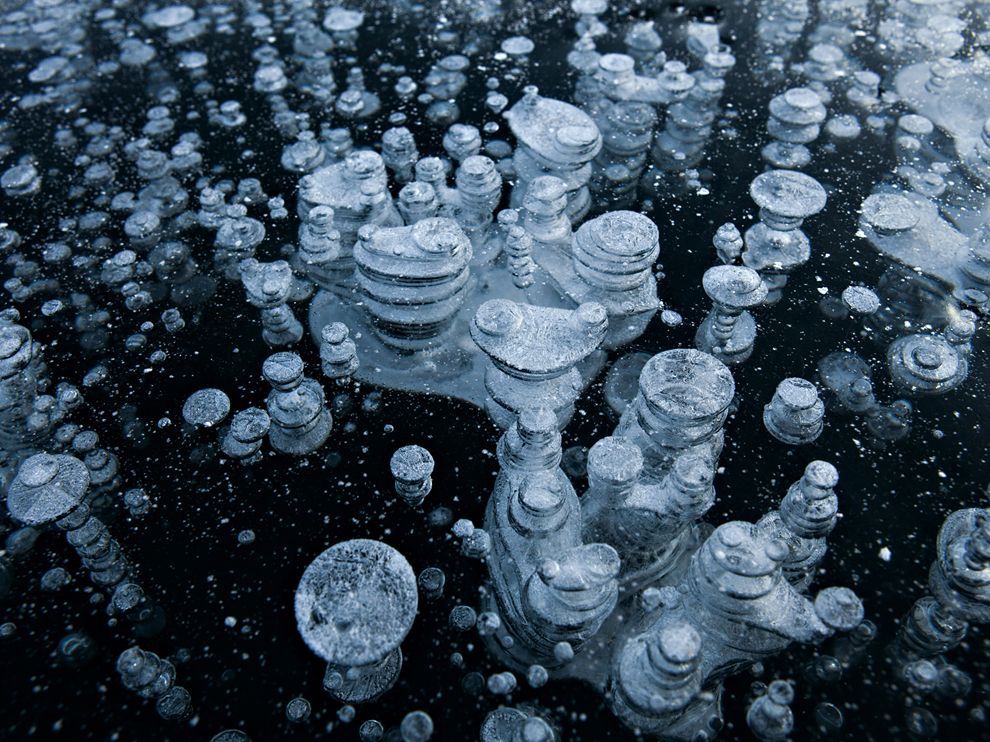
As the Arctic warms, methane that was previously trapped by permafrost rises from the muddy bottom of lakes to escape into the atmosphere. Here the first clear ice of the fall has trapped the rising methane bubbles, allowing scientists an opportunity to estimate the amount of methane being released. When spring arrives and the lakes melt, the methane will rise again. (Photo credit: M. Thiessen/National Geographic)

“Frozen” Water Stream
We saw previously how vibrating a falling stream of water and filming it with a matching camera frame rate appears to “freeze” the falling liquid. This video shows the same illusion, now with a 24 Hz sine wave, which the falling water mimics. Vibrating the speaker that drives the water stream slightly slower or slightly faster than the camera frame rate makes the water appear to slowly fall or rise relative to its “frozen” wave state. This is a beat effect caused by the slight difference in frequency between the water and the camera. (Video credit: brusspup; via BoingBoing; submitted by many readers)
Inside a Blender
The fluid dynamics of a commercial-quality blender amount to a lot more than just stirring. Here high-speed video shows how the blender’s moving blades create a suction effect that pulls contents down through the middle of the blender, then flings them outward. This motion creates large shear stresses, which help break up the food, as well as turbulence that can mix it. But if you watch carefully, you’ll also see tiny bubbles spinning off the blades. These bubbles, formed by the pressure drop of fluid accelerated over the arms of the blades, are cavitation bubbles. When they collapse, or implode, they create localized shock waves that further break up the blender’s contents. This same effect is responsible for damage to boat propellers and lets you destroy glass bottles. (Video credit: ChefSteps; via Wired; submitted by jshoer)
Tuning Fork Fluids
This high-speed video shows a liquid crystal fluid vibrating on a tuning fork. As the surface moves, tiny jets shoot upward, sometimes with sufficient energy that the fluid column is stretched beyond surface tension’s ability to keep it intact, resulting in droplet ejection. The jets and surface waves create a mesmerizing pattern of fluid motion. (Video credit: J. Savage)
Breaking Up Falling Beads
In a stream of falling liquid, surface tension instabilities cause the fluid to break up into droplets. This video shows a similar experiment with a stream of glass beads, a granular material. The whole system is housed under a vacuum to eliminate the effects of air drag on the stream, and a camera rides alongside the stream to track the evolution of the falling material in a Lagrangian fashion. As with a liquid stream, we see the granular flow develop undulations as it falls, ultimately breaking up into clusters of beads. The authors suggest that nanoscale surface roughness and van der Waals forces may be responsible for the clustering behavior in the absence of surface tension. (Video credit: J. Royer et al.)

Shock Waves in Flight
Schlieren photography allows visualization of density gradients, such as the sharp ones created by shock waves off this T-38 aircraft flying at Mach 1.1 around 13,000 ft. Although shock waves are relatively weak at this low supersonic Mach number, they persist, as seen in the image, at significant distances from the craft. The sonic boom associated with the passage of such a vehicle overhead is due to the pressure change across a shock wave. The higher the altitude of the supersonic craft, the less intense its shock wave, and thus sonic boom, will be by the time it reaches ground level. (Photo credit: NASA)
Making Metal Water-Repellent
Chemical treatments can be used to render metals hydrophobic, causing water to bead on the surface rather than spreading to wet it. Treating the surface by immersing it in boiling water before applying the chemicals creates a nanoscale texture that accentuates the hydrophobicity. Even on a common metal like aluminum, this combination of texturing and chemical treatment leads to superhydrophobic behavior. Here the technique is demonstrated by spraying water droplets on a piece of treated aluminum. (Video credit: B. Rosenberg et al.; submitted by D. Quinn)

Turbulent Flames
The flames surrounding a burning tree stump flicker and billow in this image from photographer Serdar Ozturk. The chaotic motion of the flames is indicative of turbulence, a state of fluid flow known for its many scales. Note the range of lengthscales and structures in the fire. In turbulent flows, kinetic energy cascades from large scales, like the width of the top of the plume, down to the small scales, which may be even smaller than the wisps of flame at the edges of the fire. At the largest scales, the structures and behaviors we observe are all flow- and geometry-dependent, but theory predicts that, at the smallest scales, all turbulent flows look the same. (Photo credit: trashhand/Serdar Ozturk)