As demonstrated in the video above, lasers can be used to excite molecules into a higher energy state, which will decay via the emission of photons, causing the medium to glow. This laser-induced fluorescence is utilized in several techniques for measurements in fluid dynamics, including planar laser-induced fluorescence (PLIF) and molecular tagging velocimetry (MTV). In these techniques a flow is usually seeded with a fluorescing material–nitric oxide is popular for super- and hypersonic flows–and then lasers are used to excite a slice of the flow field. The resulting fluorescence can be used for both qualitative and quantitative flow measurements. Here are a couple of examples, one in low-Reynolds number flow and one in combustion. (Video credit: L. Martin et al./UC Berkeley)
Year: 2013
Jump in a Lake
Ever wonder what would happen if every person on earth jumped into a lake at the same time? Wonder no more! Physicist Rhett Allain breaks it down over at Dot Physics.

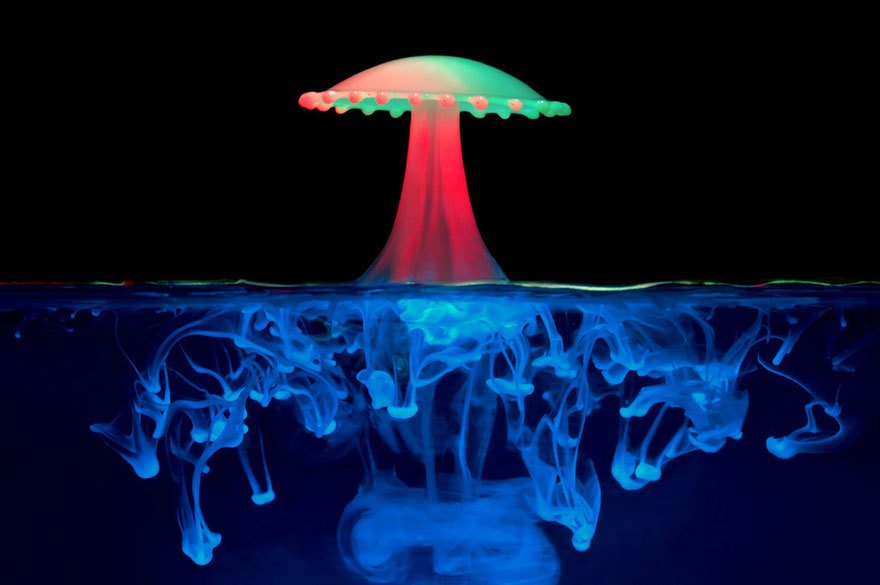
Liquid Sculptures
Artist Corrie White uses dyes and droplets to capture fantastical liquid sculptures at high-speed. The mushroom-like upper half of this photo is formed when the rebounding jet from one droplet’s impact on the water is hit by a well-timed second droplet, creating the splash’s umbrella. In the lower half of the picture, we see the remains of previous droplets, mixing and diffusing into the water via the Rayleigh-Taylor instability caused by their slight difference in density relative to the water. There’s also a hint of a vortex ring, likely from the droplet that caused the rebounding jet. (Photo credit: Corrie White)
The 9th Pitch Drop is Coming
Remember that 83-year-old pitch drop experiment designed to measure the viscosity of pitch? Well, rumor has it that the ninth drop is due to fall at any time. Will you catch it on the webcam?

Iceberg Calving
When sections of glaciers break off to create icebergs, scientists call it calving. Usually large sections of ice will break off and immediately capsize, with an energy equivalent to up to 40 kilotons of TNT. These large events are sufficient to cause measurable seismic signals. How hydrodynamic forces impact the contact and pressure forces between the calving iceberg and the glacier are still being researched, though recent laboratory experiments and numerical models suggest that hydrodynamics substantially increase these forces. The video above shows one of the largest calving events ever caught on camera, and the scale of the process is just stunning. (Video credit: Chasing Ice; additional information from J. C. Burton et al. 2012; submitted by jshoer)
Stalling
[original media no longer available]
At high angles of attack, the flow around the leading edge of an airfoil can separate from the airfoil, leading to a drastic loss of lift also known as stall. Separation of the flow from the surface occurs because the pressure is increasing past the initial curve of the leading edge and positive pressure gradients reduce fluid velocity; such a pressure gradient is referred to as adverse. One way to prevent this separation from occurring at high angle of attack is to apply suction at the leading edge. The suction creates an artificial negative (or favorable) pressure gradient to counteract the adverse pressure gradient and allows flow to remain attached around the shoulder of the airfoil. Suction is sometimes also used to control the transition of a boundary layer from laminar to turbulent flow.

Happy Valentine’s Day!
Here’s a potential flow field with heart-shaped streamlines, made just for you. Thank you to everyone for having helped made FYFD such a success over these 700 posts, whether by liking, reblogging, tweeting, or telling a friend. Happy Valentine’s Day!
For the curious among you, the flow is a superposition of uniform flow, two sources, and two sinks. The Matlab code is here. Have fun!
Truck Vortices
The video above shows vortex rings of smoke ejected from the burning tire of a moving truck. Without seeing the damaged tire, it’s tough to pinpoint the cause with certainty, but here are a couple of ideas. Typically vortex rings are formed with a burst of air through a narrow orifice; this is, for example, how humans, dolphins, vortex cannons, and volcanoes all make smoke rings. If air is escaping the tire through small holes, this could cause rings. Unlike in those situations, though, the tire is spinning, which means its motion is already imparting vorticity to the flow, so that any air escaping the tire forms a vortex ring. (Video credit: The Armory; submitted by eruditebaboon)
ETA: Others are suggesting the vortex rings are due to a failure of the engine, with unsteady exhaust velocities resulting in the vortex structures. I think this might still depend on the exhaust pipe’s geometry. Regardless of the exact cause, the video remains an interesting bit of fluid dynamics.

Spiraling Ferrofluid
Here a ferrofluid climbs a spiral steel structure sitting on an electromagnet. Magnetic field lines emanating from the sculpture’s edges tend to push the ferrofluid out into long spikes–part of the normal field instability–but surface tension resists. The short, somewhat squat spikes we see are the balance struck between these opposing forces. Though known for their wild appearance, ferrofluids appear many in common applications, including hard drives, speakers, and MRI contrast agents. Researchers have also recently suggested they might help understand the behavior of the multiverse. (Photo credit: P. Davis et al.)
Hummingbirds Singing with their Tail Feathers
Aeroelastic flutter occurs when fluid mechanical forces and structural forces get coupled together, one feeding the other. Usually, we think of it as a destructive mechanism, but, for hummingbirds, it’s part of courtship. When a male hummingbird looks to attract a mate, he’ll climb and dive, flaring his tail feathers one or more times. As he does so, air flow over the feathers causes them to vibrate and produce noise. Researchers studied such tail feathers in a wind tunnel, finding a variety of vibrational behaviors, including a tendency for constructive interference–in other words two feathers vibrating in proximity is much louder than either individually. For more, check out the original Science article or the write-up at phys.org. (Video credit: C. Clark et al.)