Year: 2013

  • Reader Question: More Standing Waves

    corroding-touch asks:

    So, further to the wave question, how about pressure? How does the pressure in a fixed spot beneath a wave vary, and how does this change with depth?

    The primary factor for pressure at any point in the water is depth. Deeper water means a higher pressure. So if you imagine your fixed point at a particular depth relative to a flat ocean, it will have some nominal pressure dependent on its depth. Waves passing induce a higher-than-nominal pressure at the fixed point as the crest passes overhead and a lower-than-nominal pressure as the trough passes. Basically, the waves cause a fluctuation in pressure around some nominal point. As you increase in depth, the fluctuation will have less and less effect because the nominal pressure is ever increasing.

  • Reader Question: Standing Waves

    Reader Question: Standing Waves

    captainandry asks:

    What would happen to a fish or swimmer in a standing wave?

    First of all, check out the video that inspired this question, which shows a standing water wave created in a wave tank. Before we tackle the standing wave, it’s helpful to know what motion exists in a typical water wave. For deep water waves, the motion of a particle as the waves pass is circular, with a decreasing radius with increasing depth. Below a certain depth the energy of the surface wave doesn’t penetrate. Here’s an animation, where the red dots represent massless particles and the blue circles show their paths:

    In shallower waters, the circular paths get compressed into ellipses. The image below shows pathlines for particles at different depths as a water wave passes. Notice how the paths are circular near the surface, where the depth is much greater than the wavelength, while close to the bottom, the pathlines are elliptical.

    So what about motion for a standing water wave? Such a wave has no apparent horizontal motion, as seen in the animation below:

    Similar to the way that decreasing the depth compresses the circular particle motion into an ellipsoid, creating a standing wave compresses the horizontal motion of any particle near the surface. What this means is that anything floating near the surface of the standing wave will simply bob up and down. Unless it’s located at one of the nodes (marked by red dots), in which case it won’t move at all! As with the other types of water waves, the amount of displacement will decrease with depth. People and fish, of course, are not massless particles, so their motion will be damped by inertia, but the same principles apply.

    (Photo credits: P. Videtich; R. L. Wiegel and J.W. Johnson; Wikipedia)

  • Egg-Spinning Fun

    Egg-Spinning Fun

    If you have any leftover hard-boiled eggs, you can recreate this bit of fluid dynamical fun. Spin the egg through a puddle of milk, and you’ll find that the egg draws liquid up from the puddle and flights it out in a series of jets. As the egg spins, it drags the milk it touches with it. Points closer to the egg’s equator have a higher velocity because they travel a larger distance with each rotation. This variation in velocities creates a favorable pressure gradient that draws milk up the sides of the egg as it spins, creating a simple pump. To see the effect in action check out this Science Friday video or the BYU Splash Lab’s Easter-themed video. (Photo credit: BYU Splash Lab)

  • Featured Video Play Icon

    Gravity’s Effect on Bursting Bubbles

    In a gravitational field, the pressure in a fluid increases with depth. You can consider it due to the weight of the fluid above. Outside of scuba diving or hiking at altitude, this effect is not one typically given much thought. But what effect can it have at a smaller scale? This video shows the collapse and rebound of three initially spherical cavitation bubbles inside a liquid. Each bubble is created in a different gravitational field – one in microgravity, one in normal gravity, and one at 1.8x Earth gravity. The bubble in microgravity remains axisymmetric and spherical, but the two bubbles recorded in gravitational fields develop jets during rebound. Even at a scale of only a few millimeters, gravity causes an imbalance in pressure across the bubble that creates asymmetry. (Video credit: D. Obreschkow et al.)

  • Featured Video Play Icon

    Saturn’s Great White Spot

    We’ve touched a couple times on Saturnian storms, but this NASA video gives a great overview of the Great White Spot, a storm that appeared in late 2010. Gauging the fluid dynamics of gas giants like Saturn and Jupiter is difficult, in large part because we can see only the outermost portion of the atmosphere. Numerous theories and models have been suggested to explain features and dynamics that we observe, but much of the overall behavior remains a subject of debate among planetary scientists. (Video credit: NASA Goddard)

  • Lava in Action

    Lava in Action

    We’ve touched on volcanoes and the fluid dynamics of lava a couple of times here at FYFD, but over at Wired volcanologist Erik Klemetti has some wonderful photos and videos he took while visiting an active lava flow in Hawaii along with great explanations of the flow shapes and processes. Above we see him using a rock hammer to remove a sample from an active flow. Klemetti describes the lava’s behavior as taffy-like – extremely viscous and stretchy but prone to break like a plastic. Be sure to check out his posts! (Photo credit: E. Klemetti; submitted by @FlexMonkey)

  • Colorful Spirals

    Colorful Spirals

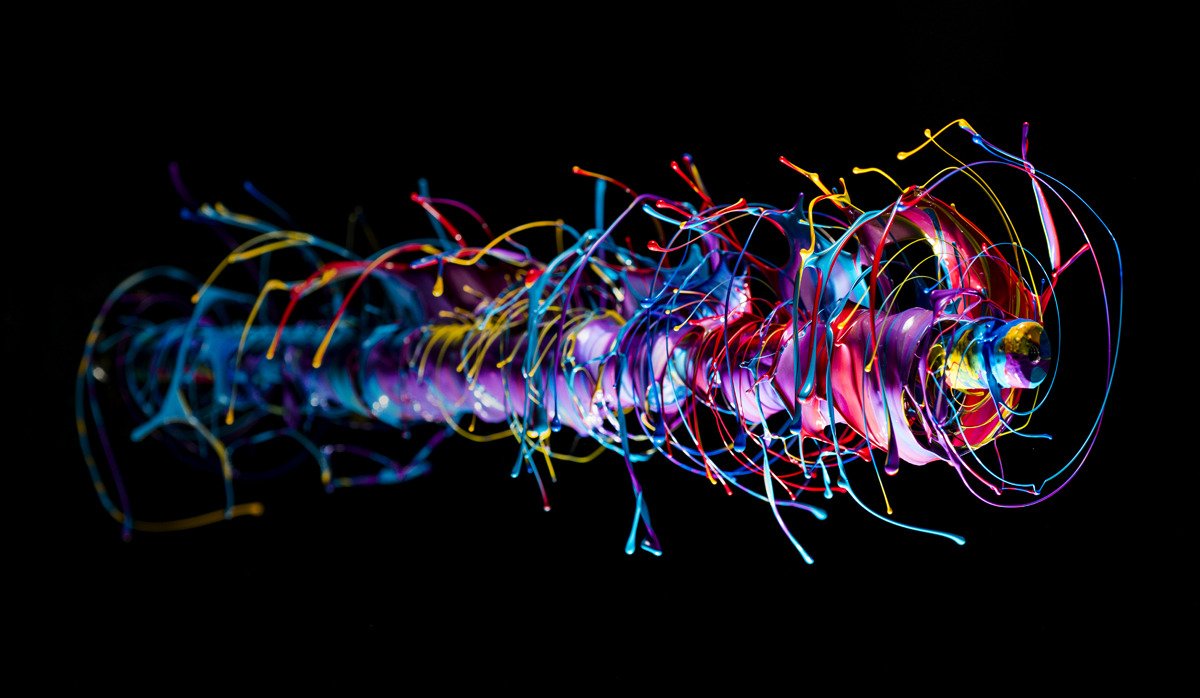
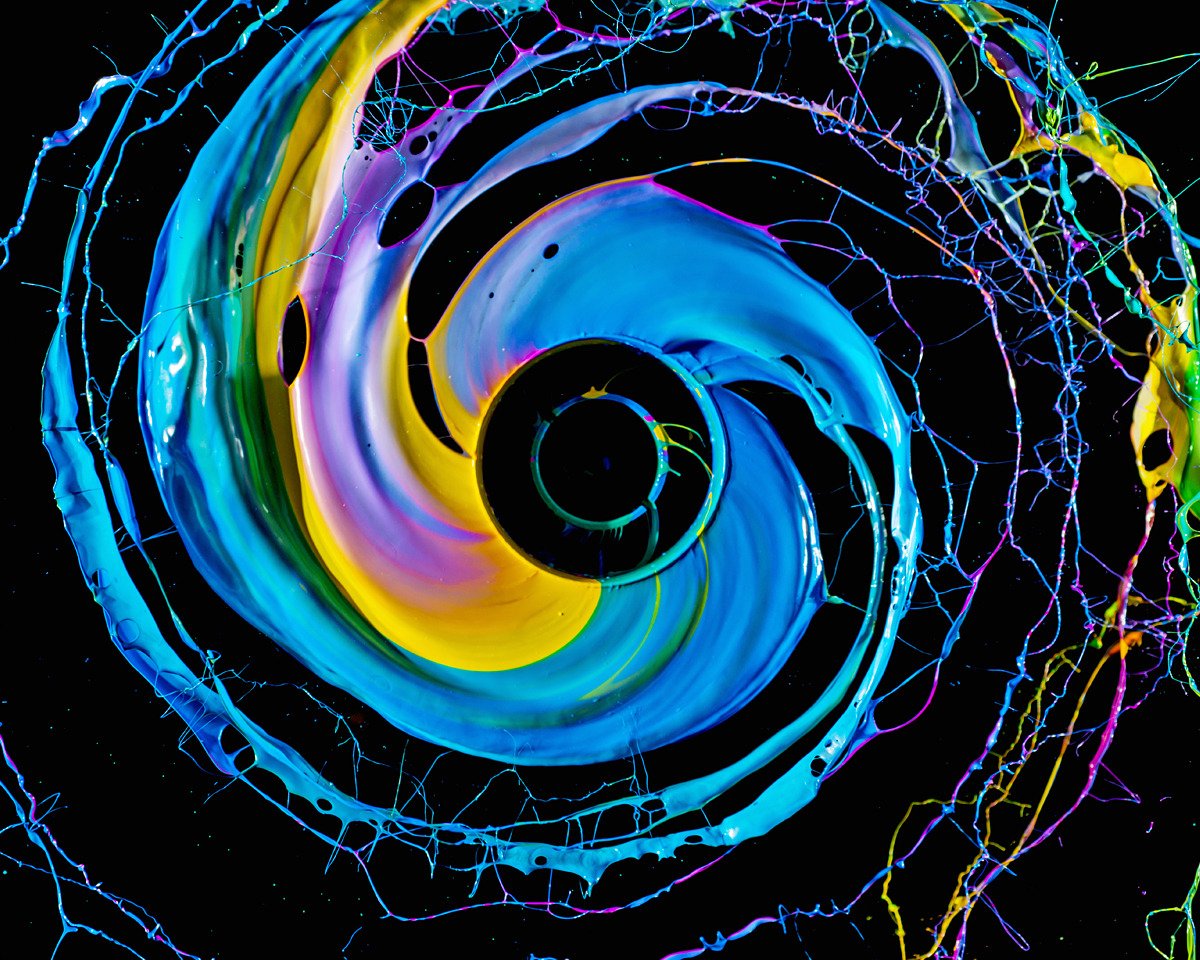
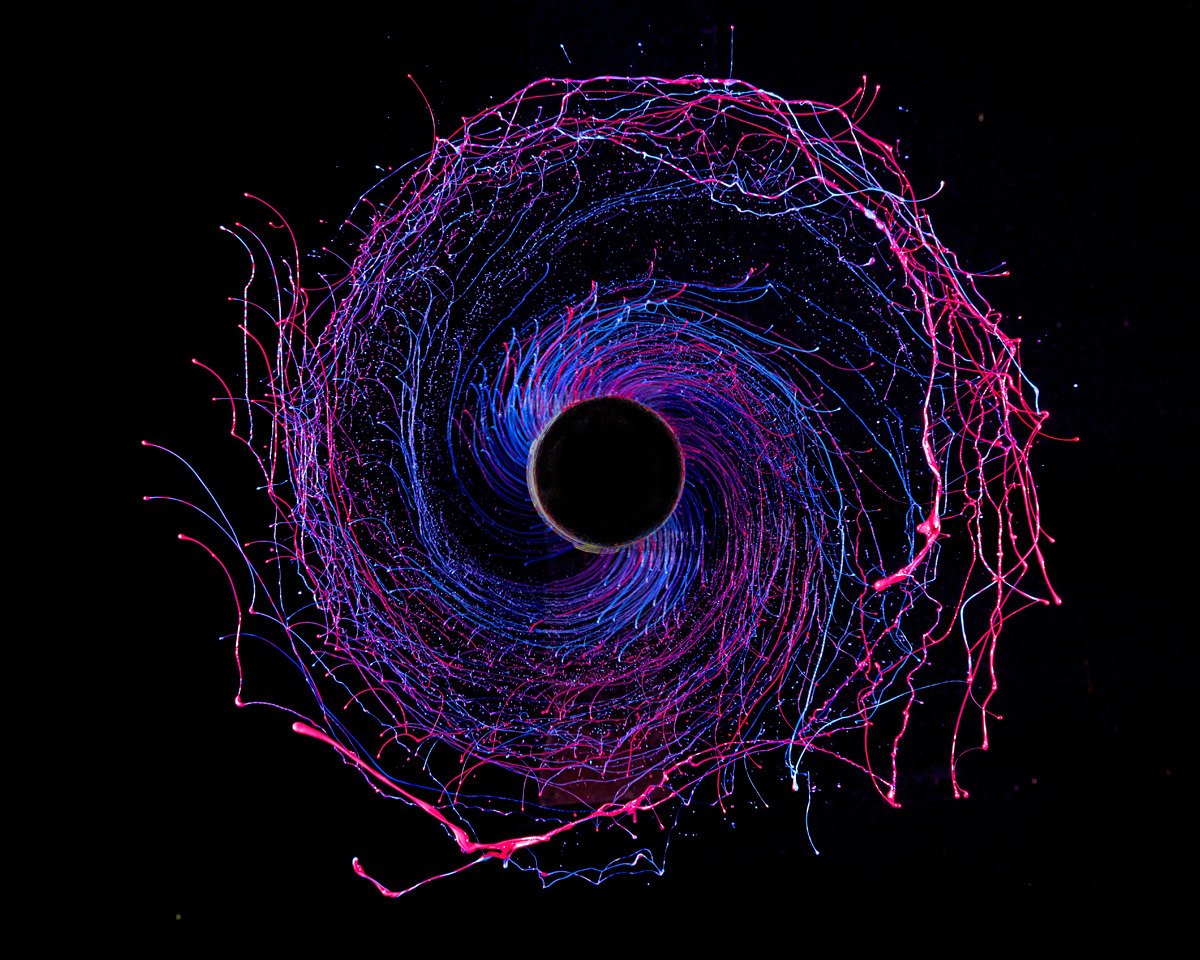
    Artist Fabian Oefner captures these colorful portraits of fluid instability by dripping acrylic paints onto a metal rod, which is connected to a drill. When the drill is switched on, paint is flung away from the rod, creating these snapshots of centripetal force and surface tension. Note how droplets gather at the ends of the spiral arms like in a Plateau-Rayleigh or a rimming instability. For more, check out Oefner’s webpage, which includes a video showing how the images are made, or his previously featured work, “Millefiori”. (Photo credit: F. Oefner; submitted by Stephen D.)

  • Featured Video Play Icon

    Mixing the Southern Ocean

    Motion in the ocean is driven by many factors, including temperature, salinity, geography, and atmospheric interactions. While global currents dictate much of the large-scale motion, it’s sometimes the smaller scales that impact the climate. This visualization shows numerically simulated data from the Southern Ocean over the course of a year. The eddies that swirl off from the main currents are responsible for much of the mixing that occurs between areas of different temperature, which ultimately impacts large-scale temperature distributions, in this case affecting the flux of heat toward Antarctica. (Video credit: I. Rosso, A. Klocker, A. Hogg, S. Ramsden; submitted by S. Ramsden)

  • Lift on a Paper Plane

    Lift on a Paper Plane

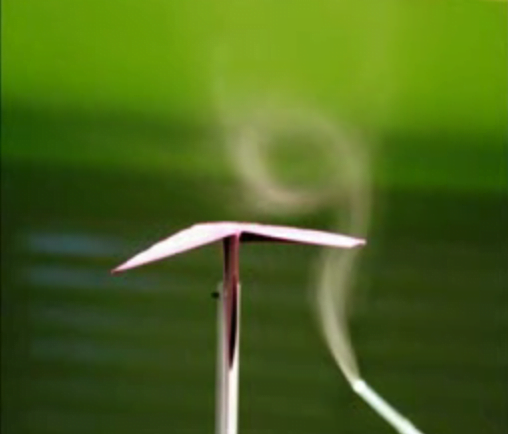
    In this still image from a student experiment, smoke visualization shows the formation of a vortex over the wing of a paper airplane during a wind tunnel test. This wing vortex is mirrored on the opposite wing, though there is no smoke to show it. At high angle of attack, the delta-wing shape of the traditional paper air plane creates these vortices on the upper surface, which helps generate the lift necessary to keep the plane aloft. (Photo credit: A. Lindholdt, R. Frausing, C. Rechter, and S. Rytman)

  • Featured Video Play Icon

    Mixing While Laminar

    Although turbulent flows are known for their mixing efficiency, in manufacturing there can often be a need to mix laminar fluid streams without the increased shear stress of a turbulent flow. This can be particularly important for polymeric liquids, where too much shear stress could damage the polymer chains. One possibility is using a static mixer, such as the one demonstrated in this video, which, when placed in pipe flow, will deflect the pipe’s contents in such a way as to produce efficient mixing over a short distance. Here two streams of high-viscosity epoxy are mixed through such a static mixer, hardened, and then ground to show the mixing at each level of the static mixer. (Video credit: Sulzer)