Month: May 2012

  • Reader Question: Drafting in Cycling

    Reader Question: Drafting in Cycling

    jonesmartinez asks:

    As a cyclist, I’m curious about drafting. How fast do I need to be going for there to be a measurable benefit? Additionally, often in a time trial a single rider is often followed by the team car and I’ve heard the rider can be pushed by the air around the team car. Any truth to this rumor? Thanks, I love the blog.

    Drafting plays a major role in cycling and its tactics (check out our previous series on cycling). In general, drag increases with the square of velocity and data show this holds for cyclists. The rule of thumb I’ve heard given is that aerodynamic drag doesn’t play a large role below 15 mph, but I have not seen the numbers that inform that claim. Moreover, you have to consider the resultant airspeed around the cyclist. For example, a cyclist moving 13 mph into a 15 mph headwind (28 mph effective) will be experiencing more drag than a cyclist moving 20 mph with a 10 mph tailwind (10 mph effective). With drag being reduced 25-40% by drafting a leading rider, it is almost always beneficial to get behind someone.

    That said, I have seen no measurable benefit for a leading rider with a paceline behind him, even though this should, in theory, reduce the drag on the lead rider by closing out his wake. With a large object like a car behind a solo rider, there might theoretically be some benefit. However, the car would have to be driving extremely close to the rider–far closer than they do in reality.

    That said, with the prevalence of power meters in the amateur market these days, I think it would be a neat project to go out and try a few of these things firsthand and see whether such tactics actually result in a measurable difference in a cyclist’s performance–though I don’t recommend riding a foot off the front or back of a car!

  • Martian Lava Coils

    Martian Lava Coils

    NASA’s HiRISE spacecraft has sent back images of lava coils left on the surface of Mars. These features form when lava flows of different speeds move past one another; they’re essentially Kelvin-Helmholtz waves–like the ones often seen in clouds–in the lava flow that have solidified into solid rock! On Earth these coils appear about a foot wide; the Martian versions are 100 feet across. (Photo credit: NASA/JPL/University of Arizona; via Wired; submitted by Brian L)

  • Why Walking with Coffee is Tough

    Why Walking with Coffee is Tough

    Almost everyone is familiar with the problem of coffee or tea sloshing over the sides of a mug as one walks, but this may be the first time researchers have systematically studied the problem. The results show that the typical frequency of the human stride closely matches the natural frequency for back-and-forth sloshing of a low-viscosity liquid in a cylindrical container the size of a typical coffee mug. Even though our natural side-to-side motion plays a role in coffee sloshing, its effect is small in comparison. A person’s maximum acceleration, which usually happens early on when walking, sets the initial sloshing amplitude, which is subsequently amplified by the stepping frequency. The researchers did find that the time to spill increased substantially if the subject was focused on not spilling the coffee, though it was unclear if this was due to the subject decreasing their acceleration and step frequency, or whether they were actively damping the oscillations with adjustments in the wrist. If you’re a perpetual coffee spiller, there’s still hope: the authors suggest that flexible cups and/or cups with a series of concentric rings–baffles–could help reduce sloshing in spite of our natural tendency to induce it.  (Photo credit: dongga/Flickr; Paper: Mayer and Krechetnikov; submitted by @__pj)

  • Featured Video Play Icon

    Egg Spinning

    Spin a hard boiled egg in a puddle of milk and you get a sprinkler. But how? The science starts at the surface. When the egg spins, the fluid touching its surface is dragged along due to friction, and, because of the fluid’s viscosity, other parts of the fluid will also be spun. Dynamics tells us that the velocity at the surface of the object varies with radius; the velocity at the bottom of a spinning sphere is much smaller than that at its equator because a particle at the equator traverses a larger distance in a single rotation. Likewise, the fluid touching the bottom of the egg is spun slower than the fluid just above it. Bernoulli’s principle tells us that, for an incompressible fluid, the pressure decreases as velocity increases, meaning that a favorable pressure gradient exists along the spinning convex surface. It is this pressure gradient that draws the fluid up the sides of the object. Near the equator, the pressure gradient is weakest and centrifugal force flings the the fluid outward. Surface tension, angular velocity, and viscosity all play a role in the jets and sheets created by the sprinklers. (Video credit: NPR Science Friday with Tadd Truscott et al)

  • Featured Video Play Icon

    “Compressed” Outtakes

    Bubbles, viscosity, diffusion, capillary action, and ferrofluids all feature in the artistic experiments of Kim Pimmel. Be sure to check out his previous film featured here. (Video credit: Kim Pimmel)

  • Featured Video Play Icon

    Moving Droplets with Electric Fields

    Many microfluidic devices employ techniques that manipulate droplet motion for applications like sorting, manufacturing, or precisely controlling chemical reactions at a small scale. The video above shows the oscillations of a droplet on an inclined surface as it is perturbed with an electric field. (Video credit and submission: K. Nichols)

  • The Pitch Drop Experiment

    The Pitch Drop Experiment

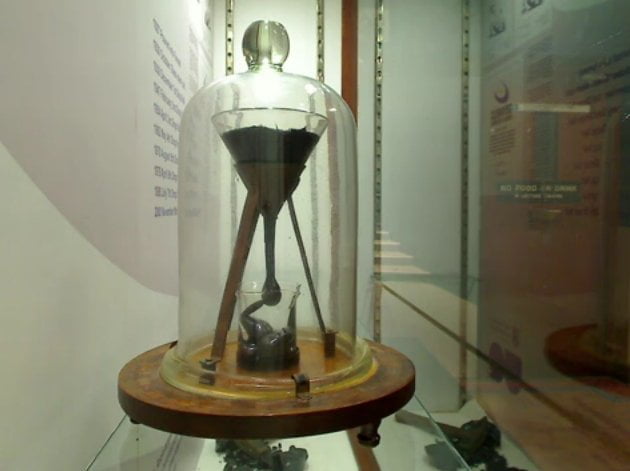
    Sometimes everyday materials are more fluid than they seem. In 1927, Professor Thomas Parnell of the University of Queensland started what is now the longest continuously running laboratory experiment when he filled a sealed glass funnel with a sample of heated tar pitch. After allowing 3 years for the pitch to settle, the funnel’s stem was unsealed and the pitch has been slowly dripping ever since. Now, over 80 years later, the ninth drop is still just forming. No one has witnessed the fall of a pitch drop but the odds are good that someone will catch the ninth drop now that it has its own webfeed. The experiment, which won an Ig Nobel Prize in 2005, demonstrates the incredibly high viscosity of pitch, which the researchers estimated at 11 orders of magnitude larger than water at room temperature. (submitted by jshoer)

  • Icing on Airplane Wings

    Icing on Airplane Wings

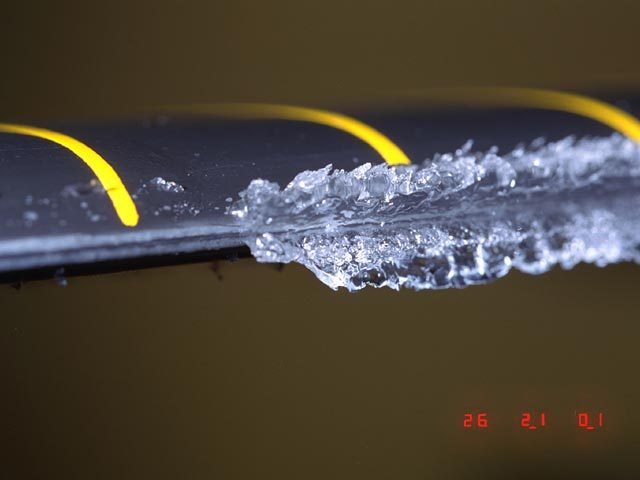
    Icing on airplane wings remains little understood and a major hazard. These photos show examples of ice formation along the leading edge of a swept wing. If an aircraft flies through a cloud of supercooled water droplets, the droplets will freeze shortly after impact with the aircraft’s wings. As ice continues to build up in strange shapes, the aerodynamic profile of the wing changes, which can lead to disastrous effects as the stall and control characteristics of the wing shift. (Photo credit: NASA Glenn Research Center)

  • Featured Video Play Icon

    Breaking Water with Sound

    Previously we saw how vibration could atomize a water droplet, breaking it into a spray of finer droplets. Here astronaut Don Pettit shows us what the process looks like in microgravity using some speakers and large water droplets. At low frequencies the water displays large wavelength capillary waves and vertical vibrations. Higher frequencies–like the earthbound experiment on much smaller droplets–cause fine droplets to eject from the main drop when surface tension can no longer overcome their kinetic energy. (submitted by aggieastronaut, jshoer and Jason C)

    (Source: /)
  • Featured Video Play Icon

    Surface Tension Floats Coins

    Surface tension arises from intermolecular forces along the interface of a fluid, but despite its molecular origins, it can have some substantial macroscopic effects. Here researchers demonstrate how surface tension can hold up metal coins that would otherwise sink. Moreover, when multiple coins are set on the surface of the water, surface tension draws them together into a closely packed array because it reduces the surface energy by creating a single large well instead of many small ones. This is the same reason that your Cheerios tend to clump together on the surface of your milk when you’re eating breakfast! (Video credit: Lawrence Berkeley National Lab)