When a droplet contacts a pool, a thin layer of air can get trapped beneath the droplet, delaying the instant when the liquids contact and surface tension pulls the droplet into the pool. If the pool is being vibrated, air flows more easily into the gap, keeping droplets intact longer. It’s even possible to make them dance.
Month: September 2011

Cloud Streets


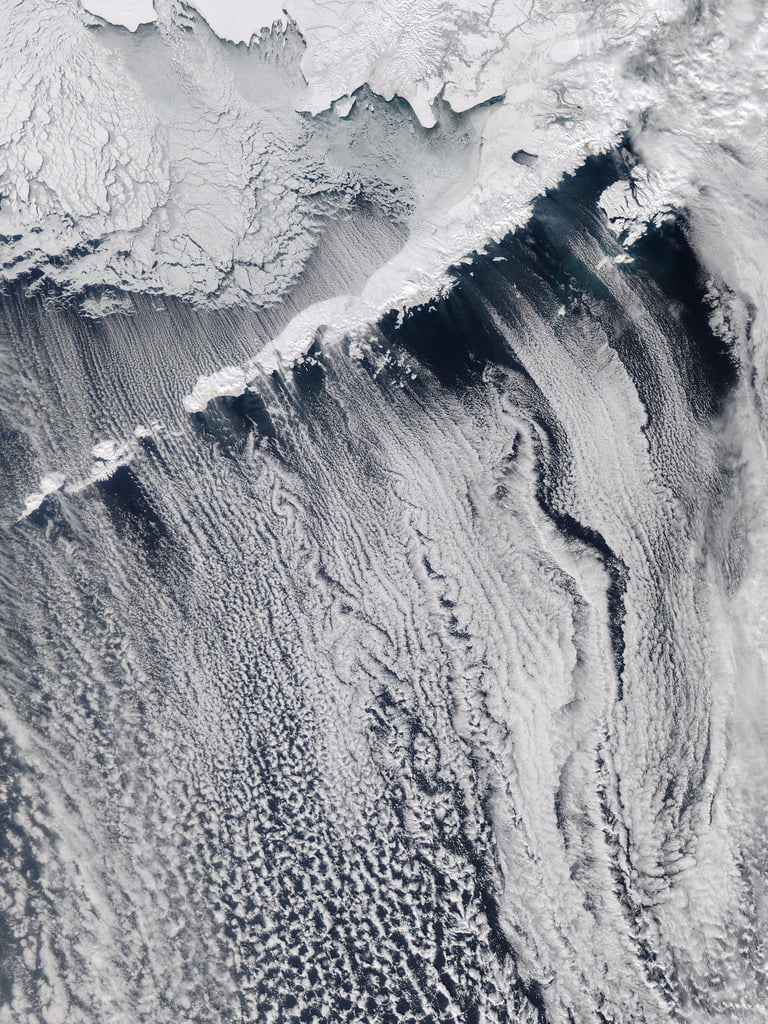
Cloud streets–long rows of counter-rotating air parallel to the ground in the planetary boundary layer–are thought to form as a result of cold air blowing over warm waters while caught beneath a warmer layer of air, a temperature inversion. As moisture evaporates from the warmer water, it creates thermal updrafts that rise through the atmosphere until they hit the temperature inversion. With nowhere to go, the warmer air tends to lose its heat to the surroundings and sink back down, creating a roll-like convective cell. (Photo credits: NASA Terra, NASA Aqua, and Tatiana Gerus)

Rocket Engine Testing
Rocket engine tests usually feature a distinct and steady pattern of Mach diamonds in their exhaust. This series of reflected shock waves and expansion fans forms as a result of the exhaust pressure of the rocket nozzle being lower or higher than ambient pressure. A rocket will be most efficient if its exhaust pressure matches the ambient pressure, but since atmospheric pressure decreases as the rocket gets higher, engines are usually designed with an optimal performance at one altitude.

Water Spray from a Tire
The spray thrown up by a rolling tire is simulated in the lab by running a single-grooved tire (top) against a smooth tire (bottom) that simulates the road. A supply of water flows from the left at the speed of the rolling tires (6 m/s). The resultant sheet of water is a familiar site to motorists everywhere. Holes in the the sheet of water collide to form the smallest droplets, whose diameters are comparable to the thickness of the sheet, of the order of 100 microns. Thicker parts of the sheet form ligaments and break down into large droplets through the Plateau-Rayleigh instability. (Photo credit: Dennis Plocher, Fred Browand and Charles Radovich) #
Bill Nye Demos
[original media no longer available]
Have a little science enthusiasm from Bill Nye to brighten your Tuesday! This video includes demonstrations on thermodynamics (sucking the balloon into the flask), the Marangoni effect (driving the powder off the water surface and powering the glue boat by creating gradients in surface tension), and buoyancy (floating cans of cola).
Shear-Thickening Oobleck
Oobleck is a commonly utilized fluid in demonstrations of non-Newtonian behavior. Rather than being linearly viscous with respect to shear, oobleck is shear thickening, meaning that it becomes more viscous the more that it is sheared. This is what causes crazy formations when it’s vibrated, makes it useful as liquid armor, and enables people to run across pools full of it. Yet it flows readily when undisturbed. #
Atomization
Atomization–breaking a flowing liquid into a fine spray–is important for fuel injection in a variety of engines, including automobiles, jet engines, ramjets, scramjets, and rockets. The more effectively a liquid fuel can be dispersed as a spray in an engine, the more efficient and stable the combustion will be. The apparatus in this high-speed video injects an annular water sheet with concentric jets of air on either side of the water. The video series shows the effects of increasing the outer and inner air velocities relative to the water on the breakup of the liquid. What to the naked eye looks like a deluge, high-speed video reveals as a complex undulating structure.

Fishbone Jet Collision
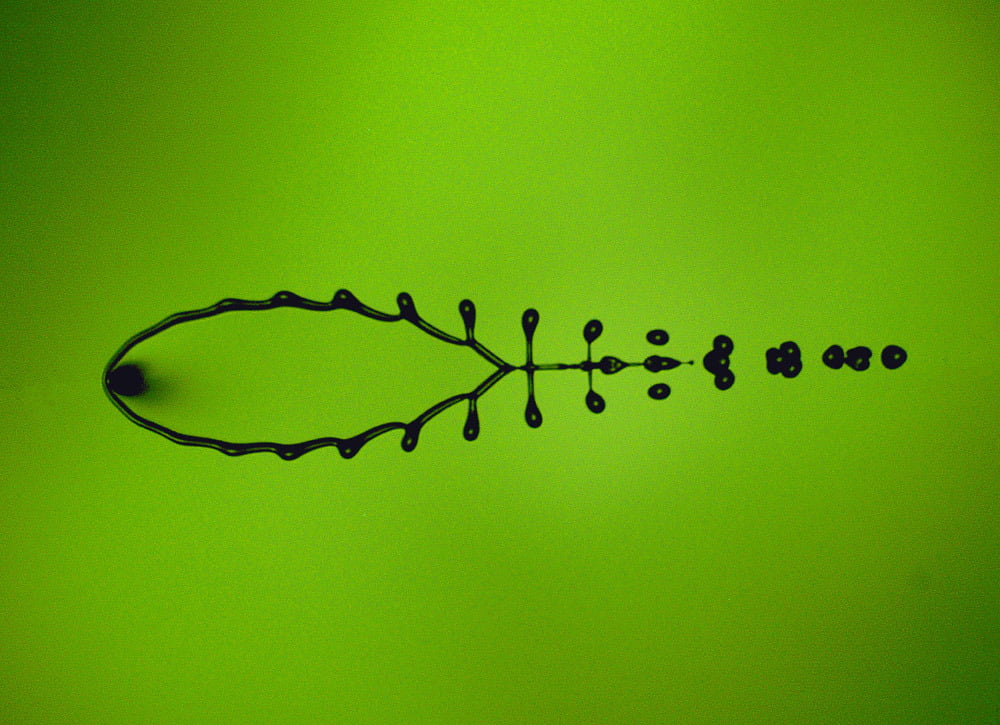
The collision of two jets of radius 420 μm results in a fishbone-like structure. The fluid contains a dilute polymer mixture whose viscoelastic effects resist the tendency of the droplets to detach from the ligaments. The breakup of the jets into droplets is important for applications in inkjet printing. The photo has been rotated 90-degrees for effect. (Photo credit: Sungjune Jung)
Microgravity Water Spheres
Here astronaut Don Pettit demonstrates the effects of rotation on a sphere of water in microgravity. Bubbles, being less dense than water, congregate in the middle of the sphere along its axis of rotation. Tea leaves, which are denser than the water, are thrown to the outside; this is the same concept used in a centrifuge for separating samples.
Guinness Physics
Take a look at the physics of a pint of Guinness, including the formation of foam, the circulation of bubbles, and the importance of nitrogen and surfactants. The Physics of Fluids paper the host refers to is available here. (And, yes, I will admit to debating the physics occurring in my pint glass while in a pub.) # (via Martin)