Droplet collisions captured instantaneously create beautiful fluid sculptures that, though common, are too fast for the human eye. Here a bubble was blown onto the surface of the fluid, then a droplet was released to fall into the center of the bubble, bursting it. As that droplet rebounded in a Worthington jet, a second droplet was released and impacted the jet, creating the umbrella-like shape in the center. See Liquid Droplet Art for more photos. (Photo credit: Corrie White and Igor Kliakhandler) #
Month: September 2011

Jet Breakup
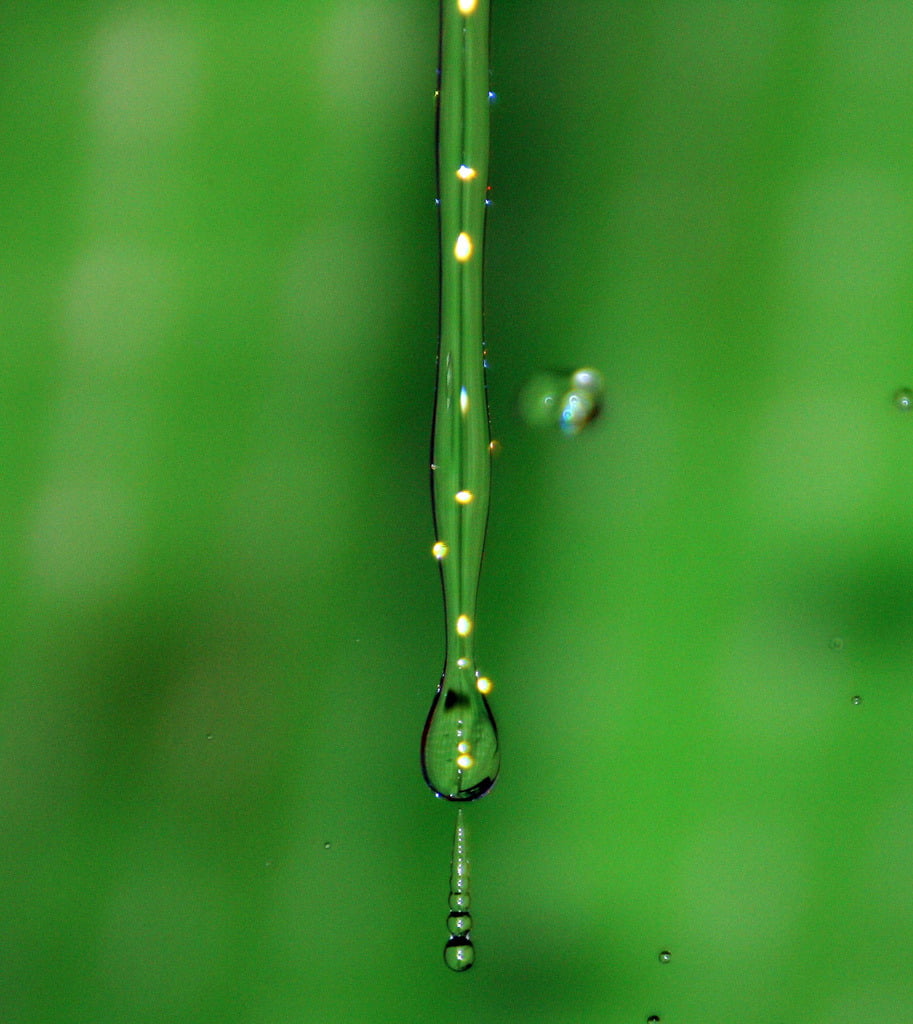
As a laminar column of water falls, slight perturbations cause waviness in the stream. Whenever the radius of the stream decreases, the pressure due to surface tension increases, causing fluid to flow away from the area of smaller radius. This outflow decreases the radius further and drives the stream to break into droplets. The mechanism is called the Plateau-Rayleigh instability. (Photo credit: Mahmoudreza Shirinsokhan)
Welcome!
I’d like to extend a special welcome to all our new followers here at FYFD. It’s been an exciting week since getting featured in the Tumblr Spotlight! In general, we try to bring you new fluid mechanical tidbits every weekday, but we also accept submissions and user questions, so if you’ve seen something cool online that’s not already in the archive or you have a burning question about how something works, speak up!

Astronomical Jets
Researchers have pieced together Hubble images of jets from newborn stars into timelapse movies that reveal the interstellar fluid mechanics responsible for the formation of stars like our sun. These jets stream out clumps of matter that has fallen on the new star. When faster moving eddies impact slower ones, bow shocks can form, much like shockwaves running before an airplane. See more HD video of these jets and bow shocks here. #