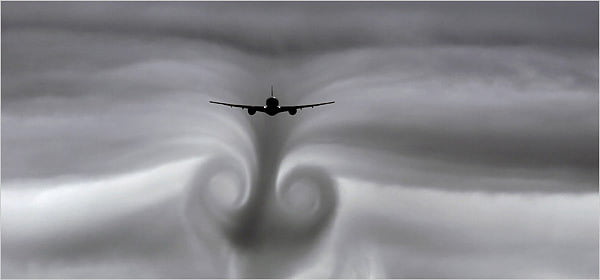
The wingtip vortices in the wake of a commercial airliner distort the clouds as the plane descends. Wingtip vortices form as a result of high pressure air from the underside of the wing accelerating around the wingtips to reach the low pressure on top of the wing. They can be hazardous to other (lighter) aircraft. They also contribute to downwash that decreases the effective lift of a wing. Geese use the same mechanism to their advantage when flying in a V-formation, and some snakes use it to glide.
Month: May 2011

Gelatin
Gelatins are actually colloidal gels, or a liquid dispersed inside a solid, cross-linked network. The crosslinks give the gelatin structure, but much of its dynamic behavior remains reminiscent of fluid motion.
Rayleigh-Taylor Art
The Rayleigh-Taylor instability occurs when a denser fluid lies atop a lighter fluid (relative to the gravitational field). The interface between the fluids deforms and the two fluids form finger-like protrusions that turn into mushroom caps and mix the dissimilar fluids together. This video, though based on a 2D Rayleigh-Taylor instability numerical simulation, was actually part of an art exhibit. (submitted by Mark S)
Personally, I recommend putting together a playlist of your favorite late 60s/early 70s rock (Pink Floyd, late Beatles, Jimi Hendrix, etc.) and sticking it on in the background while you watch the video in HD. It’s totally worth the 15 minutes. Especially in the later stages of each segment, the mixing between fluid layers really brings to mind cloud patterns on Jupiter or Saturn.

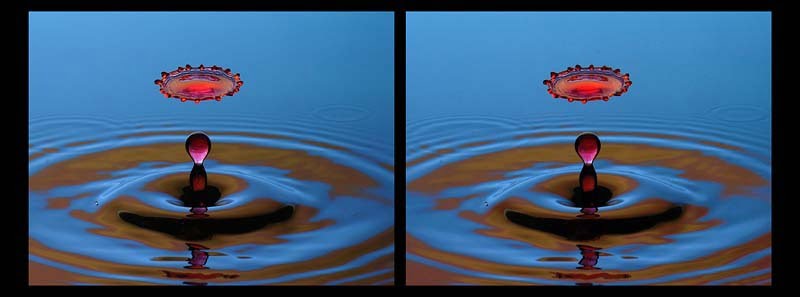
Stereo Liquid Sculpture
This stereo 3D photo shows the Worthington jet ejected when a droplet impacts a pool. The flat crowning drop is formed from an ejected droplet colliding with a falling droplet.
Supersonic Bullet
[original media no longer available]
This video shows a CFD simulation of a bullet passing through a parallel channel at Mach 2. The simulation captures 3 milliseconds of real-time and shows the Mach number in the top view and the temperature in the bottom view. Note how the bow shock near the front of the bullet and the trailing shock behind it reflect off the walls of the channel and interact. Even though the calculation is inviscid, the shock waves cause intense heating (white) in front of and behind the bullet.

Island Vortex Street
The von Karman vortex street is a series of vortices shed periodically in the wake of a bluff body. Although they are commonly observed in the lab behind cylinders, they also occur in nature, as seen here in the wake of Juan Fernandez Islands near Chile. The strong equatorward wind creates steady flow over the mountainous island, creating a pattern in the clouds that stretches 10,000 times longer than vortex streets created in a laboratory. (via freshphotons)
Cloud Ocean
Time-lapse photography is great for capturing the fluid motion of clouds over the course of a day.

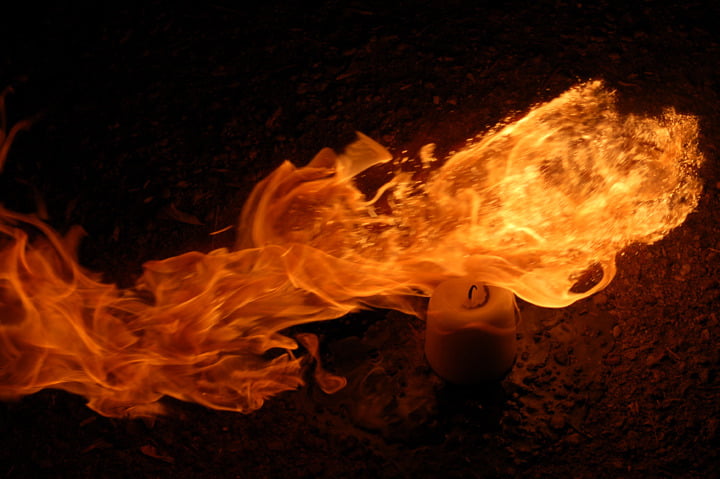
Combustion
Fluid dynamics are vital to combustion. Like here, many practical flames–such as those responsible for internal combustion in automobiles, jet engines, and rockets–are turbulent. The turbulence aids mixing of the fuel and oxidizer, resulting in more complete combustion and greater efficiency. #
Giant Water Balloon Physics
Playing with a giant water balloon and high-speed cameras is like a giant experiment in surface tension, right up until the tensile strength of the balloon comes into play. The rippling in the balloon is reminiscent of the motion of droplet breakup or impact on superhydrophobic surfaces. (submitted by Daniel B)
DIY Non-Newtonian Fluids
[original media no longer available]
We’ve featured the non-Newtonian fluid oobleck here before, but it bears repeating as a fun and easy exercise for anyone to do at home or at school, especially with kids. For extra fun, try vibrating it, using it as liquid armor, or filling a pool and walking on it.