Tag: surface tension

  • Freezing Drops

    [original media no longer available]

    The physics of droplets freezing is important for understanding applications like ice formation on airplane wings. Here we see how a warm droplet deposited on a cold plate freezes. A freezing front advances through the drop, which expands vertically as it freezes. Ultimately, the expansion of the ice and the surface tension of the water create a pointed singular tip.

  • Featured Video Play Icon

    High-Speed Droplet Collisions

    This high-speed video shows the apparatus often used by photographers for fluid sculptures created from droplet collisions. As amazing as these formations are in still images, seeing their evolution at 5,000 fps is even more lovely.

  • The Disintegrating Bowl

    The Disintegrating Bowl

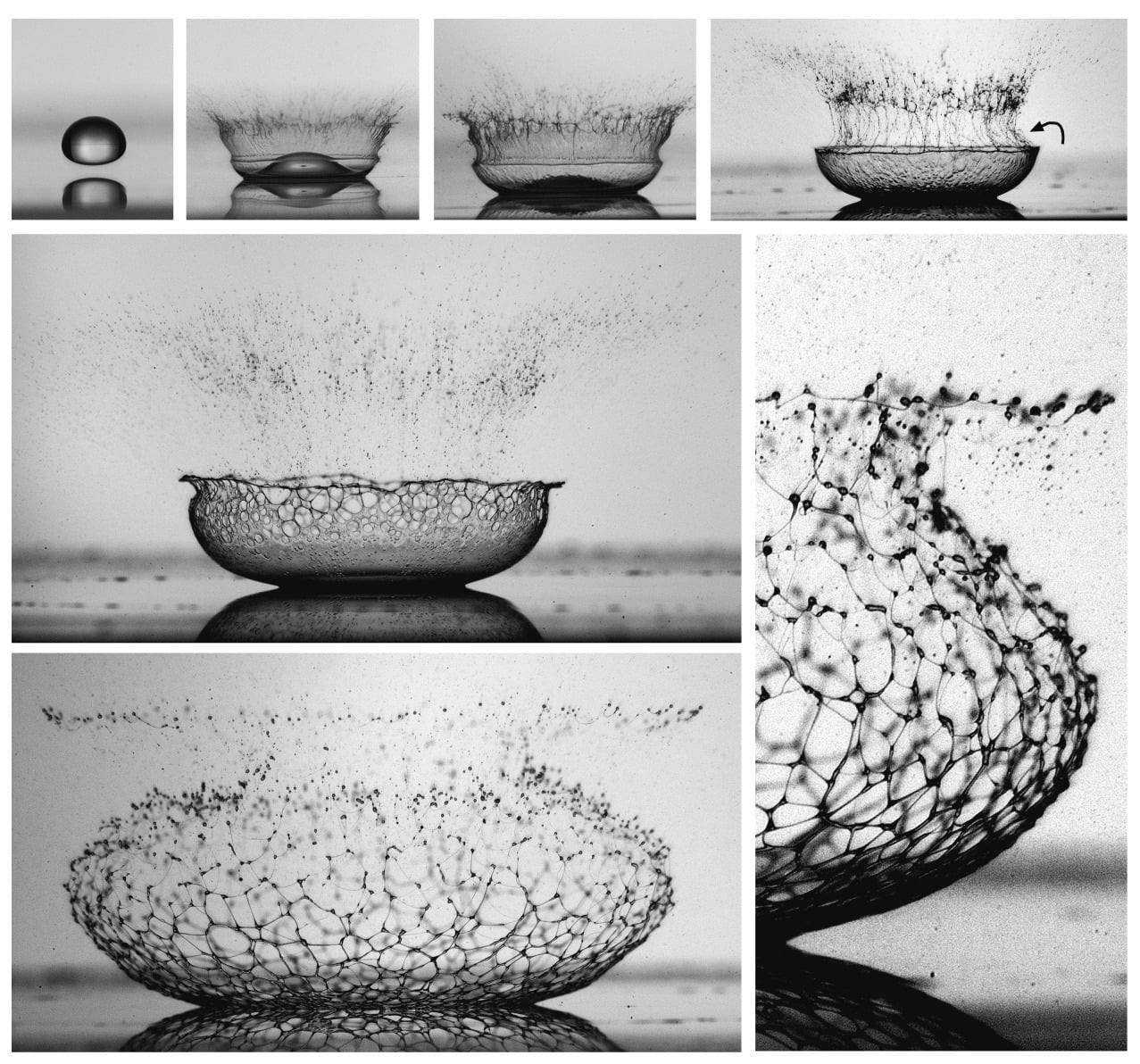
    A viscous fluid droplet impacts a thin layer of ethanol, which has a lower surface tension than the viscous fluid. A spray of tiny ethanol droplets is thrown up while a bowl-shaped crown of the viscous fluid forms. As the ethanol droplets impact the bowl, the lower surface tension of the ethanol causes fluid to flow away from points of contact due to the Marangoni effect. This outflow causes holes to form in the crown, forming a network of thin fluid ligaments. For more, see this paper (PDF) and video. (Photo credit: S.T. Thoroddson et al)

  • Featured Video Play Icon

    Convection Visualization

    Here on Earth a fascinating form of convection occurs every time we put a pot of water on the stove. As the fluid near the burner warms up, its density decreases compared to the cooler fluid above it. This triggers an instability, causing the cold fluid to drift downward due to gravity while the warm fluid rises. Once the positions are reversed, the formerly cold fluid is being heated by the burner while the formerly hot fluid loses its heat to the air. The process continues, causing the formation of convection cells. The shapes these cells take depend on the fluid and its boundary conditions. For the pot of water on the stove and in the video above, the surface tension of the air/water interface can also play a role in modifying the shapes formed. The effects caused by the temperature gradient are called Rayleigh-Benard convection. The surface tension effects are sometimes called Benard-Marangoni convection.

  • Featured Video Play Icon

    Soap Bubble Burst

    High-speed video of a soap bubble being popped reveals the directionality of the process. Like a the rubber of a bursting balloon, the soap film rushes away from the point of rupture, disintegrating as the information about a sudden lack of surface tension is propagated across the remaining film surface. In this regard, it is much like what happens when you drop a slinky toy.

  • Featured Video Play Icon

    The Coalescence Cascade

    When a droplet impacts a pool at low speed, a layer of air trapped beneath the droplet can often prevent it from immediately coalescing into the pool. As that air layer drains away, surface tension pulls some of the droplet’s mass into the pool while a smaller droplet is ejected. When it bounces off the surface of the water, the process is repeated and the droplet grows smaller and smaller until surface tension is able to completely absorb it into the pool. This process is called the coalescence cascade.

  • Featured Video Play Icon

    Surface Tension Demo

    This simple demonstration shows the power of surface tension, especially at small lengthscales. Another way to break the surface tension holding the water in the sieve would be to spray the top of the jar with soapy water. The soap acts as surfactant, decreasing the surface tension such that the water is unable to counteract the force of gravity.

  • Featured Video Play Icon

    Disrupting the Coalescence Cascade

    When a droplet contacts a pool, a thin layer of air can get trapped beneath the droplet, delaying the instant when the liquids contact and surface tension pulls the droplet into the pool. If the pool is being vibrated, air flows more easily into the gap, keeping droplets intact longer. It’s even possible to make them dance.

  • Bill Nye Demos

    [original media no longer available]

    Have a little science enthusiasm from Bill Nye to brighten your Tuesday! This video includes demonstrations on thermodynamics (sucking the balloon into the flask), the Marangoni effect (driving the powder off the water surface and powering the glue boat by creating gradients in surface tension), and buoyancy (floating cans of cola).

  • Fluid Sculpture

    Fluid Sculpture

    Droplet collisions captured instantaneously create beautiful fluid sculptures that, though common, are too fast for the human eye. Here a bubble was blown onto the surface of the fluid, then a droplet was released to fall into the center of the bubble, bursting it. As that droplet rebounded in a Worthington jet, a second droplet was released and impacted the jet, creating the umbrella-like shape in the center. See Liquid Droplet Art for more photos. (Photo credit: Corrie White and Igor Kliakhandler) #