
When a stream of liquid falls, a surface tension effect called the Plateau-Rayleigh instability causes small variations in the jet’s radius to grow until the liquid breaks into droplets. For a kitchen faucet, this instability acts quickly, breaking the stream into drops within a few centimeters. But for more viscous fluids, like honey, jets can reach as many as ten meters in length before breaking up. New research shows that, while viscosity does not play a role in stretching and shaping the jet as it falls–that’s primarily gravity’s doing–it plays a key role in the way perturbations to the jet grow. Viscosity can delay or inhibit those small variations in the jet’s diameter, preventing their growth due to the Plateau-Rayleigh instability. In this respect, viscosity is a stabilizing influence on the flow. (Photo credit: Harsha K R; via Flow Visualization)
Tag: surface tension

Colorful Spirals

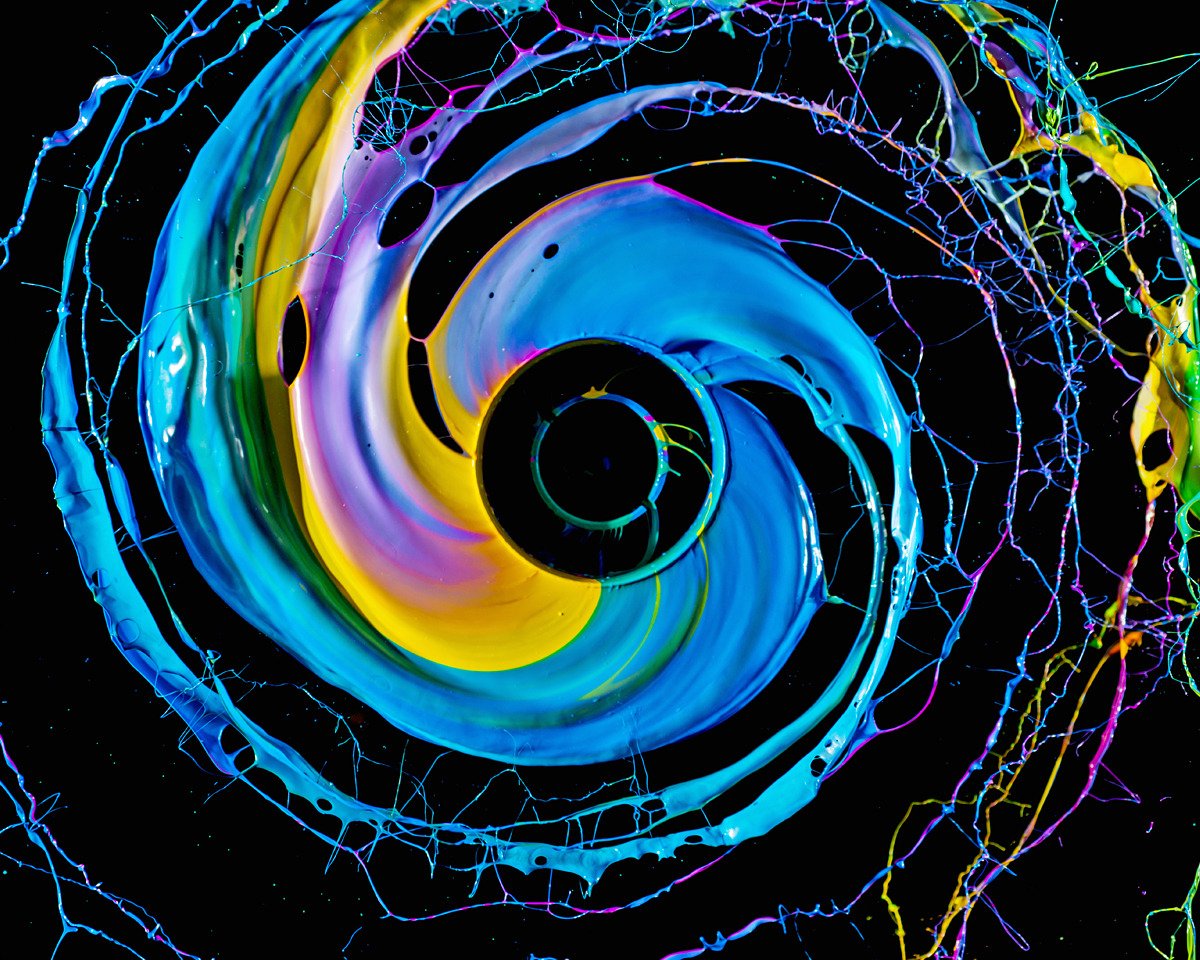
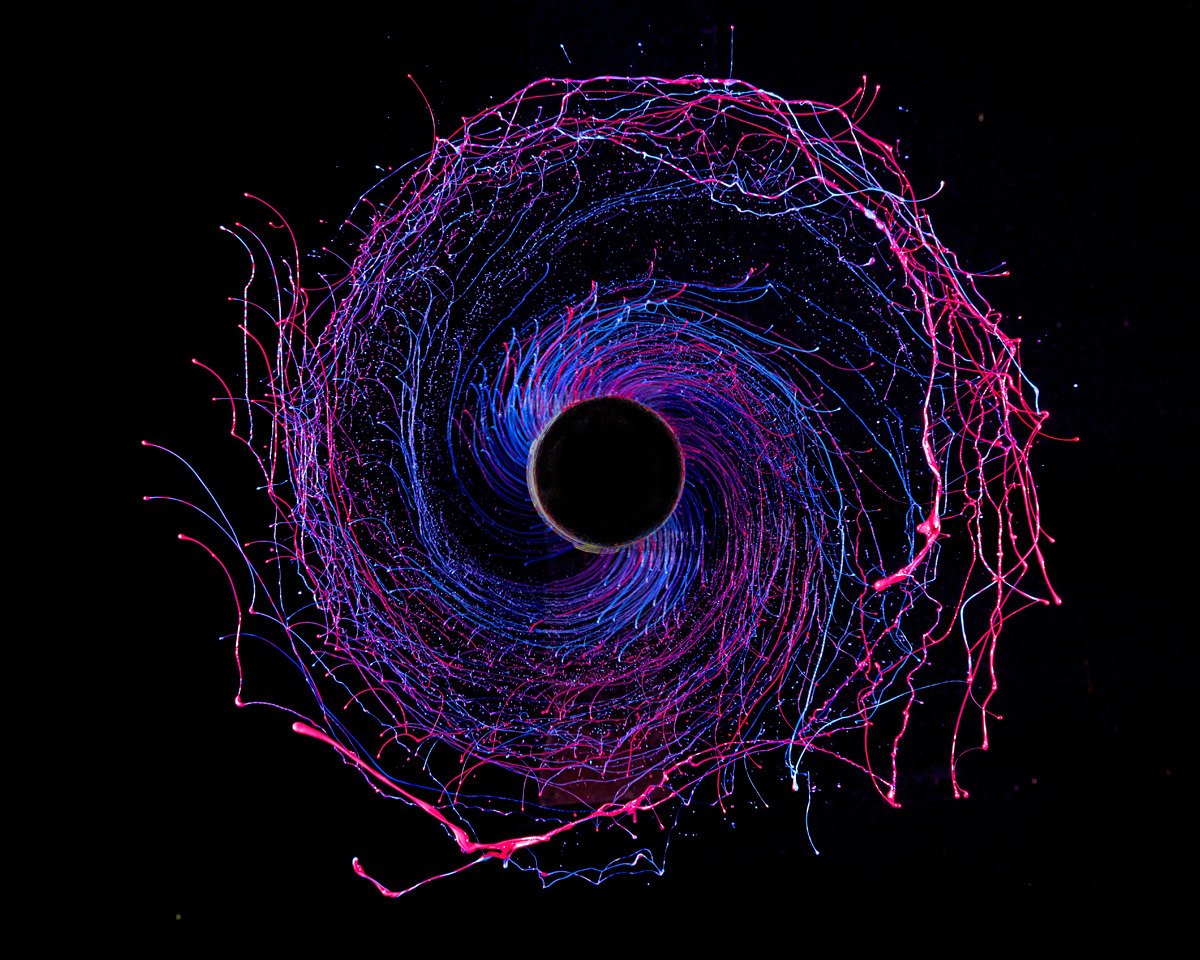
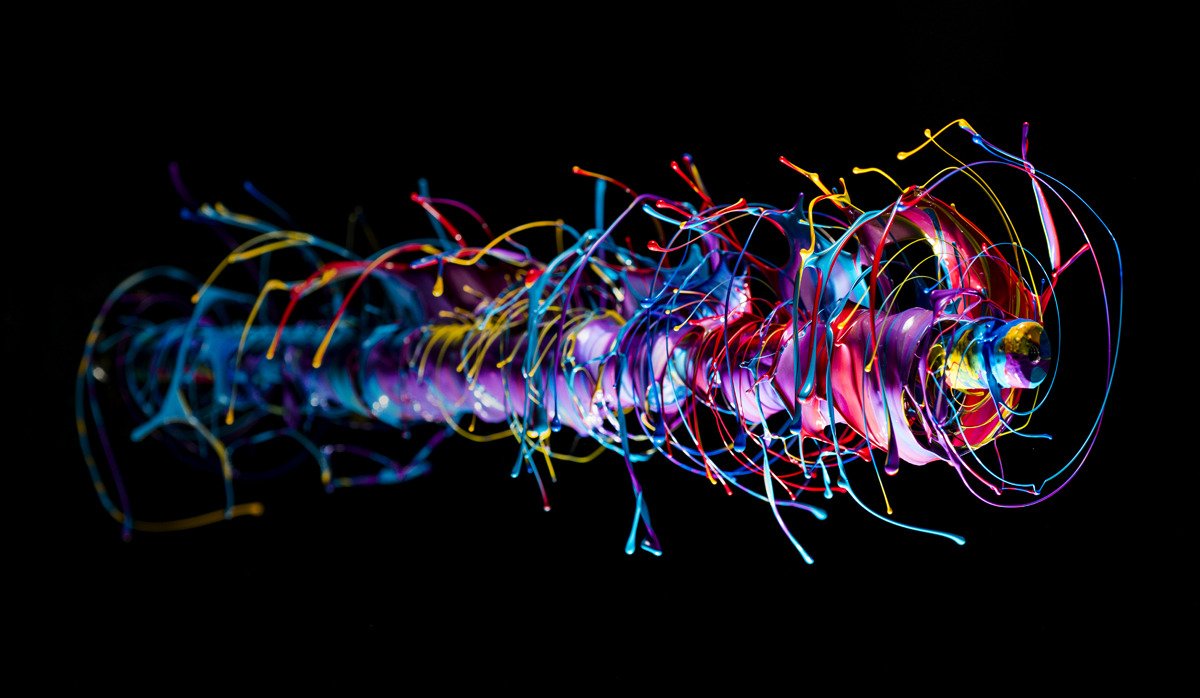
Artist Fabian Oefner captures these colorful portraits of fluid instability by dripping acrylic paints onto a metal rod, which is connected to a drill. When the drill is switched on, paint is flung away from the rod, creating these snapshots of centripetal force and surface tension. Note how droplets gather at the ends of the spiral arms like in a Plateau-Rayleigh or a rimming instability. For more, check out Oefner’s webpage, which includes a video showing how the images are made, or his previously featured work, “Millefiori”. (Photo credit: F. Oefner; submitted by Stephen D.)

Under the Waves
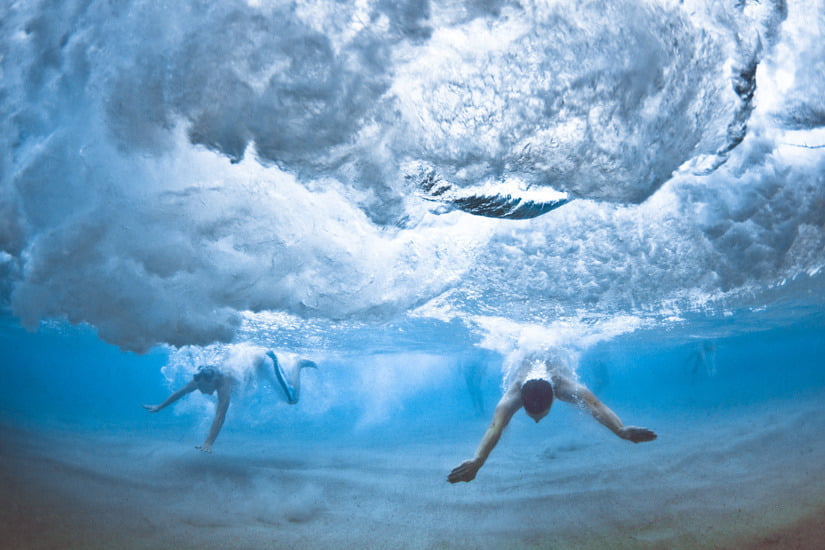


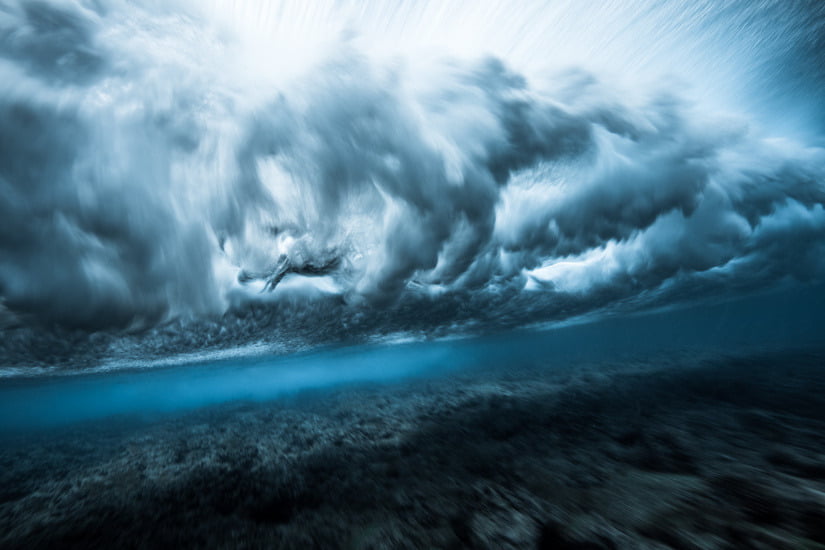
When I was a kid, I liked to dive underwater in the pool and sit at the bottom, looking up at the peculiar dancing sky the water made overhead. Photographer Mark Tipple takes it further, capturing images of the ocean from below the surface as waves roll in. His photos show swimmers and surfers diving to escape a roiling wave that, from below, bears a surreal similarity to the underside of a thundercloud in a summer storm. This is part of the beauty of fluid dynamics. Despite their differences, water and air obey the same physics. (Photo credits: Mark Tipple; via io9)

Tuning Fork Fluids
This high-speed video shows a liquid crystal fluid vibrating on a tuning fork. As the surface moves, tiny jets shoot upward, sometimes with sufficient energy that the fluid column is stretched beyond surface tension’s ability to keep it intact, resulting in droplet ejection. The jets and surface waves create a mesmerizing pattern of fluid motion. (Video credit: J. Savage)
Breaking Up Falling Beads
In a stream of falling liquid, surface tension instabilities cause the fluid to break up into droplets. This video shows a similar experiment with a stream of glass beads, a granular material. The whole system is housed under a vacuum to eliminate the effects of air drag on the stream, and a camera rides alongside the stream to track the evolution of the falling material in a Lagrangian fashion. As with a liquid stream, we see the granular flow develop undulations as it falls, ultimately breaking up into clusters of beads. The authors suggest that nanoscale surface roughness and van der Waals forces may be responsible for the clustering behavior in the absence of surface tension. (Video credit: J. Royer et al.)

The Red Crown
A drop of red dye falls into a thin layer of milk, forming a crown splash. Notice the pale edges of the droplets at the rim of the crown; this is milk that has been entrained by the original drop. The rim and satellite droplets surrounding the splash are formed due to surface tension effects, chiefly the Plateau-Rayleigh instability–the same effect responsible for breaking a falling column of liquid into droplets like in a leaking faucet. The instability will have a most unstable wavelength that determines the number of satellite droplets formed. (Photo credit: W. van Hoeve et al., University of Twente)

Spiraling Ferrofluid
Here a ferrofluid climbs a spiral steel structure sitting on an electromagnet. Magnetic field lines emanating from the sculpture’s edges tend to push the ferrofluid out into long spikes–part of the normal field instability–but surface tension resists. The short, somewhat squat spikes we see are the balance struck between these opposing forces. Though known for their wild appearance, ferrofluids appear many in common applications, including hard drives, speakers, and MRI contrast agents. Researchers have also recently suggested they might help understand the behavior of the multiverse. (Photo credit: P. Davis et al.)

Surface Tension in Action
Surface tension creates a glassy, smooth layer of water over U.S. swimmer Tyler Clary the instant before he surfaces as he competes in the backstroke. Surface tension arises from intermolecular forces between water molecules. In the bulk of the liquid, any given water molecule is being pulled on in every direction by the surrounding molecules, which results in zero net force. At the surface, however, molecules only experience forces from those to the side and below them. As a result, these molecules are pulled inwards, forcing the liquid to take on a form with minimal area. (Photo credit: Getty Images; submitted by drhawkins)
Droplet Springs
Prior to reaching terminal velocity, a falling droplet typically oscillates between a prolate shape (like an American football about to be kicked) and an oblate one (like that same football when thrown or carried). As explained by Minute Laboratory, this oscillation behaves very similarly to a mass on a spring. For a spring/mass system, the frequency of oscillation is related to the spring’s stiffness; for the falling droplet, it is instead governed by surface tension. If only high schools had high-speed cameras, this would make a fantastic fluids lab experiment! (Video credit: Minute Laboratory; submitted by Pascal W.)
FYFD is sporting a new look and new about and resources pages for those who want more fluidsy goodness.
The Evolution of Icicles
The time-lapse video above shows the growth of icicles of various compositions under laboratory conditions. Many icicles in nature exhibit a rippling effect in their shape, which some theories attribute to an effect of lower surface tension in some liquids. Here researchers show the icicle growth of three liquids: pure distilled water, and water with two concentrations of dissolved salt. They found that lowering the surface tension of the freezing liquid with non-ionic surfactants (i.e. not salt) did not produce ripples, but that dissolved ionic impurities like salt strongly affected the growth of ripples. They posit that this may be due to constitutional supercooling, in which growth of the solid-liquid interface is destabilized by the preferential concentration of impurities near the interface. (Video credit: A. S. Chen and S. Morris)


