Tag: sedimentation

  • Beach Cusps

    Beach Cusps

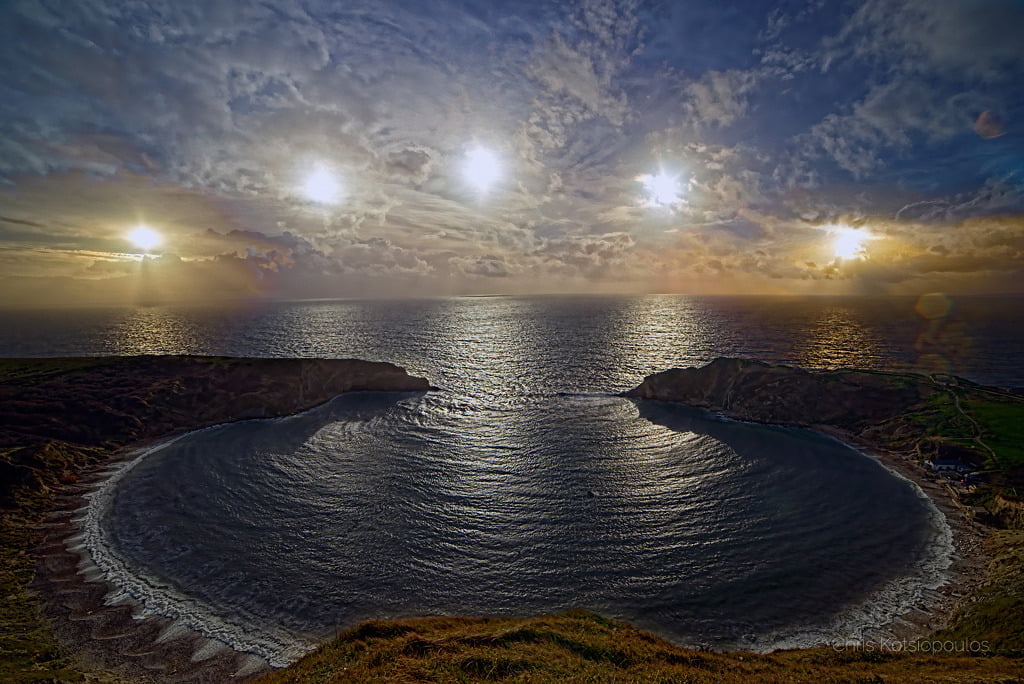
    This composite photo shows the arc of the sun over Lulworth Cove in England during the December solstice. The low sun angle reveals a distinctive circular diffraction pattern of waves inside the cove. Along the shoreline, the beach has eroded into a regular, arc-like pattern known as beach cusps. Although there are multiple theories about how cusps form, their pattern is self-sustaining. They consist of a horn of coarse materials that projects into the water and an arc of finer sediments called an embayment. When incoming waves hit the horn, they slow down, depositing heavier coarse sediment on the horn while lighter, fine particles are carried further ashore. (Image credit: C. Kotsiopoulos; via APOD; submitted by jshoer)

  • Featured Video Play Icon

    How the Grand Canyon Formed

    The Grand Canyon is a monument to the power of water, air, and time. In this video from It’s Okay To Be Smart, Joe Hanson describes the formation of the Grand Canyon – from the ancient oceans that created its many layers to the tectonic upthrusts that eventually created the Colorado River that continues to cut through the Canyon’s rocks today. Fluid dynamics play a major role in the geology of the Grand Canyon, whether it’s in the mantle convection that helps drive plate tectonics or the sedimentation that builds and erodes rock layers.   (Video credit: It’s Okay To Be Smart)

  • Featured Video Play Icon

    Earth’s Aerosols

    The motions of Earth’s atmosphere move more than just air and moisture. As seen in this animation built from NASA satellite data, the atmosphere also transports large amounts of small solid particles, or aerosols, such as dust. Each year the wind carries millions of tons of Saharan dust across the Atlantic, depositing much of it in the Amazon basin. This provides much needed nutrients like phosphorus to plants and animals in the Amazon; check out this video from the Brain Scoop to see what happens in areas that don’t receive these nutrients. Dust is only one of many sources for atmospheric aerosols, though. Sea salt, volcanic eruptions, and pollution are others. All of these aerosols serve as potential nucleation sites for raindrops or snowflakes, and their transport all around the globe by atmospheric winds means that seemingly local effects–like a regional drought or increased pollution in developing countries–can have global effects. (Video credit: NASA Goddard; submitted by entropy-perturbation)

  • Interrupting Sediments

    Interrupting Sediments

    The pier at Progreso extends 6.5 kilometers into the Gulf of Mexico, creating an artificial obstruction to ocean flow and sediment transport near the shore. The first 2 kilometers of the pier are built on arches that allow some flow through, but the newer sections do not. Prevailing winds act from the east-northeast, driving flow roughly right to left in the image. The sediment traces flow around the pier and reveals the complicated flow-shadow downstream of the newer parts of the pier. (Image credit: NASA Earth Observatory)

  • Freshwater Flux

    Freshwater Flux

    These satellite images show the effects of a sudden influx of warm freshwater on sea ice in the Arctic Ocean. On the left are natural color satellite images of Canada’s Mackenzie River delta where it enters the Beaufort Sea. On the right are temperature maps of the ice and water surface temperatures for the same regions. In June 2012, the coastal sea ice that had been blocking the river’s delta broke, releasing a massive discharge of river water. The natural color images show brown and tan sediment reaching far out from the river delta, but the temperature maps on the right are even more dramatic. Warmer river water has spread many hundreds of kilometers from the delta, melting sea ice and raising the open water surface temperatures by an average of 6.5 degrees Celsius. The effects of river discharge on sea ice melt are increasing as inland Arctic areas warm more in the summers and the sea ice becomes thinner and more vulnerable each year. (Image credits: NASA Earth Observatory)

  • Glacier Flows

    Glacier Flows

    These astronaut photos show Patagonian glaciers as seen from space. Glaciers form over many years when snow accumulates in larger amounts than it melts or sublimates. Over time the snow collects and is compacted into a dense ice which slowly flows downslope due to gravity. Many of the dark streaks in the photos are moraines, sediment formations deposited by the movement of the ice. Lateral moraines often line the edges of a glacier, and when two or more glaciers flow together, like in the lower left corner of both photos, the lateral moraines of each of the glaciers combine to form a medial moraine running through the combined glacial flow.  (Photo credits: M. Hopkins and K. Wakata)

  • Featured Video Play Icon

    Engineering Sediment Transport

    Sediment transport via fluid motion is a major factor in engineering, geology, and ecology. This video shows two common forms of sediment transport: particle suspension and saltation. Suspension, in which the fluid carries small solid particles, is visible high in the blue water layer. Saltation occurs closer to the surface when loose particles are picked up by the flow before being redeposited downstream. Watch some of the individual particles near the surface to see the process. Kuchta has several more demo videos of flow in this desktop flume, sold by Little River Research & Design. (Video credit: M. Kuchta; submitted by gravelbar)

  • Beach Cusps

    Beach Cusps

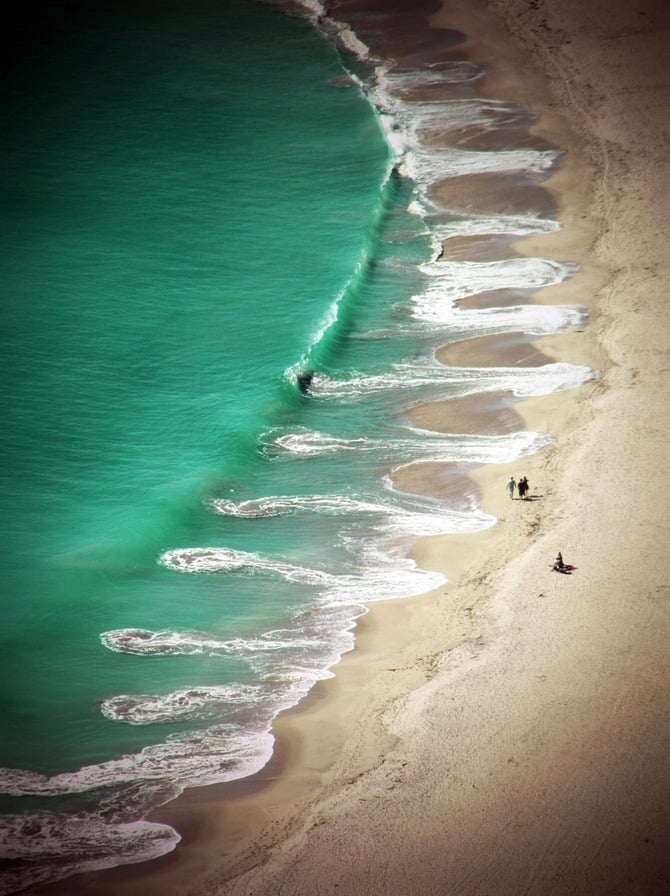
    Beach cusps are arc-like patterns of sediment that appear on shorelines around the world. Cusps consist of horns, made up of coarse materials, connected by a curved embayment that contains finer particles. They are regular and periodic in their spacing and usually only a few meters across. A couple of theories exist as to how cusps form, but once they do, they are self-sustaining. When an incoming wave hits a horn, the water splits and diverts. The impact of the wave on the horn slows the water, causing it to deposit heavy, coarse particles on the horns while finer sediment gets carried up to the embayment before the wave flows back outward. (Photo credit: L. Tella; inspired by E. Wiebe)

  • Featured Video Play Icon

    Evaporating Drops

    When still drops evaporate from a surface, they do so in several phases, as illustrated in the video above. Initially, the drop forms a spherical cap. At this point the velocity within the droplet is so small that it is difficult to resolve, but particles within the drop move outward toward the contact line. As the drop evaporates, they form a circle of sediment – the familiar coffee ring. As the drop flattens, radial velocity increases, drawing more and more particles to the coffee ring. Eventually the drop pulls away from the ring, leaving surface tension and evaporation to compete in driving the internal flow. During this phase, some parts of the contact line try to re-establish the flow pattern that made the first ring; this leaves behind circular segments broken up by the increasing instabilities in the contact line. In the final stage, surface tension smooths some of the irregularities and drives an inward velocity that leaves behind radial sediment segments. (Video credit: G. Hernandez-Cruz et al.)

  • Phytoplankton and Sediments

    Phytoplankton and Sediments

    Pale sediments are carried out to sea by the rivers of the Mergui Archipelago of Myanmar. Dark blue ocean waters mix with the sediment, creating turbulent swirls in this natural color satellite image. With the sediment comes valuable nutrients for plant life in the ocean, which can prompt the formation of phytoplankton blooms. (Photo credit: Michael Taylor/Landsat/NASA)