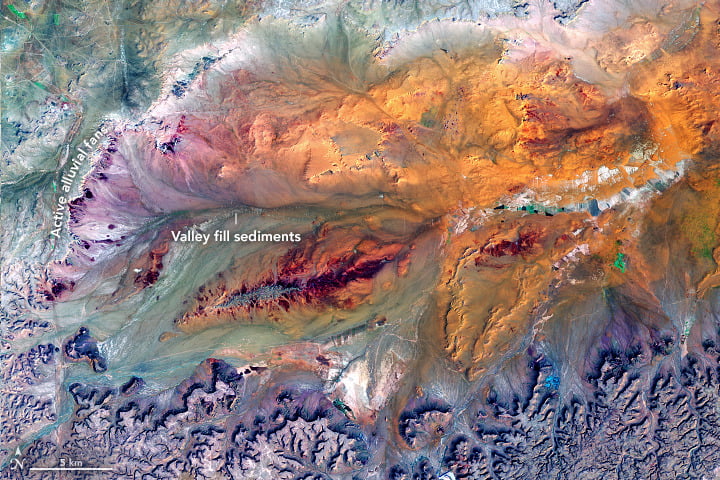
Wind, water, and gravity are great sculptors of our world. This false-color satellite image shows the Ga’ara Depression in Iraq, which formed some 300 million years ago beneath a shallow sea. The steep cliffs along the southern edge of the depression continue moving southward as they’re eroded by wind and run-off. When infrequent but intense rains pour down the channels of the southern cliffs, it carves away sediment which the water carries onward. In the flatter basin, these sometimes-rivers slow and spread out, eventually dropping the sediment they carry into sandbars. The build-up of sandbars causes the slower-moving water to shift its course back-and-forth over time, creating the alluvial fans seen along the southern and western borders. (Image credit: J. Stevens, via NASA Earth Observatory)
Tag: sedimentation

Fissures in Africa


Pictures of an enormous fissure in Kenya’s East African Rift Valley have gone viral in recent weeks along with breathless reports about how part of the African continent is splitting away. And while Africa is splitting – very, very slowly – this crack, impressive as it is, may not have anything to do with it. Geologists familiar with the area are confident that the fissure is the result of recent torrential rains and flooding – not fresh seismic activity. For one, there have been no earthquakes in this area stretching back for several years. One theory is that the crack had actually been present for quite some time but was filled with softer volcanic ash that’s been swept away by the rains. Geologists will need to study it more closely to be certain.
One thing geologists agree on, though, is that the tectonic plates that make up Africa are slowly pulling apart, or rifting. (That’s why the area is known as a rift valley in the first place.) This happens as mantle convection causes two land masses to move away from one another. That’s happening right now along a fault running through Ethiopia, Kenya, and Tanzania, and it’s happened before. A similar rift caused the South American and African continents to separate. This doesn’t mean that the countries in East Africa are in danger of being parted by ocean any time soon, though. Geologists predict it will take on the order of 50 million years for the break to happen. (Image credit: Getty Images; Reuters/T. Mukoya; DailyNation)

Water on Mars
Recurring slope lineae (RSL) are seasonal features on Mars that leave behind gullies similar to those left by running water on Earth. Their discovery a few years ago has prompted many experiments at Martian conditions to determine how these features form. At Martian surface pressures and temperatures, it’s not unusual for water to boil. And that boiling, as some experiments have shown, introduces opportunities for new transport mechanisms.
Researchers found that water in “warm” (T = 288 K) sand boils vigorously, ejecting sand particles and creating larger pellets of saturated sand. Water continues boiling out of the pellets once they form, creating a layer of vapor that helps levitate them as they flow downslope. The effect is similar to the Leidenfrost effect with drops of water sliding on a hot skillet; there’s little friction between the pellet and the surface, allowing it to travel farther.
The mechanism is quite efficient in experiments under Earth gravity and would be even more so under Mars’ lower gravity. It also requires less water than alternative explanations. The pellets that form are too small to be seen by the satellites we have imaging Mars, but the tracks they leave behind are similar to the RSL seen above. (Image credit: NASA; research credit: J. Raack et al., 1, 2; via R. Anderson; submitted by jpshoer)

An Armored Bed
A river’s flow constantly changes its underlying bed. The rocks and particulates beneath a flowing river can typically be divided into two zones: an upper layer called the bed-load zone where the flow moves particles with it and a lower layer where particles are mostly trapped but may creep over long periods. In gravelly river-beds this upper bed-load zone tends to accumulate more large particles, a phenomenon known as armoring. Experiments show that, in this region, large particles have a net vertical velocity moving upward, while smaller particles tend to move downward. Exactly why large particles are more prevalent in the bed-load zone in unknown; several theories have been offered. One suggests that the size segregation is similar to the Brazil nut effect and that smaller particles have a tendency to fall into gaps and sink more easily than larger ones. (Image and research credit: B. Ferdowsi et al., source)

Lagoon Flows
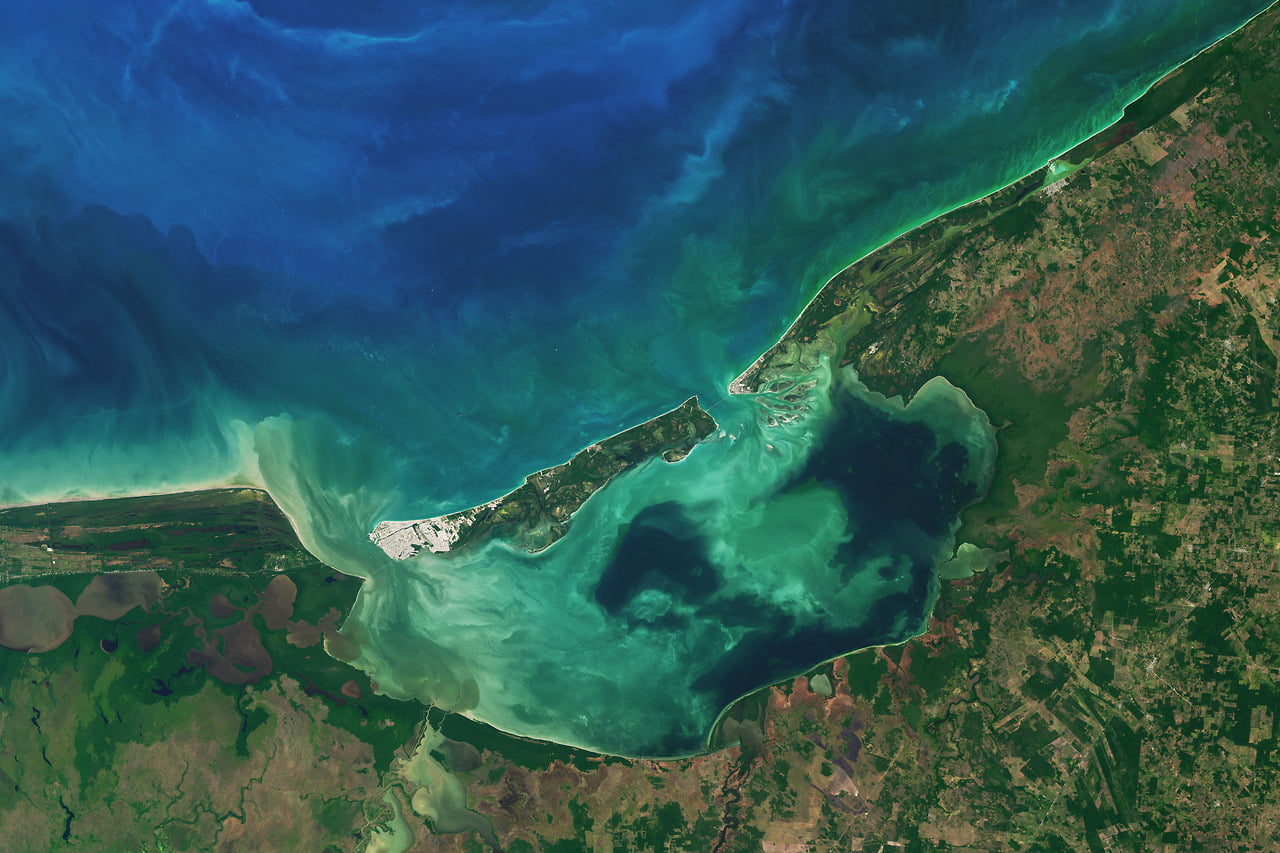
The meeting of land and sea often creates a rich and colorful environment. This satellite image shows Mexico’s Laguna de Términos, a coastal lagoon off the Gulf of Mexico. A skinny barrier island forms the lagoon’s two connections to the ocean; the eastern side is the usual inlet (right), while the western side forms an outlet. Rivers feed freshwater into the lagoon from the south and southwest. These introduce sediments that cause some of the lighter swirls in the image. Winds and tides also contribute to this turbidity. The sheltered nature of the lagoon allows fresh and salt water to mix gradually, providing harbor for many forms of life. Oyster beds thrive in the river mouths; seagrasses prefer the calmer, saltier waters, and mangrove trees line the shore, slowly desalinating water for themselves as their roots shelter young fish and shrimp. (Image credit: NASA Earth Observatory)
Surge Flows
Sandy beaches can be a great place to play with neat flows. In a recent video, Frank Howarth describes playing with beach rivers on the Oregon coast and observing a surge flow there. Under the right conditions, a current flowing over sand will build up sand ripples large enough that they form miniature dams in the flow. This traps additional water, which eventually collapses the sand ripples, releasing a surge of water. The surge tends to smooth out the sand and cause the ripple-making process to start over. It’s a fairly unusual phenomenon, but it’s one known to happen seasonally in a few specific places, like at Medano Creek in Colorado’s Great Sand Dunes National Park. There the snowmelt-fed creek surges during the late spring and early summer, releasing a fresh wave every 20 seconds or so. (Image credit: F. Howarth, source; h/t to Sebastian E.)

Turbine Wakes in the Sea
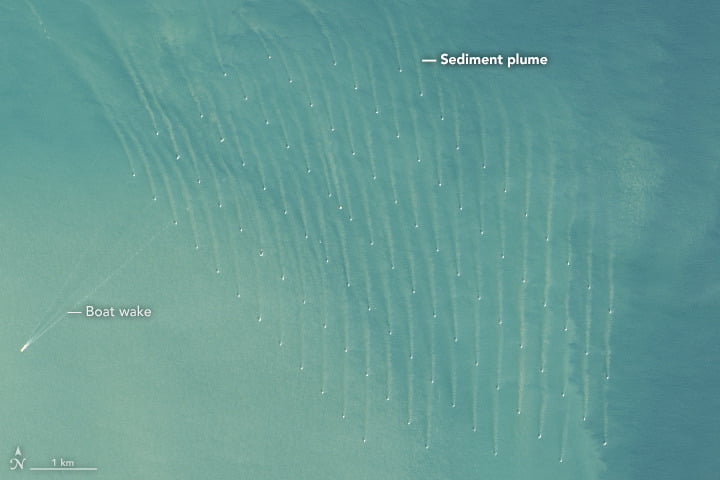
What we we build always has an impact on the environment around us. The white dots you see in the image above are an array of offshore wind turbines, standing in waters 20 to 25 meters deep. The brownish lines extending from each turbine show the underwater wakes of the turbines, colored by the sediment they’ve picked up. As with trees in a snowstorm, the currents flowing past the base of the turbine likely form a horseshoe vortex that lifts up the sediment into the wake. Because the tides in this area reverse direction every six hours, these sediment plumes can appear quite dynamic in satellite imagery, frequently changing strength and direction. (Image credit: NASA Earth Observatory)

Sedimentary Swirls
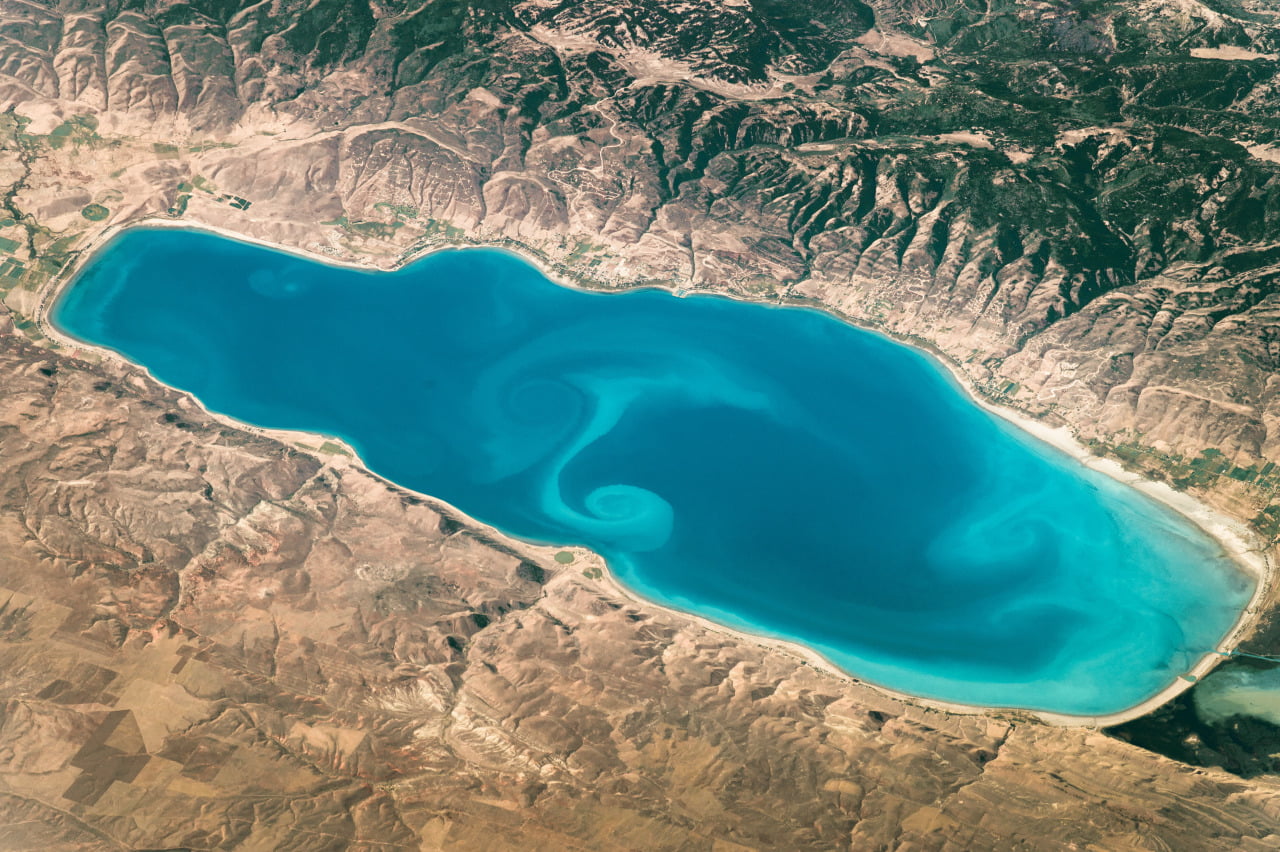
Sediment swirls in Bear Lake caught the eye of an astronaut aboard the International Space Station last year. Bear Lake is situated in the Rocky Mountains, on the Idaho-Utah border. The eddies in the center of the lake are each about 3 km across and are likely the result of inflow from the lake’s tributaries. Silt and sediment picked up by the rivers and streams gets deposited into Bear Lake, revealing the turbulent mixing of tributary waters with those already in the lake. (Image credit: NASA; via NASA Earth Observatory)
Vortex Wake in Quebec


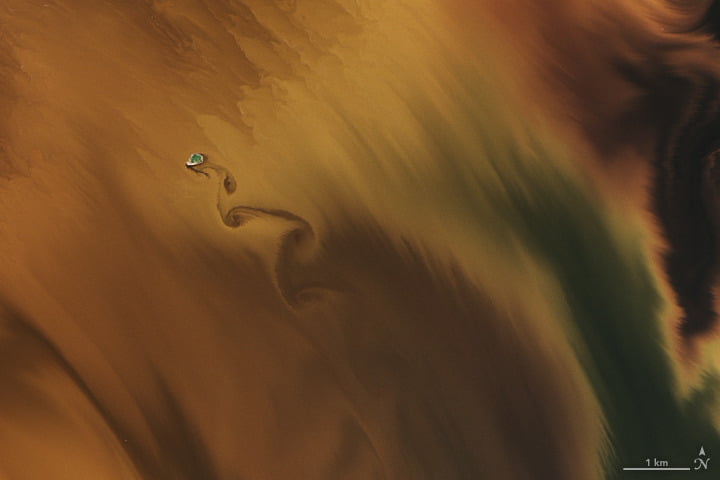
These satellite images show Rupert Bay in northern Quebec. Sediment and tannins have stained the bay’s waters various shades of brown, which helps show the dynamic flows of the area. Rivers empty into the bay, but the tide appears to be coming in from the northwest as well. The flow is just right to create a wake of alternating vortices off a tiny island near the center of the bay. This pattern is known as a von Karman vortex street and often appears in the wake of spheres, cylinders, and, yes, islands. (Image credit: NASA Earth Observatory; submitted by Adam V.)

Boiling on Mars
Today’s Mars is cold and dry, with a thin and insubstantial atmosphere. One of the challenges facing planetary scientists is unraveling the processes behind the complex terrain we can observe on the surface. Without flowing water, how do we explain these features? A new experiment suggests that the answer lies in boiling.
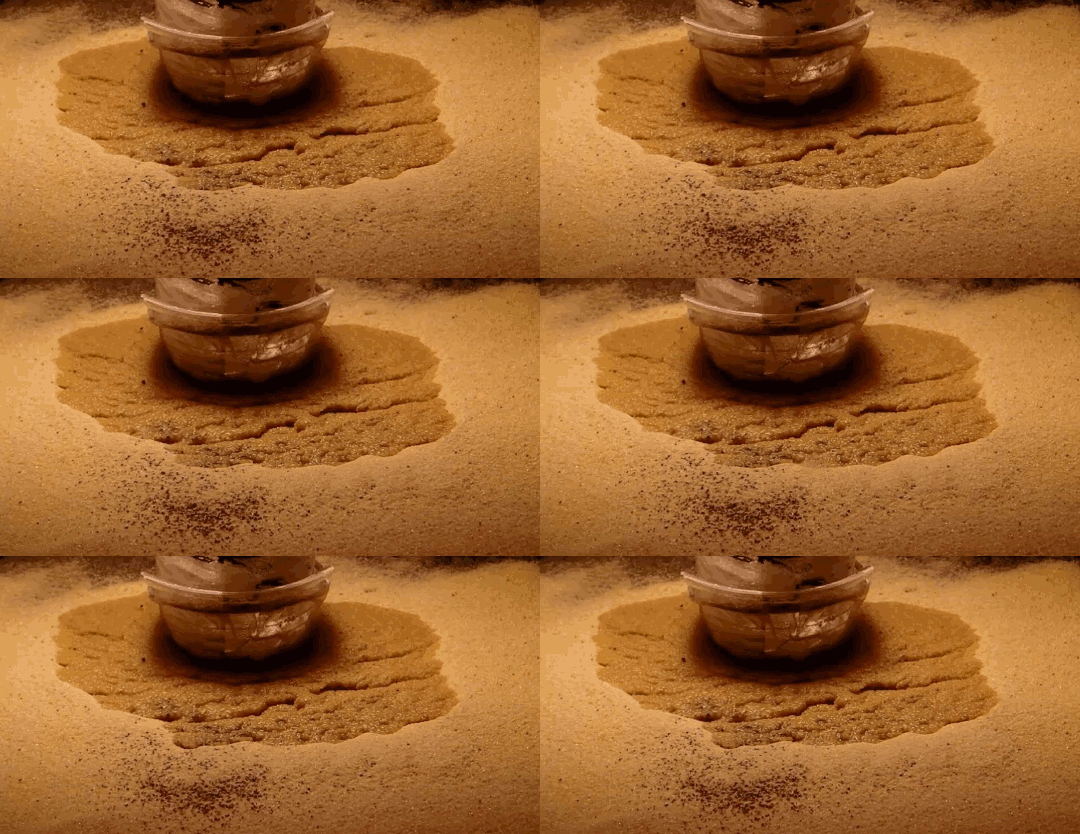
Surface conditions on Mars include atmospheric pressures low enough to be below the triple point of water* – the critical temperature and pressure where water vapor, liquid water, and ice can all exist simultaneously. This means that liquid water is unstable under Martian conditions; any water that seeped up to the surface would immediately begin to boil. That explosive boiling ejects sand particles, as seen in the animation above. The authors suggest that this hybrid process of wet percolation combined with vaporous ejection of sediment may better explain the Martian surface features we observe. (Image credit: M. Masse et al., source: Supplementary Movie 3; via Gizmodo; submitted by Paul vdB)
* The evidence we’ve seen so far on Mars points to briny water flowing near the surface. Although brines have lower freezing temperatures than pure water, the authors’ argument holds for them, as well. The boiling is simply not as vigorous.



.gif)